






Stoneco Auglaize Quarry, USA — Northwestern Ohio fluorite locality famed for iridescent brown-to-purple cubes, calcite pockets, and historic collector interest.
Key facts
Stoneco Auglaize Quarry is one of the essential modern Midwestern fluorite localities: a working carbonate quarry near Junction in Paulding County, northwestern Ohio, cut into the fossiliferous Middle Devonian carbonate section on the western side of the Findlay Arch mineral district. For collectors, its importance is not tonnage or ore—there is no great zinc-lead mine here—but the extraordinary character of its cavity minerals. The quarry’s best specimens are unmistakable: small, brilliant cubes of brown to root-beer fluorite with an oily iridescent skin, purple to raspberry or violet-blue second-generation cubes, and glass-clear to milky cubes holding sharp purple phantoms, commonly perched in pockets and fractures in pale limestone or dolostone with calcite, sphalerite, pyrite, quartz, and bituminous hydrocarbons.
The locality sits in a broad belt of low-temperature, epigenetic carbonate-hosted mineralization that has made northwestern Ohio famous among fluorite collectors. At Auglaize, the mineralization is not uniform through the quarry. The most collectible material has come from particular breccia, pocket, and fracture zones where solution cavities in carbonate rock were later lined by fluorite, sulfides, and calcite. The sequence collectors recognize in the finest pieces is beautifully architectural: an early brown fluorite generation, sometimes strongly iridescent, followed by zoned purple or colorless fluorite and, in some pockets, a late calcite event. That paragenesis gives Auglaize its signature “fluorite on fluorite” look—dark, metallic-looking first-generation cubes under gemmy, sharply zoned purple overgrowths.
Regional View
Country View
Auglaize also has an unusually strong historical footprint for a quarry specimen locality. Minerals from the site were being preserved in serious collections by the 1950s and 1960s, and later collecting by John Medici and other Midwest specialists helped define the locality’s habits, zones, and best finds in the collector literature. The finest Auglaize fluorites do not compete by sheer crystal size with Illinois-Kentucky fluorspar district giants; they compete by complexity, surface, and locality character. A thumbnail can show three stages of growth, an iridescent brown base, a purple phantom, and a high-luster transparent outer cube—exactly the sort of specimen that makes advanced collectors lean in rather than step back.

Search for specimens: View all specimens from Stoneco Auglaize Quarry, USA
Stoneco Auglaize Quarry is located at Junction, near Oakwood, in Paulding County, Ohio, close to the Auglaize River. Modern references place the quarry at 13762 Road 179, Oakwood, Ohio, while mineral labels and older literature commonly use Junction. Mindat gives the locality position as 41° 10' 40" N, 84° 25' 48" W. The quarry is part of the Findlay Arch mineral district, the classic northwestern Ohio–southeastern Michigan–northeastern Indiana carbonate-hosted mineral belt noted for fluorite, celestine, calcite, sphalerite, galena, pyrite, marcasite, dolomite, quartz, and bituminous hydrocarbons.
The deposit is best understood as low-temperature, epigenetic, Mississippi Valley-type-style mineralization in Devonian carbonate rocks, rather than as a mined fluorite ore body. Club field-trip guides have described the quarry rock as Middle Devonian Detroit River Group, while older paleontologic work measured Dundee Limestone at the Auglaize and nearby Junction quarry sections. In practical collector terms, the important host is a quarried carbonate sequence of limestone and dolostone cut by fractures, pockets, small cavities, breccia zones, fossil molds, and solution features. These openings provided the space in which fluorite, calcite, sphalerite, pyrite, quartz, and hydrocarbons crystallized.
The specimen-producing zones are not continuous veins in the classic hard-rock-mining sense. They are pockets and fractures in quarry dolostones and limestones, with fluorite most often tied to a relatively thin breccia zone whose abundance and quality vary markedly from one part of the quarry to another. The best pockets record multiple growth events. Early brown fluorite, where present, may form small perfect cubes with brilliant iridescent surfaces; this is followed in many pockets by purple, raspberry, violet-blue, or colorless fluorite, commonly as cubic crystals with edge zoning or phantoms. Calcite is generally late, and in the most attractive combinations it sits with or on fluorite rather than overwhelming it. Sulfides are present as accessories and, more rarely, as display-quality specimens.
Mining in the area along the Auglaize River began in several nearby pits in the early twentieth century. The Auglaize operation itself became a significant construction-aggregate producer during the twentieth century; collector literature notes quarry production extending back more than half a century, with Maumee Stone Company and later Stoneco names appearing on older labels. Stoneco Inc. acquired the Maumee Stone operations in 1986. In 2003 Stoneco was acquired by Oldcastle Materials, and Stoneco’s Ohio quarries became part of The Shelly Company. Current commercial listings continue to identify Auglaize as a Shelly / Stoneco aggregate and aglime facility.
Production has served ordinary construction needs—crushed stone, road gravel, rip-rap, agricultural lime, and related aggregate uses—yet the byproduct mineral specimens have given the site an international collector reputation. Serious collections preserve Auglaize material from at least the 1950s and 1960s, including F. M. Ball specimens in the Albert Barr Earth Sciences Collection. Later field collecting, especially by John Medici and other Midwest collectors, documented how habits changed by zone and over time. One of the most famous modern finds was a large intact pocket of iridescent fluorite with multiple growth stages, measuring 71 cm tall, 36 cm wide, and 20 cm thick. Another documented field occurrence lined a 53 cm vug with iridescent deep blue and dark green fluorite.
Collecting access should be treated as restricted. This is an active industrial quarry, not a public fee-dig or casual collecting site. Published field-trip guides show that organized mineral clubs have been granted limited visits under quarry rules, with MSHA training required for at least some trips. Other collector accounts explicitly warn that the quarry does not allow unscheduled collecting and that collectors should not contact the quarry for access. The practical rule is simple: no trespassing, no cold-call collecting, and no assumption that past club access implies present availability. Specimens now reaching the market most often come from old collections, estate dispersals, dealer inventories, and the occasional material preserved from organized, authorized visits.
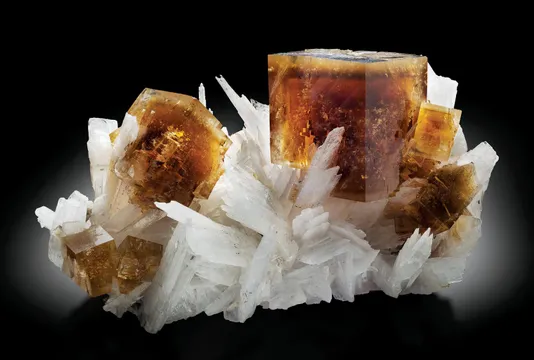
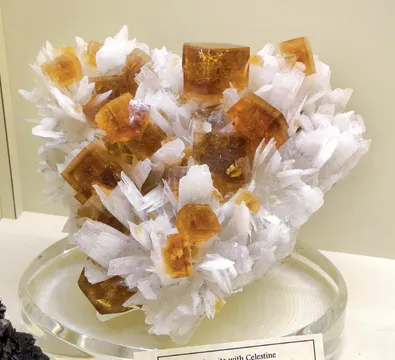
Fluorite is the signature mineral of Stoneco Auglaize Quarry and the reason the locality is known far beyond Ohio. The classic crystals are cubic, commonly small but exceptionally vivid: first-generation brown to root-beer cubes, often under 6 mm but locally lining pockets with crystals to about 3.75 cm, may show the celebrated iridescent surface; a second generation commonly forms transparent purple, raspberry, violet-blue, or colorless cubes to about 1.8 cm, commonly with edge zoning and slight trapezohedral or other corner modifications. Larger clear to milky yellow cubes with dark purple to violet-blue cubic phantoms are recorded to about 5 cm and are among the locality’s great prizes. The best pieces here are not merely purple cubes on limestone: they show multiple growth generations, sharp phantoms, high luster, intact pocket context, and minimal bruising on the exposed cube corners, commonly with calcite, sphalerite, pyrite, quartz, or bituminous hydrocarbons as associated phases.
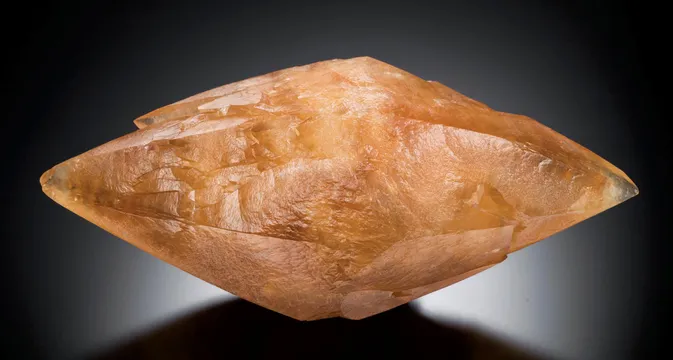
Calcite from Auglaize is an important supporting actor and, in larger clean examples, a collectible species in its own right. It occurs as late-stage crystals in the same pocket and fracture system that produced the fluorite, with habits described from the locality as bipyramidal crystals whose large rhombohedral faces can partly disguise the bipyramidal form. Fine specimens range from small thumbnail and miniature combinations with fluorite to substantial, lustrous, translucent amber, yellow-orange, or colorless crystals; collector reports document calcite crystals longer than 15 cm, including a 16.5 cm yellow-orange doubly terminated crystal. The most desirable Auglaize calcites are complete, well-isolated crystals on matrix, especially doubly terminated or gem-tipped examples and combinations where calcite frames or contrasts with iridescent brown or purple-zoned fluorite rather than simply filling the cavity.
Sphalerite at Stoneco Auglaize Quarry is much scarcer than fluorite or calcite but well documented and very much part of the quarry’s carbonate-hosted sulfide assemblage. It occurs in the mineralized pockets and fractures with calcite, fluorite, and limestone matrix, and collector accounts record crystals to about 4 cm. The usual collector appeal is in sharp, gemmy brown to honey-brown crystals in association with fluorite or calcite; smaller examples may sit as isolated crystals on limestone, while some combinations show sphalerite with massive purple fluorite and calcite. Good Auglaize sphalerite is judged by crystal sharpness, transparency, freedom from contact bruising, and the presence of a clear locality association—especially pieces showing sphalerite with recognizable Auglaize fluorite, because unattached brown sphalerite from Midwestern carbonate quarries is otherwise easy to underappreciate or misplace.
Pyrite is a documented but relatively minor display mineral at Auglaize, occurring in the same pocketed carbonate environment as fluorite, calcite, sphalerite, and quartz. It is best known as brassy accessory crystals, coatings, or inclusions associated with calcite and fluorite rather than as large freestanding pyrite specimens. Collector descriptions of older Auglaize material note pyrite with typical calcite and purple-zoned fluorite, and some specimens show pyrite included in calcite or scattered through the pocket assemblage as bright metallic accents. The best pyrite-bearing pieces from this quarry are therefore combinations: sharp fluorite or calcite specimens enlivened by fresh, untarnished pyrite that adds contrast without introducing instability, staining, or visually distracting sulfide crusts.
Other minerals documented from Stoneco Auglaize Quarry include quartz and chalcopyrite, and collector field guides also note hydrocarbons as part of the pocket environment. Quartz is particularly interesting where it occurs as tiny crystals or casts related to fossil structures in the carbonate host. Chalcopyrite is a much rarer documented accessory. No valid mineral species is currently recognized as having Stoneco Auglaize Quarry as its type locality; the “type-locality” distinction tied to the site belongs instead to paleontology, with Anostylostroma auglaizense named from the Auglaize Quarry in a study of Devonian stromatoporoids.
Auglaize specimens are strongly locality-specific in appearance, but mislabeling remains a real concern. The most persistent confusion is not between distant fluorite districts but between names: “Auglaize Quarry” in Paulding County is sometimes lazily shortened to “Auglaize, Ohio,” which can be mistaken for Auglaize County. The quarry is at Junction/Oakwood in Paulding County, not Auglaize County. Older labels may read Maumee Stone Co. Quarry, Stoneco Auglaize Quarry, Shelly Materials Inc. Auglaize Quarry, or simply Auglaize Quarry; all can be legitimate depending on date and label history.
No well-documented systematic faking problem is known for the locality, but enhanced presentation and ordinary trimming issues matter. Fluorite cubes are soft enough to chip, and Auglaize crystals commonly sit in shallow vugs where the exposed cube corners take the first hit during quarry blasting, extraction, or trimming. Examine iridescent brown fluorite carefully under angled light: true Auglaize iridescence is a natural surface phenomenon tied to the first-generation fluorite, but abrasions, oiling, heavy cleaning, or surface scuffing can dramatically change the look. Dark bituminous material may be original and locality-consistent, so aggressive cleaning can remove context as well as dirt.
Condition separates average Auglaize from elite Auglaize. Many specimens are small, and a 1 cm cube with a razor phantom and perfect edges can be better than a larger bruised pocket. For fluorite, look for transparent second-generation cubes over lustrous brown iridescent first-generation crystals, complete phantoms rather than vague zoning, high luster on all visible faces, and matrix that frames rather than hides the crystals. For calcite, complete terminations and freedom from cleaves are crucial. Sphalerite should be checked for cleaved or contacted faces, and pyrite-bearing pieces should be watched for oxidation, though the locality is not notorious for universal pyrite decay.
Fluorescence is part of the quarry’s appeal. Some Auglaize fluorites show noticeable longwave ultraviolet response, and collectors have reported pale lavender fluorescence in fluorite and strong white fluorescence in calcite on certain combinations. As always with fluorite and calcite, avoid heat shock, harsh acids, and rough ultrasonic cleaning. Fluorite has perfect octahedral cleavage and will punish careless trimming or dropping; calcite will etch quickly in acid; sulfides can stain porous carbonate matrix if stored damp.
Market availability is uneven. Small fluorite pieces and calcite-fluorite combinations appear with some regularity because the quarry has been collected for decades, but top multi-generation fluorites from old pockets are thinly traded and increasingly collection-bound. Specimens with Medici, Ball, Lloyd Tate, George Feist, or other documented Midwest collection provenance deserve attention. The most coveted examples are old-production or well-documented field-collected pieces with precise quarry provenance, intact iridescent brown fluorite, purple or colorless overgrowths, and clean, undamaged display faces.
One of the great Auglaize collecting stories begins not with a grand discovery but with the clock running out. On an August 2006 field trip, Bob Harman watched another collector move on from a boulder. With only about ten minutes left before everyone had to exit the quarry, the boulder was struck hard with a sledge. It opened into a vug of iridescent fluorite and calcite. As quarry personnel were telling the group to leave, Harman was still “madly” collecting the pocket, trying to salvage what he could before the trip ended. The piece he got into the truck measured about 14 cm by 10 cm in a large matrix block and became, by his account, the best find of that trip.
Another Auglaize pocket has become almost legendary because it preserved not just loose crystals but the architecture of the cavity itself. Everett Harrington described a huge intact pocket of iridescent fluorite with at least three stages of growth, measuring 71 cm tall, 36 cm wide, and 20 cm thick. In a locality where many excellent fluorite cubes are thumbnail-scale, a preserved pocket of that size is an event. Its importance lies in the paragenesis being visible at once: the early brown iridescent fluorite, later zoned fluorite, and minor calcite arranged in the original cavity rather than scattered as isolated fragments.
John Medici’s relationship with Auglaize was deeper than a single find. His family first collected at the Stoneco Auglaize Quarry in 1968, and he continued to study and collect the locality for roughly half a century. He kept careful records of where specimens were found in the large quarry and how habits varied from place to place. That matters because Auglaize is not a quarry where one habit defines every bench and wall. The amount of breccia varies, the fluorite habits vary, and even the direction of the phantoming can change. Medici documented ordinary purple-over-clear phantoms, reverse phantoms, and the rare clear-over-brown phantoms that make advanced collectors stop mid-conversation.
At the 2019 Friends of Mineralogy Midwest symposium, Medici’s Auglaize presentation laid out just how varied the quarry could be. He showed calcite crystals longer than 15 cm, including a 16.5 cm yellow-orange doubly terminated crystal; sphalerite crystals to 4 cm; quartz commonly as casts; pyrite and marcasite with calcite and fluorite; and fossils including Devonian fish, ammonites, and stromatoporoids. The largest fluorite aggregate shown in the talk was especially vivid: iridescent deep blue and dark green fluorite completely lining a 53 cm vug. For a locality best known through small, jewel-like cubes, that single vug gives a sense of what the quarry could produce when the right cavity intersected the right mineralized zone.
_4_(33223612913).jpg)