A collector's guide to Stoneco White Rock Quarry, USA: its geology, mining history and notable minerals, illustrated with the 159 specimens documented from this locality on EarthWonders.
Key facts
Stoneco White Rock Quarry at Clay Center, in Allen Township, Ottawa County, Ohio, is one of the definitive Midwestern carbonate-quarry specimen localities: a working dolostone quarry whose fame rests not on metal production, but on vugs and replacement pockets that have yielded some of North America’s most recognizable brown fluorite on white celestine. The locality lies in northwestern Ohio’s Findlay Arch mineral district, where Silurian carbonate rocks have been opened by quarrying and where low-temperature, strontium-, fluorine-, sulfur-, and metal-bearing fluids deposited celestine, fluorite, calcite, sphalerite, galena, pyrite, marcasite, gypsum, and rarer sulfur and cerussite in cavities and veins.
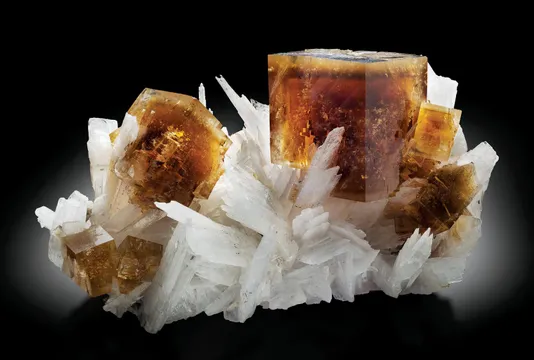
Collectors prize White Rock above the neighboring Ohio and Michigan quarry suite because its best pieces have a signature architecture: honey-yellow to dark “root beer” fluorite cubes, commonly zoned or phantom-bearing, perched on frosty to glassy white celestine blades and, less often, warmed by pale yellow calcite rhombs. The finest specimens are not merely brown cubes on matrix; they have the classic Clay Center contrast of transparent amber fluorite against stark white celestine, with enough open space that the cubes read as individual crystals rather than a massive coating. Under ultraviolet light, many fluorites from the quarry add a second identity, fluorescing whitish, yellowish white, cream white, or bluish white and often showing phosphorescence, a response long tied by researchers to hydrocarbon inclusions in the crystals.
Regional View
Country View
The quarry is also historically important because it has been in the mineral literature for nearly a century. Roger B. Morrison’s 1935 American Mineralogist paper treated Clay Center celestine and fluorite as an occurrence worth explaining geologically, not merely listing as a collecting curiosity. Later work on banding in Clay Center celestine, on the Findlay Arch fluorites, and finally the 2020 Mineralogical Record feature on the White Rock quarry elevated the site from a regional Ohio classic to an internationally recognized collector locality.

Photo: Wikimedia Commons
Search for specimens: View all specimens from Stoneco White Rock Quarry, USA
The quarry is on the north edge of Clay Center, Ohio, at 3800 North Bolander Road, and is an active aggregate and aglime operation in Silurian dolostone. Modern locality descriptions place the working in the Lockport Dolomite and Greenfield Dolomite; Morrison’s earlier stratigraphic treatment described the host as the Guelph member of the Niagara group, with the Clay Center beds correlating broadly with upper Niagaran dolomites elsewhere around the Great Lakes. The rock exposed in the quarry is a buff to brownish-yellow, granular, porous to cavernous dolomite, commonly bedded in units several feet thick and rich in fossil structures, especially corals and stromatoporoids that contributed to the development of cavities and open-textured zones.
The specimen mineralization is best understood as secondary vug and replacement mineralization in dolomite rather than a mined orebody in the economic sense. Celestine occurs in lenticular masses, veins, and cavity linings, commonly with the long dimension roughly parallel to bedding. Morrison observed that celestine was much more abundant in the upper beds than in the lower beds, and that the northeastern corner of the quarry, where the beds showed slight doming, contained larger and more numerous cavities. In lower levels, he noted flatter bladed celestine and compact crystalline masses, sometimes in clay-filled pockets with white crystalline celestine borders.
Fluorite is far less abundant than celestine, but it is the mineral that gives the locality its collector identity. Morrison documented fluorite in restricted sections of the quarry: a short distance along the southern end of the east wall in the upper level and a narrow zone near the bottom of the northern part of the west wall in the lower level. The fluorite occurs as irregular bodies, vug linings, and replacement material, nearly always with celestine. Some masses consist of brown fluorite penetrated by white celestine blades, and occasional purple fluorite was observed as small disseminated grains in celestine near the upper eastern face. The paragenesis is important: celestine came first and replaced dolomite more extensively; fluorite followed, filling interstices between celestine crystals, lining open cavities, and replacing the dolomite more weakly.
Commercial quarrying at Clay Center predates the classic specimen rushes. The White Rock quarry was operating by the late nineteenth century; Alfred C. Johnson was superintendent of the Toledo White Lime Company’s Clay Center works by 1880. The quarry produced white lime for mortar and whitewash and later dolomitic lime and aggregate. In 1905, the Kelley Island Lime and Transport Company purchased the White Rock quarry from Toledo White Lime Company, and contemporary accounts noted sixteen operating kilns. Kelley Island Lime and Transport operated the quarry for roughly the next fifty years, a period during which important early celestine and fluorite specimens entered collections.
Ownership then passed through several industrial hands. In 1955, Kelley Island sold its assets to Basic Refractories, Inc., which continued dolostone quarrying. Edward Kraemer & Sons acquired the operation after Basic, and the quarry was under Kraemer ownership by the late 1960s and through the early 1990s. Control shifted to Stoneco, a S.E. Johnson company, in the mid-1990s, and after S.E. Johnson merged into The Shelly Company in 2003, the former Stoneco Ohio quarries became part of the Shelly Materials/Shelly Company operating network. The Clay Center facility remains listed today as a Shelly/Stoneco aggregate and aglime location.
The best-known modern specimen event was the major 2006–2007 discovery, when blasting opened a large crystal-lined void yielding brown fluorite, white bladed celestine, and yellow calcite. That pocket, together with material dispersed through regional shows and major dealers after the 2007 Tucson season, reset the market’s expectations for Clay Center. Older classic material exists, but many of the lustrous, showy combination specimens now circulating—with root-beer cubes on white celestine—trace to that period.
Collecting access should be regarded as closed unless explicit permission has been granted by the operator. This is an active quarry with blasting, haulage, highwalls, water hazards, and industrial liability restrictions. Historical accounts make clear that collecting occurred under previous owners and that occasional organized access or special arrangements have produced specimens, but modern collectors should not enter, approach working faces, or inquire casually at the gate expecting permission. Most available specimens now come from old collections, dealer inventories, and material recovered from the 2006–2007 find.

Photo: Wikimedia Commons
White Rock fluorite is the quarry’s marquee mineral: cubic crystals in yellow, honey, amber, brown, and dark root-beer tones, commonly zoned with darker cores and paler rims, and very often sitting on or among white celestine blades. Morrison recorded cube faces commonly from less than one-eighth inch to one-half inch, rarely to about 1.5 inches, while later major finds produced cubes around 4 cm and cabinet-size groups large enough to make the locality internationally visible. The most desirable pieces combine sharp, glassy, transparent to translucent cubes with visible zoning or phantom structure, clean contrast against white celestine, and minimal bruising on cube edges; lesser pieces tend to be massive brown fluorite, edge-damaged cubes, crowded coatings, or specimens where the celestine is broken away. Many specimens fluoresce cream white, yellowish white, bluish white, or similar pale tones and may phosphoresce, a response that is part of their collecting appeal.
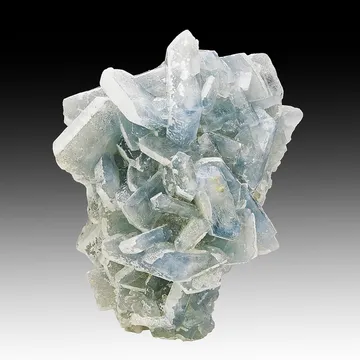
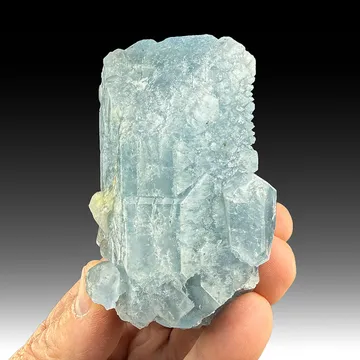
Celestine, the accepted mineral name for SrSO4, is the foundation of the Clay Center assemblage, occurring as pale blue when freshly exposed, white, colorless, frosty, or glassy crystals in solution cavities and replacement masses in dolostone. Thin bladed crystals are the common habit, but stout tabular crystals occur in larger vugs and pockets, especially in the upper beds; Morrison described lenticular celestine bodies from a few inches to several feet across, and later specimen literature documents exceptional large blades and combination groups. The best collector celestines from White Rock are not simply chalky white plates: they show sharp terminations, translucency, clean separation from the dolomite, attractive sprays or blades, and, ideally, aesthetically placed fluorite or pale yellow calcite without excessive breakage. Because the mineral predates much of the fluorite, fine pieces often preserve the quarry’s paragenetic story in a single specimen.
Specimens labeled “celestite” from White Rock are the same SrSO4 mineral more formally recorded today as celestine, and older labels using the celestite name are normal for this locality rather than a separate species. In Clay Center material, these specimens are most often bladed to tabular white or colorless crystals in dolomite vugs, sometimes faintly blue when fresh, and commonly associated with brown fluorite cubes, yellowish calcite, or minor sulfides. Strong examples have airy sprays, intact blade tips, and enough luster or translucency to avoid the dull, cleaved look that ordinary quarry celestine can acquire; the most historically resonant specimens are those where celestite/celestine blades act as the pale architectural matrix for root-beer fluorite. Collectors should preserve old “celestite” labels because they document period usage, but catalogue the mineral consistently as celestine if using current nomenclature.
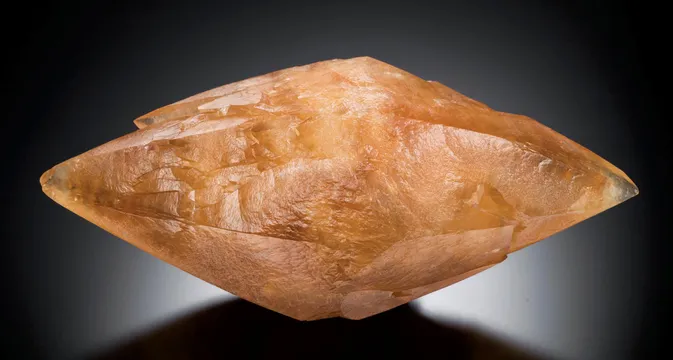
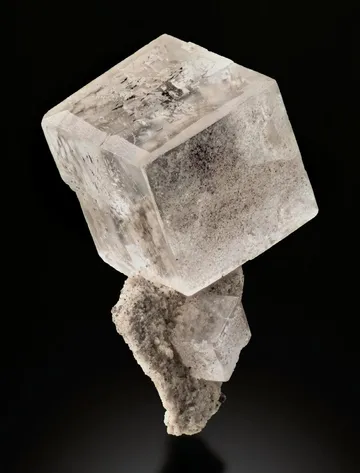
Calcite from Stoneco White Rock Quarry is a supporting but important species, typically colorless to pale yellow, yellowish, or pale honey, occurring as drusy linings, curved rhombohedral crystals, scalenohedrally modified forms, and combination pieces with celestine and fluorite. Morrison recorded crystals from minute druse to an inch or more and noted that strontium and magnesium substitution may help explain the curved faces seen on many Clay Center calcites. The finest calcites here matter because of context: pale yellow rhombs or spiky aggregates on white celestine, or calcite sharing a pocket with root-beer fluorite, make a distinctly Clay Center specimen. Stand-alone calcite is generally less competitive unless it is sharp, lustrous, and unusually aesthetic; damaged rhombs, etched surfaces, or calcite that obscures rather than complements the fluorite-celestine architecture are less desirable.
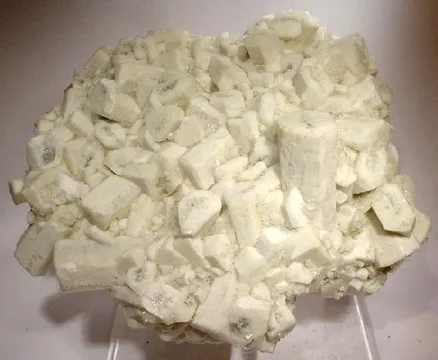
Other documented minerals from the quarry include dolomite, galena, sphalerite, pyrite, marcasite, gypsum, native sulfur, and cerussite. The locality is not known as a type locality, but it has produced notable rarities for the Ohio quarry suite, especially uncommon native sulfur and cerussite documented in the modern Mineralogical Record treatment. Sphalerite deserves special mention: although not common, twinned orange-red tetrahedral crystals from Clay Center have been singled out as among the better eastern United States examples of the species. Pyrite and marcasite occur as small drusy cavity linings and can be iridescent when fresh, but they are prone to alteration; galena and sphalerite are typically minor accessory sulfides rather than the visual focus of most specimens.
The most common mislabeling problem is locality drift. Older specimens may be labeled simply “Clay Center,” “White Rock Quarry,” “Kelley Island Stone Co. Quarry,” “Kelly Island,” “Edward Kraemer & Sons Quarry,” or “Stoneco,” and some labels preserve historical operator names rather than modern locality names. These should not automatically be treated as errors, but they should be reconciled carefully with specimen style and provenance. Conversely, White Rock material should not be casually merged with other famous Ohio fluorite localities such as Auglaize, Lime City, Pugh, Genoa, Portage, or Woodville; the visual overlap can be real, but each quarry has its own collecting history and market identity.
No well-documented, locality-specific epidemic of fakes is known for Stoneco White Rock Quarry specimens, but ordinary market cautions apply. Watch for repaired fluorite cubes reattached to celestine, composite plates assembled from broken vug material, overly bright “wet” surfaces that may have been oiled or coated, and vague labels that use “Clay Center” as a sales enhancer without provenance. Natural iridescence on some White Rock fluorite is a legitimate feature, generally understood as a thin-film surface effect formed after exposure to groundwater or air, but unusually uniform rainbow sheen should still be examined critically under magnification.
Condition is central to value. Celestine is brittle and cleaves; blades are commonly chipped, truncated, or broken where they bridged vug walls. Fluorite cubes often show edge bruising, cleavages, and contacted faces from growth against other crystals or cavity walls. Sawn bottoms are not unusual on quarry specimens and are not inherently a defect if the display face is intact, but they affect how a serious collector evaluates natural matrix. Calcite may be etched or bruised, and marcasite/pyrite-bearing pieces can deteriorate if stored in damp conditions.
The ultraviolet response is a real collecting dimension for this locality. Many root-beer fluorites glow pale cream, white, yellowish white, bluish white, or greenish white depending on lamp wavelength, crystal color, inclusions, and individual specimen. Strong phosphorescence is especially desirable, but it should be considered an added feature rather than a substitute for good form and condition. Keep celestine specimens away from rough handling, do not wash friable cavity material aggressively, and avoid prolonged soaking that may loosen clay-filled pockets or destabilize altered sulfides.
Market availability is moderate but uneven. Ordinary Clay Center fluorite/celestine specimens appear regularly from old collections and dealer stock, including damaged or small examples. Clean cabinet-size combinations from the 2006–2007 find are much scarcer and command a premium, especially when the cubes are sharp, glassy, well zoned, and attractively placed on white celestine. Large, undamaged, high-contrast root-beer fluorite on celestine remains the benchmark for the locality.
The episode every Clay Center collector remembers is the 2006–2007 strike. Blasting in the active White Rock quarry opened a large void crowded with brown fluorite, white bladed celestine, and some yellow calcite. In the dry language of locality catalogues it was a “major find,” but on the specimen market it felt like a quarry had briefly reopened a classic age. Cabinet-size combinations appeared with fresh root-beer cubes on snowy celestine, and the old Midwestern locality suddenly had the kind of new production that could compete for attention at national shows.
At the 2007 Tucson Show, dealer Dave Bunk had a hoard of Clay Center fluorite and fluorite-celestine specimens from a November 2006 strike. He reportedly described it as Clay Center’s best find in the previous fifty years. That remark mattered because White Rock was already a famous locality, not a new discovery. For a place with specimens in old public and private collections, “best in 50 years” meant the pocket had produced enough size, sharpness, and visual drama to rewrite the modern market. Collectors who had known Clay Center as a classic Ohio label suddenly had fresh examples with lustrous zoned cubes, white celestine matrix, and strong cabinet presence.
A later field-account retelling adds the human texture. A local collector-dealer had an arrangement with quarry management, described as being for donating rocks to local schools for study. Much of the lower-grade material did go to school collections and educational use, but the better pieces from the void—there were many—were kept for her collection and for sale. When she next appeared at a regional show, collectors lined up at her tables ready to buy whatever they could afford. The specimens “sold like hot cakes,” in one collector’s phrase, and at prices that now look startlingly low beside current demand for top Clay Center combinations.
The 2020 Mineralogical Record article and related presentations later identified Gail Deck and associates as central to the significant modern find that elevated White Rock’s visibility. That naming matters because quarry localities often become anonymous in the market: a blast, a pocket, a dealer box, a label. At Clay Center, the story has enough continuity to preserve the chain—from quarry wall to regional collector network to Tucson dealers to museum-quality holdings—and that chain is part of why good White Rock specimens carry such strong provenance interest today.