






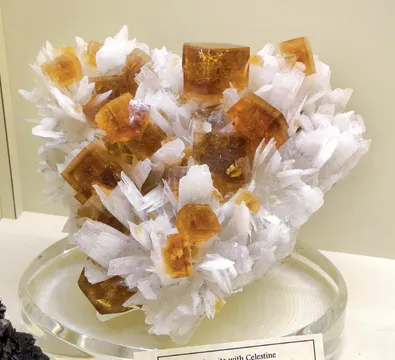
Clay Center, Ohio - renowned for brown to amber root beer fluorite with celestine and calcite; glassy, color-zoned crystals, UV fluorescence, and a storied col…
Key facts
Clay Center, Ohio, means the Stoneco White Rock Quarry: a working carbonate quarry on the north edge of the village, in Allen Township, Ottawa County, where Silurian dolostone has yielded one of the most recognizable specimen assemblages in the American Midwest. Collectors know it first for brown to amber “root beer” fluorite, but the locality is really a celestine-fluorite-calcite-sulfide occurrence developed in vugs, fissures, fossil molds, breccia openings, and replacement zones in porous Lockport and Greenfield dolostone. The finest pieces have a look that is hard to mistake: glassy, color-zoned brown fluorite cubes rising from snowy to milky blades of celestine, sometimes with pale yellow rhombohedral calcite and, more rarely, red-brown sphalerite or small galena.
What makes Clay Center especially collectible is the union of attractive cabinet display and unusually well-studied low-temperature mineralization. Early descriptions treated the occurrence as a classic secondary concentration in cavities of the Guelph/Cedarville-Springfield dolomite interval of the Niagara succession. Later work placed it firmly in the broader Findlay Arch mineral district of northwestern Ohio, southeastern Michigan, and adjacent Ontario, where strontium- and sulfate-bearing brines moved through carbonate rocks long after deposition of the host beds. At Clay Center, the solutions had enough hydrocarbon influence to color fluorite brown and to make many specimens fluorescent and phosphorescent under ultraviolet light.
Regional View
Country View
The quarry’s collector history is unusually long for an aggregate operation. Its dolostone was already being worked in the late nineteenth century for lime and building materials, and the specimen reputation grew as quarry faces cut mineralized pockets. By the 1930s, Clay Center celestine and fluorite had attracted formal mineralogical study; by the mid twentieth century, the locality was established in museum and private collections; and in the 2000s, a major pocket event renewed international attention to the locality’s best fluorite.

Photo: Wikimedia Commons / Rob Lavinsky, iRocks.com

Search for specimens: View all specimens from Clay Center, USA
Clay Center’s specimen locality is the White Rock Quarry, also known historically as the Toledo White Lime Co. Quarry, Kelley Island Lime and Transportation Quarry, Edward Kraemer & Sons Inc. Quarry, and Stoneco White Rock Quarry. It lies at 3800 North Bolander Road on the north side of Clay Center, in western Ottawa County, Ohio. The quarry is not a fluorite mine in the economic sense; it is a carbonate quarry producing dolostone products such as building stone, rip rap, armor stone, and aggregate. The specimens are by-products of extraction from mineralized zones within otherwise high-purity dolostone.
The host rocks are Silurian carbonates on the Findlay Arch, a structural high related to the Cincinnati Arch system. The older literature described the quarry rock as buff to brownish-yellow, granular, porous to cavernous dolomite in the Guelph member of the Niagara group, with abundant fossils commonly preserved as casts and molds. Modern locality summaries assign exposed beds principally to the Lockport Dolomite and Greenfield Dolomite. The essential geological point for collectors is the same: porous, fossiliferous dolostone created the open space, and later low-temperature fluids supplied strontium, sulfate, fluorine, carbonate, and sulfide components into vugs, fissures, breccia voids, and partially replaced dolomite walls.
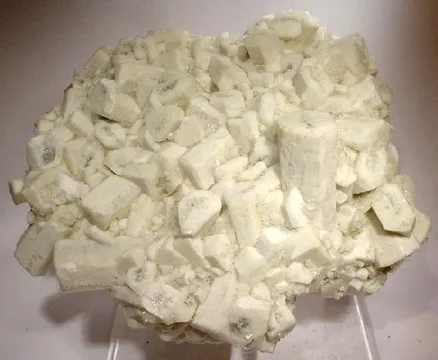
Celestine was the dominant early collector mineral in many zones. Morrison’s 1935 description noted celestine mainly as roughly lenticular masses from a few inches to several feet across, commonly aligned with bedding and occupying solution cavities. He found it much more abundant in the upper beds than the lower level, especially in the northeastern part of the quarry where cavities were larger and more numerous. In lower benches, celestine was described as flat bladed crystals or compact crystalline masses, and clay-filled pockets could have a border of white crystalline celestine.
Fluorite was far less abundant than celestine in the early observations but became the locality’s great collector draw. Morrison saw it in only two quarry sections at that time: a short distance along the southern end of the east wall in the upper level, and a narrow zone along the bottom of the northern part of the western wall in the lower level. It occurred as irregular bodies almost invariably associated with celestine, lining vugs, partly replacing dolomite, and in some lower-level masses as brown fluorite intergrown with bladed white celestine. The famous brown coloration is linked to bituminous inclusions associated with the region’s petroleum-bearing carbonate history.
The classic mining history begins with lime. Alfred C. Johnson was recorded as an early superintendent by 1880, when the quarry was being operated by the Toledo White Lime Company. In 1905, the Kelley Island Lime and Transport Company purchased the White Rock Quarry; contemporary accounts described it as a move into dolomite lime, and the quarry then had 16 operating kilns. Kelley Island Lime & Transport operated the quarry for roughly half a century, a period during which many early specimens entered public and private collections. In 1955, Kelley Island Lime & Transport’s assets passed to Basic Refractories, Inc. Basic continued quarrying the dolostone. Edward Kraemer & Sons acquired the quarry after its founding in 1969 and operated it into the 1990s. Control passed to Stoneco Inc. in the mid-1990s, and Stoneco later came under the Shelly Company/Oldcastle materials umbrella. Current regulatory and aggregate-source records continue to identify White Rock Quarry as an active carbonate quarry at Clay Center.
Commercial quarrying created the specimen supply, but specimen recovery has always depended on where active blasting intersects mineralized ground. The quarry is private and active; ordinary recreational access should not be assumed. Historically, access has occurred through permission, organized mineral-club visits, relationships with quarry personnel, and commercial collectors working under quarry approval. Good pieces are therefore not a steady “mine run” commodity. Availability rises after productive blasting and fades when quarrying moves into barren stone or when access tightens.
The best-documented recent surge was the 2006–2007 find associated with Gail Deck and associates, when blasting opened a large crystal-bearing void rich in brown fluorite, white bladed celestine, and yellow calcite. Specimens from that period helped reintroduce Clay Center to a broader international audience because they combined unusually aesthetic contrast, bright luster, sharp zoning, and in some cases large fluorite crystals. Older pieces tend to be labeled simply “Clay Center,” “White Rock Quarry,” “Kraemer,” “Kelley Island Lime,” or “Stoneco,” and all of those label styles are encountered in collections and dealer inventories.
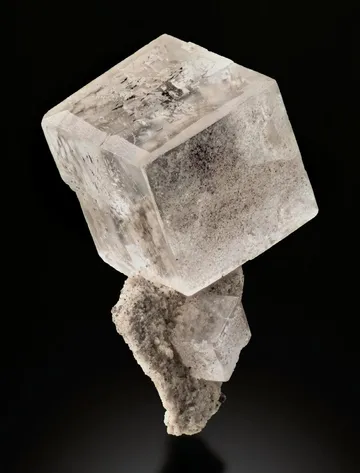
Clay Center fluorite is the signature mineral of the locality: cubic, brown to amber, cognac, honey-yellow, golden-yellow, or rarely nearly colorless, with dark “root beer” centers and paler outer zones on the best crystals. Early quarry observations gave common cube faces of less than one-eighth inch to one-half inch, with rare crystals to about 1.5 inches on edge, while later finds have produced much larger and more dramatic cabinet specimens; modern collector reports and exhibit talks describe exceptional crystals approaching 14 cm. It is typically associated with bladed white to colorless celestine and pale yellow calcite, and less commonly with sphalerite, galena, dolomite, pyrite, or marcasite. The best Clay Center fluorites are not merely brown cubes: they are lustrous, translucent to transparent, sharply edged, visibly zoned or phantom-rich, undamaged at the corners, and set in balanced contrast against white celestine blades rather than being embedded as dull brown masses in dolostone.
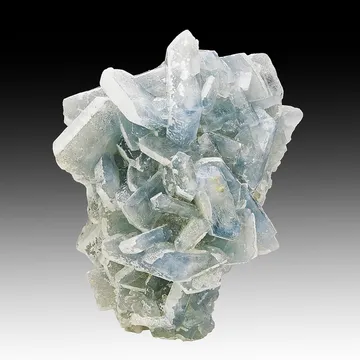
Clay Center celestine ranges from colorless and white to pale blue and, when freshly exposed, occasionally more distinctly bluish before fading toward white or colorless with light and weathering. Thin bladed crystals are the common habit, but stout tabular crystals occur in larger upper-bed vugs, and the locality has also yielded compact crystalline masses, lenticular cavity fillings, and celestine bordering clay-filled pockets. It is earlier than much of the brown fluorite in the classic paragenesis, so many of the finest specimens show fluorite perched on or partly intergrown with bladed celestine rather than the reverse; later prismatic celestine habits are also known in the broader Findlay Arch sequence. Good Clay Center celestine is judged by intact terminations, fresh glassy luster, freedom from bruising along the blade edges, attractive pale blue or water-clear transparency, and strong three-dimensional sprays rather than chalky cleaved masses.
Calcite from Clay Center is most familiar as pale yellow, honey-tinted, or colorless crystals lining vugs or accenting celestine-fluorite plates. Morrison described curved calcite crystals from minute drusy individuals to crystals an inch or more across, with strontium and magnesium substituting for calcium and contributing to the slightly curved appearance of some faces; later collector material commonly shows rhombohedral calcite in association with bladed celestine and brown fluorite. Calcite here is not usually the headline mineral by itself, but it can make a specimen: the best pieces use translucent yellow rhombohedra as a warm bridge between white celestine and brown fluorite, while ordinary pieces are simply etched, incomplete, or scattered calcite on dull dolostone.
Sphalerite is a less common but highly desirable Clay Center mineral, especially when it appears as reddish brown to orange-red, modified tetrahedral or twinned tetrahedral crystals rather than as imperfect dark masses. Early descriptions placed small, dark reddish brown sphalerite along the east wall, occupying former solution cavities and partly replacing dolostone; later Ohio sulfide studies noted sphalerite in the upper Lockport and lower Greenfield carbonate interval, commonly with brown fluorite as fissure or open-space fillings. Good Clay Center sphalerite is prized for color, definition, and association: sharp red-brown tetrahedral crystals on dolostone, with celestine, calcite, or fluorite present, are much more compelling than blackish resinous grains or massive patches.
Other documented Clay Center minerals include dolomite, gypsum, anhydrite, pyrite, marcasite, limonite after sulfides, galena, cerussite, native sulfur, and rare secondary zinc-related material reported in collector talks. There is no well-supported evidence that Clay Center is a type locality for an accepted mineral species, but it is a benchmark locality for the Findlay Arch celestine-fluorite assemblage. The true rarities are not obscure new species; they are mineralogical surprises in an otherwise simple carbonate-vug suite: native sulfur on calcite, tiny cerussite after galena, rare galena cubes, well-formed sphalerite, unusual purple fluorite grains in celestine, and fluorite replacing or occupying fossil cavities in the Silurian dolostone.
Clay Center specimens are frequently mislabeled by degrees rather than by species. The most common issue is locality precision. Older labels may read only “Clay Center,” “Ottawa County,” “Kraemer Quarry,” “Kelley Island Lime,” “White Rock,” or “Stoneco.” Those labels usually refer to the White Rock Quarry, but serious collectors should preserve the exact old wording and add a modern locality line rather than replacing the history. Confusion with other northwestern Ohio dolostone quarries is also possible, especially Genoa, Lime City, Portage, Pugh, Woodville, Rocky Ridge, and other Findlay Arch localities that produce similar celestine, calcite, brown fluorite, and sulfides.
Condition is critical. Fluorite has perfect cleavage and Clay Center cubes often show small edge bruises, cleaved corners, or pocket abrasion. The brown color can conceal internal fractures until the specimen is backlit. Celestine is softer and brittle, so blade tips are commonly broken, cleaved, or dulled; intact terminated blades elevate a specimen substantially. Calcite may be etched, bruised, or chipped along rhombohedral edges. Marcasite and pyrite from fresh quarry material can alter rapidly to limonite, and any specimen with marcasite should be kept dry and away from rapid humidity swings.
Fluorescence is an important Clay Center feature but should be tested intelligently. Brown fluorite from the locality commonly fluoresces white, yellowish white, cream, bluish white, or yellow tones depending on wavelength, inclusions, and specimen; many examples also phosphoresce briefly. Celestine can fluoresce blue. UV response is useful supporting evidence, but it is not by itself proof of locality because similar responses occur in other hydrocarbon-influenced carbonate settings.
Documented deliberate fakes are not a major published problem for this locality, but assembled, repaired, and enhanced specimens should be considered possible in the marketplace because attractive fluorite-on-celestine pieces can command strong prices. Watch for obvious glue at fluorite-celestine contacts, unnatural balancing of isolated cubes on cleaved blades, suspiciously uniform coatings, or matrix that does not match the pale buff to gray dolostone/celestine association. Repairs are not uncommon on delicate celestine plates and are not necessarily disqualifying if disclosed, but undisclosed reconstruction materially affects value.
Market availability is cyclical. Small to mid-sized Clay Center fluorite-celestine pieces appear regularly, especially from older collections and post-2006 material, but top-quality cabinet specimens with large glassy brown cubes, clean white celestine, and balanced calcite are much scarcer. Fine sphalerite from Clay Center is genuinely uncommon, and galena, cerussite, native sulfur, and unusual purple fluorite associations are specialty pieces for locality collectors rather than routine dealer stock.
In the early 1930s, Clay Center was still a living quarry face rather than a finished classic, and Morrison’s field description reads like a collector’s map frozen in time. Celestine was not scattered evenly through the pit. It concentrated in the upper beds and especially in the northeastern corner, where the rock showed a subtle dome-like structure and the cavities were bigger, more numerous, and more often productive. In the lower level, the ground was tighter and less cavernous, but there the celestine could appear as flat blades or compact crystalline masses, sometimes around clay-filled pockets edged with white crystalline celestine. Freshly exposed larger crystals could be blue—sometimes strongly so—before fading with light and weather.
Fluorite was already the prize. Morrison saw it in only two parts of the quarry. One was along the southern end of the east wall in the upper level, the oldest part of the operation, where he noted that collectors had already removed much of the supply. The other was a narrow zone near the bottom of the northern western wall in the lower level. The best lower-level masses were not neat display pieces when first broken out; they were heavy, irregular bodies of massive brown fluorite shot through with white celestine blades. From that rough material came the visual signature collectors still chase: brown fluorite, white celestine, and the buff Silurian dolostone that binds the whole association together.
The locality also has a wartime footnote that gives celestine a different kind of value. During World War II, according to later lecture summaries on the quarry, volunteers hand-picked strontium-rich celestine crystals for use in signal flares. It is a striking reminder that a mineral now prized for pale blue blades and cabinet aesthetics was once useful because strontium compounds burn with the red color needed in pyrotechnics. At Clay Center, the same pockets that delighted collectors also held a strategic mineral resource, even if the quarry itself remained primarily a dolostone operation.
The 2006–2007 fluorite find changed the modern market memory of the quarry. Gail Deck and associates were collecting material intended in part for schools, while also saving fine specimens, when blasting exposed a large void carrying brown fluorite, white celestine, and yellow calcite. The find arrived at the right time: collector appetite for fluorite had surged, and Clay Center’s odd hydrocarbon-colored cubes looked unlike the bright purple Illinois-Kentucky fluorites or the green daylight-fluorescent English material then fashionable. Some crystals from the modern period were reported at nearly 14 cm, large enough to move Clay Center from a beloved regional classic into serious international fluorite competition.
One of the more memorable modern specimen types is fossil-associated fluorite. The host rock is full of Silurian life—corals, stromatoporoids, brachiopods, gastropods, cephalopods, and the large bivalve Megalomus—and mineralizing fluids used those biological voids as architecture. A fluorite occupying or replacing a fossil cavity is not simply a brown cube on matrix; it is a mineral specimen that still carries the shape of the Silurian seafloor. That is part of Clay Center’s charm: the best pieces are not isolated crystals from a vein mine but small, crystallized rooms inside an ancient reefal carbonate.

_3.jpg)