






A collector's guide to Pugh Quarry, USA: its geology, mining history and notable minerals, illustrated with the 27 specimens documented from this locality on EarthWonders.
Key facts
Pugh Quarry is one of the classic mineral-specimen localities of northwestern Ohio: a working crushed-stone quarry in Middle Devonian carbonate rocks whose fame among collectors rests not on ore production, but on vugs, solution cavities, collapse breccias, and mineralized horizons that yielded handsome carbonate-sulfate-sulfide specimens. The quarry lies in Milton Township, Wood County, near the Wood–Henry county line, west-southwest of Weston and north of Custar, in the flat carbonate country south of the Maumee River basin. Labels commonly say “Custar,” but that town name reflects the historic office association more than the exact quarry position.
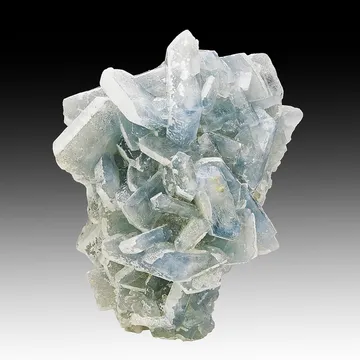
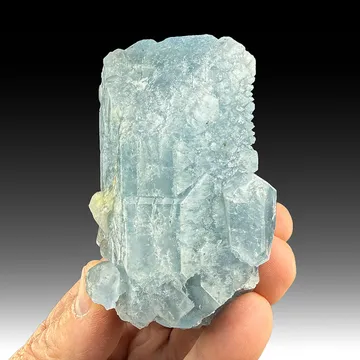
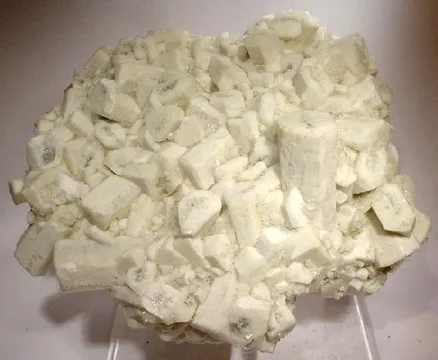
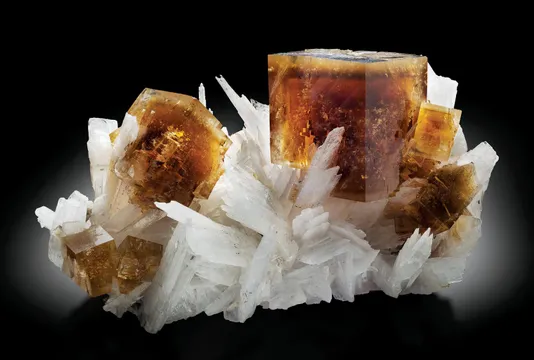
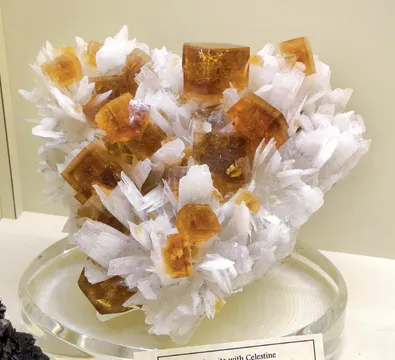
The mineral assemblage is unusually coherent and unusually well documented for a Midwestern limestone quarry. Calcite dominates the collector story: golden to brown scalenohedral “dogtooth spar” crystals, commonly in parallel groups and sometimes doubly terminated, were recovered from vugs and collapse-breccia cavities in sizes from small cabinet pieces to imposing crystals. Barite and celestine give Pugh its distinctive personality. Barite occurs as white, cream, pale blue, and other subtly colored rosette-like and spiky aggregates, sometimes perched on or coating calcite. Celestine is rarer and typically appears as pale to stronger blue prismatic or blocky crystals, or as white bladed to tabular clusters. Add brown and blue fluorite, marcasite, pyrite, dolomite, and tiny sphalerite, and Pugh becomes a textbook example of secondary mineralization in open spaces in Devonian dolostone and limestone.
Historically, the locality matters because David F. Parr and Luke L. Y. Chang treated it in a remarkable four-part descriptive mineralogy series in The Ohio Journal of Science between 1977 and 1980, covering marcasite and pyrite, sphalerite, calcite-dolomite-fluorite, and finally barite-celestite. For collectors, those papers remain more useful than a generic locality listing: they describe not just species names, but zones, habits, growth relationships, fluorescence, color zoning, and paragenesis. A good Pugh specimen has a look that is hard to mistake once learned: honey-brown or golden scalenohedra rising from gray dolostone, perhaps with pale blue celestine tucked among the calcites or milky barite crusting edges and terminations.
Regional View
Country View
The quarry’s best pieces are not bright in the alpine-cleft sense; their attraction is more stratigraphic and sculptural. The limestone-gray matrix, black stylolitic residues, rusty sulfide staining, and warm brown calcite color tell you immediately that the crystals grew in a low-temperature carbonate environment. When the associations are right—golden calcite with pale blue celestine, or calcite overgrown by white to bluish barite—the pieces have the restrained, unmistakably Midwestern elegance that serious Ohio collectors prize.

Photo: Wikimedia Commons
Search for specimens: View all specimens from Pugh Quarry, USA
Pugh Quarry is in Wood County, Ohio, in Milton Township, on Portage Road near the Wood–Henry county line. Historic and collector labels often use “Custar,” “near Custar,” or “Weston,” and another name recorded for the locality is France Stone Co. Custar Quarry. The quarry has also been associated in the mineralogical literature with the Pugh Quarry Company. Mindat lists the locality as an active quarry and records aggregates as the exploited commodity.
The deposit is not an ore mine in the usual collector sense. It is a carbonate aggregate quarry that happens to cut a mineralized Middle Devonian section. Older descriptions assigned the exposed rocks to the Dundee Formation and Detroit River Group, while other work correlated certain quarry units with the Columbus Formation. The practical collector geology is simpler: the rock is dominantly dolostone and limestone, locally vuggy, brecciated, stylolitic, and fractured. Those open spaces were the sites of secondary mineral growth. Strogonoff’s measured west-wall section recorded about 10 feet of drift over buff to gray dolostone, including massive sugary-textured vuggy dolostone with abundant stylolites, a buff highly fractured and vuggy unit, and a thicker dark-gray, thin-bedded, highly fractured dolostone interval extending to the quarry floor as then exposed.
The mineralization was strongly zoned. In the older field descriptions, calcite was concentrated in a three-foot-thick horizon about 21 feet below the top of bedrock and traceable around the quarry walls. That calcite horizon produced massive vug and fracture fillings as well as the large scalenohedral crystals for which the quarry became famous. Marcasite was closely linked with the calcite in breccias and fractures, sometimes acting as a cement between rock fragments, sometimes forming radiating or fibrous masses with iridescent blue, purple, green, and red fracture surfaces. Fluorite and small dolomite crystals were reported from shallow vugs near the top of the bedrock, while barite and celestine were more localized and less common than calcite.
The best-described productive area was the eastern part of the north wall. Parr and Chang found large calcite especially abundant there, where cavities and collapse breccias were common. Their barite study also placed the highest barite concentrations in the eastern portion of the north wall, both in the principal mineral zone and in isolated cavities stratigraphically lower than it. Celestine was still more restricted, found only in the eastern portion of the quarry in their study: blue to gray-blue crystals occurred mainly in the mineral zone, while colorless and white celestine came from the quarry wall below that zone.
Mining was for crushed stone rather than specimens, and the specimen record reflects what quarrying exposed at the time. The locality was already important to Ohio field collectors by the 1960s; Robert F. Strogonoff worked there during his 1962–1965 study of northwestern Ohio quarry minerals, and Parr and Chang later examined quarry material in enough detail to produce the four-part Pugh series. Those papers also record cooperation from the Pugh Quarry Company and from local collectors and quarry personnel who lent or donated specimens for study.
Collecting access today should be treated as closed unless a collector has explicit written permission from the operator. The locality has long been reported as closed to collecting because of insurance concerns, and modern collecting is further complicated by the fact that quarrying has advanced below the principal specimen-producing zone described in the classic literature. In practical terms, most Pugh material now entering collections comes from older private collections, estate lots, old club material, and dealer stock, not from current field collecting.
Calcite is the signature mineral of Pugh Quarry and by far the most abundant collector species there. The classic crystals are scalenohedral dogtooth forms on gray dolostone or limestone, with large crystals generally brown to golden-brown and smaller crystals colorless to gray-yellow or pale yellow. Parr and Chang separated the occurrence into large crystals over 5 mm and small crystals under 5 mm; crystals in the 10 to 15 cm range were not unusual in the large group, and older field notes record individual crystals reaching about 20 cm along the c axis in larger vugs. Large calcites were especially abundant in the eastern portion of the north wall, in cavities and collapse breccias, while small calcites were widespread in the mineral zone and in smaller cavities in overlying Dundee limestones. The best Pugh calcites show crisp dogtooth form, attractive golden to brown internal zoning, undamaged terminations, parallel growth or twinning, and lively associations with pale celestine, white to bluish barite, marcasite, fluorite, or dolomite; ordinary pieces are usually massive, cleaved, etched, heavily stained, or lack the sculptural scalenohedral outline that gives the locality its appeal.
Barite is much less common than calcite at Pugh Quarry but is one of the locality’s most diagnostic minerals. It occurs chiefly in the mineral zone and in lower isolated cavities, with the richest concentrations documented in the eastern part of the north wall. Pugh barite may be colorless, cream, white, pale blue, blue-gray, blue-green, green-yellow, or yellow-brown, commonly with more than one color zoned within a single crystal or aggregate; most specimens are cream, white, or pale blue, translucent, and sometimes transparent along thin edges. The typical habit is not a single tabular crystal but an aggregate: rosette-like clusters of parallel and subparallel rhombic prisms, paired crystals, oblong fourlings, spike clusters, crested aggregates, layer-and-spike forms, and the unusual hollow crystals described by Parr and Chang. Rosettes may reach about 1 cm, spike clusters about 1 to 5 cm, aggregate clusters as much as 7 cm, and encrustations on calcite about 5 mm thick. The best pieces retain sharp, pearly to glossy barite on matrix or on calcite, especially where the white or bluish barite contrasts cleanly with golden dogtooth calcite; lesser pieces appear as dull crusts, damaged aggregates, or chalky coatings with little visible crystal structure.
Celestine from Pugh Quarry is scarcer than the calcite and more localized, but the blue celestine-calcite combinations are among the most desirable Pugh specimens. Parr and Chang found celestine only in the eastern portion of the quarry. The gray-blue and blue crystals occurred predominantly in the mineral zone as well-formed prismatic to blocky individuals, generally simple in morphology and reaching about 1 cm in maximum dimension, while colorless to white celestine occurred below the mineral zone as tabular to bladed individual crystals and compact rosette-like clusters, with individual crystals typically under 5 mm and clusters commonly about 1 cm across. On good specimens the celestine sits with or among yellow to brown calcite and may also be associated with fluorite; the paragenetic evidence suggests celestine began forming before calcite growth had entirely ceased but that most celestine formed after calcite precipitation, and fluorite preceded celestine. The finest examples show distinct pale to stronger blue crystals, sharp blocky habit, and attractive placement against golden scalenohedral calcite; washed-out white blades, bruised edges, or sparse celestine hidden in matrix are more routine.
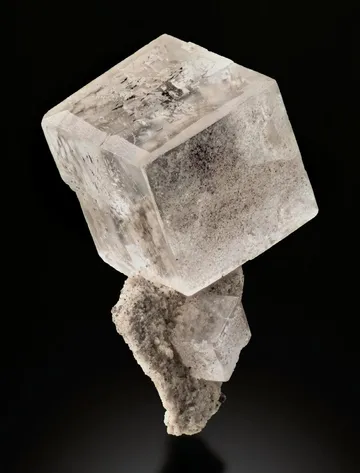
Other documented minerals from Pugh Quarry include dolomite, fluorite, marcasite, pyrite, sphalerite, and reported strontianite, with glauconite and hexahydrite also appearing in locality listings. No type-locality mineral species is documented from Pugh Quarry in the mineralogical sources consulted, but several rarities are important in a locality context. Fluorite is relatively uncommon yet widespread through the quarry, occurring as brown, colorless, pale blue, and dark blue to purple cubes, usually small and often zoned with colorless or pale-blue outer growth over brown cores. Dolomite occurs as small white to pinkish-white saddle-shaped crystals, most common in vugs. Marcasite is abundant enough to be a serious condition consideration, forming banded encrustations, globular and columnar masses, euhedral crystals, rare stalactitic aggregates, and stellate twins; pyrite is much less common, typically as highly lustrous crystals under 1 mm. Sphalerite is a micro-collector’s species at Pugh, present as banded massive material, spheroidal aggregates no more than about 1 mm, and tiny red-brown euhedral crystals in voids below the main mineral zone.
Pugh Quarry material is not known for a systematic fake problem, but the locality does suffer from the normal mislabeling hazards of classic Midwestern carbonate specimens. “Custar” is common on old labels and is acceptable historically, but the quarry itself is not in the town of Custar. More problematic are broad labels such as “Ohio,” “Wood County,” or “near Toledo,” which can blur Pugh with Clay Center, Lime City, Portage, Sylvania, Marblehead, or other Ohio and Michigan carbonate localities. For serious collection records, retain any old label and record the locality as Pugh Quarry, Wood County, Ohio, USA, with historic names noted separately.
The visual identifiers are useful but not foolproof. Golden-brown dogtooth calcite on gray dolostone is strongly suggestive, especially when accompanied by pale blue celestine or white to bluish barite, but similar carbonate-vug aesthetics occur elsewhere in Ohio. Pugh barite is a better diagnostic clue when it shows the locality’s rosette-like, spike, crested, or thin hollow habits. Pugh celestine tends to be modest in size and commonly associated with calcite rather than forming the large, showy celestine clusters for which some other Ohio localities are famous. Fluorite without a reliable label is particularly risky, because many northwestern Ohio quarries produced brown, blue, purple, or zoned fluorite on carbonate matrix.
Condition is the decisive issue. Calcite has perfect cleavage and many Pugh specimens show natural or collecting-related cleaves, healed breaks, etched surfaces, and bruised scalenohedral tips. The large brown crystals may be internally zoned and visually rich, but they are often not glassy; a lightly etched or satin surface can still be normal for the locality. Barite and celestine are brittle and should be checked for chipped blade edges, broken spikes, and repaired clusters. The most attractive specimens balance sharpness, undamaged terminations, and strong contrast between species.
Marcasite-bearing specimens need special care. Parr and Chang documented alteration coatings on Pugh marcasite and recorded white post-storage powder identified by X-ray diffraction as hydrated iron sulfates, including rozenite and szomolnokite. That is the classic warning sign for marcasite decay. Keep Pugh marcasite pieces dry, stable, and away from high humidity; isolate any specimen that begins producing white powder or acidic odor. Do not wash marcasite-rich pieces casually, and avoid sealed humid display cases.
Fluorescence can add interest but should not be the main buying criterion. Pugh calcite may show weak to moderate responses related to internal zones: darker brown bands in large calcite have been reported as weak dull red under longwave ultraviolet and strong orange under shortwave, while outer zones may show short-lived cream to greenish-white phosphorescence. Small calcite may show minimal pale-yellow fluorescence and very weak cream-white phosphorescence. Sphalerite may fluoresce dull red to reddish yellow. Fluorite from the broader Ohio carbonate district is often collected for ultraviolet response, but Pugh is better known as a display-specimen locality than as a premier fluorescent-mineral locality.
Market availability is finite. Because the quarry is closed to routine collecting and the historically productive mineralized zone is no longer readily available to collectors, fresh field material is not a realistic expectation. Good Pugh specimens appear from old collections, dealer inventories, and estate dispersals. Large, undamaged golden calcites remain the most recognizable and available classics; barite and celestine combinations are less common and command more attention when aesthetic. Fine calcite-celestine combinations, sharp barite on calcite, and well-labeled old specimens with Parr-and-Chang-era provenance are the pieces to move on quickly.
The most vivid Pugh story is not a single spectacular blast pocket but the way a working Ohio aggregate quarry became, through patient observation, a four-paper mineralogical case study. In the summers of 1962 through 1965, Robert F. Strogonoff examined a broad swath of northwestern Ohio quarries for his Bowling Green State University thesis. At Pugh he was working a quarry section that exposed about 10 feet of glacial drift above a bedrock wall dominated by vuggy, stylolitic dolostone. His notes put the calcite in a three-foot horizon 21 feet below bedrock surface, traceable around the quarry walls, and described large vugs where calcite crystals reached 20 cm along the c axis. In the same quarry face he found marcasite filling the spaces of breccia fragments, sometimes as a complete cement, sometimes as a thin coating that held broken dolostone fragments together while leaving voids open for later minerals.
A decade later, Parr and Chang turned that same working-quarry material into one of the better documented locality studies in American carbonate mineralogy. Their papers read like a specimen cabinet being disassembled under a microscope. In the calcite study, a familiar honey-brown dogtooth crystal became a record of growth zones, hydrocarbon-related color, fluorescence, healed cleavage, basal twinning, and late pale overgrowth. In the barite study, the humble white crust on calcite became an entire architecture of paired crystals, fourlings, rosettes, spike clusters, layer-and-spike aggregates, and hollow crystals. The most memorable phrase is their comparison of certain barite spike clusters to a “Christmas Tree” form, followed by another image of delicate branching clusters resembling the leafy top of a pineapple. Those are exactly the sort of small, strange habits that make old Pugh matrix worth turning under a hand lens.
The quarry also produced less glamorous but scientifically rich sulfide stories. Marcasite was not merely a dark accessory; it formed banded crusts up to several centimeters thick, globular cauliflower-like masses, columnar bands, euhedral crystals, and rare stellate twins. On fresh breaks it could show gray-white tones with a greenish cast, while exposed surfaces developed iridescent blues and greens. Sphalerite, too, was not just “minor zinc sulfide.” Parr and Chang recognized banded massive sphalerite as blebs in marcasite, spheroidal aggregates of tiny radial crystals, and minute red-brown euhedral crystals no larger than 1 mm. Their acknowledgments preserve a small social history of the collecting network around the quarry: the Pugh Quarry Company and Mr. Miller cooperated, and specimens were donated or lent by named collectors including Mr. and Mrs. Clayton Welch, Mr. Stan Esbenshade, Mr. Charles Detrich, and Mr. Larry Hargrove. Much of what collectors now call “classic Pugh” survived because quarry workers, local collectors, and academic mineralogists intersected at the right time.
_5.jpg)