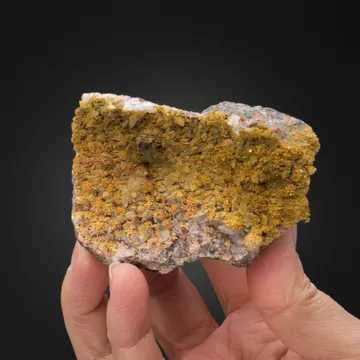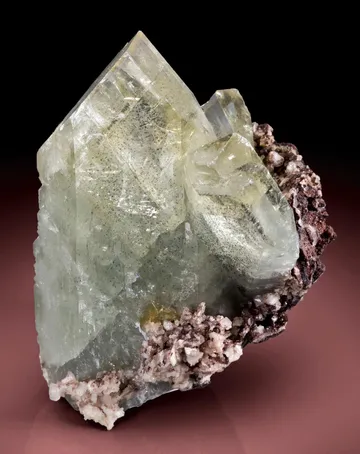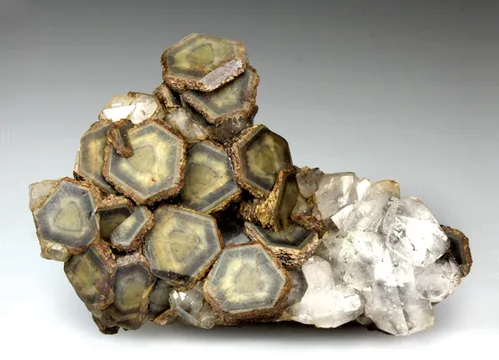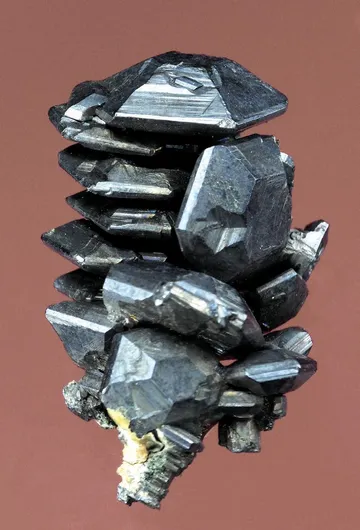
A collector's guide to South Fowey Consols, UK: its geology, mining history and notable minerals, illustrated with the 34 specimens documented from this locality on EarthWonders.
Key facts
South Fowey Consols sits in one of Cornwall’s most historically tangled and mineralogically rewarding districts: the Tywardreath–Par–St Blazey belt on the eastern side of the Luxulyan Valley, where copper, tin, bismuth, cobalt, nickel, silver, arsenides, sulphides, phosphates, carbonates and late copper oxidation products are packed into a small area of old shafts, adits, dumps and transport works. For collectors, the name is important not because South Fowey itself was a large producer, but because specimens sold under South Fowey Consols often belong to the immediately adjacent Fowey Consols–Lanescot mineral field, one of the classic Cornish copper localities and a source of old-cabinet bismuthinite, chalcotrichite, cuprite, langite, siderite, quartz and rare phosphate material.
The geological appeal is the crossing of two Cornish ore styles. East–west copper-tin lodes gave the district its industrial importance, while later north–south bismuth-cobalt-nickel-uranium-bearing veins supplied much of the collector interest. The finest specimens have the unmistakable look of old east-Cornwall material: silvery metallic needles and blades of bismuthinite bridging cavities in quartz and siderite; red to pink hair-like chalcotrichite tucked into blackened cellular gossan; bronzy chalcopyrite and tarnished native copper in limonitic matrix; and pale quartz, sometimes etched, combed or cavernous, acting as both ore gangue and display stage.
Regional View
Country View

Photo: Wikimedia Commons / Derek Harper
The modern collector must handle the name carefully. The historically documented South Fowey Consols was a small tin working south of Lanescot, recorded as producing only 1.5 tons of black tin in 1873. By contrast, the famous suite of bismuthinite, chalcotrichite, langite, francolite, siderite, native copper and rare secondary species belongs to the broader Fowey Consols complex, including Lanescot. In the specimen trade those labels have long overlapped, especially where old labels read simply “Fowey Consols,” “Fowey Consols Mine,” “Tywardreath,” “St Blazey,” or occasionally “South Fowey.” A good guide to the locality therefore has to be both appreciative and strict: enjoy the mineralogy, but preserve the label evidence exactly.
Search for specimens: View all specimens from South Fowey Consols, UK
South Fowey Consols lies in the Tywardreath and Par civil parish of Cornwall, near Lanescot, Penpillick and the southern end of the Luxulyan Valley industrial landscape. The strict mine record describes it as a small tin mine working an east-south-east-trending lode from a single shaft south of the road junction south of Lanescot, with an adit driven northwards from the small valley to the south. Its recorded output was modest: 1.5 tons of black tin in 1873. The site is now occupied, and the old mining ground is not a normal collecting locality.
The collector story is broader than the small South Fowey tin working. Fowey Consols proper began with earlier ventures known as Wheal Treasure, Wheal Fortune and Wheal Chance, which opened in 1813, stopped in 1819, and were bought and consolidated by Joseph Treffry in 1822. Lanescot was added in 1836, and the combined concern became one of the celebrated Cornish copper mines of the nineteenth century. Its success depended not only on ore, but on engineering: steam engines, waterwheels, leats, canals, inclined planes and later tramways carried fuel inward and copper ore outward through Par and the Luxulyan Valley.
The main copper-tin mineralization was hosted by east–west lodes, in keeping with Cornish regional structure, while the bismuth-cobalt-nickel-uranium vein set cut on a roughly north–south trend and is considered later. That intersection of ore systems explains why the specimen suite is richer than the output record of any one small sett might suggest. Chalcopyrite, chalcocite, copper oxides, native copper and copper sulphates reflect the copper lodes and oxidation zone; cassiterite and stannite speak to the tin-bearing phase; bismuthinite, cobaltite, nickeline, skutterudite-group minerals and associated sulphides reflect the late crosscourse-style mineralization.
For collecting access today, the important point is restraint. South Fowey itself is not an open collecting dump. Much of the wider Fowey Consols–Luxulyan landscape is on private land, heritage land, woodland, built ground or protected industrial archaeology. Old shafts, concealed workings, unstable ground and scheduled or listed remains are real hazards and legal constraints. Contemporary collecting is therefore chiefly through old collections, dealer stock, estate dispersals and carefully provenanced micromounts, rather than by field collecting.
The notable specimen finds that matter to collectors are largely nineteenth-century and early twentieth-century old-cabinet material, supplemented by occasional twentieth-century dump finds from exposed or disturbed ground. Classic specimens include bismuthinite on quartz, siderite and chalcopyrite; chalcotrichite in cellular quartz or gossan; small but bright cuprite; native copper in limonitic matrix; langite crusts and tufts; francolite or carbonate-rich fluorapatite crystals; and the rare-earth phosphate rhabdophane-(Ce). Richard Talling, the great Lostwithiel mineral dealer, is closely associated with Fowey Consols material, and old labels connected with him or with nineteenth-century museum and dealer networks add real value when the mineralogy and locality agree.
Bismuthinite from the Fowey Consols–South Fowey collecting field is one of the locality’s signature old-Cornish sulphides, typically occurring as silvery grey, metallic needles, blades or elongated prismatic crystals in quartz-rich vein material, often with chalcopyrite and siderite; good pieces show distinct individual crystals spanning open cavities rather than dull massive streaks in ore, and older dealer descriptions record crystals from about 1 cm to several centimetres, with the best specimens combining bright metallic luster, three-dimensional habit, minimal bruising and a matrix that preserves the vein texture rather than reducing the piece to a broken ore fragment.
Cuprite at this locality is best understood as an oxidation-zone mineral of the copper lodes, appearing either as small deep red crystals and crystalline patches in limonitic or quartzose gossan, or in its acicular chalcotrichite habit; cabinet-quality examples are not judged by large Chessy-style crystals, but by color, brightness and context—sharp red microcrystals, visible contrast against pale quartz or black manganese-iron oxides, and credible old labels from Fowey Consols, Tywardreath or Lanescot carry far more authority than vague “Cornwall cuprite” attributions.
Chalcopyrite is both ore and specimen matrix here, occurring as brassy to tarnished sulphide masses, vein patches and cavity-lining crystalline material with quartz, siderite and bismuthinite; the most collectible South Fowey/Fowey Consols examples are not ordinary massive copper ore, but pieces that show lustrous brassy faces, iridescent tarnish, microcavities with associated siderite or bismuthinite, or a clear relationship to the bismuth-bearing vein assemblage that made the locality famous among old Cornish collectors.
Quartz from this locality is rarely collected as isolated “pretty quartz”; its importance is as the architectural gangue of the ore, forming milky, etched, cellular, skeletal or comb-textured matrix for bismuthinite, chalcopyrite, siderite, native copper, cuprite and chalcotrichite, and the best pieces preserve open cavities, ribs or vugs where later minerals can be seen in place rather than lost in a sawn or over-trimmed lump of veinstone.
Chalcotrichite—the hair-like variety of cuprite—is the most visually distinctive copper-oxide material attributed to the Fowey Consols–South Fowey suite, occurring as bright carmine, pinkish red or red-brown acicular mats and reticulated tufts in cavities of cellular quartz and gossan, commonly on dark wad-like coatings; the finest examples are small but vivid, with intact silky needles, clean contrast, and old labels, while ordinary pieces tend to be sparse, dusty red smears in broken gossan that lose much of the locality’s charm under magnification.
Other documented minerals from the broader Fowey Consols field include langite, rhabdophane-(Ce), francolite or carbonate-rich fluorapatite, siderite, stannite, sphalerite, chalcocite, native copper, native silver, pyrite, marcasite, magnetite, tenorite, malachite, azurite, brochantite, devilline, posnjakite, cobaltite, nickeline, skutterudite-group minerals, torbernite and cassiterite. Langite and rhabdophane-(Ce) are the locality’s great mineralogical claims to fame as type-locality species. Francolite is historically important because Fowey Consols material figured in nineteenth-century discussion of carbonate-rich apatite from Cornwall, including confusion over material acquired by Talling and later compared with Levant Mine specimens.
The most important authenticity issue is locality precision. “South Fowey Consols” in the strict mining record is a small tin mine with cassiterite as the documented Mindat mineral entry, whereas the classic bismuthinite, chalcotrichite, langite, francolite and rhabdophane-(Ce) suite belongs to the neighbouring and historically much larger Fowey Consols complex, especially the Lanescot section. Specimens labelled only “Fowey Consols” should not automatically be upgraded to “South Fowey Consols,” and specimens labelled “South Fowey” but carrying a classic Fowey Consols copper-bismuth assemblage should be catalogued with the label history retained, not silently corrected.
Old labels matter unusually much here. Nineteenth-century labels from Talling-associated material, Freiberg dealer stock, early British collections, Barstow stock, or museum dispersals can establish a specimen’s place in the long collector chain. But an old label is not proof by itself: the mineral assemblage should match. Bismuthinite with quartz, siderite and chalcopyrite is credible for the classic Fowey Consols field; chalcotrichite in cellular quartz-gossan is credible; bright large standalone cuprite crystals without the right matrix should be treated cautiously unless the provenance is exceptionally strong.
Documented fakery is relevant in one specific mineralogical case: rhabdophane-(Nd) has been reported historically from Fowey Consols but is now treated as an erroneous or fake literature entry. That does not discredit genuine rhabdophane-(Ce), which remains one of the locality’s important rare-earth phosphate records, but it does mean that rare-earth phosphate labels from this locality deserve analytical care.
Condition issues are typical of old Cornish copper and sulphide specimens. Bismuthinite is soft, brittle and easily bruised at crystal tips; it should not be cleaned aggressively. Chalcotrichite is far more delicate than ordinary cuprite, with hair-like crystals that can be flattened or lost by brushing, ultrasonic cleaning or careless wrapping. Copper sulphates such as langite and posnjakite may be sensitive to repeated wetting and drying, and old gossan matrices can shed limonite dust. Store specimens dry, stable and away from crushing pressure; use a lidded box or membrane box for chalcotrichite and micromounts.
Market availability is limited but not impossible. Bismuthinite and chalcotrichite from Fowey Consols appear periodically from old collections and specialist British dealers; attractive old-cabinet pieces are much scarcer than small reference specimens. Langite and rhabdophane-(Ce) are usually micromount or small-matrix pursuits. Strictly labelled South Fowey Consols cassiterite is a different collecting target altogether and should not be confused with the more glamorous Fowey Consols copper-bismuth suite.
The Fowey Consols story begins with three hopeful names—Wheal Treasure, Wheal Fortune and Wheal Chance. They began in 1813, failed after six years, and might have disappeared into the long list of Cornish disappointments had Joseph Treffry not bought and consolidated them in 1822. When Lanescot was added in 1836, the operation became not merely a mine but the engine of a whole industrial landscape.
Treffry’s genius was to see that ore alone was not enough. Copper had to move, coal had to arrive, water had to be controlled, and the steep wooded valley of the River Par had to be turned into machinery. He built or commissioned a new harbour at Par, canalized transport up the valley, drove inclined-plane tramways to the mine, and developed the leats and water supplies that made the great works possible. At the mine’s peak, the concern was served by six steam engines and seventeen waterwheels, and local accounts describe ore being hauled by as many as 100 mules and 30 horses. This was mining as a transport empire.
One of the grandest surviving monuments to that ambition is the Treffry Viaduct in Luxulyan Valley. Built in the early 1840s of local granite, it was both viaduct and aqueduct: a structure to carry tramway traffic and water at the same time. Its design linked mines, quarries, clay works and harbour into a working landscape. The viaduct was not decoration; it was a solution to a mining problem. Without water and transport, Fowey Consols could not fully exploit its ore.
The mine also pulled people into Tywardreath and Par. In the 1830s the output rose, workers arrived from a wide area, and the parish population grew with the boom. By 1861 the parish had more than 3,300 people, but after the copper decline and the 1866 mining crash the number fell sharply; by 1891 there were only just over 30 miners left in the parish. Families that had come for copper scattered outward. From the Kilhallon and Lanescot district, one group of young people traced in local demographic work ended up in California, Oregon, Colorado and Pennsylvania. The locality’s specimens, with their old labels, are small survivals of that wider migration story.
The royal visits belong to the same age of grandeur. Queen Victoria and Prince Albert visited in 1846, and in 1865 the Prince and Princess of Wales—the future Edward VII and Queen Alexandra—visited after sailing to Fowey aboard the Royal Yacht Osborne. Yet by then the mine’s great days were nearly over. The collapse of the copper market and wider financial strain hastened the end, and Fowey Consols closed in 1867. The materials and equipment were auctioned, and William West of St Blazey, the noted engineer and foundry owner, bought much of the remaining plant.
There is one especially collector-flavoured story in the afterlife of the mine. In 1943, while old dumps at Fowey Consols were being disturbed and levelled during the building of a camp, A. W. G. Kingsbury collected material that did not at first advertise its significance. During later X-ray work, one specimen gave an unrecognized powder pattern, which was matched with material from old Oxford specimens and shown to be rhabdophane. The mineral occurred as small stalactitic or spherical concretions in cavities of comby, skeletal quartz-chlorite matrix—precisely the kind of unglamorous-looking vein material that rewards the collector who keeps the locality in mind before trimming the specimen down to the brightest crystal.
H. G. Dines, The Metalliferous Mining Region of South-West England, Geological Survey of Great Britain, 1956. The key modern mine-reference source for South Fowey Consols and the Fowey Consols district, including South Fowey’s small tin production record and its relationship to the St Austell–Tywardreath mining field. (mindat.org)
J. H. Collins, A Handbook to the Mineralogy of Cornwall and Devon, 1871. An essential early locality list distinguishing Fowey Consols, Lanescot and South Fowey entries, and recording classic Cornish species including bismuthinite, chalcopyrite, cuprite, chalcotrichite and francolite for the broader Fowey Consols suite. (upload.wikimedia.org)
Townshend M. Hall, The Mineralogist’s Directory: or, a guide to the Principal Mineral Localities in the United Kingdom of Great Britain and Ireland, 1868. A period locality guide cited in modern mineral databases for Fowey Consols copper species, including chalcotrichite. (mindat.org)
William Jory Henwood, “On the Metalliferous Deposits of Cornwall and Devon,” Transactions of the Royal Geological Society of Cornwall, 1843. A foundational nineteenth-century account of Cornish metalliferous deposits and an early reference tied to bismuthinite and other Fowey Consols mineral records. (mindat.org)
M. H. N. Story-Maskelyne and Walter Flight, “Mineralogical notices,” Journal of the Chemical Society, 1871. Important in the history of carbonate-rich apatite/francolite from Cornwall; later work notes that their material, long discussed in relation to francolite, is now known to have come from Fowey Consols. (rruff.geo.arizona.edu)
F. H. Butler, “Note on Francolite,” Mineralogical Magazine and Journal of the Mineralogical Society, vol. 7, 1886, p. 164. Discusses Fowey Consols francolite material and the range of habits seen in the Cornish apatites. (cambridge.org)
E. B. Sandell, M. H. Hey and Duncan McConnell, “The composition of francolite,” Mineralogical Magazine, vol. 25, 1939, pp. 395–401. Revisits the chemistry and historical identity of francolite, noting the Fowey Consols origin of material earlier analysed by Story-Maskelyne and Flight. (rruff.geo.arizona.edu)
A. W. G. Kingsbury, “Some minerals of special interest in South-West England,” Proceedings of the Geologists’ Association, 1964. Includes the important Fowey Consols rhabdophane account, including the 1943 dump material, skeletal quartz-chlorite matrix and the X-ray recognition of rhabdophane. (moongeology.co.uk)
J. R. Knight and R. W. Barstow, “Wroewolfeite and other langite-group minerals from Cornwall,” Mineralogical Magazine, 1970. Relevant to post-mining copper sulphates, including posnjakite and langite associations on old Fowey Consols material. (rruff.info)
P. G. Embrey and R. F. Symes, “Minerals of Cornwall and Devon,” British Museum (Natural History), 1987, and P. Golley and R. Williams, Cornish Mineral Reference Manual, 1995. Standard collector references for Cornish locality verification and the broader Fowey Consols mineral suite; both are frequently cited in modern locality databases for the district. (mindat.org)
Mindat locality record for South Fowey Consols, Tywardreath and Par, Cornwall. Useful for strict locality control: records South Fowey as a small tin mine, gives the coordinates, grid reference, cassiterite entry and 1.5-ton black tin production note. (mindat.org)
Mindat locality record for Fowey Consols, including Wheal Treasure, Wheal Fortune and Wheal Chance. The principal online mineralogical index for the broader classic suite, including langite and rhabdophane-(Ce) as type-locality minerals and the copper-bismuth assemblage relevant to many old “South Fowey” market labels. (mindat.org)
South Fowey Consols on Mindat — The essential strict locality record for South Fowey Consols as a small tin mine, with coordinates, grid reference, cassiterite and production note. (mindat.org)
Fowey Consols on Mindat — The broader classic mineral locality record for Fowey Consols, including the copper-bismuth assemblage, chalcotrichite, langite and rhabdophane-(Ce). (mindat.org)
South Fowey Consols Mine — Northern Mine Research Society — Bibliographic mine-history entry pointing to Dines, Mining Journal references, mine lists and inspectors’ reports. (nmrs.org.uk)
Fowey Consols — Tywardreath: Unearthing the Past — A concise local-history overview with ownership, workforce, transport, royal visits and closure details. (tywardreath-unearthingthepast.co.uk)
Luxulyan Valley history — Friends of Luxulyan Valley — Strong context for Treffry’s leats, tramways, viaduct, Par Harbour and the engineering landscape built around Fowey Consols. (luxulyanvalley.co.uk)
Luxulyan Valley and Charlestown — Cornish Mining World Heritage Site — World Heritage context for the canal, leat, tramway and mine infrastructure associated with Fowey Consols and the Luxulyan Valley. (cornishmining.org.uk)
Treffry Viaduct — Historic England — Official heritage entry for the combined viaduct and aqueduct that carried mineral-transport infrastructure and water power serving Fowey Consols. (historicengland.org.uk)
Chalcotrichite specimen description — Crystal Classics UK — Dealer description of a Victorian chalcotrichite specimen from Fowey Consols, including matrix, patch sizes and Talling-label discussion. (crystalclassics.co.uk)
Richard Talling — mineral discoverer and dealer — Background on Talling and his association with Fowey Consols specimens and Cornish old-cabinet material. (kernowmatters.wordpress.com)
Langite from Fowey Consols on Mindat — Occurrence record for one of the locality’s type-locality minerals. (mindat.org)
Handbook of Mineralogy: Langite — Concise mineralogical reference noting Fowey Consols among important langite localities and summarizing occurrence and associations. (handbookofmineralogy.org)
A. W. G. Kingsbury, “Some minerals of special interest in South-West England” — Primary reading for the rhabdophane story and the 1943 Fowey Consols dump material. (moongeology.co.uk)
Butler, “Note on Francolite,” Cambridge Core — Historical discussion of Fowey Consols francolite habits and nineteenth-century Cornish apatite confusion. (cambridge.org)
Sandell, Hey and McConnell, “The composition of francolite” — Important later chemical paper clarifying the Fowey Consols origin of earlier francolite material. (rruff.geo.arizona.edu)