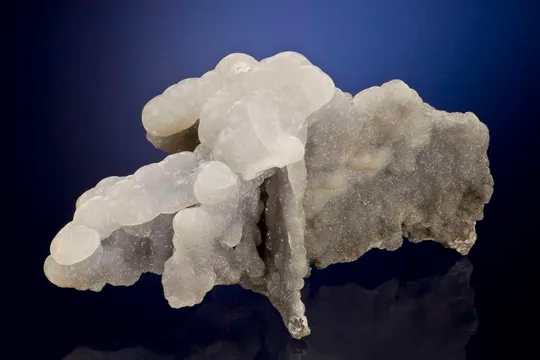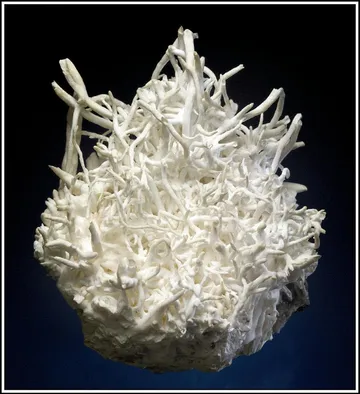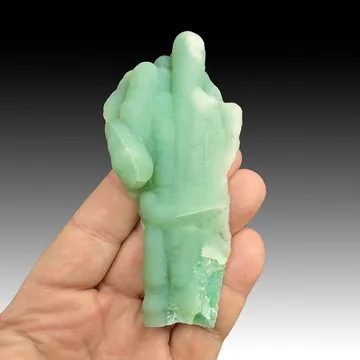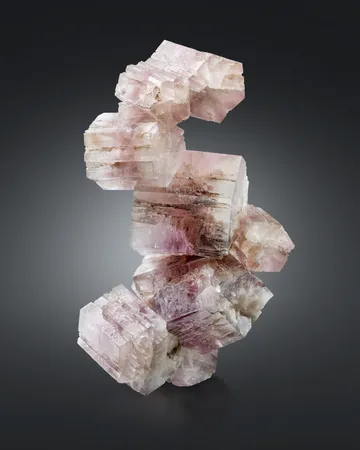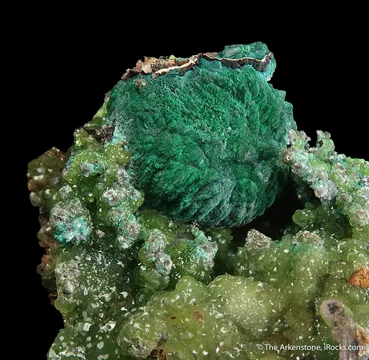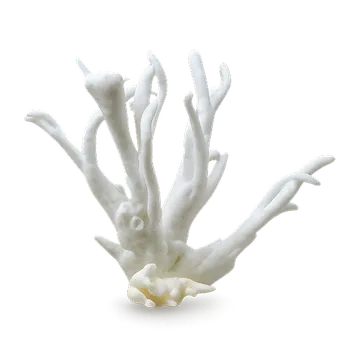
Aragonite from Lavrion, Greece — pale blue to seafoam crusts, delicate stalactites, and copper-bearing associations, highlighting its distinctive locality.
Key facts
Aragonite from the Lavrion Mining District belongs to one of the most storied mineral settings in the collector world: the ancient Pb-Zn-Cu-Ag mines of southeastern Attica, where Classical Athenian silver, modern industrial mining, and an extraordinary oxidation-zone mineral suite all overlap. Lavrion is not famous for aragonite in the simple sense of abundant, single-species showpieces; rather, its aragonite is prized because it appears as part of a distinctly Lavrion visual language—pale blue to seafoam crusts, delicate stalactitic sprays, white and blue-white “sea foam” aggregates, flos ferri branches, and dramatic associations with smithsonite, adamite, conichalcite, azurite, aurichalcite, gypsum, and iron-stained gossan.

Photo: Wikimedia Commons
The district’s aragonite is especially appealing when it shows the blue and blue-green tones that collectors associate with Lavrion’s copper-bearing secondary mineral environments. Some specimens are quiet and architectural: smooth pale bands, fibrous crusts, or drusy aragonite on matrix. Others are more animated—coral-like flos ferri, thin stalactites, “tree” forms, and millimetric spiky growths that look almost organic. The best examples combine that fragile carbonate texture with old-mine associations and strong locality specificity: Kamariza, Hilarion, Christiana, Serpieri, Sounion, Villia, Ari, or one of the district’s named shafts and adits.

Photo: Wikimedia Commons
The geological reason for this richness is Lavrion’s complicated ore history. The district sits in the Attic-Cycladic crystalline belt and contains several mineralization styles: porphyry Mo, skarn Fe-Cu-Bi-Te, carbonate-replacement Pb-Zn-Cu-As-Sb-Ag ± Au-Bi, vein and breccia Pb-Zn-Cu-As-Sb-Ag-Au-Ni-Bi ores, and Fe- and Zn-rich gossan. The carbonate host rocks, sulfide ores, detachment-related structures, and repeated oxidation and reprecipitation created exactly the kind of chemically varied open spaces in which late carbonate minerals such as aragonite could line cavities, replace earlier material, or grow as sinter-like forms.
Historically, few mineral localities carry more weight. Lavrion’s silver helped underwrite the power of ancient Athens, and the district was later revived as a modern mining center beginning in the 1860s. For collectors, that history matters. A fine Lavrion aragonite is not merely a calcium carbonate specimen; it is a specimen from a district whose dumps, galleries, slags, museums, and named mines have supplied generations of collectors and mineralogists with one of the world’s densest and most diverse mineral records.
Search for specimens: View all aragonite specimens from Lavrion Mining District, Greece
Lavrion lies in southeastern Attica, roughly 50 km southeast of Athens, around the modern town of Lavrio/Lavrion and the mining areas of Kamariza, Plaka, Agios Konstantinos, Sounion, Villia, Thorikos, Soureza, Elafos, and related subdistricts. Older labels may read Laurium, Laurion, Laurium District Mines, Attika, Attica, Kamariza, Kamareza, St. Constantine, Cato Sounio, or Sounion. For collector labels, “Lavrion Mining District, Lavreotiki, East Attica, Attica, Greece” is the modern standardized form, but preserving an older mine or shaft name is often more valuable than forcing the specimen into a simplified district label.
The primary ore system is polymetallic and structurally complex. In the Kamariza area, carbonate-replacement Pb-Zn-Ag ± Au mineralization formed mantos, chimneys, replacement veins, and breccias, with galena, sphalerite, pyrite, arsenopyrite, chalcopyrite, sulfosalts, fluorite, and carbonate gangue. At Plaka and related areas, granodiorite, skarn, and vein systems add further complexity. Later oxidation converted sulfide ores into gossan, calamine, smithsonite, goethite, hematite, cerussite, hemimorphite, hydrozincite, copper carbonates, arsenates, sulfates, and a long list of rarer secondary species. Aragonite belongs to this late carbonate and cavity-filling story, commonly occupying open spaces created by dissolution, fracturing, oxidation, and carbonate mobility.
Lavrion’s mining history is exceptionally long. Archaeological and geochemical evidence places mining activity in the district as early as the third to fourth millennium BC, with organized exploitation becoming highly important in the Archaic and Classical periods. The silver-rich lead ores reached their greatest ancient importance in the sixth to fourth centuries BC, when the income from the mines helped finance the Athenian fleet and the economic power of Classical Athens. The ancient workings include more than a thousand shafts and extensive underground galleries, with ore washeries and water-management systems still forming part of the district’s archaeological landscape.
After a long period of reduced activity, modern mining began in 1864 with Andreas Kordellas and Giovanni Battista Serpieri, leading to the development of Lavrion as an industrial mining town. The Greek Metal Works Company of Lavrio and the Compagnie Française des Mines du Laurium worked the district into the twentieth century, and modern mining ceased in the late 1970s. The modern period is important to mineral collectors because it opened, exposed, and redistributed large amounts of oxidized ore material and made possible many of the classic specimen recoveries that later entered European and international collections.
Important aragonite-producing or aragonite-bearing localities include Kamariza mines such as Hilarion, Christiana, and Serpieri; Sounion, including Sounion Mine No. 19 for flos ferri; Villia, including the celebrated “Aragonite-Bell” sinter formation in an adit recorded as No. 111; and the Ari area, where green aragonite has been photographed in situ. Museum and old-collection examples also show large blue aragonite from Villia No. 132 and old Laurium combinations of green smithsonite with white aragonite.
Collecting access must be treated cautiously. Lavrion is a historically mined, archaeologically sensitive, and locally protected landscape with old shafts, adits, unstable dumps, private or restricted ground, and areas within or near Sounion National Park and Natura 2000 settings. The district has also suffered from uncontrolled commercial specimen extraction. Serious collectors should regard old underground workings as hazardous and should collect only where access, land status, and safety conditions are clearly established. For many buyers, the best route is acquisition through well-documented old collections, reputable Greek and European dealers, or specimens with precise mine-level provenance.
Lavrion aragonite is chemically simple—CaCO3—but visually diverse. The locality’s strongest material is usually not the ordinary colorless or white carbonate crust, but aragonite that records the district’s metal-rich oxidation environment through blue, blue-green, seafoam, or pale turquoise coloration. These colors are generally seen in fibrous, stalactitic, coralloidal, or drusy aggregates rather than in large, sharply terminated freestanding crystals.
The most recognizable forms are thin stalactites, delicate sprays, flattened or elongated satiny crystals, fibrous crusts, flos ferri branches, and coral-like or shrub-like aggregates. Some specimens show an almost biological architecture: branching white “fingers,” blue-green encrustations, or aragonite “trees” rising from gossan. Others form broad blue bands with a white crystalline surface, as in museum examples from Villia. The Villia “Aragonite-Bell” is significant because it shows aragonite as a sinter-like cave/mining-adit formation rather than a conventional detached cabinet specimen.
Colors range from white and cream through pale blue, blue-white, turquoise-blue, seafoam, and green. White aragonite is often seen with smithsonite, and the contrast between green smithsonite and white aragonite is a classic old-Laurium association. Pale blue aragonite stalactites and glassy translucent blue-tinted crystals are particularly prized because they are less common and visually distinct from the more ordinary white carbonate material. Green aragonite has been documented from the Ari mining area, including sizeable in-situ material.
Specimen sizes vary widely. Many collector-quality pieces are thumbnail to small-cabinet size, especially when the aragonite occurs as delicate sprays, druses, or branchlets on gossan. Documented examples include a 5 x 4 x 3 cm pale blue stalactitic piece from the district, a 51 x 36 x 27 mm blue aragonite from Christiana, an 8.4 x 6.3 x 5.8 cm glassy blue-tinged aragonite from Kamariza, and a 17.3 x 15.9 x 14.4 cm cuprian aragonite from Hilarion with spray groupings rising up to about 5 cm. Large museum and in-situ aragonite examples from Villia and Ari can be much larger, but cabinet specimens with strong aesthetics and minimal damage are less common.
Associated minerals are a major quality factor. At Christiana, aragonite is recorded with adamite, copper-bearing adamite, conichalcite, zincolivenite, jarosite, goethite, and olivenite in photo-based association data. Across the broader district, aragonite may appear with smithsonite, calcite, aurichalcite, gypsum, azurite, malachite, conichalcite, cuprian adamite, hemimorphite, zincaluminite, and limonitic gossan. A specimen that unites pale aragonite with a sharply colored Lavrion secondary—blue azurite, green conichalcite, turquoise adamite, or botryoidal smithsonite—usually has stronger collector appeal than an isolated carbonate crust.
Top examples are judged by locality precision, color, architecture, and survival. A fine Lavrion aragonite should have open, undamaged sprays or stalactites; a natural blue or blue-green tone that is not garish; clean contrast against matrix; and a specific mine or subdistrict label. Old labels, especially those naming Kamariza, Hilarion, Christiana, Serpieri, Sounion, Villia, or a shaft number, are especially important. Because the mineral is fragile, an intact “360-degree” aragonite or an undisturbed flos ferri branch is far more desirable than a larger but rubbed or broken mass.
Lavrion aragonite is a collector’s locality mineral rather than a common species acquisition. Aragonite itself is abundant worldwide, but Lavrion examples with strong color, sculptural habit, and precise provenance are much less routine. The most desirable pieces are blue or seafoam cuprian-looking aragonites, delicate flos ferri, old Laurium smithsonite-aragonite associations, and aragonite in combination with the district’s more famous copper and zinc secondary minerals.
The chief condition issue is fragility. Thin stalactites, flos ferri branches, fibrous crusts, and millimetric coral-like crystals are easy to bruise, dust, or snap. Damage may hide in the interior of a branching spray, so specimens should be examined from multiple angles under strong light. On matrix pieces, look for flattened tips, missing branch ends, chalky abrasion, and old glue repairs at the base of aragonite clusters. Dust is a serious problem because fibrous aragonite is difficult to clean without breaking; a covered display case is preferable.
Authenticity concerns are mostly about labeling, color, and identity. “Lavrion” is often used loosely in the market, and older labels may say Laurium, Sounion, Kamariza, Attika, or simply Greece. That is not automatically a problem, but a high-value specimen should preserve the most specific locality information available. Be cautious with vague “Greek blue aragonite” labels that lack a mine, district, or collection history.
No strong collector literature tradition centers on Lavrion-specific fake aragonites, but modern blue carbonate material in the broader mineral market is sometimes dyed, misidentified, or sold under loose trade names. Natural Lavrion blue tends to be pale to medium, often seafoam or turquoise rather than neon. Artificial dye commonly concentrates in cracks, pits, and broken surfaces, and overly even electric-blue color should be treated skeptically. Also separate aragonite from blue calcite, hemimorphite, chrysocolla-rich crusts, aurichalcite aggregates, and other pale blue Lavrion secondaries. A simple acid reaction confirms carbonate but does not distinguish calcite from aragonite; habit, associations, and, for important pieces, Raman or XRD testing are more reliable.
Market availability is intermittent. Small aragonite-bearing association pieces appear periodically, while high-quality freestanding blue aragonite or large cuprian aragonite from named Lavrion mines is scarcer. Recent auction records show that a small-cabinet 8.4 cm Kamariza aragonite with glassy blue-tinged elongated crystals sold for $160 in 2022, while a large 17.3 cm Hilarion cuprian aragonite with seafoam-blue sprays and old collection provenance sold for $710 in 2025. A blue Christiana aragonite measuring 51 mm was sold through a dealer listing, and rare association pieces combining cuprian adamite, smithsonite, and aragonite have also appeared in the auction market. These records suggest a broad range: modest prices for small or less dramatic examples, and stronger competition for large, colorful, undamaged, well-provenanced specimens.
Lavrion’s aragonite sits inside a mining story much older than the specimen trade. In the ancient landscape between Thorikos and Cape Sounion, miners followed lead-silver ores through narrow galleries and shafts long before mineral collectors cared about blue carbonate sprays. The district’s workings were not a small local enterprise: ancient galleries run for many hundreds of kilometres in aggregate, arranged across multiple levels and linked by shafts. The rock was advanced only a few metres per month with hand tools and, at times, fire. Water was scarce, so the miners built systems to collect and manage it for washing ore. The landscape still carries those engineering traces—shafts, washeries, galleries, and processing remains scattered through the dry Attic hills.
The silver changed history. In the early fifth century BC, the revenues of Lavrion became bound to the naval policy of Themistocles. Instead of distributing the windfall from the mines, Athens invested in ships. That fleet became central to the Greek victory at Salamis in 480 BC. It is one of the rare cases in which a mineral district can be discussed not only as geology, but as a hinge in political and military history. When a collector handles a Lavrion aragonite, the specimen is late, secondary, and chemically modest—but the ground beneath it is the same ground that helped turn ore into coinage, triremes, and Athenian power.
Modern Lavrion has its own origin story. In 1864, Giovanni Battista Serpieri and Andreas Kordellas brought the old district back into industrial life. Lavrion, then a minor settlement, was transformed within a year into a mining town of more than 10,000 residents. The companies built houses, schools, churches, pharmacies, infirmaries, railways, and industrial works. Between 1882 and 1885, the railway line connecting Athens with Lavrion was constructed. Modern mining produced the dump and underground exposures that later generations of collectors would comb for smithsonite, azurite, adamite, serpierite, ktenasite, and, more quietly, aragonite.
Field visitors still encounter that layered history. A 2022 Wendel Minerals trip report describes arriving after four years away, visiting the Temple of Poseidon at Cape Sounion, meeting the Kapellas family, and going to the Mineralogical Museum of Lavrion. In the museum cases, among mixite from Hilarion, glaucocerinite from Serpieri, azurite pseudomorphs after native copper from Christiana Mine No. 132, and light blue-yellow smithsonite from Serpieri, the visitors noted a large specimen of blue aragonite. The same route continued to the old Kordellas smelting plant, the “KM 3” locality famous for annabergite, the Serpieri shaft headframe, an old mining railway tunnel from Kamariza down toward the harbor, and the entrance of the Hilarion mine. It is a modern collector’s itinerary, but it reads like a condensed map of the district’s mineral memory.
One of the more evocative aragonite-specific details comes from Villia. Adit No. 111, the number itself recorded with uncertainty, is known for an “Aragonite-Bell”—a sinter formation rather than a portable specimen in the ordinary sense. That matters because it reminds collectors that Lavrion aragonite is not only found as trimmed matrix pieces. It also formed in the damp, carbonate-rich microenvironments of old workings, where late fluids deposited aragonite in architectural forms on mine walls and cavities. In a district famous for rare arsenates, sulfates, and named species, this simple calcium carbonate still found a way to become memorable.