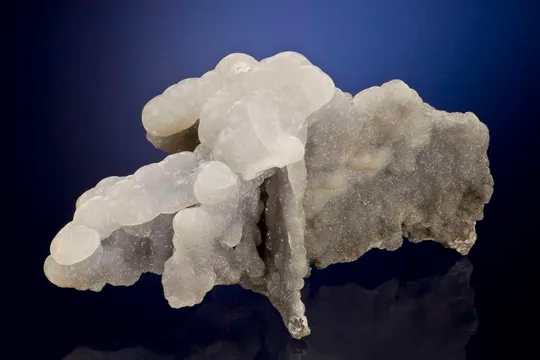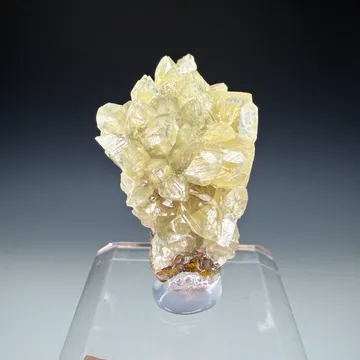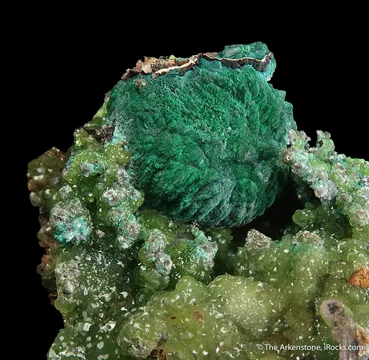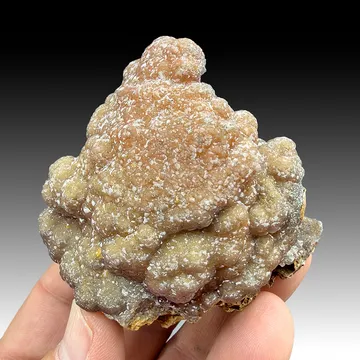
Smithsonite from Lavrion Mining District, Greece — pastel blue to sea-green botryoidal forms with a wet, silky glow; historic provenance and collecting appeal.
Key facts
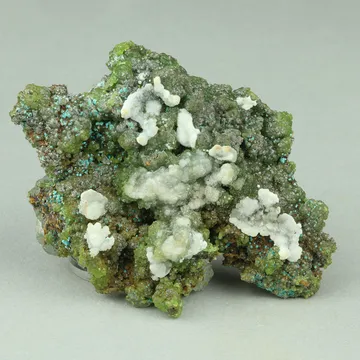
Smithsonite from the Lavrion Mining District is one of the classic European expressions of ZnCO3: not usually a locality of sharp single crystals, but of color, surface, age, and atmosphere. The best pieces are soft blue to sea-green, apple-green, honey-yellow, cream, white, gray, and locally brownish to orange, commonly in botryoidal crusts, rounded “bubbly” aggregates, stalactitic masses, rice-grain druses, and vug linings on limonitic gossan. Fine pieces have the wet, vitreous-to-silky glow that makes smithsonite so collectable, but the Lavrion look is more archaeological than flashy: pastel carbonate over ancient oxidized ore, often carrying the visual memory of a mining district worked since prehistory.

Photo: Didier Descouens, Wikimedia Commons
The geological setting gives Lavrion smithsonite its unusually rich mineral company. Lavrion is a polymetallic Pb-Zn-Ag-Cu district on the southeastern Attic peninsula, developed in marbles and schists of the Attic-Cycladic crystalline belt and cut by Miocene intrusions and hydrothermal systems. Primary sphalerite, galena, pyrite, chalcopyrite, and related sulfides and sulfosalts were oxidized through a deep supergene zone; sphalerite alteration produced smithsonite, hydrozincite, and hemimorphite, while the same weathering system generated the spectacular secondary lead, copper, zinc, arsenate, sulfate, carbonate, chloride, and slag-mineral suites that made Lavrion a world reference locality.

Photo: Rob Lavinsky / iRocks.com, Wikimedia Commons
For collectors, Lavrion smithsonite sits at the intersection of beauty and provenance. A modest miniature of blue-green cuprian smithsonite from Hilarion, Kamariza, Sounion No. 6, or an old Lavrion label can carry far more meaning than a larger but anonymous zinc-carbonate specimen from a less historic locality. The best examples show continuous undamaged botryoidal coverage, strong internal color when backlit, a pleasing contrast with brown gossan or white calcite/hemimorphite, and a precise mine attribution. Older pieces with 19th- or early-20th-century European provenance are especially desirable, because Lavrion was already a classic mineral source before many modern smithsonite localities entered the specimen market.
Search for specimens: View all smithsonite specimens from Lavrion Mining District, Greece
The Lavrion Mining District occupies the Lavreotiki peninsula of southeastern Attica, close to Cape Sounion and roughly 60 km from Athens. In mineral-label usage it appears under several older spellings: Laurion, Laurium, Laurium District, Lavrion District Mines, and occasionally simply “Attica, Greece.” For modern locality work, “Lavrion” or “Lavreotiki” is preferable, with the mine or subdistrict added whenever known.
Geologically, Lavrion is not a single mine but a district-scale polymetallic ore field of roughly 150 square kilometers. Its mineralization is structurally and lithologically controlled, related to the Western Cycladic detachment system and to Miocene intrusive activity. The Kamariza unit contains two important marble horizons, the Upper and Lower marbles, separated by Kamariza schists; these carbonate units were exceptionally receptive hosts for Pb-Zn-Ag-Cu replacement mineralization. The district includes several closely associated deposit styles: porphyry Mo-W, Fe-Cu-Bi-Au skarn, high-temperature carbonate-replacement Pb-Zn-Cu-Ag-Au mineralization, and Pb-Zn-Ag-Au veins and breccias. Smithsonite belongs to the later oxidized zinc-carbonate story: it formed when sphalerite-rich primary ores were attacked by oxygenated waters and carbonate-bearing solutions in marble-hosted open spaces.
The Kamariza area is central to the collector’s map. Hilarion, Jean Baptiste, Serpieri, Clemence, Christiana, and related Kamariza mines are among the names that appear most often on serious Lavrion labels. Hilarion has produced memorable cuprian green smithsonite, Jean Baptiste is an important carbonate-replacement locality and appears in the literature and figure captions for smithsonite, and Kamariza more broadly is the source area for many classic botryoidal and stalactitic zinc-carbonate specimens. Sounion No. 6, Agrileza/Mine No. 6, Km 3, Esperanza, Plaka-Villia, Megala Pefka, and other sublocalities add further complexity; old labels often require careful reconciliation with modern locality names.
Mining history at Lavrion is inseparable from Western civilization. Archaeological evidence places mining at Thorikos in the Final Neolithic/Early Helladic period, around 3200 BC, and some accounts of broader activity in the Thorikos area reach still earlier into the 5th millennium BC. Classical Athens transformed the district into an industrial landscape of shafts, galleries, washeries, cisterns, smelting furnaces, and legal arrangements for leasing state-owned mines. The rich Maroneia/Kamariza ore discovery in 483–482 BC supplied the revenues that Themistocles famously redirected toward the Athenian fleet, setting the stage for the naval victory at Salamis in 480 BC. For a collector holding a Lavrion smithsonite, that history is not decorative background; it is the reason this district became a model for organized mining, ore processing, and mineral collecting.
Modern exploitation began in the 1860s after Andreas Kordellas recognized the potential of ancient slag and mine residues. Jean-Baptiste Serpieri and associated companies developed modern operations, and two major enterprises—the Metallurgical Company of Lavrion and the French Mining Company of Lavrion—worked the district through the late 19th and 20th centuries. Modern operations concentrated on Kamariza and Plaka-Villia mines, including Hilarion, Clemence, Jean Baptiste, Serpieri, and Christiana. Mining and metallurgy finally ceased in the late 20th century, but specimen recovery from old mine workings, dumps, and collections has continued to keep Lavrion material in the mineral market.
Collecting access must be treated conservatively. Lavreotiki is now a UNESCO Global Geopark, designated in 2023, and large portions of the district overlap archaeological, historical, natural, and forest-protection concerns. Old shafts and adits are numerous, unstable, and hazardous; some underground visits are conducted through organized or guided heritage activity rather than casual collecting. Within the Sounion Forest Nature Reserve, special restrictions apply to mineral collecting. Practical collecting has historically centered on mine dumps and already disturbed material, but any field activity should be preceded by local permission, current legal checking, and serious respect for archaeological features. Lavrion is not merely an old mine dump; it is a protected cultural and geological landscape.
Lavrion smithsonite is most recognizable in botryoidal, mammillary, stalactitic, reniform, and drusy habits. Individual rounded aggregates commonly range from a few millimeters across to pea-sized botryoids; cabinet pieces can show uninterrupted crusts over many centimeters, while old and exceptional stalactitic material can be much larger. “Rice-grain” smithsonite—small, rounded to elongate crystals with a soft satiny luster—is a distinctive collector term often applied to blue to blue-green Lavrion material.
Color is one of the locality’s great strengths. Blue and green Lavrion smithsonite are especially prized, and mineral-chemical work on Lavrion material has shown that copper can be incorporated as a ZnCO3-CuCO3 solid solution rather than merely appearing as included copper minerals; reported copper carbonate component reaches up to 6.3 mol% CuCO3 in that study. Light yellow tones may involve iron and possibly manganese, yellow may also be affected by greenockite inclusions, and brown colors may reflect iron hydroxides. In real specimens, the final color can be a composite of trace chemistry, inclusions, iron staining, translucency, and the color of underlying gossan.
The best Lavrion smithsonites have a combination of saturated but natural-looking pastel color, translucency, continuous botryoidal surface, and minimal abrasion on the high points. Backlighting can be revealing: good blue-green cuprian pieces often glow internally rather than appearing flatly painted on the surface. In hand, many fine pieces show a pleasing contrast between colored smithsonite and dark-brown limonite or gossan, sometimes with white calcite or hemimorphite providing additional structure.
Associations are important for locality confidence and display value. Smithsonite from Lavrion may occur with hemimorphite, hydrozincite, calcite, aragonite, gypsum, fluorite, galena, sphalerite, cerussite, goethite/limonite, and an array of secondary copper and lead minerals. In Kamariza material, calcite overgrowths on greenish smithsonite, smithsonite with hemimorphite, and smithsonite on oxidized sulfide matrix are all credible and desirable. Associations with adamite, aurichalcite-like color contrasts, azurite, malachite, mimetite, or other supergene species can make combination specimens especially attractive, but multi-species Lavrion pieces often require analytical caution because the district contains many visually similar secondary minerals.
Mine attribution improves quality substantially. “Lavrion District” is acceptable on old labels when no more detail is recoverable, but “Hilarion Mine, Kamariza,” “Jean Baptiste Mine, Kamariza,” “Sounion No. 6,” or another specific sublocality gives a specimen sharper collector standing. Hilarion green cuprian smithsonite, older pastel-blue Lavrion pieces, and well-preserved botryoidal or rice-grain coatings on matrix are the forms that most reliably attract experienced smithsonite collectors.
The chief authenticity issue with Lavrion smithsonite is not a famous named fake unique to the district, but the broader problem of look-alikes and loose locality claims. Blue-green smithsonite, hemimorphite, calcite, and aragonite can be confused in the trade, and large quantities of blue or green calcite/aragonite from other countries have been offered falsely as hemimorphite or smithsonite. Lavrion adds another complication: its secondary-mineral suite is so diverse that a visually plausible specimen may still need testing if the species assignment matters.
For serious purchases, ask for the specific mine, previous labels, collection history, and whether the identification was visual or analytical. Smithsonite should effervesce in acid more readily than hemimorphite, but destructive acid testing is inappropriate on display specimens; Raman, XRD, or careful microchemical testing is preferable for high-value or scientifically important pieces. Specific gravity can help distinguish smithsonite from many look-alikes, but botryoidal crusts on porous matrix make casual density measurements unreliable.
Condition issues are common and should be evaluated under magnification. Botryoidal smithsonite exposes its highest rounded points to abrasion; old Lavrion pieces may show edge wear, contact marks, bruised domes, sawed backs, trimming scars, or iron-oxide residues. Minor peripheral wear is normal on old matrix specimens and does not necessarily ruin value, but the central display surface should be intact. Stalactitic and rice-grain pieces are more vulnerable to broken tips and rubbed luster. Many specimens also have soft gossan matrix, so poor packing can shed brown matrix grit or detach fragile crusts.
Cleaning should be restrained. Lavrion smithsonite is part of an oxidized assemblage, and aggressive acid cleaning can damage carbonate surfaces, remove aesthetically important iron oxides, or disturb associated calcite and aragonite. Water and gentle mechanical cleaning are usually safer than chemical intervention. Avoid prolonged exposure to acidic fumes, harsh cleaners, or repeated wetting of friable gossan.
Market availability is steady but uneven. Small green, blue-green, cream, or gray botryoidal pieces appear regularly from dealers and auctions, especially as old European collections are dispersed. Recent auction records show affordable miniatures and small-cabinet pieces selling in the under-$200 range, while finer old pieces, exceptional color, large size, rare habits, or museum provenance can move much higher. A notable winter 2020/2021 find of cuprian smithsonite with hemimorphite from Sounion No. 6 was described by a specialist dealer as one of the best smithsonite finds from Lavrion, keeping modern material in circulation alongside the old classics. Large, undamaged, vividly colored specimens with precise Kamariza or Hilarion attribution remain substantially scarcer than ordinary gray or cream smithsonite crusts.
The deepest story behind a Lavrion smithsonite begins not with a collector’s cabinet but with a fourth-century BC oil lamp, a drinking cup, a piece of litharge, and the stubborn engineering of people chasing silver through marble. Xenophon, writing in 355 BC, could already look back and say that no one would dare fix the date when the mines first began to be worked. Modern archaeology has given that memory a harder edge: ceramics in the famous underground Mine No. 3 at Thorikos date to around 3200 BC, and litharge from Thorikos shows that cupellation for silver production was underway by the early Mycenaean period.
By the Classical period the district had become an industrial machine. In Maroneia, the area now known as Kamariza, there were more than 1,000 shafts and 120–150 km of galleries at the Third Contact. Those figures matter to the mineral collector because Kamariza later became one of the great names on Lavrion specimen labels; the same carbonate contacts and oxidized ore environment that drew ancient miners later yielded the smithsonite, cerussite, azurite, adamite, and other secondary minerals that fill cabinets today.
The year 483 BC is the turning point every Lavrion collector should know. A rich ore discovery in Maroneia/Kamariza brought a flood of revenue into Athens. The lease alone for those silver mines was reported as one hundred talents—600,000 drachmas, about 2.5 tons of silver—and the profits were taxed separately. Themistocles persuaded the Athenians not to divide the windfall as a public dividend, but to build ships. A trireme cost 12,000 drachmas, roughly 52 kg of silver. The result was the fleet that defeated Persia at Salamis in 480 BC. In that sense, the pale blue-green smithsonite from Kamariza sits above the same ore field that helped pay for the naval turn of Greek history.
Lavrion’s wealth was policed with severity. Mine leases ran for three or ten years, and mine safety laws were enforced by a special court. One case is unforgettable: in 330 BC a man named Difilos was sentenced to death by beheading for removing support pillars that contained high-grade ore. In the same year, Periokles lost all his property and was branded and enslaved after removing ore in a critical zone and causing a cave-in in a neighboring mine. The law protected production as much as human life; a pillar could be richer than prudence, and the state made an example of those who treated the roof as ore.
The scale of labor was immense. More than 20,000 enslaved workers labored in the mines, and Aristotle described the silver as flowing from the “Argyreia” like water from a rich fountain. Xenophon names mine owners such as Nikias, said to have owned 6,000 slaves, while Hipponikos and Philimonides are associated with holdings of 1,000 to 2,000. These are grim numbers, but they are part of the honest provenance of the district. Lavrion is beautiful on a mineral shelf; underground, it was an economy of darkness, law, silver, and forced labor.
The processing landscape above ground was just as sophisticated. Ore was broken to pieces smaller than 1 cm with iron mallets on flat marble blocks, then ground in hopper mills until valuable grains were liberated at roughly 1–2 mm. Rectangular washeries used water to separate dense galena and cerussite from lighter gangue. More than 200 washery plants have been recorded over about 20 square kilometers. Their operation demanded water in an arid landscape: processing 2,000 tons of ore required on the order of 1,000 cubic meters of water. Lavrion’s miners answered with hundreds of cisterns, channels, settling tanks, and waterproof plaster. Some cistern linings still preserve a dark brown hydraulic plaster after 2,500 years, including an outer layer only about 0.1–0.2 mm thick with lead oxide, or litharge, as a key component.
After antiquity, the old district slept in stages, then reawakened in the 19th century. Andreas Kordellas examined the slag heaps in 1860 and recognized that ancient waste could become modern ore. In 1864 Jean-Baptiste Serpieri founded a company to work Lavrion, and the resmelting of ancient slags launched a new industrial town. This modern phase brought new shafts, metallurgical plants, railway and port development, and eventually the Greek and French mining companies whose names still echo in mine labels. Many smithsonites in old European collections entered the collector world during or after this modern industrial period, when the district was no longer only an archaeological landscape but a working mineral source again.
There is also a quieter modern collecting story: Lavrion never stopped producing surprises. New species, new analyses, and re-examined old samples keep changing the district’s mineral list. Academic field trips still visit Kamariza dumps, Plaka granodiorite, Avlaki detachment exposures, and underground systems. Collectors know the feeling in miniature: a brown Lavrion rock that looks unpromising can open to reveal blue-green smithsonite, white hemimorphite, tiny arsenates, or an association that sends the specimen from “nice” to “Lavrion.”
A. Cordella, “Notes sur les mines du Laurium et sur les nouveaux gîtes de minerai de zinc (smithsonite),” Bulletin de la Société géologique de France, series 3, vol. 6, 1878, pp. 577–581 — Early published reference specifically mentioning new zinc-ore/smithsonite occurrences at Laurium/Lavrion.
A. Frenzel, “Mineralogisches,” Tschermaks Mineralogische und Petrographische Mitteilungen, vol. 14, 1895, pp. 121–130 — Historical mineralogical reference cited for Lavrion smithsonite records.
A. Katerinopoulos, C. Solomos & P. Voudouris, “Lavrion smithsonites: A mineralogical and mineral chemical study of their coloration,” in J.W. Mao & F.P. Bierlein, eds., Mineral Deposit Research: Meeting the Global Challenge, Springer, 2005, pp. 983–986 — Key paper on color causes in Lavrion smithsonite, including Cu-related blue/green color, possible Fe/Mn effects, greenockite inclusions, and iron hydroxides.
P. Voudouris, A. Katerinopoulos, C. Mavrogonatos, I. Graham, G. Giuliani, A. Tarantola, V. Melfos, S. Karampelas & A. Magganas, “Gemstones of Greece: Geology and Crystallizing Environments,” Minerals, 2019, 9, 461 — Includes Lavrion smithsonite among Greek gem and collector minerals and illustrates the variety of colors and forms.
P. Voudouris et al., “The Lavrion Mines: A Unique Site of Geological and Mineralogical Heritage,” Minerals, 2021, 11, 76 — Major modern synthesis of Lavrion geology, deposit styles, supergene mineralogy, mining heritage, and geopark significance; includes photographed Cu-bearing smithsonite from Hilarion and smithsonite from Jean Baptiste.
A. Katerinopoulos & E. Zissimopoulou, Minerals of the Lavrion Mines, Greek Association of Mineral and Fossil Collectors, Athens, 1994, 304 pp. — Foundational book-length treatment repeatedly cited in modern Lavrion mineralogical literature.
B. Ottens & P. Voudouris, Griechenland: Mineralien-Fundorte-Lagerstätten, Christian Weise Verlag, Munich, 2018, 480 pp. — Important modern collector and locality reference for Greek minerals, including Lavrion.
Smithsonite collection from the mines of Lavrion, 19th century, Mineralogy and Petrology Museum, National and Kapodistrian University of Athens — Museum display record documenting a 19th-century Lavrion smithsonite collection.
Mineralogical Museum of Lavrion, Greek Travel Pages listing — Notes the museum’s Lavrion mineral displays, including beautiful smithsonite specimens and rare slag minerals, in the historic metal-washing plant setting.
Mindat: Smithsonite from Lavrion Mining District — Best starting point for mine-by-mine smithsonite records, historical references, sublocalities, and specimen photographs.
Mindat: Lavrion Mining District map and locality page — Useful for locality hierarchy, alternate spellings, subdistricts, collecting cautions, and the broader mineral list.
UNESCO: Lavreotiki UNESCO Global Geopark — Official overview of the geopark designation, mineral diversity, deposit scale, cultural landscape, and guided heritage context.
Voudouris et al., “The Lavrion Mines: A Unique Site of Geological and Mineralogical Heritage” — Essential open-access synthesis of Lavrion geology, supergene mineralogy, ore deposit types, and ancient/modern mining history.
OpenArchives: “Lavrion smithsonites: A mineralogical and mineral chemical study of their coloration” — Concise repository record for the key color-chemistry paper on Lavrion smithsonite.
Wikimedia Commons: SmithsoniteGrece.jpg — High-resolution photograph of a 14 x 9 cm botryoidal smithsonite from Kamariza Mines, Lavrion.
Wikimedia Commons: Smithsonite-43064.jpg — Classic pastel-blue rice-grain smithsonite from Lavrion, with older collection context.
Branko Rieck, “The Mines and Minerals of Lavrion – Ancient Mining History (I)” — Collector-oriented historical essay on prehistoric, Bronze Age, and archaic mining at Lavrion.
Branko Rieck, “The Mines and Minerals of Lavrion – Ancient Mining History (II)” — Details the classical mining peak, Maroneia/Kamariza shafts and galleries, mine leases, safety laws, and the Themistocles fleet episode.
Branko Rieck, “The Mines and Minerals of Lavrion – Ancient Mining History (III)” — Covers slave labor, mine owners named by Xenophon, later decline, slag reworking, and the Roman/Late Antique end of mining.
P. Tzeferis & D. Bitzios, “The exploration, mining and metallurgical process know-how of the ancient miners of Lavrion” — Detailed account of ancient ore extraction, crushing, grinding, washeries, water management, smelting, and production estimates.
Spirifer Minerals: “Smithsonite, hemimorphite NEW FIND from LAVRION” — Dealer record for a Sounion No. 6 cuprian smithsonite/hemimorphite specimen from the winter 2020/2021 find.
Mineral Auctions: Cu-bearing smithsonite, Hilarion Mine, sold February 2025 — Market reference for a small-cabinet greenish-blue Hilarion piece with auction price, size, and condition notes.
Mineral Auctions: Cu-bearing classic Lavrion smithsonite, sold June 2024 — Market reference for a miniature classic blue-green Lavrion smithsonite with old collection provenance.
EpiGem: Calcite/Aragonite, Hemimorphite & Smithsonite look-alikes — Practical cautionary resource on false offerings and visual confusion among blue-green carbonate and zinc minerals.