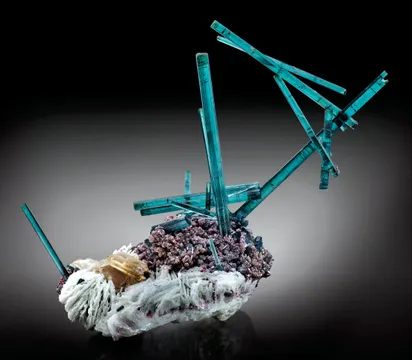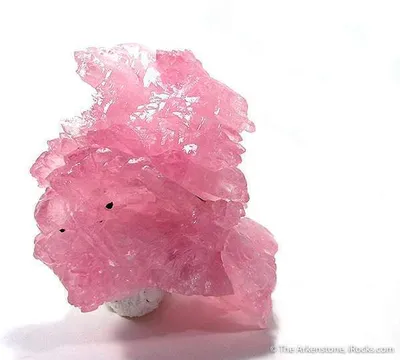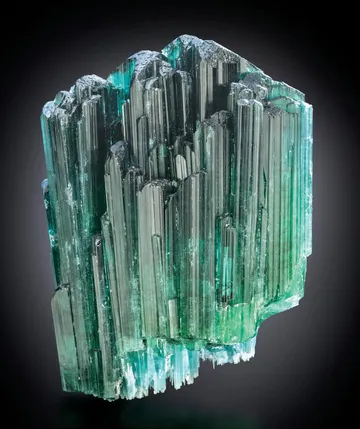
São Geraldo do Baixio, Brazil: pegmatite locality in Minas Gerais yielding sculptural smoky quartz and rare cassiterite and wodginite, prized by collectors.
Key facts
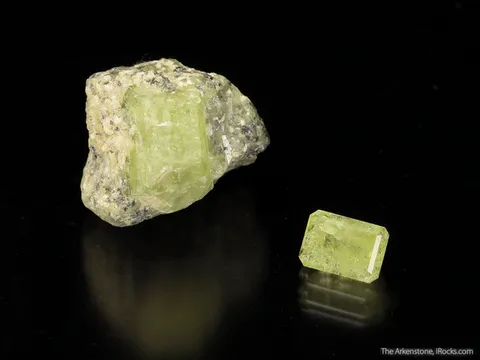
São Geraldo do Baixio is a deceptively small name on the mineral map of eastern Minas Gerais, but for collectors it sits in one of Brazil’s classic pegmatite landscapes: the Rio Doce country, where schists of the São Tomé Formation and related metasediments are cut by granitic pegmatites that yielded mica, beryl, quartz, phosphates, and rare Ta-Sn oxides. The municipality is best known on the specimen market for sculptural quartz—especially smoky, “elestial” or alligator-style crystals—and for the Lavra Jabuti suite, where cassiterite and wodginite occur in one of the memorable epitaxial associations of Brazilian pegmatite mineralogy. A second strand of importance comes from the Ari Machado pegmatite, an old mica working reactivated briefly in 1999, which produced fine yellow to greenish-yellow brazilianite crystals as large as 7 x 7 cm in a phosphate assemblage with fluorapatite, hydroxylherderite, gormanite, beryl, muscovite, and sillimanite.
Regional View
Country View
The best São Geraldo do Baixio quartz specimens have a look quite unlike the clean, spear-like rock crystal of some other Brazilian districts. They tend toward architectural growth: flat tabular individuals, doubly terminated clusters, skeletal or fenstered smoky crystals, pale smoky-to-citrine tones, and stepped faces that make a single cabinet specimen read almost like a miniature landscape. Older labels may use spellings such as “Sao Geraldo do Baixio,” “Baixio,” “Galiléia,” or “Lavra Jabuti/Jaboti,” reflecting both accent omission in international trade and the administrative history of the area.

Photo: Wikimedia Commons

Photo: Wikimedia Commons
Search for specimens: View all specimens from São Geraldo do Baixio, Brazil
São Geraldo do Baixio is a municipality in Minas Gerais, in the Rio Doce region, with a modern municipal identity that postdates many classic specimen labels: the district was created in 1948 from territory then attached to Galiléia, elevated to municipality by Minas Gerais state law in December 1995, and installed in January 1997. That history matters to collectors because older material—especially Lavra Jabuti oxides and smoky quartz—may legitimately carry Galiléia or Baixio labels even when the locality is now catalogued under São Geraldo do Baixio.
Geologically, the collector localities belong to the rare-element pegmatite province of eastern Minas Gerais. Published work on brazilianite places the Ari Machado pegmatite within the Conselheiro Pena pegmatite district, in the middle Rio Doce valley, a district that includes parts of Conselheiro Pena, São Geraldo do Baixio, Goiabeira, and Galiléia. These pegmatites are related to the Araçuaí Orogen, a Brasiliano-age mobile belt along the eastern margin of the São Francisco craton, where Neoproterozoic schists and other metasediments were intruded by tonalitic and granitic suites. In the Conselheiro Pena district the economically important pegmatites are typically tabular to lenticular bodies, locally irregular, and commonly emplaced in biotite schist and quartz-biotite schist of the São Tomé Formation.
The Ari Machado pegmatite, also known locally as Lavra da Mica, is the best-documented São Geraldo do Baixio body in the literature. It is an old mine worked from the 1940s chiefly for industrial muscovite. In 1999 it was reopened briefly and produced excellent brazilianite crystals, somewhat equant rather than long prismatic, with documented sizes up to 7 x 7 cm. The pegmatite body is described as homogeneous, tabular, subvertical, and about 3 m thick, enclosed in sillimanite-rich biotite schist of the São Tomé Formation. The pegmatite is muscovite-dominant, with beryl, fluorapatite, hydroxylherderite, and gormanite occurring with brazilianite in small replacement bodies.
Lavra Jabuti is the locality that gives São Geraldo do Baixio its rare-oxide fame. Mineral records for the claim include cassiterite, wodginite, quartz, beryl, microcline, muscovite, lithiophorite, tourmaline, and amblygonite-montebrasite series material. Its classic specimens are black, lustrous, sharply formed wodginite-rich pieces that preserve an epitaxial relationship to cassiterite; in some examples the cassiterite core is largely consumed or decayed, leaving the wodginite overgrowth as the dominant display mineral. The association was important enough to receive a dedicated Mineralogical Record article in 1978 by Pete J. Dunn, Richard V. Gaines, C. Wroe Wolfe, and Carlos do Prado Barbosa.
The municipality also contains the Zucolotto mine, recorded as an active claim in recent locality data, with galleries noted in locality photographs, but published specimen-mineral information for that working is far thinner than for Ari Machado and Jabuti. Modern mining-title data for the municipality show continuing mineral interest: registered substances include granite and several pegmatite commodities such as beryl, feldspar, quartz, tourmaline, emerald, lithium ore, beryllium ore, morganite, and lepidolite. For specimen collectors, that means the district is not a purely historic name, but collecting access should be treated as private and claim-controlled. Permission from landowners and mineral-rights holders is essential; old underground workings, active garimpo areas, and unstable pegmatite galleries are not casual field-collecting sites.
Quartz from São Geraldo do Baixio ranges from water-clear tabular crystals to smoky, citrine-tinted, phantom-bearing, skeletal, and alligator-style pieces, with well-documented specimens from the municipality and from Lavra Jabuti. Collector-grade examples are typically small-cabinet to cabinet size: published specimen records include a 50 x 33 x 15 mm tabular group with the largest crystal 36 x 20 x 3 mm, a 10.7 x 2.8 x 2.5 cm gemmy single from Jabuti, an 11.9 x 3.9 x 3.2 cm phantom-bearing crystal, and a 13 x 8 x 5.5 cm alligator quartz with a partially terminated schorl on the side. The better pieces here are not merely transparent quartz; they show undamaged terminations, doubly terminated or floater architecture, internal phantoms, stepped skeletal growth, or the pale smoky-to-citrine color that makes São Geraldo material immediately attractive in a case.
Smoky quartz is the signature display mineral of São Geraldo do Baixio in the broader marketplace, most often seen as complex “elestial,” “alligator,” skeletal, fenstered, or doubly terminated crystals rather than plain single points. The color is usually light to medium smoky brown, sometimes with a warm orangey-citrine cast instead of a cold gray tone, and good specimens can be gemmy, glassy, and sharply lustrous despite the complicated growth. Documented examples include a 5.9 x 4.5 x 1.7 cm floater cluster with individual crystals to 3 cm, a 9.9 x 7.3 x 6.5 cm smoky-citrine crystal with a natural truncated contact, and thin ornate cabinet pieces around 7.7 to 11.1 cm long. The most desirable São Geraldo smoky quartz specimens combine rich transparency with complete skeletal edges and minimal bruising on the many exposed steps and windows.
Cassiterite from São Geraldo do Baixio is collector-important chiefly through Lavra Jabuti, where it occurs with epitaxial wodginite in a rare Ta-Sn oxide association rather than as ordinary tin-ore crystals. The documented specimens are commonly dark, lustrous, blade- to spindle-like miniatures in which cassiterite forms the internal or earlier crystal and wodginite forms a sharp black overgrowth; photo records note cassiterite in association with wodginite repeatedly, and Mineralogical Record indexing records wodginite epitaxial on cassiterite crystals to about 4 cm. Fine pieces are judged by sharpness, luster, the visibility and integrity of the epitaxial form, and old provenance, because the best-known pocket was small and surviving examples circulate as rare, high-value systematic specimens rather than abundant Brazilian cassiterites.
Other documented minerals from São Geraldo do Baixio include brazilianite, hydroxylherderite, fluorapatite, gormanite, moraesite, zanazziite, beryl varieties goshenite and morganite, muscovite, microcline, sillimanite, tapiolite-(Fe), lithiophorite, possible cryptomelane, tourmaline, and roscherite-group material. The locality is not the type locality of brazilianite—that honor belongs to Córrego Frio near Divino das Laranjeiras—but the Ari Machado find is an important outlying brazilianite occurrence within the broader Conselheiro Pena district. The roscherite-group record is also noteworthy: São Geraldo do Baixio material was studied as brown zanazziite aggregates with minor Fe-dominant roscherite-group species associated with white moraesite, and some analyses were relatively rich in Pb and Mn.
The principal buying challenge for São Geraldo do Baixio is locality precision, not a well-established epidemic of fakes. Labels may read São Geraldo do Baixio, Baixio, Lavra Jabuti, Jaboti, Galiléia, Doce Valley, or Minas Gerais, and some may predate the municipality’s 1995–1997 administrative separation from Galiléia. Those labels can be historically legitimate, but they should be reconciled carefully when cataloguing: Lavra Jabuti cassiterite-wodginite, Ari Machado brazilianite, and general São Geraldo smoky quartz are not the same collecting context.
Quartz condition deserves close inspection. The very features that make the locality desirable—skeletal steps, fenstered faces, tabular edges, alligator ridges, and floater terminations—also create numerous exposed corners. Minor edge wear is common, and old dealer descriptions often distinguish between a complete display side and a contacted or removed back side. The best specimens should show natural contacts rather than sawed bases, clean luster across the steps, and no distracting chips on the most prominent terminations.
For smoky quartz, color treatment is always a general market concern, but no specific São Geraldo do Baixio treatment tradition is well documented in the locality literature. The locality’s natural smoky to citrine-smoky palette is typically pale to medium; unnaturally uniform black color, over-bright “citrine” claims, or metaphysical marketing terms should be evaluated with the same caution used for Brazilian quartz generally. “Elestial,” “alligator,” “fenster,” and “skeletal” are descriptive trade terms here, not species names, and they are applied inconsistently.
Cassiterite-wodginite from Lavra Jabuti is substantially rarer and should be bought with stronger provenance. Old labels from Richard Gaines, Carlos do Prado Barbosa, John S. White, or later specialized Ta-Nb collections add real confidence and value. Because these pieces can appear as glossy black blades or spindles, they are easy to oversimplify as “cassiterite” or “wodginite” alone; the important specimens are the epitaxial association, and analytical or literature-backed identification is desirable for high-end examples.
Ari Machado brazilianite should be treated as a serious locality specimen rather than simply another Brazilian brazilianite. The documented production was brief, and the best crystals are equant, lustrous yellow to greenish-yellow individuals or clusters from small replacement bodies in a muscovite-rich pegmatite. Brazilianite has perfect cleavage and can be brittle in cabinet handling; specimens should be mounted or boxed so that crystal edges cannot knock against harder quartz or feldspar.
The most memorable São Geraldo do Baixio story is a pocket no larger than a basketball. Out of Lavra Jabuti came a limited group of black, lustrous oxide crystals that initially looked like fine wodginite specimens, but the real surprise was structural: the wodginite had grown epitaxially over cassiterite. In some pieces the inner cassiterite spindle had nearly vanished, leaving a sharp shell-like overgrowth that preserved the geometry of the earlier mineral. When these specimens reached major shows in the late 1970s and early 1980s, they stood out immediately. They were not large by pegmatite standards—documented miniatures include pieces around 3.7 to 4.2 cm long—but they were strange, glossy, and sharply made, the sort of specimen that makes systematic collectors stop walking.
The provenance trail is part of the appeal. Richard V. Gaines, the well-known collector and one of the authors of the 1978 Mineralogical Record paper on the find, had the pocket and many of the best pieces. Another documented specimen carried a John S. White label noting that White obtained it directly from Carlos Barbosa in 1978, probably at the moment when the material was circulating but before its epitaxial nature had been fully appreciated by the wider market. Later examples entered specialized collections of niobium-tantalum minerals, including the collection of Dr. Bruce Jarnot. That is a telling afterlife: São Geraldo do Baixio’s most famous rare-oxide specimens did not disappear into general Brazilian suites, but into the cabinets of people who cared deeply about the chemistry and crystallography of the wodginite group.
The Ari Machado story is quieter but just as characteristic of eastern Minas Gerais. It began not as a gem mine but as a mica working, active since the 1940s for industrial muscovite. Decades later, in 1999, a brief reactivation of the old Lavra da Mica produced something quite different: excellent, somewhat equidimensional brazilianite crystals up to 7 x 7 cm. The setting was a narrow, about 3 m thick, subvertical pegmatite enclosed in sillimanite-rich biotite schist. Brazilianite occurred not as a broad orebody, but in small replacement bodies—the “ximboquinhas” familiar to local miners in the wider district—where the phosphate chemistry had concentrated just enough to make collector crystals.