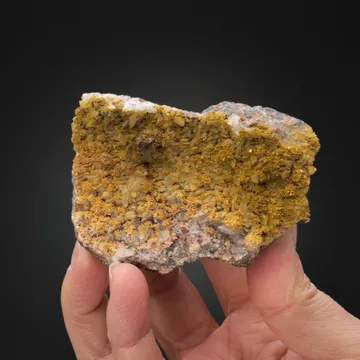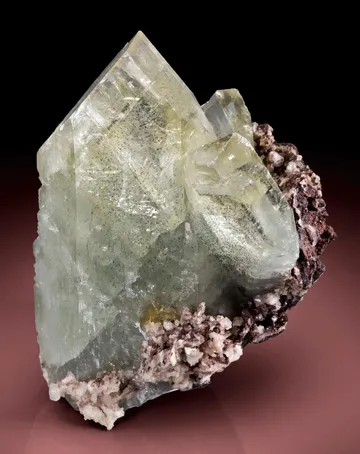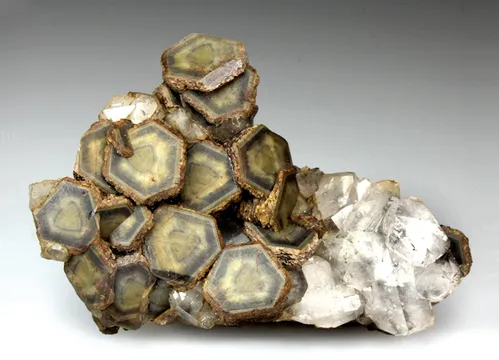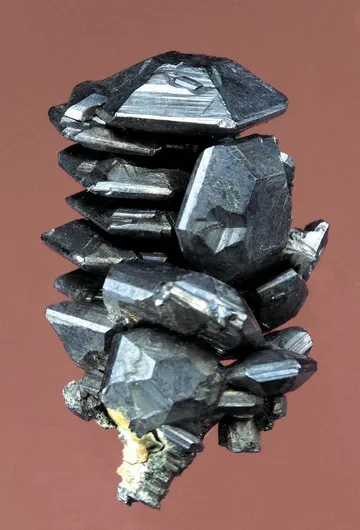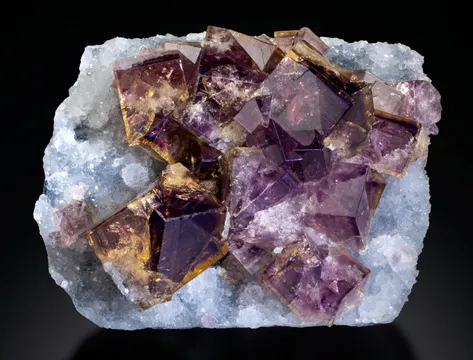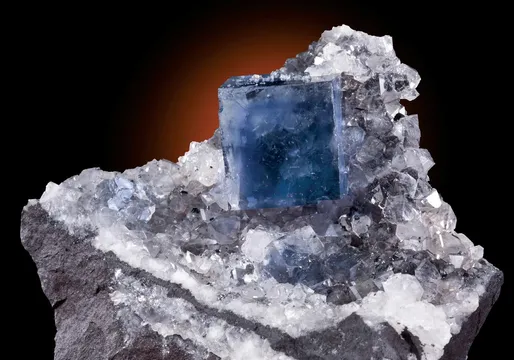
Silverband Mine, UK - premier English baryte locality on Great Dun Fell, producing glassy, honey-yellow baryte crystals; famed for architectural blades.
Key facts
Silverband is one of the great English baryte localities: a high, exposed mine on the south-western flank of Great Dun Fell, near Milburn and Knock in Cumbria, at the western edge of the Northern Pennine Orefield. For collectors its importance is not simply that baryte was mined there in quantity, but that the mine cut a particularly favourable part of the Carboniferous Great Limestone, where the Dun Fell fault system and associated splays carried baryte-bearing veins and broad replacement bodies. In that setting Silverband produced some of the most distinctive British baryte crystals: glassy, water-clear to honey-yellow, tabular or “chisel-headed” crystals, sometimes as single freestanding prisms and sometimes as compact parallel groups on little or no matrix.
The mine sits in the outer barium-rich part of the orefield, away from the classic Weardale fluorite centre. Its geology is consequently more “spar mine” than “fluorite mine”: baryte dominates, with galena, sphalerite, quartz, calcite, aragonite, ankerite alteration, limonite/goethite after iron carbonates, and uncommon fluorite or secondary lead-zinc minerals forming a much smaller part of the collector story. Historically, Silverband also matters because it bridges two eras of northern English mining. The London Lead Company drove miles of levels here for silver-bearing galena in the nineteenth century, but the mine’s real industrial success came in the twentieth century when Laporte reopened it for barytes and solved the transport problem with an aerial ropeway descending the Pennine escarpment toward the Eden Valley.
Regional View
Country View
The best Silverband specimens have a recognisable severity. They are not lush druses of small crystals; they are architectural pieces—single blades, parallel sheaves, and terminated bars with glassy faces, pale yellow zoning, and occasional silky or striated growth textures. Old specimens may be labelled Silverband Mine, Knock; Silverband Mine, Appleby; Great Dun Fell; Dun Fell, Westmorland; or, less precisely, Dufton Fell. Many fine pieces were collected during the active barytes period, and the locality has long been represented in British collections by hand-sized crystals and miniature to small-cabinet groups.

Photo: Wikimedia Commons

Photo: Wikimedia Commons
Search for specimens: View all specimens from Silverband Mine, UK
Silverband Mine is on Great Dun Fell in the Cross Fell–Dun Fell part of the Pennine escarpment, north-east of Milburn and Knock. The mine worked mineralisation in and around the Great Limestone, one of the key limestone units of the Alston Block’s Carboniferous “Yoredale” succession. In regional terms the deposit belongs to the Northern Pennine Orefield: a Mississippi Valley-type vein and replacement system dominated in different zones by galena, sphalerite, fluorite, baryte, witherite, quartz, calcite, and iron carbonates. Silverband lies on the western margin of that field, in the barium-rich outer belt, where baryte rather than fluorite became the economically decisive gangue mineral.
The principal structure is the Dun Fell fault, an east-west fault described in mid-twentieth-century geological accounts as downthrowing to the north by roughly 120–140 feet. Smaller faults leave the main structure on the downthrow side, initially at a low angle before swinging north-east. Both the main fault and its splays are mineralised, especially where they pass through competent limestone. The most important baryte production came not only from vein filling, but from replacement ore bodies in the Great Limestone—baryte replacing limestone in broad, locally clay-rich bodies between faults. These replacement bodies are the key to Silverband’s unusual specimen character: large individual crystals could grow in clay and residual pockets, with unreplaced limestone and iron-stained material around them, rather than being confined to narrow fissures.
The older mining objective was lead. Work in the area is recorded back into the seventeenth century, and the London Lead Company developed Silverband in the nineteenth century as part of its exploration of the Great Dun Fell fault complex. Silverband Low Level and High Level were driven high on the fell, and the old workings ultimately amounted to several miles of levels for a modest return of lead concentrates. Contemporary and later accounts describe the lead output as disappointing: the mine exposed a great deal of ground for comparatively little galena. The galena did, however, carry silver in the normal North Pennine manner, and the ore was part of the long Pennine tradition of lead-smelting in which silver was recovered as a by-product.
Barytes changed the mine’s fortunes. Small-scale barytes working took place around 1914–1918 under Brammall, but the major phase began in 1939 when B. Laporte & Co., later Laporte Chemicals, reopened the mine. The site was exceptionally awkward: the workings stood at over 2,000 feet on an exposed Pennine slope, far above the Eden Valley. Laporte’s answer was an aerial ropeway carrying crude ore down to a plant at Milburn Grange, with further transport onward toward Long Marton station. Between 1939 and 1963 the mine produced about 215,000 tons of dressed barytes ore during the Laporte period alone. Later twentieth-century working used opencast methods; Horace Taylor Minerals acquired the lease in the 1970s, a mill was built at the mine in 1974, and later operators followed the Dun Fell vein eastwards in open cut. Subsequent production brought the broader Silverband baryte total to roughly 300,000 tons in modern summaries.
The ore bodies contained abundant baryte with smaller amounts of galena and sphalerite. Other documented minerals include quartz, fluorite, ankerite, witherite, pyromorphite, hemimorphite, goethite or limonite, and minor carbonate species such as calcite and aragonite reported from the ore bodies. Fluorite is not a signature Silverband mineral; geological accounts place it only in the deepest workings, around the Four Fathom Limestone horizon reached by an underground shaft on the Slope Vein. Bright pyrite groups have also been noted weathering from shales above the Great Limestone, but they are peripheral to the mine’s classic baryte reputation.
The notable specimen pockets were connected with the large baryte crystals in the replacement ore. Mid-century accounts describe crystals often water-clear and, in exceptional cases, up to two feet long. One important 1952 find produced complete transparent single crystals with unusual yellow-brown colour zoning, and the morphology of Silverband baryte crystals—especially changes in habit and surface growth structures—became interesting enough to be discussed in the mineralogical literature. Known old specimens include sharply terminated tabular groups, chisel-headed crystals to several centimetres, and larger single crystals preserved in museum and private collections.
Collecting today should be approached as historical-site stewardship rather than casual dump collecting. The mine area includes old levels, shafts, opencast workings, unstable ground, and the legally protected remains of the aerial ropeway, brake house, and inclined plane, which are scheduled as a monument. Surface access on the fell does not imply permission to dig, disturb archaeology, enter workings, or remove material from protected remains. Any collecting should be limited to lawful, low-impact activity with landowner permission where required, and the old underground workings should be treated as hazardous.
At Silverband, barite is the collector name most international buyers use for the same mineral that British labels usually call baryte, and the locality’s best examples are sharply crystallised BaSO4 from the Great Limestone replacement ore bodies and associated Dun Fell vein workings. Typical collector pieces are colourless, pale straw, honey-yellow, or yellow-brown zoned tabular crystals, often glassy and transparent, with chisel-like terminations or stout bladed habits; miniatures around 4–8 cm are the most familiar on the market, but historic accounts and museum specimens show that much larger single crystals occurred, including examples over 15 cm and reports of crystals up to about two feet in the clay-rich replacement bodies. The finest pieces here are judged by transparency, complete terminations, strong colour zoning, undamaged edges, and sculptural isolation of the crystal or group; ordinary pieces are more massive, iron-stained, cleaved, or lack the crisp termination and glassy faces that make Silverband barite immediately recognisable.
Baryte is the historically correct British usage for Silverband’s signature mineral, and old labels from Westmorland, Cumberland, Knock, Appleby, or Great Dun Fell commonly use that spelling. Silverband baryte came chiefly from the barytes-rich Dun Fell fault system and from extensive replacement of the Great Limestone, where crystals could form in clay and residual limestone rather than only in tight fissures. Fine specimens are usually simple and elegant: glass-clear to pale yellow or golden tabular crystals, sometimes in parallel growth, sometimes as freestanding terminated blades, associated at times with galena, iron oxides after ankerite, quartz, calcite, or goethite. The most desirable Silverband barytes show clean lustrous faces, undisturbed chisel-head terminations, internal clarity, and attractive honey or yellow-brown zoning; matrix is uncommon on many old pieces, so provenance, crystal style, and old collection history matter heavily when separating classic Silverband material from generic northern English baryte.
Other documented Silverband minerals form a compact but interesting suite around the baryte story. Galena and sphalerite represent the original lead-zinc ore association, with galena the reason the London Lead Company drove the nineteenth-century levels. Fluorite is recorded, but it is a subordinate deep-level mineral rather than the locality’s claim to fame. Quartz, calcite, aragonite, ankerite, witherite, goethite or limonite, pyromorphite, and hemimorphite are reported from the mine or its immediate mineralised setting. The most collector-relevant rarities are the secondary lead-zinc species—especially pyromorphite and hemimorphite—and the barium carbonate witherite, but none has the abundance or visual dominance of Silverband baryte.
Silverband baryte is a classic locality material, but it is also a material where labelling discipline matters. Old specimens may legitimately carry obsolete county or district wording: Westmorland, Cumberland, Knock, Appleby, Great Dun Fell, Dun Fell, or Silverband Mine can all appear on historical labels. “Dufton Fell” and “Dufton area” labels should be treated more cautiously, because Dufton Fell and the broader Cross Fell escarpment include multiple mines and baryte-bearing sites. A strong Silverband attribution is best supported by old labels, collection history, or a crystal style matching the locality’s known glassy tabular to chisel-headed habit.
The main authenticity issue is not a known wave of manufactured fakes, but confusion with other northern English baryte localities. Cow Green, Dufton Fell, Hilton, Closehouse, Settlingstones, Nentsberry Haggs, Force Crag, and Derbyshire baryte can all produce pale or tabular material that a casual seller might label imprecisely. Silverband pieces tend to be simple, bright, transparent to translucent, and often low-matrix or matrix-free; some old specimens are single terminated crystals rather than plates of many small blades. If a specimen is sold as Silverband but has a very different habit, abundant fluorite matrix, or a locality style more typical of central Weardale or Derbyshire, ask for provenance.
Condition is a serious value factor. Baryte has perfect cleavage and Silverband crystals commonly stand as isolated blades or thick tabs, so bruised terminations, cleaved backs, small edge chips, and contact damage are common. Many old specimens were collected in a working mine environment, extracted from clay or pocket walls, and trimmed to stand; damage on the rear or base may be acceptable, but a chipped chisel head or scuffed main face sharply lowers desirability. Iron staining can be natural and attractive when it emphasizes zoning, but heavy brown crusting can obscure the glassy character that collectors want.
There are no special fluorescence expectations for Silverband baryte, and the species is generally stable under normal display conditions. Witherite, if genuinely present, deserves more care: barium carbonate is toxic if ingested or inhaled as dust, so avoid grinding or acid treatment and wash hands after handling. Old mine material may also contain lead-bearing galena or pyromorphite; ordinary cabinet handling is safe if dust is avoided and specimens are kept away from children.
Market availability is moderate but selective. Small old-time Silverband baryte specimens appear periodically from British collections, dealer stock, and estate dispersals, but top examples—transparent, damage-free, well-terminated, and with old provenance—are much scarcer than the mine’s industrial tonnage might suggest. The locality is best collected by choosing fewer, better crystals rather than accumulating massive baryte or iron-stained fragments.
In April 1947, the Mineralogical Society’s excursion party climbed to Silverband in the most civilized manner possible for a mine at 2,400 feet: they inspected the mill near Milburn Grange, then rode up the four-mile mine road following Knock Ore Gill in a company lorry. The guest list reads like a roll call of mid-century British geology and mineralogy—K. C. Dunham, S. E. Hollingworth, W. Campbell Smith, W. A. Deer, F. A. Bannister, L. R. Wager, and others—standing for a group photograph at the baryte mill before being taken to the mine by Laporte’s staff. Underground and in the headings they saw the geological reason Silverband had become important: the Dun Fell fault, its splays, the Great Limestone, and the large replacement ore body carrying water-clear baryte crystals in clay and unreplaced limestone. The day ended not on the fell but in Appleby, where the company entertained the party to dinner at the King’s Head Hotel; Dunham thanked Laporte for “every possible encouragement” in his investigation, and the evening closed with speeches and music.
The later mine was a place of machinery, weather, and stubborn logistics. A 1995 visit recorded barytes being taken from a stockpile by wheeled front loader, dropped into a crusher to reduce it to four-inch material, lifted by conveyors, fed through a screwfeeder, crushed again to 22 mm, and passed to jigs for dressing. Four men normally worked the mine. Phil Saul ran the jigs and kept the plant maintained; Arnold Maughan fed the big crusher and moved dressed barytes; Ian Maughan, the foreman, looked after the plant and fitting work and also worked in the open cut. The vein then being worked was the Dun Fell Vein, reported as ranging from one foot to 10–12 feet wide. No blasting was needed at that stage: tracked excavators and backacters extracted the barytes, and dump trucks moved it to the mill or stockpile. Dressed production was given as about 200 tons per week, with the potential for more in better ground. The working day ran from 8:00 a.m. to 6:00 p.m., five days a week plus Saturday mornings, over 2,000 feet up the fell.
The same visit gives a vivid sense of why Silverband was never an easy mine. The weather that day was wet and misty, and the visitor wrote that the mist and rain “never cleared”; only a brief break allowed a safe drive down. It is one thing to admire a transparent baryte crystal in a cabinet, another to picture it coming from an opencut high on Great Dun Fell, reached by a steep road where cloud could settle suddenly and where the valley below might vanish altogether.
A year later, in August 1996, seven members of the Cumbria Amenity Trust Mining History Society left the sunny Eden Valley for “the damp mist hanging over Great Dun Fell.” They toured the surface remains of Silverband Low and High levels. The Low Level portal near the mill was already blocked, but an ore-pass shaft about 75 m behind it had previously allowed access; when descended in 1991, the level was open but chest-deep in water for 120 m until it reached the Dun Fell Vein, where a blockage below a major shaft filled by opencast debris stopped progress. On the 1996 visit, “lack of rope” and “the mist is clearing” became the convenient excuses for not descending the shaft, and the party carried on to the obliterated High Level site at GR704318, where the spoil heap was the only remaining feature.
Their afternoon took them around to Lords Level near Middle Tongue Beck, an older level abandoned by 1824. Plans suggested it might connect through natural caverns and a crosscut into Silverband Low Level. The level drove straight for 100 m north-north-east, turned sharply north-north-west, then sent a branch eastward along weak veins through collapsed ground for about 250 m “or until discretion overcomes curiosity.” Beyond a flooded shaft, the continuation reverted north-north-west and appeared to have been abandoned after failing to locate the hoped-for veins. After the mine meet ended, several members staged an impromptu second meet near Knock village, collecting mushrooms for the following day’s breakfast.
Silverband’s ropeway has its own afterlife. Installed around the beginning of Laporte’s 1939 operation, the system carried ore down from the high mine to the processing plant and ultimately into the rail network. A 1941 siding at Long Marton station handled the barytes traffic, and postwar freight figures show how strongly the mine shaped the station’s “other mineral traffic.” By 1944, 59 men were employed in the Silverband operation: 28 underground and 31 on the surface, including ropeway and mill work. In 1963, when Laporte ceased working the mine, the aerial ropeways were dismantled; later accounts record that parts of the system went to the Aviemore Ski Centre in Scotland. What remains on Great Dun Fell today—twisted bases, fallen pylons, a brake house, and the line of an earlier inclined plane—is protected as one of England’s best surviving examples of an aerial ropeway used in a metal-mining context.
The modern fell has a different kind of strangeness. Great Dun Fell is instantly recognised by the white radar dome on its summit, the “golf ball” above the old mine roads and pylon remains. One walker descending from the summit in winter chose Silverband as a route off the hill through drifting snow and “howling wind,” then found an unexpectedly comic detail at the mine: traffic cones pinned to the ground with iron bars to stop maintenance vehicles driving over the edge in mist. In a landscape of baryte, lead levels, ropeway pylons, and Pennine weather, the cones are a very modern warning that Silverband is still a working landscape even after mining has ended.