






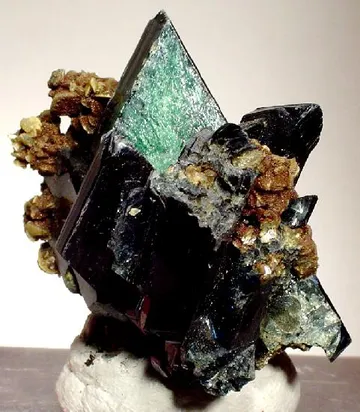
Siglo Veinte Mine, Bolivia — a famed locality uniting tin ore bodies, historic camp status, and delicate hydrated phosphates prized by collectors.
Key facts
Siglo Veinte—usually written Siglo XX on older labels—is one of the great names of Bolivian mineral collecting because it unites three different kinds of importance in a single locality: a world-scale tin orebody, a historically decisive mining camp, and a phosphate assemblage that became a reference point for systematic collectors. The mine lies at Llallagua in Rafael Bustillo Province, Potosí Department, where the Salvadora stock and its associated vein system form one of the classic porphyry-tin deposits of the Bolivian Tin Belt. Ore geologists know the district for cassiterite in stockworks, disseminations, hydrothermal breccias, and later quartz-cassiterite-sulfide veins; collectors know it for the small, brilliant, often improbably beautiful hydrated phosphates that formed late in open fractures in that same tin system.
The signature look of Siglo Veinte is not one thing but a family resemblance: colorless quartz carrying cinnamon to orange-pink monazite-(Ce); heavy black-brown cassiterite twins; mirror-bright pyrite; dark, lustrous wurtzite; and, above all, delicate phosphate crusts in blue, pale green, tan, cream, and yellow. Vauxite, paravauxite, metavauxite, sigloite, ferrivauxite, and jeanbandyite tie the mine permanently to the history of mineral description. The best Siglo Veinte specimens have the feel of old science as much as display mineralogy: small, intricate pieces in which rare phosphates sit on quartz, clay, or altered porphyry matrix, or where a single old label reading “Llallagua,” “Catavi,” or “Siglo XX” preserves a century of collecting history.
Regional View
Country View
Unlike many famous mines whose collector reputation rests on one mineral, Siglo Veinte is a locality where the associations matter as much as the species names. A fine vauxite is better when the paravauxite and metavauxite are also present; a monazite is more telling when it is perched on bright quartz with cassiterite; a vivianite is more securely “Llallagua” when it rises from a childrenite or paravauxite crust. Serious collectors prize these pieces for their paragenetic clarity: they show the late phosphate event superposed on a giant tin system rather than merely offering isolated crystals.

Photo: Wikimedia Commons

Photo: Wikimedia Commons
Search for specimens: View all specimens from Siglo Veinte Mine, Bolivia
Siglo Veinte is at Llallagua, a few minutes southwest of the city center, and the name has accumulated several layers of label history. Specimens may be labeled Siglo Veinte, Siglo XX, Llallagua, La Salvadora, or Catavi. “Catavi” is especially common on older mineral labels because Catavi functioned as the mill, residential area, and administrative center for the mine complex; for specimen purposes, most significant “Catavi” pieces in the classic phosphate and tin-vein suites are better understood as Siglo Veinte/Llallagua material rather than products of a separate specimen-producing mine.
Geologically, the mine belongs to the Llallagua tin porphyry system, centered on the Salvadora stock. The stock is a high-level subvolcanic body of dacitic to rhyodacitic character, intensely altered and brecciated, intruding Paleozoic sedimentary rocks. The ore system includes disseminated and stockwork cassiterite, hydrothermal breccia mineralization, and later throughgoing veins. The principal alteration assemblages include quartz, sericite, tourmaline, clay minerals, sulfides, and cassiterite. In the broader porphyry-tin model, Llallagua is one of the best-known examples of a Bolivian system in which tin mineralization is tied to high-level intrusive centers rather than to a simple narrow-vein lode alone.
Cassiterite is the economic backbone of the deposit. Early mining exploited richer veins, while later operations also treated lower-grade disseminated and stockwork material in the altered stock. The veins and veinlets carry quartz, cassiterite, pyrite, sphalerite, stannite, chalcopyrite, franckeite, bismuth minerals, tungsten minerals, apatite, monazite, xenotime, and a wide suite of late phosphates, sulfates, oxides, and secondary alteration products. The collectible phosphates are not the main ore; they are late-stage, fracture-lining minerals whose importance is mineralogical rather than economic.
Historically, Llallagua was transformed by tin at the turn of the twentieth century. Simón I. Patiño acquired La Salvadora in 1897, and the discovery of very high-grade cassiterite ore made the district central to the rise of the Bolivian tin industry. Serious mining of the Siglo Veinte ores began in 1901, giving the mine its “Twentieth Century” name. In the early decades, production and ownership were bound to the Patiño interests and the larger Catavi-Siglo XX complex. After Bolivia’s 1952 National Revolution, Siglo XX and associated operations passed into the state mining corporation COMIBOL, and the Catavi-Siglo XX complex became one of the most important units of the state mining sector.
The mine’s modern operating reality is different from its classic industrial period. After the collapse of tin prices in the 1980s and the restructuring of Bolivia’s state mining sector, large-scale COMIBOL operation gave way to cooperative mining and reworking of dumps and tailings. Current collecting access should be treated as restricted industrial access, not as a casual field-collecting destination. Underground workings, old stopes, dumps, tailings, and processing areas are active, hazardous, privately or cooperatively controlled, and subject to Bolivian mineral-rights and safety rules. Specimens on today’s market are therefore most often old collection pieces, dealer-circulated material from past finds, or specimens recovered through miners and local networks rather than material obtained by visiting collectors.
The classic specimen zones most often associated with the phosphate suite are the tin veins and their late open fractures, especially material historically tied to the Contacto and San José vein systems. Monazite-(Ce) specimens are particularly associated with hydrothermal tin veins where quartz, cassiterite, and monazite crystallized together. The vauxite-paravauxite-metavauxite-sigloite suite occurs as small crystal aggregates, crusts, and fracture coatings on quartz, wavellite or fluorwavellite, clay, and altered porphyry. Some modern-market vauxite pieces are linked to finds in the late 2000s and around 2010, but older pieces from the Gordon, Vaux, Bandy, and mid-century collecting era remain especially desirable because they carry both mineralogical and historical provenance.
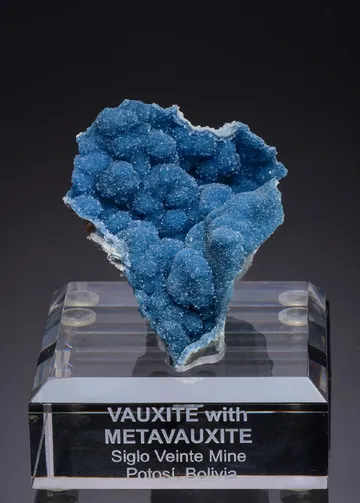
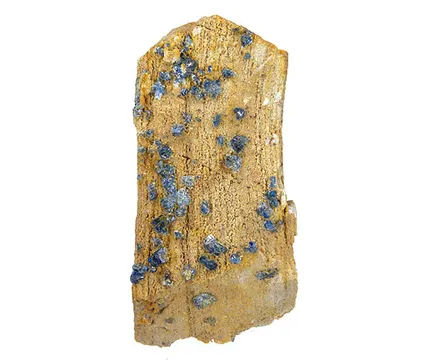
Vauxite is the blue signature mineral of Siglo Veinte and one of the locality’s defining type-species. Here it occurs as tiny tabular crystals in sparkling subparallel to radial aggregates, crusts, nodules, and rounded sprays, most admired when the color is saturated sky blue to deep Venetian or electric blue rather than grayish or washed out. The crystals are generally small, so a strong thumbnail or miniature with rich coverage can be more important than a larger but thinly coated plate. Good specimens show intact, lustrous blue aggregates on a stable matrix of quartz, altered porphyry, clay, or pale wavellite/fluorwavellite, and the best pieces preserve the classic Siglo Veinte phosphate association with paravauxite, metavauxite, childrenite, or sigloite. Ordinary examples are flat crusts with bruising, dull color, or ambiguous identity; exceptional examples have three-dimensional blue rosettes, clean contrast, old provenance, and enough associated species to read as a true Llallagua phosphate document.
Monazite from Siglo Veinte is properly treated as monazite-(Ce) in modern usage, despite older assumptions and labels that sometimes called Llallagua material monazite-(La). Collector specimens typically show sharp, lustrous, translucent orange-pink to honey-orange crystals, often twinned, on quartz-rich matrix with cassiterite and locally other tin-vein species; documented specimens show crystals in the several-millimeter range, with fine pieces carrying bright monazite crystals to about 4–7 mm. The mineral is especially important here because it is a hydrothermal vein monazite in a tin porphyry system, locally associated with quartz, cassiterite, fluorapatite, xenotime, and hübnerite rather than the pegmatitic settings most collectors instinctively expect for monazite. The best Siglo Veinte monazites combine translucent color, sharp twinning, high relief on sparkling quartz, and visible cassiterite association; lesser pieces are visually crowded, iron-stained, or dependent on a label for interest.
Quartz at Siglo Veinte is both a common gangue mineral and one of the principal display stages for the mine’s rarer species. It occurs as colorless to smoky prismatic crystals, druses, vein quartz, and occasional Japan-law twins, and the locality is especially admired when quartz supports orange-pink monazite-(Ce), black to brown cassiterite twins, yellow to cream wavellite/fluorwavellite spheres, or slender tungsten minerals. Because quartz is abundant in the system, stand-alone pieces need a special feature to rise above ordinary Bolivian vein quartz: sharpness, transparency, an elegant Japan-law twin, old provenance, or a significant association with monazite, cassiterite, hübnerite, vauxite, or paravauxite. The finest examples are not merely quartz specimens; they are balanced miniature records of the tin-vein environment, with clean, glassy crystals framing the heavier ore minerals and late phosphates.
Specimens long labeled “wavellite” from Siglo Veinte are a classic part of the phosphate suite, but modern analytical work has shown that at least some Llallagua material is fluorwavellite, the fluorine analogue, so important specimens deserve analytical caution. In collector form these pieces are usually pale yellow, cream, mint-green, or bluish-green radiating spheres, botryoidal crusts, rope-like cavernous sheets, or small well-defined crystals on quartz, cassiterite-bearing matrix, or associated rare phosphate crusts. Displayable Siglo Veinte wavellite/fluorwavellite is much scarcer than the locality’s fame might suggest: good examples show complete radiating balls around 1–1.5 cm, attractive color, and intact surfaces rather than broken hemispheres or powdery crusts. The strongest pieces are those where the wavellite forms clean spherules on quartz or serves as the pale platform for vauxite, paravauxite, or sigloite, placing the specimen unmistakably in the late phosphate episode of the mine.
Siglo Veinte vivianite occurs as blue-green to deep teal prisms and blades, with documented crystals reaching about 10 cm, though most collectible matrix specimens are smaller and valued for association rather than sheer size. The finest pieces show sharp, lustrous, translucent crystals on childrenite, siderite, quartz, paravauxite, wavellite/fluorwavellite, or iron-rich matrix, and they have a different personality from the brighter emerald vivianites of other Bolivian localities: the Siglo Veinte appeal is the union of color, old-mine provenance, and phosphate-suite context. Vivianite from this mine may darken with light and oxidation, so very dark crystals are not automatically poor but do lose some of the translucency and internal blue-green glow collectors prize. A good piece has complete tips, visible crystal form, balanced matrix, and a credible Siglo XX/Catavi/Llallagua provenance; an ordinary one is blackened, cleaved, detached, or visually lost in brown matrix.
Childrenite at Siglo Veinte is a supporting but important phosphate, most often valued as part of the locality’s vauxite-paravauxite-vivianite assemblage rather than as a large stand-alone species specimen. It is documented from the mine with the classic late phosphate suite and appears on collector pieces as brownish, yellowish, tan, or pale microcrystalline coatings and small crystals associated with paravauxite, vauxite, wavellite/fluorwavellite, sigloite, and vivianite. Its visual role is often subtle: it may form the granular or sparkling phosphate crust from which blue-green vivianite crystals rise, or occur with the pale green paravauxite and blue vauxite aggregates that make a Siglo Veinte specimen mineralogically rich. The best childrenite pieces are those where the crystals are identifiable, clean, and associated with more diagnostic Llallagua species; ordinary pieces need analysis or an excellent label because the small tan phosphates of this mine are easy to confuse by eye.
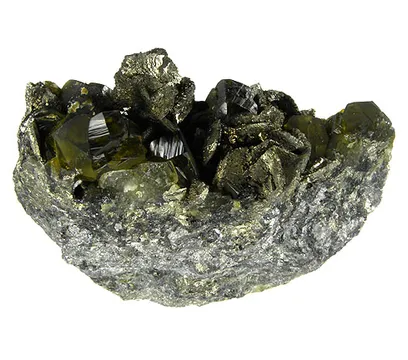
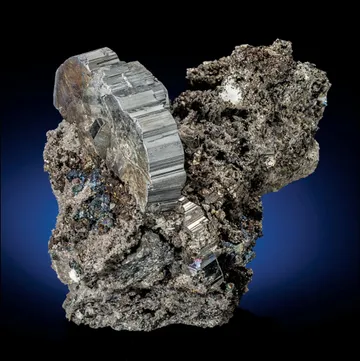
Pyrite is part of the primary and late sulfide story at Siglo Veinte and occasionally produces surprisingly fine collector specimens, although it is far less common on the market than the mine’s phosphates. Good pieces show sharp modified cubes, octahedral forms, or cuboctahedral crystals with bright brassy metallic luster, broad reflective faces, striations, and sometimes matrix or associations with quartz, cassiterite, siderite, franckeite, vauxite, paravauxite, wavellite/fluorwavellite, or sigloite. Documented market specimens include sharp thumbnails around 2 cm and miniatures with prominent pyrite crystals over 3 cm, which is substantial for display-quality Siglo Veinte pyrite. The best examples are complete, lustrous, and three-dimensional, with little edge wear and a firm old locality; ordinary pieces are massive ore pyrite or dull sulfide aggregates with little specimen architecture.
Wurtzite is one of the more interesting sulfides from Siglo Veinte, and Llallagua material was important enough to be studied as manganoan ferroan wurtzite. Collector specimens are old, uncommon, and usually appear as dark brown to black resinous or submetallic hexagonal crystals and crystal groups in the zinc-sulfide assemblage, commonly discussed alongside sphalerite, greenockite, chalcopyrite, and other sulfides from the tin-polymetallic veins. The attraction here is not bright color but rarity, crystal definition, and locality pedigree: a sharp, well-labeled Siglo XX wurtzite belongs in a serious Bolivian sulfide suite. Good pieces show distinct crystal faces, lustre, and freedom from massive sulfide overgrowth; lesser examples are visually indistinct and can be difficult to separate confidently from sphalerite-rich material without analytical support.
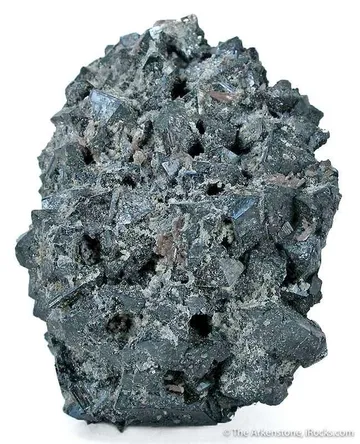
Cassiterite is the ore mineral that made Siglo Veinte famous industrially and remains one of the essential collector species from the locality. It occurs in disseminations, stockwork veinlets, hydrothermal breccias, and quartz-cassiterite veins, and collector pieces typically show black to dark brown, highly lustrous, dense crystals and twins on quartz or altered matrix, sometimes with monazite-(Ce), pyrite, or other tin-vein minerals. Old references and museum holdings record fine twinned cassiterites from the mine, and modern market examples still appear as small but sharp twins with quartz. The best cassiterites have bright adamantine to submetallic luster, crisp twin form, visible contrast against quartz, and enough matrix to show their vein origin; ordinary pieces are heavy but massive ore fragments whose interest is more historical than aesthetic.
Beyond the headline species, Siglo Veinte has a remarkable documented mineral list exceeding a hundred valid species. The type-locality suite is central: vauxite, paravauxite, metavauxite, sigloite, ferrivauxite, and jeanbandyite anchor the mine in systematic mineralogy. Other notable minerals include fluorwavellite, fluorapatite, xenotime-(Y), monazite-(Ce), hagendorfite, chalcosiderite, variscite, rockbridgeite, crandallite, römerite, greenockite, franckeite, cylindrite, stannite, sphalerite, zinkenite, scheelite, ferberite, siderite, and native bismuth. Some names on old labels or older literature require care: “wavellite” may be fluorwavellite in some cases, “monazite-(La)” from Llallagua has been treated as an erroneous report where modern analyses show Ce dominance, and “Catavi” is often an administrative or milling label for specimens really from Siglo Veinte.
Siglo Veinte specimens reward careful labels. A piece with old “Llallagua,” “Catavi,” “Siglo XX,” “La Salvadora,” “Vaux,” “Bandy,” Philadelphia Academy, Smithsonian, or other museum/dealer provenance can be far more important than a visually similar piece without history. This is especially true for the phosphate suite, where small crystals, similar colors, and intergrown habits make visual identification difficult. Vauxite, paravauxite, metavauxite, sigloite, ferrivauxite, and childrenite should not be assigned casually from color alone; analytical confirmation, old collection context, or association with reliably identified specimens is important.
The most common locality problem is not outright fakery but naming drift. “Catavi” labels usually refer to the Catavi-Siglo XX complex rather than a separate specimen-producing Catavi mine. Old “monazite-(La)” labels should be treated cautiously because modern commentary and analyses favor monazite-(Ce) for the Llallagua material. Many specimens sold historically as wavellite may be fluorwavellite, or at least part of the wavellite-fluorwavellite compositional problem, so high-end examples should be tested if the exact species matters. The rare blue and green phosphates can also be confused with one another on mixed pieces: a blue crust may be vauxite, but color zoning, alteration, and intimate growth with sigloite or metavauxite can complicate identification.
Condition is a serious issue. Vauxite and related hydrated phosphates are delicate, commonly occurring as thin crusts or small radial aggregates that bruise easily at exposed high points. Paravauxite and metavauxite blades are fragile; wavellite/fluorwavellite balls are often broken or abraded; and childrenite may appear as small, inconspicuous crystals easily lost to cleaning. Avoid aggressive washing, acids, ultrasonic cleaning, or prolonged soaking on mixed phosphate specimens. Dust should be removed only with a very soft brush or air bulb, and specimens should be stored dry and stable.
Vivianite deserves special handling. Siglo Veinte vivianite can darken through oxidation and light exposure, so display it under low light and avoid sunny cases. Do not judge every dark specimen as damaged—some old vivianites naturally present as deep blue-black—but translucent blue-green blades are more desirable and should be protected. Sulfide-rich specimens, especially those containing pyrite, marcasite, or pyrrhotite replacements, should be kept dry and monitored for oxidation. Efflorescent sulfates from old mine environments may be water-soluble and unstable, and they should not be stored against delicate phosphate pieces.
Market availability is uneven. Cassiterite, quartz, and minor sulfides appear periodically, but fine Siglo Veinte examples are much less common than the locality’s fame suggests. Vauxite is available often enough that a serious collector can be selective, yet top-quality deep blue, three-dimensional, undamaged specimens remain scarce. Paravauxite, metavauxite, sigloite, ferrivauxite, and childrenite associations are more specialized and may require patience. Display-quality wavellite/fluorwavellite, old vivianite on childrenite, sharp monazite-(Ce) on quartz, and well-crystallized wurtzite or pyrite are all genuinely competitive when they surface with good labels.
The founding story of Llallagua reads like a mineral collector’s myth, except that it shaped the economy of a country. Simón I. Patiño entered the district not as the “tin baron” he later became, but as a commercial man tied to the Oruro firm Hermann Fricke y Compañía. In the 1890s he joined Sergio Oporto in a venture at La Salvadora, supplying money, goods, and commercial connections while Oporto handled the workings. The operation struggled; debts mounted; Oporto wanted out. Patiño bought him out and took on the burden with his wife Albina. On 16 August 1897, La Salvadora became Patiño’s risk.
Then came the episode remembered as the “miracle of Llallagua.” At the turn of the century, after a dynamite blast, miners broke into ore so rich that the cassiterite fragments were described as needing no hand crushing or further preparation before shipment. The local phrase “metal del diablo”—the devil’s metal—captures both the black density of cassiterite and the almost unsettling wealth it represented. What had been a difficult prospect became one of the great tin mines of the world, and the mountain began sending not just ore but mineral specimens into the cabinets of Europe and North America.
The scientific story moved almost as dramatically. In the early twentieth century, material from the mine reached Samuel G. Gordon and other mineralogists associated with the Academy of Natural Sciences of Philadelphia and the Vaux collecting circle. Their attention fell not on the cassiterite alone but on delicate, late-formed phosphates in the tin veins: blue, green, tan, and cream minerals that did not fit the usual species lists. In 1922, vauxite and paravauxite entered the literature from Llallagua. Metavauxite followed, and then sigloite, named directly for Siglo XX. Later work added ferrivauxite and jeanbandyite to the locality’s type-mineral legacy. Few ore deposits have contributed such a memorable cluster of rare phosphate species to collector vocabulary.
Mark Chance Bandy later became one of the great names tied to the locality. He worked in Bolivia for the Patiño interests and served at Llallagua in senior technical roles, including chief geologist, chief engineer, and general manager of the Siglo XX mine. The Bandy connection matters because many older mineral labels and references are not merely commercial tags; they come from a period when the people studying the orebody were also documenting, preserving, and distributing specimens. A small phosphate thumbnail with a reliable old provenance can therefore carry a direct line back to the technical history of the mine.
Siglo Veinte’s human history is darker than the sparkle of its specimens. The Catavi-Siglo XX complex was a center of labor power, and that made it a repeated target of state violence. On 21 December 1942, during wartime tensions and miners’ wage disputes, government troops fired on workers at Catavi. Decades later, in the early hours of 24 June 1967, soldiers entered the Siglo XX and Catavi camps during the traditional San Juan night celebrations. Contemporary accounts describe families gathered around bonfires when troops arrived by rail at Cancañiri and moved into the mining camps. The assault became known as the San Juan massacre.
The details remain stark: miners and families celebrating a winter festival; radios and union spaces seized; firing in the darkness; women, children, workers, and bystanders among the dead and wounded. Bolivian institutional commemorations list named victims from Siglo XX and Catavi, including children aged nine and eight, a newborn, miners, and unidentified civilians. For mineral collectors, this history is not separate from the locality. Siglo Veinte specimens come from a place where geology, labor, wealth, science, and violence were inseparable. An old cabinet label may look quiet, but the name on it belongs to one of the most charged landscapes in Bolivian mining history.
The mine also has a long afterlife. When large-scale state mining declined after the tin crisis of the 1980s, thousands of workers were displaced, and cooperatives became central to the district’s survival. Modern accounts of Llallagua describe miners walking kilometers underground before reaching a workable vein and returning with ore on their backs, while other groups reprocess old tailings for cassiterite left behind by earlier operations. The same ground that yielded world-class specimens now carries the environmental and social burden of a century of extraction: dumps, sand tailings, fine tailings, acidic drainage, and cooperative processing plants built around the stubborn value of tin still present in the waste.
Samuel G. Gordon, “Vauxite and Paravauxite, Two New Minerals from Llallagua, Bolivia,” American Mineralogist, 7, 107–108, 1922. The original short description that introduced two of the classic Llallagua phosphate species. https://rruff.info/doclib/am/vol7/AM7_107.pdf
Samuel G. Gordon, “The Mineralogy of the Tin Mines of Cerro de Llallagua, Bolivia,” Proceedings of the Academy of Natural Sciences of Philadelphia, 96, 279–359, 1944. A foundational locality paper for the mine’s mineral assemblage. https://www.mindat.org/reference.php?id=16955172
Cornelius S. Hurlbut and Russell Honea, “Sigloite, a New Mineral from Llallagua, Bolivia,” American Mineralogist, 47, 1–8, 1962. The formal description of sigloite, named for the Siglo XX mine. https://msaweb.org/AmMin/AM47/AM47_1.pdf
F. G. Smith, S. K. DasGupta, and V. G. Hill, “Manganoan Ferroan Wurtzite from Llallagua, Bolivia (I),” The Canadian Mineralogist, 6, 128–135, 1957. A focused study of the locality’s unusual wurtzite. https://www.mindat.org/loc-336.html
Anthony R. Kampf, “Jeanbandyite: A New Member of the Stottite Group from Llallagua, Bolivia,” The Mineralogical Record, 13, 235–239, 1982. Description of a Llallagua type-locality mineral named in the Bandy tradition. https://www.mindat.org/loc-336.html
Alfredo Petrov and Jaroslav Hyršl, “Famous Mineral Localities: Llallagua, Bolivia,” The Mineralogical Record, 37, 117–162, 2006. The essential modern collector-oriented locality treatment. https://mineralogicalrecord.com/
K. A. Rodgers, H. W. Kobe, and C. W. Childs, “Characterization of Vivianite from Catavi, Llallagua Bolivia,” Mineralogy and Petrology, 47, 193–208, 1992. A dedicated study of the locality’s vivianite. https://doi.org/10.1007/BF01161567
Ulf Kempe, Thomas B. Lehmann, Jens Götze, and coauthors, “U–Pb SHRIMP Geochronology of Th-poor, Hydrothermal Monazite: An Example from the Llallagua Tin-Porphyry Deposit, Bolivia,” Geochimica et Cosmochimica Acta, 72, 4352–4366, 2008. Important geochronological work on hydrothermal monazite from the deposit. https://www.sciencedirect.com/science/article/pii/S0016703708003669
Władysław B. Betkowski, John Rakovan, and Daniel E. Harlov, “Geochemical and Textural Characterization of Phosphate Accessory Phases in the Vein Assemblage and Metasomatically Altered Llallagua Tin Porphyry,” Mineralogy and Petrology, 111, 547–568, 2017. A modern study of monazite, fluorapatite, xenotime, and phosphate alteration in the Siglo XX/Salvadora stock system. https://doi.org/10.1007/s00710-017-0510-6
Anthony R. Kampf, Paul M. Adams, Henry Barwood, and Barbara P. Nash, “Fluorwavellite, Al3(PO4)2(OH)2F·5H2O, the Fluorine Analog of Wavellite,” American Mineralogist, 102, 909–915, 2017. Establishes fluorwavellite and bears directly on the identity of some Llallagua material long labeled wavellite. https://rruff.info/uploads/AM102_909.pdf
P. Ayora and coauthors, “Process Mineralogy of the Tailings from Llallagua: Towards a Sustainable Activity,” Minerals, 12, 214, 2022. Useful for understanding the modern tailings, processing, and environmental context of the Llallagua-Catavi operation. https://www.mdpi.com/2075-163X/12/2/214
-49178.jpg)
-Quartz-252670.jpg)