






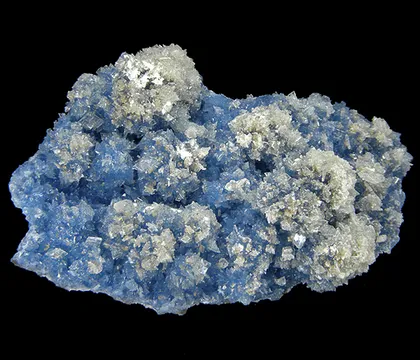
Llallagua, Bolivia — a premier tin locality in the Andes, yielding jet-black cassiterite, quartz, rare sulfosalts, and a phosphate suite prized by collectors.
Key facts
Llallagua is one of the great hard-rock tin localities of the Andes: a compact, high-altitude mining district in northern Potosí where the Siglo Veinte–Catavi–La Salvadora complex exposed one of the world’s classic porphyry-tin systems. For collectors, its importance is not simply “tin ore.” Llallagua joins black, lustrous cassiterite; quartz and tourmaline gangue; arsenopyrite, pyrite, pyrrhotite, sphalerite and stannite; rare lead–tin sulfosalts such as cylindrite, franckeite and teallite; and a remarkable late phosphate suite that made the locality a type-locality landmark. The deposit sits in the Bolivian Tin Belt, tied to a subvolcanic Salvadora stock of dacitic to rhyodacitic affinity, altered by quartz-sericite assemblages and later tourmalinization, with cassiterite introduced in veinlets, breccias, disseminations and open-space veins.
Historically, Llallagua was the mountain that helped make Simón Iturri Patiño the “King of Tin,” then became one of the central stages of Bolivia’s twentieth-century mining economy, nationalization, labor organization and political violence. Mineralogically, it is a locality where specimen labels can carry layers of meaning: old Vaux expedition pieces, Academy of Natural Sciences material, Patiño-era tin specimens, COMIBOL-era phosphate finds, and modern cooperative-mined specimens all point back to the same battered porphyry hill.
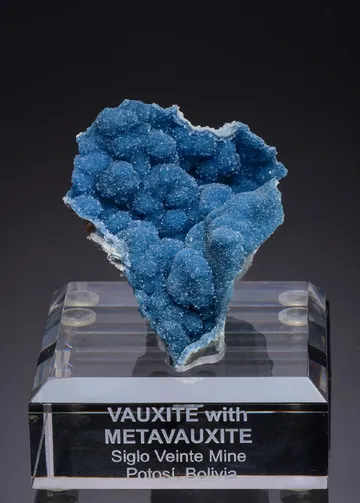
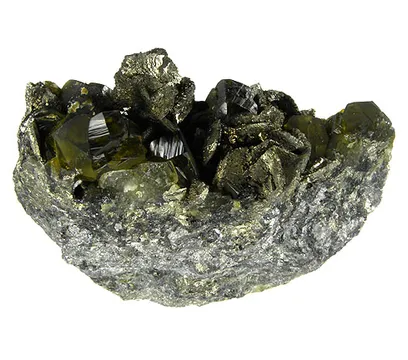
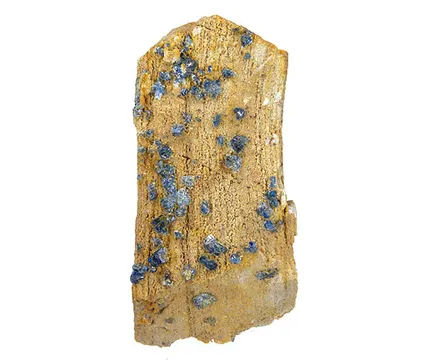
The best Llallagua specimens have a look of their own. Cassiterite is commonly jet-black to brown-black, sharply crystallized, glassy to adamantine, and often crowded over dark matrix or perched with quartz. Quartz specimens may be colorless, gray, smoky or iron-stained, ranging from small drusy pockets to lustrous miniature crystal groups. The phosphate pieces are far more delicate: pale greenish-white paravauxite, blue vauxite, colorless to white metavauxite, yellowish to brown sigloite, wavellite spheres, childrenite and other late minerals in small open fractures. Fine Llallagua specimens reward close inspection; even cabinet pieces are often really landscapes of tiny, precise crystals.
Regional View
Country View
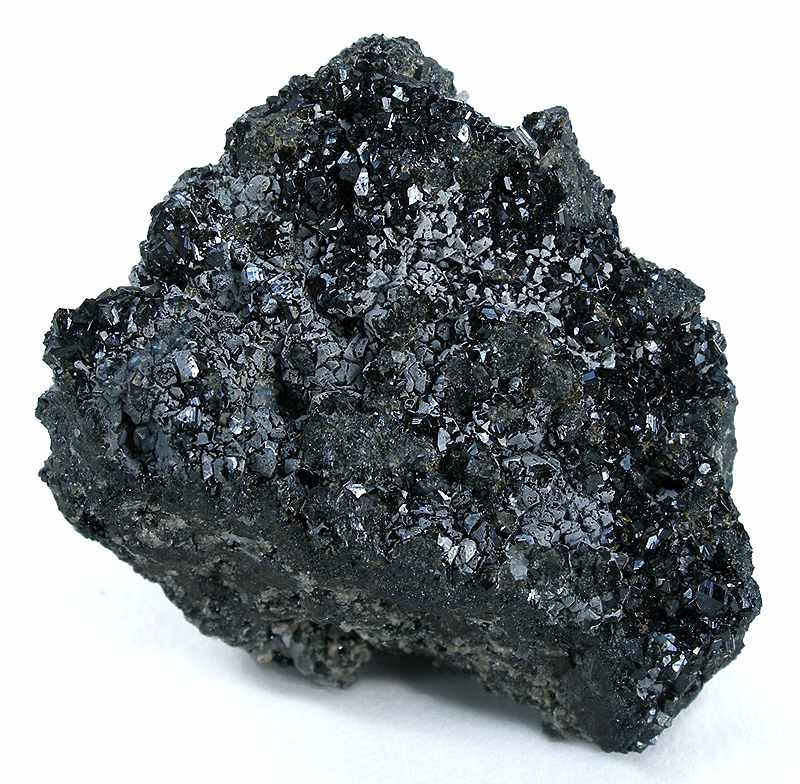
Photo: Wikimedia Commons
The collector’s Llallagua is often encountered under several overlapping names: Llallagua, Siglo Veinte, Siglo XX, Catavi, and La Salvadora. These are not interchangeable in a strict historical sense, but in the specimen trade they commonly reflect different labeling traditions around the same mining complex. The most precise modern form for many specimens is Siglo Veinte Mine, Llallagua, Rafael Bustillo Province, Potosí Department, Bolivia; older labels may simply say “Llallagua,” “Catavi,” or “Siglo XX.”

Photo: Wikimedia Commons
Search for specimens: View all specimens from Llallagua, Bolivia
Llallagua lies in Rafael Bustillo Province, northern Potosí Department, Bolivia, near the old mining settlements of Siglo XX, Catavi and Uncía. The mineral district is part of the Bolivian Tin Belt, the long Andean metallogenic province that extends from southern Peru into northern Argentina. In deposit-class terms, Llallagua is one of the reference examples of a porphyry tin system: cassiterite mineralization related to a high-level subvolcanic stock, overprinted and intersected by later vein systems. The central intrusive body is generally referred to as the Salvadora stock, a porphyritic dacitic to rhyodacitic body and associated breccia complex, with the mineralized area described in modern work as roughly 1.7 by 1.0 km at surface.
The ore system is not a single simple vein. Early high-grade mining followed rich quartz-cassiterite and quartz-cassiterite-sulfide veins, but the district also contains disseminated, stockwork and breccia-hosted cassiterite mineralization within altered porphyry and adjacent rocks. The porphyry-style mineralization is associated with pervasive quartz-sericite alteration and tourmalinization; late fracture-controlled veins and open spaces carry complex sulfides, sulfosalts and the famous phosphate assemblage. In a typical collector specimen, quartz may be more than an attractive support: it is part of the ore-forming history, present with cassiterite and tourmaline in veins and vugs, and later joined by secondary minerals in open fractures.
Paragenetically, Llallagua spans high-temperature tin assemblages through late, low-temperature secondary phosphates. Cassiterite is the defining ore mineral, joined in the broader system by quartz, tourmaline, pyrite, pyrrhotite, marcasite, arsenopyrite, sphalerite, stannite, bismuthinite, ferberite or hübnerite, and a suite of lead–tin–antimony sulfosalts. Later fluids and oxidation produced hydrous phosphates including vauxite, paravauxite, metavauxite, sigloite, wavellite, childrenite, crandallite and ferrivauxite. Monazite-(Ce), fluorapatite, xenotime-(Y), rutile and zircon are also important in the deposit’s mineralogical and geochronological story, even where they occur as microscopic or small accessory phases.
Mining history at Llallagua is inseparable from La Salvadora and Simón Iturri Patiño. Patiño acquired La Salvadora in the late 1890s after earlier work had been discouraging; the spectacular turn came around 1900, when a very rich tin vein transformed the property. By the early twentieth century the district was rapidly industrialized, and Patiño consolidated nearby operations including Catavi, Siglo XX, Uncía and Huanuni. The Compañía Estañífera de Llallagua, backed by Chilean capital, also played an early role in the district, and Patiño later bought out interests and brought the complex into Patiño Mines & Enterprises. The Machacamarca–Uncía railway, completed in the early twentieth century, was crucial in moving ore from this remote highland district toward export routes.
In the first decades of the twentieth century, Llallagua was worked for relatively high-grade vein ore. By the 1940s, as the bonanza grades declined and the scale of the operation changed, mining shifted toward large-volume extraction of lower-grade ore, including block-caving methods more often associated with porphyry copper operations. The mine was nationalized in 1952 after the Bolivian National Revolution and placed under the Corporación Minera de Bolivia, COMIBOL. Siglo XX and Catavi became one of COMIBOL’s largest and most politically important mining complexes. After the tin crisis and restructuring of Bolivian mining in the 1980s, much work passed to cooperatives; modern studies of Llallagua tailings and dumps show that the district still contains significant tin-bearing waste, with cassiterite commonly locked with quartz, tourmaline and rutile.
For collectors today, Llallagua should be treated as an active and historically sensitive mining district, not a casual collecting locality. Access to underground workings, dumps, processing areas and cooperative claims is controlled locally and can be dangerous. The most reliable route for collectors is the specimen market: older collection pieces, material from recognized dealers, and specimens with labels specifying Siglo XX, Siglo Veinte, Catavi, La Salvadora or Llallagua. The best documented specimen-producing zones include open fractures and vugs in and around the major vein systems, especially the Contacto vein area that yielded celebrated phosphate finds, and older tin veins that produced cassiterite, quartz, monazite, fluorapatite and sulfosalt specimens.
Notable pockets have come in several very different styles. The classic tin-ore pockets produced lustrous black cassiterite, sometimes twinned, on quartz or dark matrix. Rare-earth phosphate pockets produced monazite-(Ce), commonly as small orange, reddish, brownish or resinous crystals on quartz with cassiterite. The famous phosphate pockets are more delicate and more colorful: blue vauxite, greenish-white paravauxite, colorless to whitish metavauxite, wavellite and sigloite in open seams. Modern collector literature records mid-2000s finds in the Contacto vein area with paravauxite sprays and “pinwheels” to about 3 cm and splintery yellow sigloite crystals to about 1 cm, among the most desirable late-phosphate specimens from the district.
Quartz from Llallagua is not usually collected as isolated “pretty quartz” in the way alpine fissure quartz is; its value is in its role as the framework of the tin-vein assemblage. It occurs as colorless to gray, smoky or iron-stained crystals in veins and vugs with cassiterite, tourmaline, monazite-(Ce), fluorapatite, wavellite, tetrahedrite and other sulfides or sulfosalts. Good examples are miniatures to small cabinets with sharp, glassy quartz points carrying a contrasting mineral: black cassiterite, orange-brown monazite, pale wavellite spheres, or metallic tetrahedrite. Ordinary pieces are drusy or massive vein quartz with little contrast; better Llallagua quartz shows open-space growth, undamaged terminations, recognizable association, and enough matrix to tell the tin-district story.
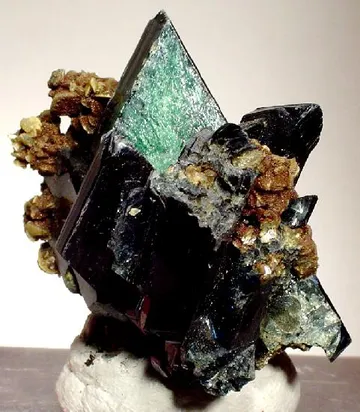
Cassiterite is Llallagua’s signature mineral and the reason the mountain mattered economically. Collector specimens range from small, sparkling crusts of black microcrystals to sharp, lustrous, brown-black to nearly jet-black crystals and twins on quartz or altered porphyry matrix. The finest pieces are not just “ore”; they show bright, reflective faces, crisp tetragonal form, visible twinning or well-separated crystals, and association with quartz, tourmaline, arsenopyrite, stannite, pyrite, monazite-(Ce) or late phosphates. Because Llallagua produced enormous quantities of tin but comparatively few fine display specimens, attractive crystallized cassiterite with an old Siglo XX, Catavi or Llallagua label is much scarcer than the production history might suggest.
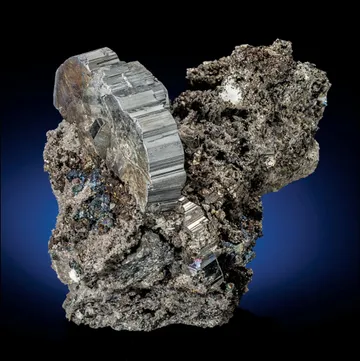
Beyond quartz and cassiterite, Llallagua is a type-locality district of exceptional breadth. Valid type-locality minerals include vauxite, paravauxite, metavauxite, sigloite, ferrivauxite and jeanbandyite, all tied to the Siglo Veinte/Llallagua complex. The late phosphate suite also includes childrenite, wavellite, crandallite, vivianite, fluorapatite, monazite-(Ce), xenotime-(Y), augelite, faustite, florencite-(Ce), hagendorfite and mélonjosephite. Sulfosalt collectors know the district for cylindrite, franckeite, teallite, andorite, boulangerite, bournonite, jamesonite, zinkenite, stannite and potosíite, while the broader ore suite includes arsenopyrite, pyrite, pyrrhotite, marcasite, sphalerite, galena, chalcopyrite, native bismuth, native silver, siderite, baryte, gypsum, goethite and hematite. Monazite-(Ce) deserves special mention: Llallagua material has been important in geochronology and rare-earth mineralogy, with hydrothermal monazite occurring in many vein systems with quartz, cassiterite and tourmaline.
The main authenticity issue with Llallagua specimens is locality precision. Old labels may say Llallagua, Catavi, Siglo XX, Siglo Veinte, La Salvadora, Uncía-Llallagua or simply Bolivia. Such labels can be legitimate, but they do not all convey the same level of precision. For important pieces, especially type-locality phosphates or rare sulfosalts, a label naming Siglo Veinte or Siglo XX is preferable to a vague “Bolivia” label. Provenance through a known old collection, dealer archive, museum duplicate, or published specimen matters.
Mislabelling is commonest within the phosphate suite. Vauxite, paravauxite and metavauxite are closely associated and visually subtle at small scale; blue vauxite, pale greenish-white paravauxite, colorless to white metavauxite and altered brown ferrivauxite or sigloite can occur intergrown on the same small matrix. Specimens sold as “vauxite” may actually be paravauxite-dominant, and vice versa, unless the material is visually obvious or analytically checked. “Vauxite” is also easily confused in writing with bauxite, an unrelated aluminum ore rock. Jeanbandyite, ferrivauxite, sigloite and other rarities should be regarded as analytical-specimen species unless identification is supported by expert provenance or testing.
Cassiterite from Llallagua is generally robust as a mineral, but display specimens can be fragile because the cassiterite crystals sit on brittle vein or altered porphyry matrix. Edges of black crystals show chips readily; look for bruised high points, dull broken faces, and old glue repairs in dense clusters. Quartz-associated pieces often hide contacts or sawed bases. The best cassiterite has bright luster and undamaged form rather than merely heavy tin-ore mass.
The late phosphates are far more delicate. Vauxite and paravauxite aggregates can be crushed, rubbed or dulled by handling; clay-rich or decomposed allophane matrix can crumble; wavellite spheres and tiny bladed sprays are easy to abrade. Store these pieces dry, stable and dust-free, and avoid aggressive cleaning. Do not soak phosphate specimens unless you are certain the matrix and species will tolerate it. Avoid repeated strong light exposure for visually sensitive hydrated phosphates and associated vivianite, which can darken or alter with oxidation.
Radioactivity is usually not a practical hazard for ordinary Llallagua cabinet specimens, but monazite-(Ce), thorite, zircon and some rare-earth phases may contain uranium or thorium in trace to minor amounts. Handle monazite-rich pieces sensibly: do not grind them, keep dust out of the case, and wash hands after handling. Sulfide-rich pieces may carry pyrite or marcasite and should be stored in a dry environment to reduce the risk of oxidation and sulfate efflorescence.
Market availability is uneven. Cassiterite and quartz from Llallagua appear periodically, but fine crystallized examples are much less common than the mine’s massive production history implies. Vauxite, paravauxite, metavauxite and sigloite are always specialist pieces; thumbnails and miniatures are the norm, while large, richly covered specimens are exceptional. Monazite-(Ce) on quartz appears occasionally and is prized when crystals are sharp, colorful and visible rather than merely massive or microscopic. A strong Llallagua specimen should have three things: a precise label, a mineral association characteristic of the locality, and condition good enough that the tiny details—the real charm of Llallagua—survive under magnification.
Simón Iturri Patiño’s Llallagua story has the structure of a mining legend because it really did pivot on a single mountain. In the 1890s he was not yet an international tin magnate but a struggling entrepreneur tied to a modest concession on Cerro Llallagua. The property had disappointed others; Patiño and his wife Albina took on the debts and persisted. Around 1900, after years of poor results, work on La Salvadora struck the rich tin ore that changed everything. Bolivian accounts remember the episode as the “milagro de Llallagua,” the miracle of Llallagua: cassiterite so rich that selected fragments could travel as high-grade ore rather than ordinary rock needing elaborate hand treatment. From that vein, Patiño built the industrial base that later absorbed Catavi, Siglo XX, Uncía and other operations and ultimately reached smelters and markets overseas.
The specimen story has its own expeditionary chapter. Samuel George Gordon of the Academy of Natural Sciences of Philadelphia collected and studied Llallagua material during the era of the Vaux-Academy Andean expeditions. Those labels still carry weight. A small cassiterite collected on the Fourth Vaux Expedition and later preserved in the Academy collection is not simply another black tin-oxide miniature; it is a surviving piece of the period when North American mineralogists were first bringing the strange Bolivian phosphate suite into the scientific literature. Gordon’s work led to the description of vauxite and paravauxite, then to the broader 1944 treatment of the mineralogy of Cerro de Llallagua. For collectors, this is why an old Academy, Vaux or Gordon-associated Llallagua label can be as compelling as the specimen itself.
The Contacto vein phosphate finds gave modern collectors a different sort of excitement. In the mid-2000s, specimens reached the Tucson market showing pale greenish-white paravauxite sprays and pinwheel aggregates, with extremely rare sigloite as splintery yellow crystals. Good pieces were small but visually alive under magnification: radiating blades, fragile seams, tiny balls of wavellite, and microcrystals of associated phosphates. Reports from the 2006 Tucson season describe paravauxite sprays and “pinwheels” to about 3 cm and sigloite crystals to about 1 cm—large enough, in this mineralogical world, to be world-class. The appeal was not cabinet grandeur in the quartz-museum sense; it was the chance to see multiple Llallagua type-locality phosphates together, in their natural textural relationships, rather than as isolated analytical grains.
The mine’s human history is much darker than a mineral label can hold. Siglo XX and Catavi were centers of Bolivian labor organization, and the district’s miners were central to the politics that led to nationalization in 1952. On June 24, 1967, during the feast of San Juan, troops under the government of René Barrientos moved on the mining camp. The episode became known as the San Juan Massacre and entered Bolivian memory through testimony, journalism and film, including Jorge Sanjinés’s The Courage of the People. Any serious collector of Llallagua material eventually confronts this double identity: the same name stands for dazzling phosphate micromineralogy and for one of the most charged mining communities in modern Latin American history.


-202137.jpg)