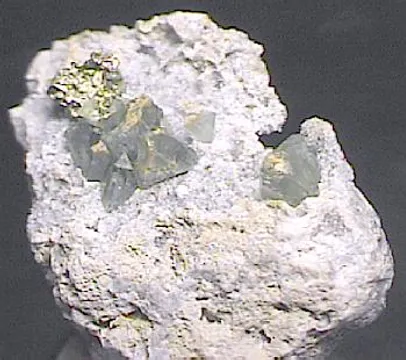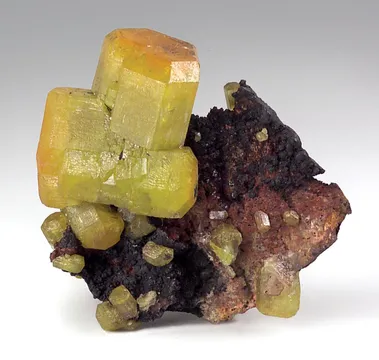
Siegerland, Germany: historic ore district known for classic siderite veins with galena, sphalerite, and chalcopyrite; prized specimens and mining heritage.
Key facts
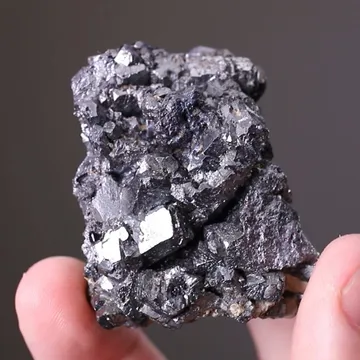
Siegerland is one of the great old European ore districts: a folded, faulted piece of the Rhenish Massif where iron, lead, zinc, copper, nickel, cobalt, bismuth, antimony, silver and a little gold were concentrated in hydrothermal veins worked for many centuries. For mineral collectors, its name means above all the classic “Siegerland-type” siderite veins—steep lodes in Devonian sedimentary rocks, locally opened by later hydrothermal events and carrying galena, sphalerite, chalcopyrite, tetrahedrite-group minerals, bournonite, pyrite, quartz, dolomite and siderite. The best cabinet pieces have an unmistakable old-German look: lead-gray galena perched on pale cream to tan siderite or dolomite, brass-yellow chalcopyrite with sharp modified crystals, and compact, heavy sulphide specimens whose metallics sit against a quiet carbonate gangue rather than a showy alpine matrix.
The district matters historically as much as mineralogically. Iron working in the region reaches back into the La Tène period; modern deep mining ended only in 1965, when the last Siegerland iron-ore operations were shut down. Between those poles lies a dense mining landscape of small adits, deep shafts, consolidated mine groups, inherited drainage galleries, dumps, museums, and old labels that may say “Siegen,” “Müsen,” “Eiserfeld,” “Herdorf,” “Katzwinkel,” “Biersdorf,” or simply “Siegerland.” That breadth is part of the appeal: a good specimen is not just a species label but a surviving fragment of one of Germany’s defining mining provinces.
Regional View
Country View
Geologically, the collector’s story is a story of repeated mineralizing pulses. Early quartz and cobalt-nickel arsenide/sulphide assemblages were followed by the economically dominant siderite-quartz phase; later sulphide deposition introduced or enriched sphalerite, galena, chalcopyrite, tetrahedrite and bournonite; still later antimony-, bismuth- and copper-bearing fluids overprinted some veins and produced complex sulphosalts. Oxidation and cementation zones then generated the bright secondary suite—lead, copper, zinc, nickel, cobalt, silver and iron minerals—that keeps Siegerland important to micromounters as well as classic sulphide collectors.

Photo: Wikimedia Commons

Photo: Wikimedia Commons
Search for specimens: View all specimens from Siegerland, Germany
Siegerland is best understood as a historical mining region rather than a single mine. In mineral-collection usage it commonly covers the old Siegerland ore district and the closely related Siegerland-Wied siderite district, straddling what are now North Rhine-Westphalia and Rhineland-Palatinate. The core geology is the Rhenish Massif, especially Devonian sedimentary rocks—slates, shales, siltstones and sandstones—cut by faults and fracture systems produced or reactivated during Variscan deformation. Hydrothermal fluids used those structures as plumbing. The result was a swarm of veins, mostly siderite-quartz veins, but locally carrying important Pb-Zn-Cu, Ni-Co-As-Sb-Bi and secondary oxidation assemblages.
The dominant ore was manganiferous siderite, the classic “Spateisenstein” of Siegerland mining. Near surface, weathering converted siderite and accompanying iron minerals into brown iron ores rich in goethite and limonite-like material, the “Eiserner Hut” that early miners could see and work without deep shafts. At depth, the carbonate lodes were exploited as steel-making iron ore. The district’s mineralogy is not a simple single-stage assemblage: early quartz-arsenopyrite/glaucodot-type material, the main siderite-quartz stage, the sphalerite-galena sulphide stage, local hematite-bornite and stibnite-bearing episodes, ankerite-quartz and barite-bearing lead-copper-zinc veins, oxidation-zone minerals, and locally even contact effects from younger basaltic activity all contribute to the range seen on old specimens and dump material.
Several mine groups define the collector’s mental map of Siegerland. Müsen and the Stahlberg area are essential, both for early documented mining and for the type locality of siegenite. Eiserfeld is equally important: the Eisenzecher Zug was one of the great consolidated workings, historically called the “Queen of the ironstone mines,” and the surrounding mines and veins yielded a broad primary and secondary suite. Salchendorf and the Pfannenberger Einigkeit mine are known to collectors for fine galena-chalcopyrite combinations and for old labelled material. Herdorf, Biersdorf and Daaden include the Füsseberg-Friedrich Wilhelm complex, one of the last great industrial mines of the district and a source of classic chalcopyrite-quartz-siderite specimens. Katzwinkel’s Vereinigung mine is especially familiar from attractive small cabinet specimens with galena, chalcopyrite, siderite and dolomite. Gosenbach’s Storch und Schöneberg mine anchors the type-locality story for ullmannite, while the Hollertszug near Dermbach/Herdorf is central to goethite and chalcosiderite history.
Mining history here is unusually long. Archaeological work has connected the Siegerland iron industry with La Tène-period activity, and modern sources regularly describe more than 2,500 years of mining and smelting in the region. The earliest miners exploited near-surface oxidized iron and copper ores; later generations drove adits, inherited drainage galleries, and ultimately deep shafts. By the nineteenth and twentieth centuries the economics shifted toward large-scale iron-ore production, though earlier centuries had valued the associated non-ferrous ores as well. In 1953, many surviving operations came under Erzbergbau Siegerland AG. The end came quickly after imported ores and changing steelworks contracts undermined the local industry: Füsseberg-Friedrich Wilhelm and Georg were among the last operations, closing on March 31, 1965.
Collectors today should treat Siegerland as a historical and museum district, not as an open collecting field. Many old mine sites are sealed, protected, unstable, forested, privately owned, or regulated as industrial heritage. The Stahlbergmuseum at Müsen and the Stahlberger Erbstollen preserve the Müsen mining story; the Reinhold Forster Erbstolln at Eiserfeld preserves part of the Eisenzecher Zug setting; and the mining museum in the Herdorf-Sassenroth area has presented exhibitions on Füsseberg-Friedrich Wilhelm and the Florz-Füsseberger vein system. Old dumps have yielded, and in places may still yield, micromount material and iron-rich oxidation specimens, but permission, safety, conservation rules and local regulations are essential. A “found on an old Siegerland dump” label without mine name is common; for serious collectors, a precise mine, village, vein or old collection label adds substantial value.
The most desirable specimen finds were not from broad open cavities like alpine clefts, but from localized drusy spaces, sulphide-rich zones, and late-stage replacements in carbonate-quartz veins. Galena may occur as modified cubes, cubo-octahedral crystals, flattened or spinel-law twinned forms, and etched or skeletal-looking groups. Chalcopyrite ranges from massive ore and disseminations to bright, sharply formed crystals on siderite, dolomite, baryte or quartz; some classic examples show curved faces or complex twinning. The best old specimens preserve the contrast of metallic sulphides with cream siderite or white dolomite and carry labels naming one of the better mines—Vereinigung, Pfannenberger Einigkeit, Füsseberg-Friedrich Wilhelm, Grimberg, Stahlberg, Brüderbund, Eisenzecher Zug, Wildermann, Neue Haardt, or one of the smaller but well-documented workings.
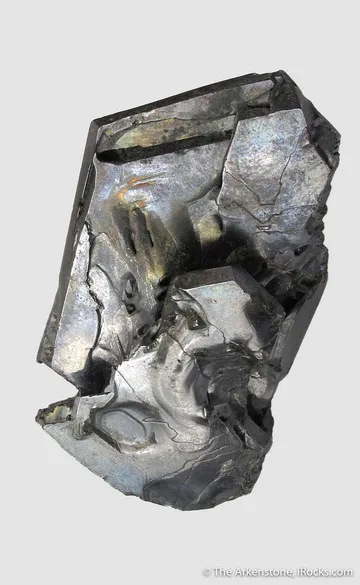
Siegerland galena is a classic sulphide-stage mineral, widespread across the district and especially valued where it is crystallized rather than massive in siderite ore. Good pieces show metallic lead-gray cubes, modified cubes or cubo-octahedra on siderite, dolomite, quartz, sphalerite or chalcopyrite; the small but elegant Vereinigung mine specimens from Katzwinkel are especially memorable for flattened, airy cubo-octahedral galena crystals, sometimes spinel-law twinned, sitting with bright chalcopyrite and pale tabular siderite or dolomite. Pfannenberger Einigkeit has produced attractive matrix pieces with cubic galena crystals reported to around 2 cm, and the Grimberg mine is represented by old aesthetic galena groups in the small-cabinet range. Ordinary Siegerland galena is heavy, massive, cleaved or bruised ore; the better collector pieces have isolated crystals, undamaged edges, bright metallic luster, visible association, and a specific mine attribution rather than a broad “Siegen” label.
Chalcopyrite is one of the district’s defining accessory-to-important sulphides, appearing both in the main siderite-quartz stage and through the later sulphide mineralization with sphalerite and galena. In ordinary ore it is brassy massive material, grains and veinlets in siderite or quartz, but the collector-grade pieces are sharp, lustrous, golden crystals on pale siderite, dolomite, quartz or baryte, often with galena, pyrite or sphalerite. The Friedrich Wilhelm and Füsseberg area is well known for the chalcopyrite-quartz-siderite look; Vereinigung specimens may show small twinned chalcopyrite crystals with strongly curved faces and sharp forms; and Pfannenberger-type pieces can be bright and architectural when chalcopyrite is scattered across contrasting matrix. Fresh luster is critical: pieces with natural golden sheen and crisp crystals stand well above tarnished, bruised or massive sulphide ore, although old, honest patina is acceptable on historic material.
Beyond galena and chalcopyrite, Siegerland is a district for specialists. Siderite is the great ore mineral and the visual matrix of many classics. Sphalerite, pyrite, marcasite, tetrahedrite-group minerals, bournonite, stibnite, semseyite, boulangerite, zinckenite, meneghinite and other sulphosalts document the district’s multistage hydrothermal history. Nickel-cobalt minerals are particularly important: siegenite has its type locality at the Stahlberg Mine in Müsen, and ullmannite is tied to the Storch und Schöneberg mine at Gosenbach. The oxidation zones and iron caps add goethite—classically linked to the Hollertszug—as well as chalcosiderite, pyromorphite, cerussite, linarite, brochantite, malachite, azurite, adamite, zincolivenite and many rarer arsenates, phosphates and sulphates. Other noteworthy Siegerland type-locality or type-locality-related species include phosphosiderite from the Kalterborn mine, mückeite from the Grüne Au mine, and gobelinite from the Schlänger und Eichert vein of the Eisenzecher Zug. Recent and modern work has also emphasized the district’s Bi-Ag sulphosalts and Au-Ag-Hg minerals, confirming that Siegerland still rewards careful ore microscopy long after the mines closed.
The first authenticity issue with Siegerland specimens is locality precision. Old labels often use “Siegen,” “Westphalia,” “Müsen,” “Herdorf,” “Sieg,” “Westerwald,” or “Siegerland” in ways that do not match modern administrative boundaries. This is not automatically suspicious; it reflects historical collecting and mining language. But value increases sharply when an old label names the exact mine—Vereinigung, Pfannenberger Einigkeit, Grimberg, Füsseberg-Friedrich Wilhelm, Stahlberg, Storch und Schöneberg, Eisenzecher Zug, Brüderbund, Neue Haardt, Kalterborn, Wildermann, Grüne Au, Hollertszug—or provides a collection pedigree.
Documented intentional fakes are not a major theme for this district, but misidentification and relabelling are real concerns. Old “linnaeite” from the Müsen/Stahlberg sphere may actually be siegenite; nickel-cobalt sulphides require analysis if the species matters. Similar-looking black or steel-gray sulphides—siegenite, ullmannite, gersdorffite, linnaeite-group minerals, pyrite/bravoite, galena and sphalerite—are easily confused in hand specimen. Brown iron oxides are another trap: “limonite,” goethite, lepidocrocite, hematite-rich material and manganese oxides are frequently used loosely on old labels. For micromount rarities, especially arsenates, phosphates, sulphates and Bi-Sb sulphosalts, SEM-EDS, Raman or microprobe support is much more persuasive than an inherited name.
Condition is a central grading point. Galena from Siegerland commonly shows cleaved corners, abrasion, old mining bruises and dull surfaces; sharp edges and undamaged high points are uncommon enough to matter. Chalcopyrite may tarnish, dull, or show small edge rubs; avoid specimens that look artificially brightened or chemically cleaned unless the treatment is disclosed. Siderite and dolomite matrices are often cleaved, bruised or iron-stained, and quartz points may be chipped. Many fine pieces are small—miniatures and small cabinets with one excellent crystal group are often more desirable than larger massive ore pieces.
Fluorescence is not a primary reason to collect Siegerland sulphide specimens, though individual associated carbonates or secondary minerals from specific mines may respond weakly or variably. More important are handling concerns: galena is a lead sulphide, and many Siegerland secondary minerals contain arsenic, copper, cobalt, nickel, antimony, bismuth, mercury or lead. Normal dry handling is not a problem for careful collectors, but do not grind, soak, acid-clean or ultrasonically clean complex ore specimens without knowing the assemblage. Wash hands after handling, keep friable secondary minerals away from children and pets, and store sulphides dry and stable.
Market availability is better than for many European classics because the district was vast and heavily collected, yet top examples are not common. Broad-locality massive siderite-sulphide pieces remain obtainable. Attractive galena with chalcopyrite on matrix, sharp chalcopyrite-siderite combinations, old-labelled siegenite or ullmannite, and verified micromount rarities from named mines are much scarcer. The best pieces tend to surface from old German collections, European dealer stock, and deaccessioned historical collections rather than from new mining.
In Siegerland, the story begins at the surface. The early miners did not need geological maps to find ore: the iron caps broke through on ridges and slopes as brown, workable weathering zones. Those oxidized outcrops—goethite- and limonite-rich residues above siderite veins—were visible targets, and the district’s wet forests and steep hills quietly supplied charcoal, ore and working ground for one of Central Europe’s important early iron landscapes. Archaeologists now place parts of that production deep in the La Tène world; the mining historian’s landscape and the collector’s matrix specimen are therefore linked by the same brown ironstone.
The old mine names still carry personality. Eisenzecher Zug was not merely another iron mine; Johann Philipp Becher called it the “Queen of the ironstone mines” in 1789. The name suits the scale. The Eisenzecher system became one of the deepest and most important mine groups in the Siegerland, tied to the Reinhold Forster Erbstollen, whose portal at Eiserfeld still represents the drainage and transport logic of the old district. A mineral specimen labelled Eisenzecher Zug carries that context: it is a small object from a mine group that grew from early workings into a consolidated deep-mining enterprise.
Müsen has a different tone—older, compact, and almost intimate. The Stahlberg mine was famous for high-quality iron ore, yet the Müsen area also carried non-ferrous mineralization that made it unusually interesting to collectors. Its surviving heritage is unusually tangible: the Stahlbergmuseum occupies the mining landscape, the Stahlberger Erbstollen can be visited, and the museum preserves tools, plans, mineral specimens and the memory of a mine whose documented story reaches back to the medieval period. To handle siegenite from Stahlberg is to handle not just a thiospinel from its type locality, but a specimen from a place where local mining memory has been deliberately kept alive.
The last chapter came abruptly. In the 1960s, cheap imported ore and cancelled supply contracts finished what centuries of changing technology had not. Füsseberg-Friedrich Wilhelm, one of the final large operations, had employed more than a thousand people at times and reached roughly 1,200 m depth. Georg, another of the last mines, worked deep ore as well. On March 31, 1965, the closure of the last Siegerland iron-ore mines ended the district’s industrial mining era. For collectors, that date explains why new production specimens do not appear: the best material now comes from old mine dumps, museums, inherited collections, and labels written before the district became history.