






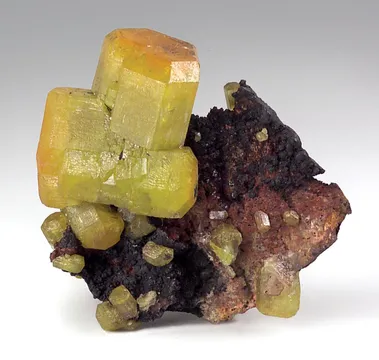
Harz Mountains, Germany - historic ore province notable for St. Andreasberg deposits: pyrargyrite, dyscrasite, calcite, pink apophyllite, prized by collectors.
Key facts
The Harz Mountains are not a single pocket locality but a compact, historically layered ore province whose name appears on classic labels from the oldest European cabinets. For collectors, “Harz” usually means one of several overlapping traditions: the thousand-year polymetallic massive-sulfide ore of Rammelsberg at Goslar; the Upper Harz silver-lead-zinc veins around Clausthal-Zellerfeld, Lautenthal, Wildemann and Bad Grund; and, above all for fine specimen connoisseurs, the small but extraordinary St. Andreasberg silver district, where dark ruby pyrargyrite, metallic dyscrasite, stephanite, breithauptite, native arsenic, pink apophyllite, harmotome and wildly varied calcite made a reputation out of all proportion to the district’s metal output.
Geologically, the province sits in the Variscan slate belt of central Germany, where Devonian to Carboniferous sedimentary and volcanic rocks were folded, faulted, intruded and later cut by hydrothermal systems. Rammelsberg is the great sediment-hosted Cu-Zn-Pb-Ba sulfide-barite deposit, a compact but rich, deformed body of pyrite, sphalerite, galena, chalcopyrite, barite and carbonate gangue. The Upper Harz and St. Andreasberg deposits are vein systems, many of them narrow, steep and structurally complicated, carrying lead-zinc-copper-silver ore with quartz, calcite, siderite, barite and locally exceptional late silver minerals, arsenides, antimonides and selenides.
The best Harz specimens have the old-European look serious collectors love: black-red pyrargyrite crystals that glow port-wine red only when backlit; bright silver-white dyscrasite and granular native arsenic, often with löllingite; delicate calcite habits from St. Andreasberg with names preserved in mining lore; pink apophyllite and sharp barium zeolites; massive, finely banded Rammelsberg ore; and micromount rarities in which a polished section may be more important than the hand specimen itself. A great Harz label is often as meaningful as the specimen, because many of the finest pieces were mined generations before modern locality recording became routine.
Regional View
Country View
The region’s mineralogical importance is unusually broad. Rammelsberg gave its name to goslarite and römerite as type-locality species and remains a reference deposit for shale-hosted Zn-Pb-Ag SEDEX-style ore. Clausthal gave its name to clausthalite, PbSe, one of the classic selenides. St. Andreasberg is the type area for important species and names including harmotome, breithauptite, arsenolite and samsonite, and in the 21st century it has continued to yield new mineral species such as roterbärite, gysinite-(Ce) and theuerdankite from carefully studied historical or newly examined material.

Photo: Wikimedia Commons

Photo: Wikimedia Commons
Search for specimens: View all specimens from Harz Mountains, Germany
For collecting purposes the Harz should be read as a province made of districts, not as a point on a map. The major specimen-producing sublocalities fall into three families. Rammelsberg, just south of Goslar, is the famous sediment-hosted massive sulfide-barite orebody. The Upper Harz veins around Clausthal-Zellerfeld, Lautenthal, Wildemann, Bockswiese and Bad Grund form the long-lived silver-lead-zinc mining heartland. St. Andreasberg, now part of Braunlage, is the small, highly mineralogically diverse silver district that supplied many of the most coveted cabinet specimens.
At Rammelsberg, the ore is a deformed, overturned, shale-hosted Cu-Zn-Pb-Ba massive sulfide system. Classic ore consists chiefly of pyrite, sphalerite, galena, chalcopyrite and barite with carbonate gangue, divided by miners and geologists into multiple ore types according to texture and metal content. Collectors encounter Rammelsberg most often as dense banded ore, massive sulfide pieces, weathering products and old museum material rather than open-vug crystal specimens. The mine operated for more than a millennium, produced nearly 30 million tonnes of ore in its modern historical accounting, closed in 1988 under Preussag, and became part of the UNESCO World Heritage property in 1992; the World Heritage listing was expanded in 2010 to include the Upper Harz Water Management System.
The Upper Harz vein district is different in both structure and specimen character. Its ores occupy fault-controlled veins in the Variscan basement, typically carrying galena, sphalerite, chalcopyrite, tetrahedrite-group minerals, siderite, quartz, calcite and barite. Around Clausthal-Zellerfeld, the Burgstätter, Zellerfelder and Rosenhöfer systems supported deep, technically advanced mining, later centralized through shafts such as Ottiliae and Kaiser Wilhelm. The broader Upper Harz crude ore production has been estimated at 36.9 million metric tonnes, yielding about 1.91 million tonnes of lead, 1.463 million tonnes of zinc and slightly more than 5,000 tonnes of silver. Most mines closed in 1930 after the collapse of metal prices during the world economic crisis; Bad Grund survived until 1992, when the Hilfe Gottes/Erzbergwerk Grund operation ended the long tradition of ore mining in the Upper Harz.
St. Andreasberg is the district that matters most to classic mineral collectors. Its veins occupy a horst-like block bounded by the Neufanger and Edelleuter fault systems. The veins are usually narrow, commonly averaging less than a metre thick, and dip steeply north to northeast. Mineralization is known to more than 800 metres depth. Country rocks include Middle Devonian slates, marly shales, sandstones and spilitic rocks, much of it affected by the contact aureole of the Brocken granite. The small size, changing wall rocks, repeated movement and variable mineralogy made mining difficult but made specimens exceptional.
The St. Andreasberg paragenesis is commonly described in successive stages. Early low-grade oxide-carbonate mineralization was followed by a main base-metal stage of galena, sphalerite, chalcopyrite and tetrahedrite. Later reactivation opened fractures and produced rich silver shoots together with nickel-cobalt arsenides, native arsenic and antimony in the celebrated “noble calcite” generation. Final remobilization of calcite and silver produced some of the district’s richest and finest specimen material. Ore shoots favored the footwalls of vein intersections and thick broken zones, such as the Silberburger Ruschel, where structure controlled the movement and trapping of hydrothermal fluids.
The Samson Mine at St. Andreasberg is the iconic name on labels. Opened in 1521, it ultimately reached great depth, was one of the world’s deepest mines in the mid-19th century, and produced until 1910. Its specimens were already famous in the 18th and 19th centuries and were sold through mineral depots at Clausthal. The mine is known for pyrargyrite, dyscrasite, stephanite, polybasite, argentopyrite, native silver, breithauptite, nickeline, native arsenic, löllingite, native antimony, chlorargyrite, pink apophyllite, harmotome, analcime and an almost bewildering range of calcite habits. Samsonite, the very rare silver-manganese-antimony sulfosalt, was discovered there in 1908 by Berginspektor Heinrich Werner at a depth of roughly 550 metres.
Roter Bär, east of St. Andreasberg in the Bären Valley, began as an iron-ore mine and is now an educational visitor mine. Its geology is unusually valuable because it exposes metasomatic iron ore, altered Devonian rocks, quartz-calcite veins and later polymetallic mineralization. It has become mineralogically prominent for selenide-bearing material and for roterbärite, PdCuBiSe3, described from tiny grains in clausthalite. The mine has been reopened and maintained by the St. Andreasberg historical and mining group, with visitor access by guided tour rather than collecting access.
Collecting access today is limited and must be approached conservatively. Rammelsberg, Samson, Roter Bär, Knesebeck and several other mine sites are museums, heritage monuments or managed visitor mines. Underground collecting is not part of normal visitation, and dumps and old workings may be protected for safety, heritage, environmental or nature-conservation reasons. In the Harz, where historic ore processing left heavy-metal and arsenic-bearing residues in places, old dumps are not merely collecting grounds; many are cultural and ecological sites. Serious modern Harz collecting usually means acquiring old specimens with labels, working with reputable European dealers, or visiting museums and educational mines to understand the geology rather than expecting open field access.
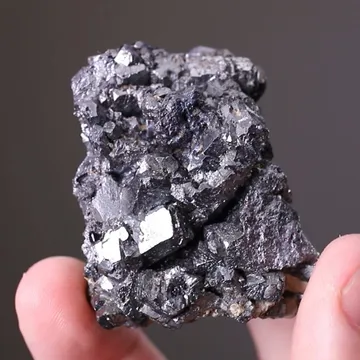
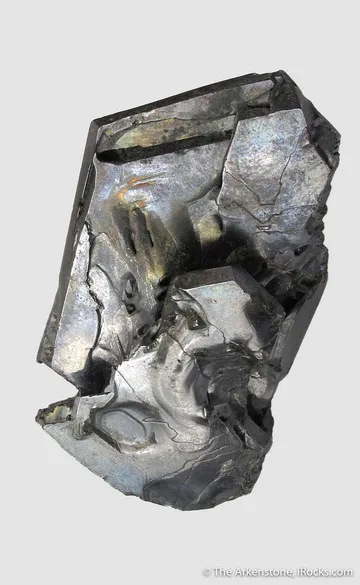
Pyrargyrite is the visual emblem of St. Andreasberg. The best Samson Mine crystals are dark, lustrous, nearly black by reflected light, but glow deep red when a strong light is placed behind them. Fine examples are commonly small, but their aesthetics are unmistakable: sharp rhombohedral to prismatic forms, brilliant faces, and a somber old-European color that rewards careful lighting. Compared with later showy material from Mexico or Chile, Harz pyrargyrite is generally more historic, more compact and more label-dependent, but top pieces remain among the finest classic European ruby silvers.
Dyscrasite is another St. Andreasberg signature. It occurs as metallic silver-white to tin-white masses, nodules, aggregates and rare crystal groups, often darkened by tarnish and associated with native arsenic, löllingite, calcite and other silver minerals. Many old specimens are deceptively unattractive until understood mineralogically: a dull gray nodule with arsenic crusts and minute arsenides may be far more important than a bright modern cabinet piece from a more common locality.
The silver-sulfosalt suite is a major reason the district is still studied. Stephanite, polybasite, pyrargyrite, pyrostilpnite, miargyrite, argentopyrite and related species are reported from the St. Andreasberg veins, with the richest pieces tied to late-stage silver remobilization. Because several of these minerals can be visually similar when dark, tarnished or minute, reliable identifications matter. Old labels saying simply “dark red silver ore” or “Rotgültigerz” may not be enough for species-level certainty unless the specimen has been examined.
Samsonite, Ag4MnSb2S6, is the locality’s rarest famous species. It was described from the Samson Mine and named for it. St. Andreasberg remains the classic locality, and the best crystals are tiny by cabinet standards but large for the species, reaching centimetric scale in exceptional historical material. Its scarcity is extreme; many collections will never hold a confirmed example, and much of the known material is locked in institutional or old private holdings.
Breithauptite, NiSb, gives St. Andreasberg a second important antimonide identity. It is a type-locality mineral for the district and appears in association with the nickel-cobalt-arsenide and native-arsenic suite. In hand specimens it is easily overshadowed by pyrargyrite and calcite, but for systematic collectors a St. Andreasberg breithauptite with old provenance is a serious piece.
Harmotome, the barium zeolite historically known in part through the Harz as “Andreasbergolith” or cross-stone, is one of the locality’s great non-ore species. The district’s harmotome occurs with calcite and other late vein minerals, and older European labels may emphasize the cruciform twinning rather than modern nomenclature. Analcime is another sought-after zeolite from St. Andreasberg; old German collector vocabulary preserves the phrase “Andreasberger Tautropfen,” or Andreasberg “dew drops,” for attractive analcime crystals.
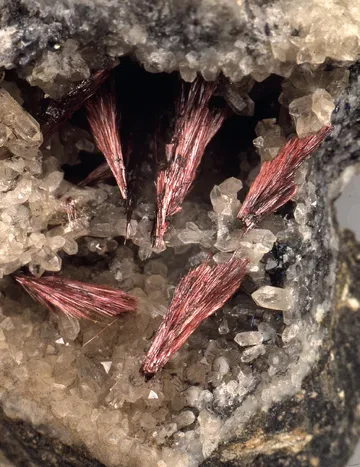
Calcite from St. Andreasberg deserves more respect than it sometimes receives from collectors who focus only on silver minerals. The district is famous for an extraordinary variety of habits, including thin platy forms and complex scalenohedral and rhombohedral combinations historically distinguished by miners and collectors as paper spar, leaf spar, cannon spar, cube spar and composite spar. Manganese-bearing pink calcite and pink apophyllite add color to an assemblage otherwise dominated by silver-gray, black and white.
Native arsenic and löllingite are characteristic and often essential to the St. Andreasberg look. Native arsenic may form gray, botryoidal or nodular masses; löllingite can appear as sparkling coatings or crystals on arsenic-rich material. These are not casual handling minerals. They are part of what made the district mineralogically distinctive, but they also require storage and handling with respect.
Chlorargyrite, especially the old variety name “Buttermilcherz,” is a distinctive supergene silver mineral from St. Andreasberg. Theuerdank Mine material is notable for its pale, soft-looking silver chloride masses that darken with exposure to light. Such material is historically and chemically fascinating but can be fragile, visually unstable and easily misrepresented if the old variety name is treated as a separate species.
Rammelsberg is best known not for large open crystals but for ore minerals and secondary sulfates. Sphalerite, galena, pyrite, chalcopyrite and barite define the deposit, while goslarite, ZnSO4 · 7H2O, and römerite, Fe2+Fe3+2(SO4)4 · 14H2O, are type-locality species tied to the oxidation of sulfide ore. Fine Rammelsberg specimens are often mineralogical documents: banded ore, polished slabs, old mine pieces, or delicate post-mining sulfate material that must be treated as humidity-sensitive and potentially ephemeral.
Clausthalite, PbSe, belongs to the Harz selenide story. Named for Clausthal, it occurs in the Harz at localities including the Clausthal district and selenide-bearing occurrences around St. Andreasberg. It is typically a dense, gray to lead-gray metallic mineral, rarely showy in a conventional crystal sense, but extremely important historically and scientifically. In polished section, clausthalite can host microscopic inclusions of rarer selenides and precious-metal phases.
Roterbärite, PdCuBiSe3, is a modern reminder that the Harz is not exhausted mineralogically just because mining ended. Described from the Roter Bär Mine, it occurs as euhedral to subhedral grains only up to about 50 micrometres across, enclosed in clausthalite and associated with gold, mertieite-II, bohdanowiczite, hematite, chalcopyrite, barite, ankerite and dolomite. It is not a cabinet mineral; it is a polished-section and analytical mineral, but it gives the St. Andreasberg district a remarkable platinum-group selenide footnote.
Rhodonite adds a very different chapter from the eastern Harz. Its type locality is the Kaiser Franz, or König Wilhelm, Mine at Schävenholz near Elbingerode in Saxony-Anhalt. Harz rhodonite is not the same collecting proposition as modern ornamental rhodonite from large manganese deposits elsewhere; its importance is historical and systematic, tied to the early definition of the species.
Newer St. Andreasberg species have kept the locality current. Gysinite-(Ce), PbCe(CO3)2(OH)(H2O), was approved from the Abendröthe Mine, where the rare-earth carbonate occurs in association with albite, calcite and mimetite. Theuerdankite, Ag3AsO4, was described from the Alter Theuerdank Mine at Beerberg as dark violet to reddish-black grains in strongly supergene-weathered silver-rich material with native silver, chlorargyrite and calcite. These are not marketplace minerals in the usual sense, but they matter because they show how much species-level information remains hidden in old Harz material.
Harz specimens reward provenance. The first question is not “Is it from the Harz?” but “Which mine, which vein or district, and how old is the label?” A label reading only “Harz” may be acceptable for a 19th-century cabinet piece, but it is not equivalent to “Samson Mine, St. Andreasberg,” “Rammelsberg Mine, Goslar,” or “Hilfe Gottes, Bad Grund.” Broad Harz labels often conceal very different deposit types and mineral assemblages, so sublocality precision has real market and scientific value.
Misidentification is the principal authenticity issue. Dark silver sulfosalts from St. Andreasberg can be difficult to separate visually: pyrargyrite, stephanite, polybasite, pyrostilpnite and related species may all appear black or red-black in hand specimen. Dyscrasite may be tarnished, native arsenic may be altered or coated, and breithauptite or nickeline may require analytical confirmation when present as small metallic grains. For expensive pieces, a dealer’s confidence should rest on a chain of provenance, previous collection history or analytical work, not on color alone.
Beware of over-specific modern labels on old material. A specimen from an old European collection may have been relabeled several times, translated from German, or upgraded from a district label to a famous mine name because the association “looked right.” “Andreasberg” material is commonly safe as a district attribution when the mineral suite is characteristic, but assigning it to Samson, Catharina Neufang, Gnade Gottes, Alter Theuerdank or Abendröthe should require stronger evidence.
Condition is central to value. Pyrargyrite is brittle and can show bruising on edges; the best crystals are lustrous and sharp, with minimal rubbing. Backlighting can reveal the internal red color, but prolonged intense light is not advisable for display. Chlorargyrite is light-sensitive and can darken rapidly; specimens described historically as Buttermilcherz should be stored in low light and handled as delicate supergene silver chloride material. Rammelsberg sulfates such as goslarite and römerite are humidity-sensitive and should not be kept in damp cabinets or subjected to repeated environmental swings.
Arsenic-bearing Harz specimens deserve careful handling. Native arsenic, arsenolite, löllingite, realgar/orpiment associations where present, and arsenate alteration minerals should be kept away from food preparation areas, children and pets. Do not trim, saw, grind or ultrasonically clean arsenic-rich material. Wash hands after handling and keep friable specimens boxed or sealed. The same caution applies to selenide-rich polished sections and heavy-metal secondary crusts from Roter Bär, Clausthal and Rammelsberg.
Market availability is uneven. Rammelsberg ore pieces and modest massive sulfide specimens are obtainable, especially through German and European dealers, but fine crystallized material and good old labels are scarcer. St. Andreasberg pyrargyrite, dyscrasite, stephanite and pink apophyllite appear periodically but true top examples are fiercely competed for. Samsonite is genuinely rare, and confirmed crystals are institutional-level or advanced-specialist material. Roterbärite, gysinite-(Ce) and theuerdankite should be regarded as analytical species for systematic reference collections rather than normal display minerals.
On 12 December 1777, Johann Wolfgang von Goethe went underground at St. Andreasberg. His diary note is wonderfully terse: “Abends eingefahren in Samson, durch Neufang auf Gottes Gnade heraus. Ward mir sehr sauer diesmal.” The sentence is often softened in English, but the physicality matters. He entered by Samson, came out by Neufang “by God’s grace,” and found the trip bitterly hard. This was not a scenic tunnel walk; it was an 18th-century descent through the working world that produced the dark ruby silvers later prized by collectors.
The Samson Mine became a monument not because it was large in modern industrial terms, but because it preserved the machinery and the vertical ambition of old Harz mining. The inclined shaft reached its final depth in the 19th century, and the mine developed 42 levels. Its great reversible waterwheel of 1824, roughly 9 metres in diameter, worked with rope drums and braking gear to move ore and materials. In 1837 a man-engine was installed, powered by a 12-metre waterwheel, to move miners through a working depth that exceeded 600 metres and later approached 800 metres. For a collector holding a thumbnail of Samson pyrargyrite, the engineering context is part of the specimen: those crystals came from a mine where water, rope, timber, iron and human endurance were as important as silver.
The Harz also gave mining engineering one of its quiet revolutions. In 1834, at Clausthal, Wilhelm Albert developed the wire hoisting rope, the “Albert rope,” a technology born from the demands of deep metal mining. Within this same technical culture, man-engines and water-management systems made the narrow veins workable long after simpler mines would have been abandoned. The Upper Harz Water Management System, with its ponds, ditches, tunnels and underground drains, is not just a heritage landscape; it is the reason deep Harz mineralization could be followed downward.
Samson’s end came slowly. Compressed-air drilling installed in 1890 raised annual output to about 10,000 metric tonnes, but the ore was poorer, silver prices were low, and hoisting from depth was expensive. After the pumps were stopped in 1910, water rose through the workings to the main drainage level. Two years later, the mine began a second life as an underground power source: water management that had served silver mining was redirected to generate electricity. The same hydrologic machine that once made ore possible kept functioning after the ore was gone.
The strangest upstairs room at Samson may be the canary museum. The Harzer Roller canary arrived with Tyrolean miners in the 18th century, and by the 19th century canary breeding had become economically important in St. Andreasberg. In 1883, about 350 families in the town were breeding birds, and as many as 150,000 were exported in a year to destinations including North America, South America and Australia. It is an unexpectedly tender postscript to a hard silver district: after the veins declined, songbirds helped carry the town’s name into the wider world.
Roter Bär tells a different story, one of rescue. The old iron mine had worked brown ironstone from the beginning of the 19th century until 1866, then saw renewed exploration in the 1920s when up to 42 miners drove kilometres of galleries without finding reserves worth mining. It opened as a visitor mine in 1931, fell into disrepair after the war, and by 1988 was no longer accessible because of collapses. A mining working group formed that year and began securing and reopening the workings. More than a museum display, Roter Bär became a working educational mine where historical mining practice, geology and preservation intersect. Its later reward was mineralogical as well as cultural: tiny selenide-bearing veinlets, studied with modern methods, yielded roterbärite.
The Alter Theuerdank Mine has its own small drama in the behavior of silver chloride. A documented chlorargyrite specimen collected there in 1995 was described as snow-white when brought to daylight, then turning gray-blue in about 45 minutes. That is exactly the kind of field detail collectors should remember: some Harz minerals are not static objects. They continue to react to light, humidity and air long after leaving the vein.
Guenter Grundmann, Thomas P. Moore and Wendell E. Wilson, “The St. Andreasberg Mining District, Western Harz Mountains, Niedersachsen, Germany,” The Mineralogical Record, 48(3), May–June 2017, pp. 301–410. A major collector-focused treatment of the St. Andreasberg silver district, its mines and its classic minerals. https://www.researchgate.net/publication/317176372_The_St_Andreasberg_Mining_District_Western_Harz_Mountains_Niedersachsen_Germany
Nicole Nolte, Wilfried Ließmann and Bernd Lehmann, “Clausthalite (PbSe) and tiemannite (HgSe) from the type locality: New observations and implications for metallogenesis in the Harz Mountains, Germany,” Ore Geology Reviews, 2018. A modern study of historical Harz selenide material from the Clausthal district. https://www.sciencedirect.com/science/article/pii/S0169136818305523
Anna Vymazalová, Alexandre R. Cabral, František Laufek, Wilfried Ließmann, Chris J. Stanley and Bernd Lehmann, “Roterbärite, PdCuBiSe3, a new mineral species from the Roter Bär mine, Harz Mountains, Germany,” Mineralogy and Petrology, 114, 2020, pp. 443–451. Formal description of the palladium-copper-bismuth selenide from Roter Bär. https://handbookofmineralogy.org/pdfs/Roterbarite.pdf
Jakub Plášil, Jiří Sejkora, Zdeněk Dolníček, Václav Petříček, Joy Désor, Juraj Majzlan, Manfred Gross, Gerhard Möhn and Christian Schürmann, “Theuerdankite, Ag3AsO4, a new mineral from the Alter Theuerdank Mine, St. Andreasberg, Germany,” Mineralogical Magazine, 88(5), 2024, pp. 557–564. Formal description of the silver arsenate from supergene-weathered St. Andreasberg material. https://www.cambridge.org/core/journals/mineralogical-magazine/article/theuerdankite-ag3aso4-a-new-mineral-from-the-alter-theuerdank-mine-st-andreasberg-germany/749901CDE123C70965ACFBF230204963
Anthony R. Kampf, Gerhard Möhn, Chi Ma, Joy Désor and Manfred Groß, “Gysinite-(Ce), IMA 2023-035,” in CNMNC Newsletter 74, European Journal of Mineralogy, 35, 2023. IMA notice for gysinite-(Ce) from the Abendröthe Mine, St. Andreasberg. https://ejm.copernicus.org/articles/35/659/2023/
TU Clausthal Geomuseum, “Samsonit.” A museum account of samsonite from the Samson Mine, including the historical discovery context and associated minerals. https://www.geomuseum.tu-clausthal.de/mineralogie/minerale/minerale-alphabetisch/samsonit
Wilfried Ließmann, field-trip notes, “Economic Geology and History of Mining Operations of the Harz Vein Deposits,” University of Potsdam PDF. A concise geological and historical overview of the western Harz vein districts, St. Andreasberg, Samson and Roter Bär. https://www.uni-potsdam.de/fileadmin/projects/spp2238/Bilder/Dokumente/Field_trip_plan.pdf
SGA Mineral Deposit Archive, “Rammelsberg Cu-Zn-Pb sulfide-barite deposit,” field notes PDF. A technical summary of the Rammelsberg SEDEX-style massive sulfide deposit and its ore textures. https://www.e-sga.org/fileadmin/sga/Mineral_Deposit_Archive/Rammelsberg/RammelsbgVs2-Notes.pdf
“Mines of Rammelsberg, Historic Town of Goslar and Upper Harz Water Management System,” UNESCO/NHK. A short World Heritage overview of the Rammelsberg-Goslar-Upper Harz mining landscape. https://whc.unesco.org/en/list/623/video/
“Mines of Rammelsberg, Historic Town of Goslar and Upper Harz Water Management …,” UNESCO YouTube channel. UNESCO’s video introduction to the World Heritage property. https://www.youtube.com/watch?v=aw9JRL2-uY8
“Mines of Rammelsberg, Historic Town of Goslar, and Upper Harz Water System, Germany,” World Heritage Journeys. A visitor-oriented overview of the mining landscape and its medieval to modern significance. https://www.youtube.com/watch?v=jSl_iivgUaM
“Rammelsberg mine | Goslar in the Harz | Germany,” Anderswohin / Ulrich Kronenberg. A filmed visitor-mine tour showing the underground and surface museum context. https://www.youtube.com/watch?v=nPm2f7JUWec
Mindat: Harz Mountains, Germany — Broad mineral list and locality hierarchy for the Harz province.
Mindat: St Andreasberg, Braunlage, Goslar District, Lower Saxony — Essential reference for the St. Andreasberg silver district and its sublocalities.
Mindat: Samson Mine, St Andreasberg — Locality page for the classic Samson Mine, type locality of samsonite and source of many major silver specimens.
Mindat: Rammelsberg Mine, Goslar — Locality page for the Rammelsberg massive sulfide deposit, including goslarite and römerite type-locality information.
Mindat: Roter Bär Mine, St Andreasberg — Reference page for the Roter Bär Mine, important for roterbärite and selenide-bearing material.
UNESCO World Heritage Centre: Mines of Rammelsberg, Historic Town of Goslar and Upper Harz Water Management System — Authoritative heritage overview of the mining landscape, its history and its protected status.
World Heritage Site Rammelsberg Museum and Visitor Mine — Official visitor information for the Rammelsberg mine museum at Goslar.
GeoPark Harz: Red Bear Pit — Visitor and geological information for the Roter Bär educational mine at St. Andreasberg.
Knesebeck Shaft Mining Museum, Bad Grund — Visitor information for the Bad Grund mining museum connected with the last operating Upper Harz ore mine.
Upper Harz Water Management System, UNESCO World Heritage in the Harz — Overview of the ponds, ditches, tunnels and water-power system that made deep Harz mining possible.
Wikimedia Commons: Pyrargyrite from the Samson Mine — Freely licensed image of a classic Samson Mine pyrargyrite specimen.
Wikimedia Commons: Chlorargyrite, variety Buttermilcherz, from Theuerdank Mine — Useful visual reference for the light-sensitive silver chloride material from St. Andreasberg.


.jpg)