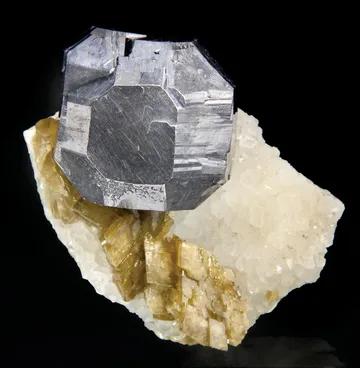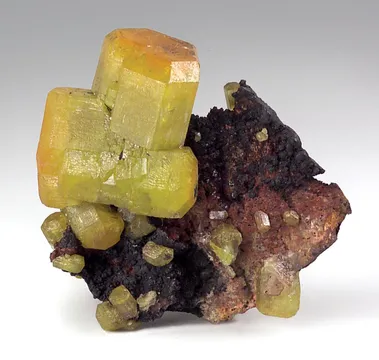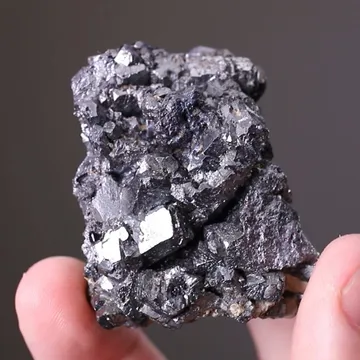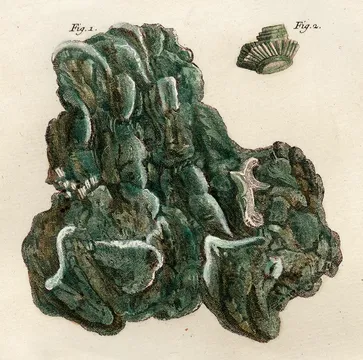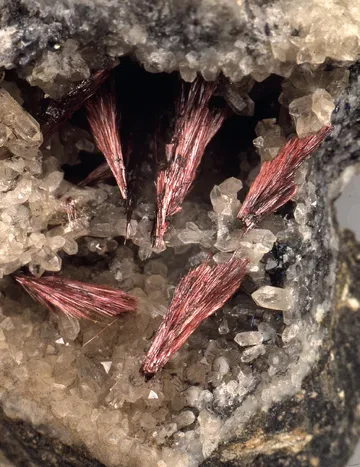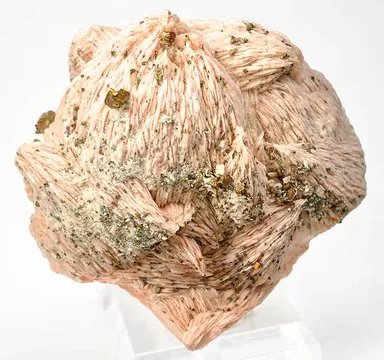
North Rhine-Westphalia, Germany — a dense ore province with Siegerland quartz on siderite, Ramsbeck lead–zinc veins, and Meggen/Mechernich textures prized by c…
Key facts
North Rhine-Westphalia is not a single mineral locality in the narrow sense; it is a compact mineral province whose best specimens come from several historically distinct ore districts packed into the Rhenish Massif and its northern foreland. For collectors, the state matters above all for three intertwined traditions: the siderite–quartz–base-metal veins of the Siegerland, the lead-zinc-silver veins of Ramsbeck in the Sauerland, and the great sediment-hosted and sandstone-hosted lead-zinc deposits of Meggen and Mechernich. Add the old Aachen-Stolberg and Bensberg calamine districts, the Brilon/Sauerland carbonate-hosted lead-zinc occurrences, and the smelter-slag localities around Stolberg, Letmathe, and Arnsberg, and the result is one of Germany’s densest historical ore landscapes.
The collecting personality of the region is correspondingly varied. Classic Siegerland pieces are dark, heavy, and architectural: lustrous quartz crystals on brown siderite, brass-yellow chalcopyrite, galena, sphalerite, and steel-grey nickel-cobalt minerals. Ramsbeck adds delicate secondary copper-zinc sulfates and carbonates to a lead-zinc vein assemblage, including the green type mineral ramsbeckite. Meggen is less famous for showy cabinet pieces than for its world-class importance as a stratiform pyrite-sphalerite-barite orebody; its specimens speak in massive pyrite, sphalerite-rich ore, barite, and polished sections rather than in flamboyant crystals. Mechernich, by contrast, is a lead-mining landscape of galena-impregnated Triassic sandstone—the famous “Knottensandstein”—where ore textures, mining history, and environmental legacy are often as interesting as individual display crystals.
Regional View
Country View
North Rhine-Westphalia’s strongest mineralogical claim is its type-locality record. Ramsbeckite was described from the Bastenberg Mine at Ramsbeck; siegenite takes its name from the Siegen district and has its type occurrence at the Stahlberg Mine at Müsen; ullmannite has its type locality at Storch und Schöneberg in Gosenbach; phosphosiderite was described from the Kalterborn Mine near Eiserfeld; and heteromorphite is tied to the Caspari Mine at Uentrop near Arnsberg. In more recent systematic work, the Eisenzecher Zug Mine at Eiserfeld also became the German cotype locality for gobelinite, a cobalt-bearing member of the ktenasite group.


Photo: Wikimedia Commons
Search for specimens: View all specimens from North Rhine-Westphalia, Germany
The bedrock framework behind most of North Rhine-Westphalia’s classic ore specimens is the Rhenish Massif, particularly the Sauerland and Siegerland portions of the Variscan belt. In the Siegerland, Devonian sedimentary rocks were folded and cut by hydrothermal veins carrying siderite, quartz, and a complex suite of sulfides. The collector’s shorthand “Siegerland” is important but potentially treacherous: the historical mining district crosses modern state boundaries, so labels must be read carefully. A specimen marked simply “Siegerland” may belong to North Rhine-Westphalia, Rhineland-Palatinate, or the border zone between them.
The Siegerland veins are the source of some of the state’s most characteristic display material. Mines around Müsen, Gosenbach, Eiserfeld, Neunkirchen, Salchendorf, and Wilnsdorf produced siderite with quartz, chalcopyrite, galena, sphalerite, pyrite, and a notable suite of cobalt-nickel sulfides and sulfosalts. The Stahlberg Mine at Müsen is especially important historically and mineralogically; it is associated with high-quality iron ore and with the type-locality record of siegenite. Storch und Schöneberg at Gosenbach is the classic type locality for ullmannite, while the Kalterborn Mine at Eiserfeld is the type locality for phosphosiderite. The Eisenzecher Zug Mine, a consolidated and highly important Siegerland operation, worked iron-copper-cobalt ores and is significant for both older cobalt-nickel mineralogy and modern sulfate-systematics work.
Ramsbeck, in the Hochsauerland near Bestwig, is a different collector’s world. The Ramsbeck ore field worked lead-zinc-silver veins hosted in Devonian schists and related rocks, with the Bastenberg and Dörnberg vein systems among the best-known names. The deposit was mined for centuries and remained active into the modern era, closing on January 31, 1974, when metal prices and the low grade of the remaining ore made continued production uneconomic. Its underground workings are not a collecting field today; the principal legal access is through the Sauerländer Besucherbergwerk Ramsbeck, now an important mining museum and visitor mine. Old Ramsbeck specimens, however, remain central to German systematic collections because the district produced a rich oxidation assemblage over galena-sphalerite-chalcopyrite ore, including ramsbeckite, linarite, cerussite, anglesite, pyromorphite, rosasite, smithsonite, brochantite-group and langite-group minerals, and other secondary copper-zinc sulfates.
Meggen, near Lennestadt in the Olpe district, is best understood as a major stratiform sediment-hosted pyrite-sphalerite-barite deposit rather than a pockety collector mine. The ore formed roughly 370 million years ago in the Devonian Meggen basin, where hot, metal-bearing fluids produced a central pyrite-sphalerite-galena body fringed by barite. Mining began in the early 1850s, at first centered on pyrite for sulfuric-acid manufacture. Later, barite and zinc-lead concentrates became increasingly important. The Siciliaschacht, preserved today as a mining museum, belonged to the Sachtleben operation, and the Meggen mine finally closed in 1992 after the economically workable reserves were exhausted. Meggen specimens are commonly massive to granular rather than showy: pyrite-rich ore, sphalerite-bearing bands, galena, barite, and polished or sawn material illustrating the stratiform texture of the deposit.
Mechernich, in the northern Eifel portion of the state, is one of Europe’s historically great lead districts. The ore is famous for galena nodules and impregnations in Triassic sandstone, especially the “Knottensandstein,” rather than for open cavities lined with well-developed crystals. Mining around Mechernich and Kall has roots extending back to Celtic and Roman exploitation, with written references to Mechernich lead mining by the late medieval period. By the nineteenth century the industry had transformed Mechernich into a mining town; the Magdalenenhütte smelter and its tall chimney, the “Lange Emil,” became a landmark of the district. Production ended at the close of 1957, and the modern Bergbaumuseum Mechernich preserves part of the old Günnersdorf workings as a visitor mine. Collecting around Mechernich must be approached with particular care because the district’s lead-rich soils and slags are a documented environmental issue, not an open invitation to gather ore.
The Aachen-Stolberg and Bensberg districts add the state’s classic zinc-lead carbonate and calamine story. At Stolberg, Aachen, and nearby localities, hydrothermal Pb-Zn mineralization in Devonian and Dinantian limestones was deeply weathered, producing calamine ores dominated historically by zinc carbonates and silicates, with limonite, cerussite, galena remnants, and other secondary species. The Diepenlinchen Mine near Stolberg was the largest operation in the Aachen-Stolberg district. East of Cologne, the Bensberg ore district and the Lüderich Mine represent another major Pb-Zn mining landscape; Lüderich remained active until 1978 and was among the last significant lead-zinc producers of its district.
Modern collecting access across North Rhine-Westphalia is limited and must be treated conservatively. Many underground workings are closed, flooded, collapsed, gated, protected as industrial monuments, or incorporated into visitor museums. Dumps may be private, reclaimed, forested, contaminated, or nature-protected. The best collector practice is to treat published localities as historical and mineralogical references, not as access permission. Museums at Ramsbeck, Mechernich, Meggen, and Müsen are the safest ways to see the geology and mining landscape in context; specimen acquisition is usually through old collections, German dealer stock, micromount exchanges, and carefully documented estate material.
North Rhine-Westphalia is especially important for minerals whose names and type localities are tied to the Siegerland and Sauerland. Ramsbeckite, (Cu,Zn)15(SO4)4(OH)22 · 6H2O, is the most locality-branded of these: a green secondary copper-zinc sulfate named for Ramsbeck and described from the Bastenberg Mine. It is a micromount mineral by normal collector standards, occurring as tiny green crystals or coatings in the oxidized part of a lead-zinc-copper system. Its appeal is not size but identity: a genuine Ramsbeckite from Bastenberg carries the locality name, the type status, and the characteristic oxidation chemistry of the Sauerland veins in one small specimen.
Siegenite, CoNi2S4, belongs to the linnaeite subgroup of the thiospinels and was named for the Siegen district. The Stahlberg Mine at Müsen is its type locality. Good identified siegenite specimens from the district are not common; the mineral is more often a collector’s analytical problem than a visually obvious cabinet mineral. It can occur with siderite, quartz, chalcopyrite, linnaeite-group minerals, and other cobalt-nickel sulfides. Because older labels may use broad or outdated cobalt-nickel sulfide names, serious specimens deserve analytical confirmation if the species name drives the value.
Ullmannite, NiSbS, is another keystone species. Its type locality at Storch und Schöneberg in Gosenbach makes North Rhine-Westphalia central to the history of nickel-antimony sulfide mineralogy. The best ullmannite specimens are metallic grey to silver-grey, sometimes in platy or cubic-looking aggregates, and old European labels can greatly enhance desirability. As with siegenite, visual identification is not always enough; ullmannite can be confused with other grey metallic minerals in the cobaltite-gersdorffite-ullmannite neighborhood.
Phosphosiderite, FePO4 · 2H2O, was described in 1890 from the Kalterborn Mine at Eiserfeld. Modern collectors often associate phosphosiderite with pink to purple massive or botryoidal material from pegmatitic or phosphate-rich occurrences elsewhere, but the type material from Kalterborn is a very different proposition: historically important, scarce, and not normally encountered as colorful lapidary-style material. Type-locality phosphosiderite is therefore a label-driven rarity.
Heteromorphite, Pb7Sb8S19, gives the Caspari Mine at Uentrop its place in the systematic canon. Caspari was an antimony mine rather than a typical Pb-Zn collector locality, and its suite includes stibnite, boulangerite, jamesonite, berthierite, bournonite, plagionite, semseyite, zinkenite, valentinite, senarmontite, cervantite, and other Sb-Pb minerals. Heteromorphite itself is rare and visually unhelpful without analysis; many fibrous or “feather ore” specimens historically labelled heteromorphite are better treated skeptically unless supported by modern work.
The broader Siegerland assemblage is what most collectors will actually see on the market. Siderite is the backbone: brown rhombs and lenticular crystals, often associated with quartz, chalcopyrite, galena, sphalerite, and pyrite. Quartz from the district may be clear rock crystal or more modest drusy material, and chalcopyrite can provide bright metallic contrast against the darker carbonate matrix. Pfannenberger Einigkeit at Salchendorf is one of the familiar North Rhine-Westphalian names for quartz-siderite-chalcopyrite specimens. Mines such as Eisenzecher Zug, Brüderbund, Stahlberg, Storch und Schöneberg, and others add cobalt-nickel minerals, tetrahedrite-group minerals, sulfosalts, and secondary copper species.
Ramsbeck’s collector suite is strongest in secondary lead, zinc, and copper minerals. Galena and sphalerite are the primary economic sulfides, with chalcopyrite and pyrite in the ore assemblage. Oxidation produced cerussite, anglesite, pyromorphite, linarite, malachite, smithsonite, rosasite, brochantite-group material, langite-related phases, schulenbergite-type minerals, and ramsbeckite. Many Ramsbeck specimens are small and systematic; the best are attractive under magnification, with blue linarite, green copper-zinc sulfates, white to colorless cerussite, or yellow-green pyromorphite on oxidized vein material.
Meggen is mineralogically important in a different way. The chief species—pyrite, sphalerite, galena, and barite—record a large SEDEX-style system rather than a classic Alpine-style crystal pocket. Pyrite can be abundant and fine-grained, sphalerite is commonly intergrown in the ore, and barite forms a major part of the marginal and overlying mineralization. For collectors, Meggen is a locality where polished sections, ore textures, and stratiform relationships can be more meaningful than isolated crystals.
Mechernich is best known for galena in sandstone, with subordinate sphalerite and oxidation minerals such as cerussite and anglesite documented in the district. Specimens often show ore geology better than crystal beauty: lead-rich nodules, disseminations, and impregnations in reddish or pale sandstone. Old Mechernich pieces with mine or level data are desirable because they anchor the specimen to one of Europe’s classic lead-mining landscapes.
The Aachen-Stolberg and Bensberg districts are the state’s traditional zinc-ore and calamine realm. Smithsonite, hemimorphite, hydrozincite, cerussite, galena, sphalerite, limonite, and related secondary minerals define much of the older collector material. Stolberg also has an important anthropogenic mineral dimension: smelter-slag localities around Münsterbusch, Binsfeldhammer, and related sites have yielded numerous lead, zinc, copper, chloride, carbonate, and sulfate phases. These can be fascinating, but they must be sold and catalogued clearly as slag or anthropogenic occurrences, not as natural ore-pocket minerals.
Locality precision is the first rule for North Rhine-Westphalia specimens. “Siegerland” is historically meaningful but geographically imprecise. The district straddles North Rhine-Westphalia and Rhineland-Palatinate, and some famous “Siegerland” reference localities—most notably the type locality of goethite at Hollertszug near Herdorf—are not in North Rhine-Westphalia. A specimen offered as “North Rhine-Westphalia” should ideally carry a mine name, village, district, and older collection label.
Analytical caution is essential for the cobalt-nickel minerals. Siegenite, linnaeite, carrollite, polydymite, grimmite-related compositions, ullmannite, gersdorffite, and cobaltite-group minerals can be visually similar as grey metallic grains or crystals in siderite-quartz-sulfide ore. Older German labels are valuable historical documents, but they are not a substitute for modern EDS, electron microprobe, or XRD when the exact species is important.
Heteromorphite is a special case. Fibrous Pb-Sb sulfosalts historically called “feather ore” or “plumosite” have often been labelled too broadly, and heteromorphite has been a particular recipient of optimistic or inherited names. Unless a Caspari specimen is documented by analysis or comes from a highly reliable old systematic source, treat the name as provisional. The same caution applies to rare Ramsbeck secondary sulfates where tiny blue-green crusts may require XRD or EDS to separate ramsbeckite, schulenbergite-like phases, langite, brochantite-group minerals, and related copper-zinc sulfates.
Condition issues vary by district. Siegerland quartz-siderite specimens are generally robust, but siderite edges bruise, chalcopyrite tarnishes, and old iron-carbonate matrix may shed limonitic dust. Ramsbeck microminerals can be delicate and should not be cleaned aggressively; copper-zinc sulfates and fine linarite sprays can be ruined by water, acid, ultrasonic cleaning, or careless brushing. Mechernich galena-sandstone specimens may be friable and should be kept dry, handled with normal lead-ore hygiene, and not used as children’s handling pieces. Slag specimens from Stolberg, Letmathe, and other smelter sites may contain soluble or environmentally sensitive lead, zinc, copper, and chloride phases; keep them dry, boxed, and clearly labelled.
Fluorescence is not the defining collector feature of the major ore districts, though calcite, some smithsonite or hydrozincite material, and certain slag minerals may respond under ultraviolet light. The better reason to use UV and magnification is diagnostic: coatings that look dull in daylight can reveal zoning, crust relationships, or secondary growth generations.
On the market, common North Rhine-Westphalia material includes small Siegerland quartz-siderite-chalcopyrite specimens, galena/sphalerite ore, pyrite-rich Meggen pieces, Mechernich galena sandstone, and smelter-slag micromounts. Scarce and premium material includes well-crystallized type-locality ullmannite, confirmed siegenite from Müsen, type-locality phosphosiderite from Kalterborn, true heteromorphite from Caspari, and attractive ramsbeckite from Bastenberg. The highest value is usually not size alone but a combination of species significance, old label quality, exact locality, and analytical confidence.
Ramsbeck has one of the great boom-and-bust stories in German mining. In 1853, the district was promoted with the feverish language of a mineral rush—the “California in the Sauerland.” The phrase was not just local pride; it captured the speculative mood around the lead-zinc-silver veins. That euphoria collapsed into a stock-exchange scandal, but the mine itself survived the fever dream. From 1855 onward, industrial development put the Ramsbeck workings on firmer ground, and the district continued through repeated modernizations until its final closure on January 31, 1974. The irony is sharp: the mine was technically capable and still had ore potential, but the ore was too poor and metal prices too unforgiving.
At Ramsbeck today, the visitor mine preserves a late chapter of that industrial story. The museum occupies the former surface facilities, and visitors enter a mine world that was still working in living memory. The route takes people deep enough into the mountain to understand why these deposits were never simply “holes with minerals,” but engineered systems of levels, haulage, ventilation, machines, and men. The phrase used for the last phase of mining—“reich an armen Erzen,” rich in poor ores—belongs on any collector’s label from Ramsbeck, because it explains why so much mineral potential stayed underground.
Mechernich’s mining story begins with a very different image: not a bright crystal pocket, but sandstone broken by hand. The lead ore occurred as knots and impregnations in the Knottensandstein, and miners loosened the rock with a tool called a Wolf, a slender iron wedge roughly 25 cm long and about 8 cm wide, together with a miner’s hammer. The ore-bearing sandstone was broken, crushed, and washed locally in simple baskets before Mechernich became the industrial lead town of the nineteenth century. That humble beginning makes the later scale of the district more striking: thousands of workers, large surface works, smelting, and the tall “Lange Emil” chimney of the Magdalenenhütte.
The end at Mechernich came at the close of 1957. Local accounts remember the shutdown of “Spandau,” the popular nickname for the lead mine, as an emotional rupture in a landscape shaped by roughly two millennia of mining. One of the oddest postscript details is that after the mine closed, lead was still smelted for a time in the region from imported Australian ore, even while the famous local lead deposit lay uneconomic beneath the Eifel hills. For mineral collectors, Mechernich specimens carry that contradiction: they are modest-looking pieces of galena-bearing sandstone from a district whose human and environmental weight far exceeds their cabinet sparkle.
Meggen’s field story is a lesson in industrial scale. The Siciliaschacht, preserved as a museum, represents a mine where the ore was not a pocket-by-pocket collector’s prize but a daily flow of pyrite, sphalerite, galena, and barite. In the shaft hall, the preserved hoisting system recalls the speed and volume of the operation: miners rode during the Seilfahrt down to the 11th level, 567 m deep, at about 10 m per second. The shaft could move up to 5,000 tonnes of ore and 1,000 tonnes of waste rock per day, while also transporting hundreds of miners.
Meggen also has a darker wartime chapter. During the Second World War, pyrite was strategically important for sulfuric-acid production, and the mine expanded under severe pressure. Forced laborers and prisoners of war were used, and the workforce rose to more than 4,000 men in 1943–44, with annual pyrite output exceeding one million tonnes. The ore specimens from Meggen can look plain beside a glittering quartz group, but that plainness is deceptive: they come from one of the great industrial mineral engines of twentieth-century Germany.
The last Meggen shift was driven on March 31, 1992. By then the economics had shifted again. Sulfur from oil and gas refining had undercut pyrite, barite reserves had already been exhausted, and zinc grades in the remaining ore had fallen below the level needed for profitable mining. The preserved Siciliaschacht and its mining trail now turn a once-enormous production system into a readable landscape—shaft, machines, ore dressing, drainage, and the memory of a mine that had been one of the world’s important pyrite, zinc ore, and barite operations.
Bruhns, W. & Busz, K. H. E. G. (1890). “Phosphosiderit, ein neues Mineral von der Grube Kalterborn bei Eiserfeld im Siegenschen.” Zeitschrift für Kristallographie, Mineralogie und Petrographie, 17, 555–560. Original description of phosphosiderite from the Kalterborn Mine near Eiserfeld. Source: Mindat phosphosiderite reference.
Zincken, C. & Rammelsberg, C. (1849). “Beiträge zur Kenntnifs von Mineralien des Harzes. III. Heteromorphit.” Annalen der Physik und Chemie, 77, 236–267. Original work tied to heteromorphite, with the Caspari Mine at Uentrop recognized as the type locality. Source: Mindat heteromorphite.
von Hodenberg, R., Krause, W., Schnorrer-Köhler, G. & Täuber, H. (1985). “Ramsbeckite, (Cu,Zn)7(SO4)2(OH)10 · 6H2O, a new mineral.” Neues Jahrbuch für Mineralogie, Monatshefte. Original description of ramsbeckite from the Bastenberg Mine, Ramsbeck. Source: Typmineral-Katalog Deutschland: Ramsbeckite.
Effenberger, H. (1988). “Ramsbeckite, (Cu,Zn)15(OH)22(SO4)4 · 6H2O: revision of the chemical formula based on a structure determination.” Neues Jahrbuch für Mineralogie, Monatshefte, 1988, 38–48. Structure-based revision of the ramsbeckite formula. Source: Mindat ramsbeckite.
Mills, S. J., Kolitsch, U., Favreau, G., Birch, W. D., Galea-Clolus, V. & Henrich, J. M. (2020). “Gobelinite, the Co analogue of ktenasite from Cap Garonne, France, and Eisenzecher Zug, Germany.” European Journal of Mineralogy, 32, 637–644. Establishes Eisenzecher Zug in the Siegerland as the German cotype locality for gobelinite. Source: PDF via Semantic Scholar.
Krebs, W. (1981). “The geology of the Meggen ore deposit.” In K. H. Wolf, ed., Handbook of Stratabound and Stratiform Ore Deposits. A key geological treatment of the Meggen stratiform pyrite-sphalerite-barite orebody. Source: Handbook excerpt via Geokniga.
Dejonghe, L. (1998). “The calamine-type zinc-lead deposits in Belgium and West Germany: a product of Mesozoic palaeoweathering processes.” Useful regional comparison for the Aachen-Stolberg calamine-style zinc-lead deposits. Source: University of Liège PDF.
Uffmann, K. (2008). “Mineralien sammeln im Sauerland.” Berichte des Naturwissenschaftlichen Vereins für Bielefeld, Sonderband, 138–145. Collector-oriented overview of Sauerland mineral localities and species, including Ramsbeck material. Source: Zobodat PDF.
Mindat: Bastenberg Mine, Ramsbeck — Essential locality page for the ramsbeckite type locality and Ramsbeck lead-zinc vein mineral list.
Mindat: Ramsbeckite — Mineral data, formula, type locality, and references for the locality’s namesake species.
Mindat: Ramsbeck mining area — Broader Ramsbeck-area mineral and locality record.
Sauerländer Besucherbergwerk Ramsbeck — Official visitor mine and museum site for the Ramsbeck ore district.
Geopark GrenzWelten: Ramsbeck visitor mine — Concise geological and historical summary of the Ramsbeck lead-zinc deposit.
Mindat: Stahlberg Mine, Müsen — Type-locality record for siegenite from the Müsen district.
Mindat: Siegenite — Species page explaining siegenite’s name, formula, type locality, and thiospinel relationships.
Mindat: Kalterborn Mine, Eiserfeld — Type-locality page for phosphosiderite.
Mindat: Phosphosiderite — Species page with the 1890 original description reference and Kalterborn type occurrence.
Mindat: Caspari Mine, Uentrop — Type-locality page for heteromorphite and the Caspari antimony assemblage.
Mindat: Heteromorphite — Species page with type locality, formula, and warning about historical mislabelling of feather ores.
Mindat: Meggen Mine — Locality record for the Meggen pyrite-sphalerite-barite deposit.
Bergbaumuseum Siciliaschacht Meggen — Official museum site for the preserved Siciliaschacht and Meggen mining history.
Bergbaumuseum Siciliaschacht: Geschichte — Detailed museum account of Meggen’s ore formation, pyrite mining, flotation, and closure.
Deutsche Stiftung Denkmalschutz: Schachtanlage Sicilia — Heritage summary of the Siciliaschacht complex and its place in Meggen’s mining history.
Bergbaumuseum Mechernich: Das Bergwerk — Official visitor-mine page for the Mechernich Bleiberg workings.
Bergbaumuseum Mechernich: Geschichtliche Entwicklung des Bergbaus — Historical overview of Mechernich lead mining and the Knottensandstein ore.
City of Mechernich: Mechernich-Kall lead contamination zone — Important environmental and historical context for the Mechernich-Kall lead district.
Die Blei-Zink-Lagerstätten der Mechernicher Voreifel — Accessible geological and historical account of the Mechernich lead-zinc deposits.
Mindat: Diepenlinchen Mine, Stolberg — Locality record for the largest Aachen-Stolberg zinc-lead operation.
Marc Remmert: The Bensberg Ore District — Field-oriented Mindat article on the Bensberg lead-zinc district east of Cologne.
Das Bergische: On the trail of traces in the Bensberg ore district — Useful access-oriented overview of the mining landscape and heritage trail.
Mindat: Münsterbusch zinc smelter slag locality — Reference page for one of the important Stolberg anthropogenic mineral localities.
GovData: Rohstoffübersichtskarte Nordrhein-Westfalen 1:1,000,000 — State-level raw-material map data showing NRW’s energy, rock, salt, ore, and industrial-mineral resources.