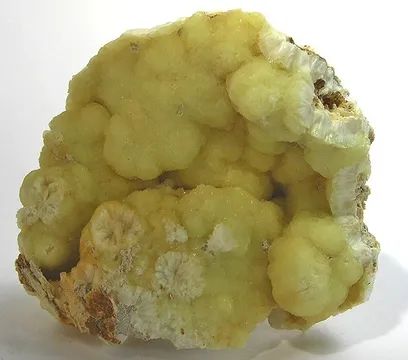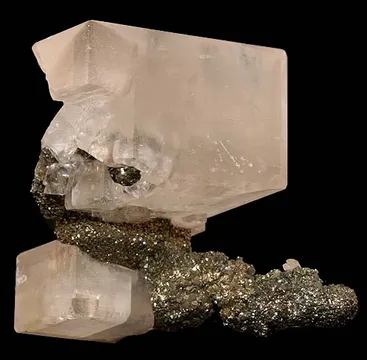
Shullsburg area, Wisconsin — classic Upper Mississippi zinc-lead locality, famed for lustrous calcite crystals, often with sphalerite and galena; prized.
Key facts
The Shullsburg area of Lafayette County, Wisconsin, is one of the classic specimen districts of the Upper Mississippi Valley zinc-lead field: a carbonate-hosted, Mississippi Valley-type ore province where low-temperature mineralizing fluids filled and replaced Ordovician dolostone, limestone, and shale along joints, bedding-plane openings, pitches, flats, and brecciated zones. For collectors, Shullsburg means more than ore. It means superb Midwestern calcite: complex, lustrous crystals in sceptered, stair-stepped, rhombohedral, and scalenohedral forms, often with pyrite or marcasite phantoms and associations with sphalerite, galena, and iron sulfides. The best pieces have the architectural clarity of the district’s ore structures themselves—crystals perched over older growths, transparent caps over ghostly internal forms, and plates where pale calcite floats over brassy marcasite.
The district’s mining importance is just as strong. Shullsburg stands in the old heart of Wisconsin’s lead and zinc country, a landscape of early lead diggings, 19th-century hand-dug mines, and later industrial zinc-lead operations by companies such as Eagle-Picher. The mines around Shullsburg, New Diggings, Benton, and Meeker’s Grove formed part of a district that helped give Wisconsin its “Badger State” identity and remained active into the late 1970s. Today the mines are abandoned, many are reclaimed or on private land, and the specimens on the market are mostly old mine finds, old collection pieces, and saved material from dumps and pockets worked during the last productive decades.
Regional View
Country View
The core Shullsburg collecting aesthetic is built on contrast: honey, cream, colorless, white, or pinkish calcite against metallic marcasite; dark brown to orange sphalerite beneath pale carbonate; bright galena cubes in dolomite-lined openings; and occasional oxidized zinc minerals from the upper workings. The district’s finest calcites are not simply “Midwest calcite,” but a recognizable style: broad or steep scalenohedra overgrown by stacked rhombohedral growths, scepter-like forms, clear terminal caps, and visible internal phantoms. Good specimens look deliberate and sculptural; ordinary ones are cloudy cleavages, bruised plates, or loose crystals with little matrix or paragenetic context.
Search for specimens: View all specimens from Shullsburg area, USA
The Shullsburg area belongs to the Upper Mississippi Valley zinc-lead district, a classic Mississippi Valley-type deposit system developed in Paleozoic carbonate rocks of southwestern Wisconsin and adjacent Illinois and Iowa. In the Shullsburg mine area the principal host sequence is the Middle Ordovician Sinnipee Group—Platteville, Decorah, and Galena formations—made up chiefly of dolomite with lesser limestone and shale. The Sinnipee is locally overlain southeast of the mine area by Maquoketa shale and underlain by the St. Peter sandstone, with thin Glenwood shale locally between them. From a specimen perspective, the important point is that the ore fluids exploited an already fractured, bedded, and locally cavernous carbonate package: vugs, solution openings, bedding separations, and breccias gave crystals room to grow.
The ore bodies around Shullsburg are not single massive veins in the western mining-camp sense. They are numerous, relatively small but locally rich bodies along vertical joints known historically as gash veins, inclined fractures called pitches, bedding-plane openings called flats, and disseminated sulfide zones within the carbonate host rock. The Shullsburg Mine complex was particularly associated with gash-vein and pitch-and-flat ore, while disseminated sulfides were also common. In old mine descriptions, the repeated language of “pitches,” “flats,” “oil rock,” “glass rock,” and “crevices” is not quaint terminology; it is the physical architecture that controlled where specimen pockets appeared.
The principal ore minerals were sphalerite and galena, with marcasite and pyrite commonly present and calcite, dolomite, quartz, and baryte as major gangue or late-stage minerals. The typical collector assemblage is calcite with sphalerite, galena, marcasite, pyrite, dolomite, quartz, or baryte. The best pockets formed where open cavities remained after sulfide deposition, allowing later calcite to develop as sharp crystals rather than massive vein filling. In several Shullsburg-area mines the paragenesis recorded marcasite early, followed by sphalerite, galena, calcite, and in some places baryte; other pockets show late marcasite coatings or marcasite-rich lower surfaces in cavities.
Mining history begins early. Shullsburg-area lead mining was underway in the first decades of the 19th century, long before Wisconsin statehood, and the old Badger Mine preserves the style of the earliest hand-dug lead work. By the later 19th and early 20th centuries, as zinc became increasingly important, mines worked deeper sulfide ore as well as oxidized zinc carbonate ore. A 1906 USGS account singled out the Shullsburg mines as among the oldest in the region and noted that the district was important in the early commercial success of dressing mixed sulfide ores. W. P. Blake’s roasting and cleaning work at Shullsburg, especially around the Little Giant and Helena mines, placed the district at the front of a technological change that made zinc sulfide ore more profitable.
The later industrial era produced much of the material most recognizable to modern collectors. The Calumet and Hecla, or Shullsburg, Mine—later associated with Eagle-Picher—was an important zinc-lead operation in section 22, T.1N., R.2E. It was discovered in 1947, developed from 1949, and operated almost continuously until closing in 1979. The Blackstone Mine was opened in 1950 and later connected to the Shullsburg workings by underground drifts in 1970. The Shullsburg and Bear Hole mine complexes were not single holes but groups of ore bodies and workings connected by underground tunnels. Ore from these operations went to a mill at the Shullsburg Mine site, and large volumes of water had to be pumped to keep the workings dry.
Documented specimen-producing mines and pockets include several of the names collectors still see on labels. At the Calumet and Hecla/Eagle-Picher mine, calcite occurred in cavities as scalenohedrons more than 10 cm long with sphalerite and marcasite, and old collections preserve large honey-yellow and glassy rhombohedral crystals. The Rodham Mine produced abundant large clear calcite. The Jug Handle Mine yielded coarse calcite in veins with sphalerite and marcasite. New Cottingham produced abundant coarsely crystallized calcite in vugs with sphalerite and galena, while nearby New Hoskins was noted for sphalerite and giant galena crystals. The Rickert, Stevens and Company mine near Shullsburg yielded dogtooth scalenohedral calcite with galena. The B.A.T. mine produced large calcite rhombohedra. The Gritty Six Mine in the Meeker’s Grove subdistrict produced fine masses and crystals of calcite, some associated with barite, galena, sphalerite, and scattered chalcopyrite. Blackstone and Teasdale are repeatedly documented for calcite, marcasite, pyrite, sphalerite, galena, and baryte associations.
Collecting access today should be approached conservatively. The old mines are abandoned; many workings are reclaimed, obliterated, flooded, unstable, or on private land. Some dumps historically yielded sphalerite, calcite, marcasite, and other minerals after mining ended, but a modern collector should assume permission is required and that any open mine feature is unsafe unless it is part of an official tour. The legitimate public mining experience in Shullsburg is the Badger Mine and Museum, which interprets 19th-century lead mining rather than offering specimen collecting in active workings. Serious specimens now come mainly through collections, dealer stock, old labels, and saved mine material.
Calcite is the Shullsburg area’s signature collector mineral, and the best examples are unmistakable: complex rhombohedra, dogtooth scalenohedra, scepter crystals, and stair-stepped parallel overgrowths, commonly white, colorless, honey-brown, pale yellow, cloudy gray, or locally deep pink in earlier generations. The district is especially prized for crystals that show growth history—transparent rhombohedral caps over scalenohedral cores, internal phantoms outlined by pyrite or marcasite, and stacked rhombohedral faces that give small-cabinet pieces a dramatic, architectural profile. Documented occurrences include dogtooth calcite with galena at the Rickert, Stevens and Company mine; large deep pink Type 1 calcite at the Liberty Mine in Meeker’s Grove; coarse calcite with sphalerite and galena at New Cottingham and New Hoskins; vein calcite with sphalerite and marcasite at the Jug Handle Mine; large rhombohedra from the B.A.T. mine; scalenohedrons over 10 cm long at the Calumet and Hecla/Eagle-Picher mine; large clear crystals at the Rodham Mine; and abundant material from Blackstone and Teasdale. The finest pieces are complete, sharply lustrous, visibly zoned or phantomed, and still attached to marcasite, sphalerite, galena, or dolomite matrix; merely cleaved, cloudy, bruised, or matrixless crystals are much less desirable.
Marcasite from the Shullsburg area is both a specimen mineral and a key recorder of the ore sequence, occurring as brassy to pale golden metallic crusts, granular masses, radiating or concentric aggregates, cavity linings, and intimate intergrowths with sphalerite, galena, pyrite, and calcite. It is especially important in the Blackstone, Calumet, Gritty Six, Jug Handle, Lucky Hit, and other pitch-and-flat deposits, where old mine descriptions record marcasite as an early layer beneath sphalerite or as a later coating on sulfides; at Gritty Six, marcasite could form radiating concentric arrangements on the lower side of cavities, and in some horizons iron sulfide was abundant enough to affect ore dressing. The most collectible Shullsburg marcasite specimens are not massive lumps but sculptural metallic plates or sparkling cavity surfaces with clean calcite perched on top, preferably from a named mine such as Blackstone; ordinary pieces suffer from dullness, crumbling, oxidation, or indistinct massive texture.
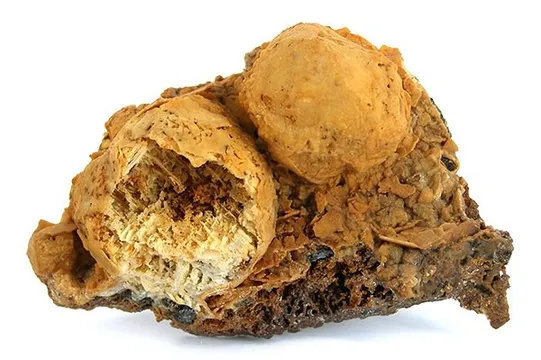
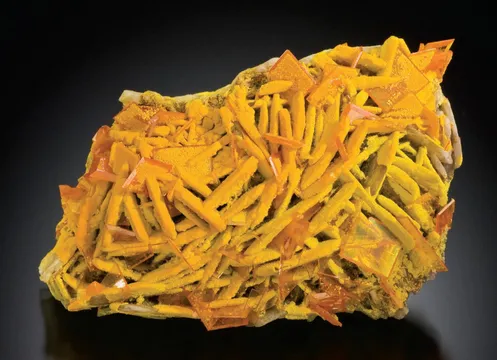
Other documented Shullsburg-area minerals include sphalerite, galena, pyrite, dolomite, quartz, baryte, smithsonite, cerussite, gypsum, melanterite, goethite, hydrozincite, malachite, azurite, cuprite, chalcopyrite, cobaltite, millerite, montmorillonite, wurtzite, and sphalerite var. schalenblende. Sphalerite was the dominant zinc ore and occurs as brown, orange, light yellow, drusy, massive, botryoidal, stalactitic, and locally schalenblende-like material; galena appears as cubes, cubo-octahedra, massive ore, and locally skeletal to dendritic forms described from polished sections of the East Blackstone Mine. Smithsonite was a major oxidized zinc ore in the district, notably at the Little Giant Mine and other Hazel Green-Shullsburg workings, where “dry bone ore,” cavernous smithsonite, and casts after leached calcite are part of the area’s historic mineral record. Baryte is notable near Shullsburg and Lead Mine, including white sheaf-like clusters with sphalerite, galena, and marcasite at Blackstone and vein material at several Meeker’s Grove mines. The rarer species—cobaltite, millerite, wurtzite, azurite, cuprite, and chalcopyrite—are specialist-label minerals rather than common aesthetic cabinet specimens, but they round out the district’s surprisingly varied low-temperature sulfide, carbonate, and oxidation assemblage.
Shullsburg calcite is a classic but label-sensitive material. Many older specimens are broadly labeled “Shullsburg,” “Shullsburg area,” “Upper Mississippi Valley District,” or simply “Wisconsin,” even when they came from a specific mine such as Calumet and Hecla/Eagle-Picher, Blackstone, Rodham, Little Giant, Jug Handle, New Cottingham, or Gritty Six. A named-mine label with old collection provenance is worth preserving. Conversely, not every Midwest calcite on marcasite is Shullsburg: similar-looking calcite-marcasite pieces occur elsewhere in the Upper Mississippi Valley and in other MVT districts, and loose, unlabeled calcite rhombs should be treated with caution unless their morphology, matrix, and provenance support the attribution.
No well-documented, locality-specific epidemic of fabricated Shullsburg calcites appears in the standard references, but mislabeling is a real market concern because “Shullsburg” has become a shorthand for attractive Midwestern calcite scepters and rhombohedral overgrowths. The strongest visual indicators are complex scepter or stair-stepped rhombohedral growths, internal phantoms, marcasite or pyrite inclusions, and association with the district’s sphalerite-galena-marcasite-dolomite matrix. A specimen described only as “Wisconsin calcite” may still be excellent, but it should not be upgraded to Shullsburg without evidence.
Condition matters greatly. Calcite from this area commonly shows edge wear, bruising on rhombohedral corners, cleaved contacts, etched areas, and mining damage. Larger crystals are especially prone to bruised terminations and broken side faces. Transparent caps and phantom-bearing crystals should be checked under strong side light and backlighting; fine bruises that disappear in diffuse light become obvious when the crystal is illuminated from behind. Marcasite-rich specimens need dry storage and stable humidity. Avoid washing marcasite-bearing pieces unnecessarily, and do not leave them in damp cabinets or sealed humid containers.
Fluorescence can add interest but should not be assumed. Some Shullsburg calcites show pastel red, pink-red, purple-magenta, or dim red-purple responses under different UV wavelengths, and some smithsonite from Little Giant dump material has been reported with blue, yellow, and red responses under shortwave or midwave UV. Fluorescence varies specimen by specimen and is best treated as a bonus characteristic, not a diagnostic guarantee of locality. As with all galena-bearing specimens, wash hands after handling, avoid dust, and keep friable ore away from children and food-preparation areas.
Market availability is limited but not hopeless. Shullsburg calcites appear regularly enough from old collections and dealer back stock to remain attainable, but really good pieces—complete sceptered crystals, transparent caps over phantoms, well-balanced calcite on marcasite plates, and named-mine examples from Calumet, Blackstone, or Rodham—are much scarcer than generic labels suggest. Fine marcasite specimens are less common still, especially stable, bright, well-crystallized pieces with calcite in good condition. The best buys are not necessarily the largest crystals, but the ones that show the district’s growth story cleanly.
The first Shullsburg story is not a pocket story but a human one: the origin of the “badger” identity that still clings to Wisconsin. Early lead miners in southwestern Wisconsin did not always build houses first. They drove shallow holes into hillsides, worked crevices, and lived close to the ground they were digging. The image was so strong that the miners became “badgers,” and Shullsburg preserves the memory with unusual intimacy. The Badger Mine and Museum stands at Badger Park, where visitors descend into a hand-dug 19th-century lead mine and can still see the small side tunnels that make modern shoulders tighten just looking at them.
A state historic inventory records the Badger Mine as the Van Matre Brothers Mine, worked by the Van Matre brothers after their arrival during the lead rush beginning in 1827. The shaft is recorded as 60 feet deep, with drifts running southwest for about a quarter mile. It was not a long-lived industrial mine. It worked for roughly ten years before flooding, then remained closed for about a century. In 1936, Mayor Hoesley and Dr. Hanifan promoted reopening the old shaft on the south edge of Badger Park; the shaft and drifts were cleaned, a stairway was built, electric lights were installed, and guides began taking visitors underground. That is a remarkable afterlife for a lead dig: ten hard years as a mine, a hundred years of silence, then reborn as a civic memory.
The modern tour is deliberately sensory. The visitor goes down 51 steps into the mine. The official descriptions emphasize the dampness, the smell, and the sound of dripping water as the guide leaves daylight behind. The ceiling was raised in 1963 when the mine was reopened for access, but the original side tunnels remain low and narrow enough to make the point. This is not the spacious, track-lined world of later zinc mining; it is the crawl-and-chip world of pick, gad, black powder, and hand labor.
A later Shullsburg story belongs to the industrial mine and to water. The Shullsburg Mine was opened in 1949 in dolomitic host rocks, the Blackstone Mine opened in 1950, and the two were joined by drifts in 1970. To mine ore bodies roughly hundreds of feet below the pre-mining water table, operators had to pump extraordinary volumes of water. Early in operation, reported pumping reached up to 20 million gallons per day. In especially fractured ore, inflows as high as 8,000 gallons per minute were observed when a drift encountered a new ore body. Water entered along bedding planes, solution channels, fractures, joints, springs in the floor, and even open exploration holes intercepted by workings. For the miner this was a battle to keep the stopes and drifts workable; for the geologist it was a demonstration of how completely the ore bodies, aquifers, and fractured carbonate beds were connected.
When the mine closed, that engineered dryness ended. Within a year of cessation of mining, private wells near the Shullsburg Mine began producing sulfate-rich water, with sulfate concentrations reported from 700 to 3,500 mg/L. The problem was not just a number on a lab sheet: local complaints included effects on people and livestock, and some farmers reported pronounced declines in milk production from dairy cattle. The proposed mechanism was mineralogical at its core—oxidation of iron sulfides, formation of soluble sulfate phases, acid attack on carbonate host rock, and then dissolution of those products as groundwater refilled rock that had been dewatered during mining. It is a sobering companion story to the glittering calcite and marcasite: the same sulfides that make specimens sparkle also governed the chemistry of the post-mining groundwater.
There is also a small, pleasing afterlife of the Blackstone Mine away from Shullsburg. At the Mining & Rollo Jamison Museums in Platteville, visitors can ride behind a 1931 Whitcomb locomotive that was used in the Blackstone Mine near Shullsburg until the 1950s. It now pulls ore cars around a museum campus rather than through a zinc-lead mine, and the train has carried hundreds of thousands of visitors since 1978. For a collector, that locomotive is a useful mental image: Shullsburg specimens are not abstract “MVT” minerals. They came from an intensely worked industrial and human landscape, one where ore cars, pumps, mills, wet drifts, hand-dug holes, and crystal pockets all belonged to the same story.