A collector's guide to Blackstone Mine, USA: its geology, mining history and notable minerals, illustrated with the 21 specimens documented from this locality on EarthWonders.
Key facts
Blackstone Mine is a classic Wisconsin locality for the kind of Upper Mississippi Valley mineral specimen that serious collectors recognize at arm’s length: pale yellow to colorless calcite rhombs and scepters set against glittering, brassy marcasite, with dark sphalerite and lead-zinc ore as the industrial background. The mine lay in the New Diggings–Shullsburg part of Lafayette County, Wisconsin, within the Upper Mississippi Valley Zinc-Lead District, a broad Mississippi Valley–type carbonate-hosted ore province developed in Ordovician rocks. Its economic life was zinc and lead; its collecting reputation rests on vug-grown gangue and sulfides from pitch-and-flat ore structures in the Platteville, Decorah, and Galena formations.
The best Blackstone specimens have a distinctly Midwestern elegance. Calcite may form frosted, honey-tinted rhombohedra on dark reddish-brown sphalerite, or more spectacular sceptered forms in which an older scalenohedral core is capped by a later, transparent complex rhomb. Marcasite is the other signature: not merely scattered crystals, but lustrous, golden, stalactitic to worm-like aggregates, sometimes complete all around and carrying perched glassy calcite crystals. Compared with the better-known Shullsburg-area calcites from Calumet and Hecla, Blackstone pieces are less common on the market and carry the appeal of a productive but now-extinct underground zinc mine.
Regional View
Country View
Blackstone is also important because it is unusually well tied to the mining geology of the Shullsburg area. The West Blackstone workings were used in U.S. Geological Survey studies to illustrate pitch-and-flat structures: inclined sulfide veins, bedding-parallel “flats,” breccia, and disseminated mineralization concentrated in altered carbonate units. For collectors, that matters because it explains the specimens. These were not alpine cleft pockets or pegmatite miaroles; they were the open spaces and vein centers of a carbonate-hosted lead-zinc system, where calcite lined vugs after sulfides and where marcasite could grow in delicate forms that were beautiful but chemically temperamental.

Photo: Wikimedia Commons

Photo: Wikimedia Commons
Search for specimens: View all specimens from Blackstone Mine, USA
Blackstone Mine was a lead-zinc mine in Lafayette County, Wisconsin, in the New Diggings area mines of the Upper Mississippi Valley Zinc-Lead District. The locality belongs to the same historic mining belt that made southwestern Wisconsin famous for galena, sphalerite, calcite, marcasite, and associated carbonate-hosted mineralization. The ore was worked chiefly for zinc, with lead as a companion commodity, and occurred mainly in “pitches and flats”: inclined vein structures and bedding-parallel ore bodies developed in Ordovician carbonate rocks, particularly the Platteville, Decorah, and Galena formations.
The Blackstone complex was opened in the postwar revival of Shullsburg-area zinc mining. Vinegar Hill Zinc Company developed a group of ore bodies in section 28, T.1N., R.2E., beginning in 1949, and the Blackstone shaft, about 283 feet deep, was completed by March 1950. Nearby ore bodies were then brought into the same operating orbit: Hancock was opened in 1952, and later work included the Coulthard and Winskell ground. American Zinc, Lead and Smelting Company acquired Vinegar Hill’s Shullsburg-area holdings in 1955. Mining stopped in the Blackstone complex in September 1957, pumping continued into April 1958, and intermittent production resumed in late 1959. By the late 1960s the American Zinc holdings were winding down, and Eagle-Picher Industries acquired the properties in 1970.
The mine’s longer history became entangled with the Shullsburg mine and mill complex. The Blackstone, Hancock, and Winskell ground was ultimately connected underground with the Shullsburg workings. In the broader complex, Eagle-Picher operated the Shullsburg mine and mill from 1954 until 1979, using modified room-and-pillar methods and processing ore in a flotation mill. Ore handling changed from shaft hoisting to decline access, allowing trucks and equipment to move directly to the working faces. Mining in the district ended permanently in 1978–1979, closing the chapter on a lead-zinc industry that had shaped the landscape around Shullsburg, New Diggings, and Benton for generations.
Geologically, Blackstone is one of the localities where the architecture of the ore bodies is especially instructive. USGS work on the West Blackstone mine described pitch-and-flat structures in which sulfide-filled fractures cut through the carbonate sequence while bedding-parallel mineralization formed flats in altered units. Calcite was the principal gangue mineral in the district, commonly lining central vein spaces and vugs; at Blackstone the collector-quality calcite belongs to this same paragenetic setting. Barite was also significant in the West Blackstone mine: white fibrous barite occurred in bedding-parallel veins in the Quimbys Mill interval, locally in closely spaced veinlets through a zone several feet thick. That barite-rich setting is part of the reason Blackstone is more mineralogically interesting than a simple four-species cabinet label might imply.
Documented Blackstone specimens came from underground workings and mine-related material rather than from an open modern collecting site. A Dakota Matrix specimen records calcite on massive crystalline reddish-brown sphalerite personally collected underground by R. J. Waidler in 1968. Surviving old-time pieces and museum specimens show that attractive material was removed during the productive decades, but the locality should now be treated as closed, reclaimed, private, and historically significant rather than as an active collecting destination. Any collecting today would require explicit landowner permission and careful attention to reclaimed mine hazards, dump stability, and lead-zinc contamination issues.
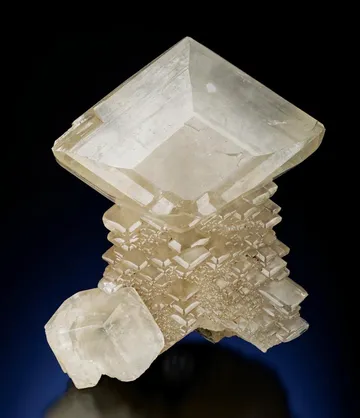
Calcite from Blackstone Mine is the locality’s signature display mineral, ranging from small frosted rhombohedra averaging under a centimeter on dark sphalerite to cabinet-size sceptered and complex-rhombohedral specimens; the classic pieces show a grayish-tan or pale honey scalenohedral core overgrown by stepped rhombohedral calcite and capped by a larger transparent, lustrous complex rhomb, while other examples carry glassy translucent rhombs perched directly on marcasite. The strongest Blackstone calcites are complete-all-around or nearly so, with sharp terminations, visible internal phantoms or cleavage traces, and attractive contrast against metallic marcasite or reddish-brown sphalerite; ordinary pieces tend to be massive calcite, broken rhombs, or small frosted crystals lacking the sculptural scepter habit that made Shullsburg-area calcites famous.
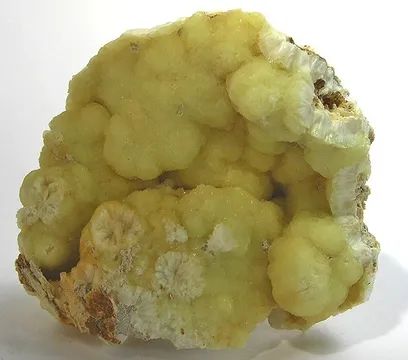
Marcasite from Blackstone Mine is best known as golden to brassy, glittering stalactitic aggregates and worm-like clusters, commonly associated with calcite and locally forming the visual matrix for transparent rhombohedral calcite crystals. Fine specimens may be miniature to cabinet size; published and market examples include complete stalactitic forms several centimeters across, an 8.9 cm marcasite-on-calcite specimen, and an old 5 x 4 inch stalactitic marcasite noted in a private collection. The premium Blackstone marcasites are bright, metallic, stable-looking, and undamaged at the tips of the stalactites; pieces with dull gray-green surfaces, powdery alteration, repairs, or broken terminations are much less desirable because marcasite from the Upper Mississippi Valley district is well known for post-collection deterioration.
Other documented minerals from Blackstone include galena and sphalerite as the ore minerals, with sphalerite forming dark reddish-brown massive to crystalline matrix on some specimen pieces and galena representing the lead component of the deposit. Additional species reported from Blackstone or the West Blackstone workings include barite, pyrite, quartz, and minute strontianite; the strontianite was recorded as tiny grains with barite, sphalerite, pyrite, marcasite, quartz, and calcite. No type-locality mineral appears to be associated with Blackstone, and its importance is not as a birthplace of new species but as a classic source of well-crystallized carbonate-hosted lead-zinc gangue specimens.
Blackstone specimens should be judged first by locality confidence. Labels may read “Blackstone Mine,” “West Blackstone,” “Shullsburg,” “New Diggings area,” or more broadly “Upper Mississippi Valley District.” Because the Shullsburg, New Diggings, Benton, and Hazel Green areas produced broadly similar calcite-marcasite-sphalerite assemblages, old labels matter. A Blackstone attribution is strongest when supported by a period label, a known collection history, a museum or dealer archive, or a specimen style matching documented Blackstone material: calcite rhombs or sceptered calcite with marcasite, or frosted pale yellow calcite on dark reddish-brown sphalerite.
Marcasite condition is the central preservation issue. Bright, metallic marcasite is preferred, while dull gray-green, friable, powdery, or sulfurous-smelling material should be approached cautiously. The Upper Mississippi Valley district is notorious for marcasite that oxidizes after collection, sometimes damaging nearby calcite and labels. Store Blackstone marcasite specimens in a stable, dry environment, avoid sealed damp cases, keep them away from direct heat and humidity swings, and isolate any specimen that begins producing acidic alteration products or loose sulfate crusts.
Calcite damage is the second major concern. Blackstone calcite has perfect cleavage and many specimens have protruding rhombohedral caps or fragile scepter terminations. Edge bruising, cleaved tips, and repaired calcite-on-marcasite contacts are common hazards in old pieces. Stalactitic marcasite clusters are also physically vulnerable; look closely for glued breaks at the bases of “worm” forms, missing tips, and incongruent surfaces where a calcite crystal may have been reattached.
No well-documented locality-specific fakery is widely reported for Blackstone, but mislabeling by overgeneralization is a real risk. Specimens sold simply as “Shullsburg calcite” or “Wisconsin marcasite” should not be upgraded to Blackstone without evidence. Conversely, old Blackstone pieces may be undervalued when they are lumped into generic Upper Mississippi Valley material. The market is thin: fine calcite and marcasite combinations appear intermittently through old collections, dealer archives, and auctions rather than as a steady supply. Recent public sales show that modest Blackstone specimens can still be affordable, while complete, aesthetic, old-time calcite or marcasite combinations with strong provenance are much scarcer than ordinary district calcite.
In the winter of 1964, Blackstone produced the kind of underground episode that never appears on a specimen label but belongs to the locality’s history. On January 29, at about 8:00 in the morning, two men had been welding in the shop area when a truck driver noticed that a tractor had caught fire. He and another miner attacked it first with soda-acid and dry-chemical extinguishers, but the fire would not go out. They went to the surface for more extinguishers and then could not get back to the shop: dense smoke had taken over the passage.
The mine was not a little hand-dug prospect by then. It was a room-and-pillar lead-zinc operation listed at 285 feet deep and about 800 tons per day. Word went to the production area. Five men evacuated, while eight others chose to remain in intake air underground until rescue could reach them. A crew equipped with oxygen breathing units brought them out. Local fire departments tried to fight the fire, but the smoke was too heavy, and the practical solution was stark: the fire was allowed to burn itself out. The report recorded no deaths and no injuries, but the episode captures the industrial setting from which many Blackstone specimens came—dark carbonate drifts, machinery underground, mine air moving through the workings, and a lead-zinc operation large enough that specimen pockets were a byproduct of hard-rock production, not the purpose of the mine.
There is a quieter collecting story from 1968, preserved not in a field diary but in a specimen record. R. J. Waidler collected calcite underground at the Blackstone mine, a cabinet specimen later described as frosted faint-yellow rhombohedral calcites averaging about 8 mm across on massive crystalline dark reddish-brown sphalerite. It is the kind of detail that fixes a locality in the hand: not just “calcite from Wisconsin,” but calcite removed while the underground workings were still accessible, with the ore mineral that paid for the mine forming the matrix beneath the crystals.
The mine’s later story is one of connection and consolidation. Blackstone began as its own postwar ore-body group, with Hancock and Winskell added nearby, but by 1970 the Blackstone complex and the Shullsburg mine were joined underground. A collector holding a Blackstone calcite today is holding a specimen from a mine that was once part of a much larger subterranean industrial network beneath the farms and ridges of Lafayette County. Pumps had to work constantly because mining was below the water table; after closure, the consequences of that dewatering and the remaining mine wastes became part of the reclamation history of the Galena River and Shullsburg Branch watershed.