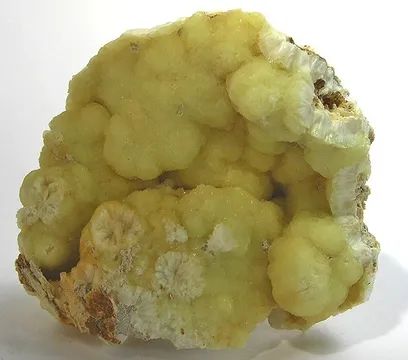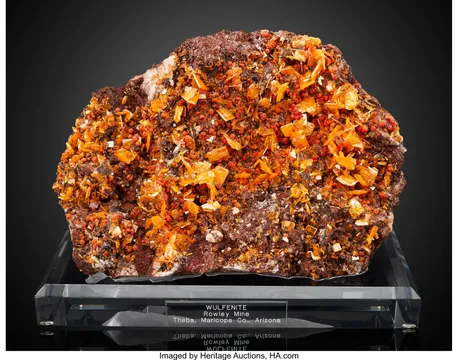
Rowley Mine, Arizona’s premier wulfenite locality, yields orange to honey-yellow plates with baryte and mimetite; a cabinet classic and mineralogical laborator…
Key facts
Rowley Mine is one of the great Arizona wulfenite localities: a compact, arid, hard-rock mine on the west flank of the Painted Rock Mountains near Theba, where a modest copper-lead-molybdenum-baryte vein system became far more important to mineral collectors than to industry. Its fame rests on the oxidation of a baryte-rich lead vein into an exceptionally aesthetic suite of wulfenite, mimetite, vanadinite, baryte, chrysocolla, and rare secondary lead-copper minerals. The best Rowley specimens have an unmistakable presence: thin, glassy orange to honey-yellow wulfenite plates, often transparent like little panes of amber glass, rising from pale bladed baryte or dark volcanic matrix and sometimes dusted or dotted with red-orange mimetite.
The mine is geologically and historically appealing because it is both a classic specimen locality and a mineralogical laboratory. Economically it was a small underground producer, worked intermittently in the early twentieth century for copper, lead, molybdenum, gold, silver, baryte, and fluorite. Scientifically it has become famous twice over: first for its supergene wulfenite-mimetite specimens, and later for a remarkable suite of post-mining, bat-guano-related oxalate, phosphate, vanadate, chloride, and ammonium minerals from the 125-foot level. Few Arizona localities bridge the cabinet-specimen world and modern new-mineral research as neatly as Rowley.
Regional View
Country View
Rowley’s signature look is smaller and more delicate than the heavy red plates of the Red Cloud mine, and different again from the chunky, butterscotch-to-orange style familiar from the Glove mine. A fine Rowley miniature can be intensely architectural: orange tetragonal plates with bevelled edges, mimetite in wet-looking red balls or yellow-orange druse, grey-white baryte blades, and occasional copper color from chrysocolla or malachite. The visual tension is part of the charm. These are not merely “orange Arizona wulfenites”; they are Rowleys—fragile, luminous, and typically judged by sharpness, transparency, and the quality of the mimetite accent.

Photo: Wikimedia Commons

Photo: Wikimedia Commons

Photo: Wikimedia Commons
Search for specimens: View all specimens from Rowley Mine, USA
The Rowley Mine is in the Painted Rock Mining District, on the western edge of the Painted Rock Mountains in Maricopa County, Arizona, northwest of Gila Bend and near the settlement of Theba. Older and alternate names include Rawley Mine, Reliance Mine, Reliance Copper Mine, Rainbow Mine, Theba Mine, and the San Carlos patented claim. The mine is an underground, vein-type deposit on private or controlled ground, and it should be regarded as a permission-only locality rather than a casual public rockhounding site.
The deposit follows a northwest-trending fault zone in volcanic country rock. Historical descriptions and MRDS-derived records describe a structure roughly 4,000 feet long, striking about N30°–37°W, with a quartz vein on the footwall and a baryte vein on the hanging wall. The host rocks include Tertiary volcanic rocks, especially andesite, with rhyolitic volcanic rocks and later basalt noted in the district. The vein system is not simply one uniform ore shoot. It is a fractured, chemically varied hydrothermal structure in which primary sulfides and gangue were later overprinted by oxidation, producing the lead-molybdate, lead-arsenate, lead-vanadate, copper, sulfate, carbonate, chloride, and rare post-mining assemblages that collectors know today.
The quartz part of the system was historically described as several feet wide in the main workings and along the 125-foot level, carrying quartz, jasper, specular hematite, pyrite, malachite, chrysocolla, and low-grade copper-silver-gold values. The hanging-wall baryte vein is the crucial specimen host. It has been described as 15 to 30 feet thick, separated from fractured andesite by gouge, and carrying galena, calcite, wulfenite, vanadinite, mimetite, copper oxide staining, and many rarer lead-copper species. This thick, fractured baryte was both the reason for the mine’s specimen fame and a serious underground hazard: broken baryte made the ore body unstable and unforgiving.
Mining activity in the district became important in the early 1900s. The Rowley property was discovered around 1900 and organized work began around 1909 under Rowley Copper Mines Co. A small camp grew at the site, with a bunkhouse, boarding house, cottages, tents, and power houses. Water was a constant adversary. Early accounts describe Cornish pumps running 16 hours a day and lifting 200 gallons per minute to keep the workings open. About 1917, after wulfenite had been found, a 75-ton concentrator was installed to treat material from the mine.
The mining record is modest but fascinating. Work was intermittent between 1909 and 1923, after which the mine’s importance increasingly shifted from ore to specimens. U.S. Geological Survey work in the early 1950s recorded perhaps 8,000 to 10,000 tons of vein material mined during development, with at least 2,000 tons milled. Shipments included one small car of copper ore averaging 15 percent copper and 30 tons of wulfenite concentrate assaying 18.26 percent MoO3. The idea that Rowley wulfenite—today one of Arizona’s treasured display minerals—was once crushed for molybdenum is one of the locality’s more poignant historical facts.
Ownership and naming history are part of the collector story. Reliance Copper Co. assumed control by 1922, but operations were short-lived and the property was foreclosed. Charles A. Rowley became majority owner in 1927 and served as president of Rowley Mines, Inc.; later summaries note that he protected the property with a night watchman and a six-foot barbed-wire fence set in concrete. By 1933, the mine was reported to have more than 1,400 feet of workings, including inclined shafts, a vertical shaft, drifts, crosscuts, and stopes. Ore valued at $10,000 was shipped that year, but groundwater seepage and disappointing deeper drilling discouraged sustained expansion.
The underground layout includes inclined shafts, a vertical shaft, crosscuts, drifts, stopes, and the repeatedly cited 125-foot level. A 1952 government examination found the 125-foot level to be the only level not under water at that time. Later accounts noted fire damage to timbering in the inclined shaft, flooding of lower workings, and difficult ground conditions. Collectors should not romanticize the underground environment: old mine openings, water, unstable baryte, damaged timbering, backfill, and decades of collecting pressure make unauthorized entry dangerous as well as inappropriate.
Specimen production has come from both underground pockets and the dumps. The greatest Rowley pieces were not simply scraped from the surface; many came from underground baryte-rich zones where wulfenite and mimetite lined openings and brecciated pockets. Named specimen areas and pockets have entered collector lore, including Monnie’s stope, the Jaegermeister pocket, and the Crybaby pocket. Surface and dump collecting, when conducted with permission, has produced chrysocolla, mimetite, baryte, galena, micromount material, thumbnail wulfenite, and occasional better pieces. Recent organized club trips have emphasized surface and dump collecting only, with no underground access for participants, and with material sometimes provided or refreshed on the dumps by the mine operators.
Today, Rowley is a controlled classic locality. It is not exhausted in the sense that no material exists, but the best old-style wulfenite-mimetite pieces are finite, and truly fine specimens generally come through old collections, historical dealer stock, documented modern specimen mining, or organized access under the current operators. The mine’s ongoing reputation is therefore split between two worlds: the classic display-specimen market, where older orange wulfenites on baryte remain prized, and the micro-mineral research world, where the 125-foot level has yielded an extraordinary suite of rare type-locality species.
Wulfenite is Rowley’s defining collector mineral, occurring as bright orange, honey-yellow, butterscotch, and reddish-orange tetragonal plates, commonly thin and glassy, with square to rectangular outlines, bevelled edges, and a “windowpane” transparency on the finest examples. Most crystals are small, commonly in the millimetre to low-centimetre range; Wikimedia-documented specimens show sharp gem-clear blades to 8–9 mm, while collector accounts and notable pocket descriptions record rarer crystals approaching 2 inches. The classic matrix is grey-white to iron-stained bladed baryte, though dark porphyritic volcanic matrix also gives strong contrast, and the most coveted association is mimetite—especially red-orange, wet-looking balls or sparkling yellow-orange druse that decorates the plates without hiding them. Fine Rowley wulfenite is separated from ordinary material by complete, unbruised blade edges, high vitreous luster, transparency, saturated orange color, balanced placement on matrix, and an attractive mimetite accent; mediocre pieces are far more common and often show broken corners, flat scattered crystals, or crystals partially buried in massive baryte.
Mimetite from Rowley is far more than a background species: it is one of the features that gives the mine’s best wulfenites their identity. It occurs as orange, yellow-orange, and deep red microcrystalline coatings, balls, tufts, and small prismatic to acicular aggregates on baryte, wulfenite, and oxidized matrix. The most famous style is the deep red, wet-looking mimetite ball on wulfenite, particularly from Monnie’s stope and related classic pockets; one published 2.2 cm specimen from the Paul Geffner collection was specifically described as deep red mimetite balls with wulfenite from Monnie’s stope. Other Rowley mimetite is more granular, drusy, or yellow and may form attractive carpets on baryte, but the premium pieces are those in which vivid red to orange mimetite forms discrete, lustrous, three-dimensional accents beside intact glassy wulfenite plates rather than simply coating them into anonymity.
Vanadinite is less common than wulfenite and mimetite at Rowley, but it is important both as a collector mineral and as part of the mine’s vanadium-rich oxidation chemistry. It occurs as orange-brown, brick-red to orangy-red lustrous prisms, drusy coatings, and, most distinctively, as vanadinite replacing or coating wulfenite plates; a Wikimedia-documented 10.1 cm specimen from the ex-Carnegie Museum collection shows wulfenite crystals to 1.5 cm pseudomorphed or coated by orange-brown vanadinite. A documented auction specimen from George Godas’s late-1980s collecting produced unusually large, strongly hoppered brick-red to orangy-red prisms to 1.0 cm on a 10.7 cm lead-ore matrix, confirming that Rowley vanadinite can occasionally be cabinet-scale and highly crystallized rather than merely drusy. Good Rowley vanadinite is judged by rich coverage, recognizable crystal form, strong red-orange color, and especially by pseudomorph or replacement textures after wulfenite; ordinary material is usually sparse, brownish, or subordinate to the mine’s more abundant wulfenite-mimetite assemblage.
Beyond the three headline species, Rowley is unusually rich. Classic secondary lead-copper minerals include anglesite, cerussite, diaboleite, leadhillite, linarite, caledonite, minium, phosgenite, pseudoboleite, pyromorphite, mottramite, and perite, with chrysocolla, malachite, galena, calcite, quartz, fluorite, baryte, and willemite also part of the broader assemblage. The 125-foot level has made the mine a type-locality powerhouse for post-mining minerals associated with bat-guano chemistry, including rowleyite, phoxite, davidbrownite-(NH4), thebaite-(NH4), dendoraite-(NH4), relianceite-(K), allantoin, natrosulfatourea, ferriphoxite, carboferriphoxite, edwindavisite, ebnerite, and epiebnerite. These are not cabinet minerals in the usual sense; many are microscopic, delicate, and scientifically significant because they record unusual reactions among mine-wall minerals, moisture, salts, ammonium, oxalate, phosphate, vanadium, and organic guano-derived chemistry.
The main authenticity issue with Rowley specimens is locality confidence, not a well-known tradition of artificial enhancement. Rowley wulfenite can be confused with material from other Arizona and northern Mexico localities when labels are vague, lost, or reduced to “Arizona wulfenite.” The strongest locality clues are the combination of thin, glassy orange to honey plates, bevelled square or rectangular outlines, baryte matrix, and orange-red to yellow mimetite. Old labels may use Rowley, Rawley, Reliance, Rainbow, or Theba; those names can be legitimate, but they should be weighed against the specimen’s style, provenance, and any collection history.
Condition is critical. Rowley wulfenite blades are often thin and exposed, so edge nicks, missing corners, broken plates, and repaired clusters are common. Examine specimens from several angles under bright light. Damage that is hard to see from the front may appear as frosted corners, odd reflectivity, tiny chips along blade edges, or mismatched luster on a repaired plate. Because many crystals sit on brittle baryte, also check the matrix for glued breaks, recemented baryte blades, and stabilized crumbly back surfaces. None of these issues necessarily disqualifies a specimen, but they should be priced honestly.
Mimetite can be a blessing and a curse for grading. Deep red balls on wulfenite are highly prized, but dense mimetite can obscure damaged wulfenite or make a piece look more colorful than it is structurally fine. On the best specimens, mimetite enhances the composition without smothering the wulfenite. Yellow-orange druse and tufts are attractive, especially under magnification, but the premium Rowley look remains transparent orange plates with discrete red-orange mimetite accents on baryte.
Handle Rowley specimens as fragile lead-bearing secondary minerals. Wulfenite, mimetite, vanadinite, galena, cerussite, and related lead minerals should not be abraded, trimmed casually, or handled and then followed by eating without washing hands. Dry storage is wise, especially for unusual post-mining salts and guano-related micro-minerals from the 125-foot level, which may be moisture-sensitive. Keep fine wulfenite out of crowded drawers where exposed plates can touch cotton, lids, or neighboring specimens.
Market availability is better than for many closed classics, but quality falls off steeply. Small orange wulfenites, baryte pieces with scattered crystals, dump material, and modest miniatures appear periodically. The serious Rowley market begins when a specimen shows intact glassy plates, a balanced matrix, provenance, and a good mimetite association. Historic pieces from named pockets, older Arizona collections, documented dealers, or published collections carry a premium, as do unusual vanadinite-after-wulfenite specimens and scientifically documented type-locality micro material.
In the early mining years, Rowley was less a specimen shrine than a stubborn industrial gamble on a hot desert slope. The mine camp had enough confidence behind it to justify buildings—bunkhouse, boarding house, cottages, tents, power houses—and enough water below it to make confidence expensive. Cornish pumps reportedly ran 16 hours a day, raising 200 gallons of water per minute to keep the workings from drowning. By 1917, wulfenite had been found in sufficient quantity to justify a 75-ton concentrator. To a modern collector, the thought is almost painful: dozens of tons of lead molybdate crystals, now the very things that would stop traffic in a Tucson display case, were treated as ore.
Charles A. Rowley brought a different sort of drama to the property after he became majority owner in 1927. He was protective of the mine to a degree that still reads vividly: a night watchman, a six-foot barbed-wire fence, and posts set in concrete. That kind of guarding tells us something about the mine’s value before it became a modern classic. Rowley was never simply a casual hole in the hill. It had ore, water trouble, old workings, specimen potential, and enough perceived promise to make people defend access fiercely.
The most famous old specimen story belongs to Monnie Speck’s pocket. A 6.2 cm wulfenite-mimetite specimen from Tucson dealer Susie Davis’s collection, probably collected by Monnie Speck, became one of the iconic Rowley pieces: transparent orange wulfenite carrying the wet-looking deep red mimetite balls collectors prize most. It was sold to the Smithsonian Institution with the rest of Susie Davis’s collection in 1972. Another 7.2 cm wulfenite and wet-looking mimetite specimen on baryte from the same famous pocket was in Wayne Thompson’s collection when Rock Currier photographed it in 1973. Those pieces did more than preserve a find; they fixed a visual ideal for the mine.
The 2006 visit recorded by Mike Streeter has the best underground immediacy of any public Rowley field account. Streeter and his companions drove 90 miles south to Gila Bend, set up camp at an RV park, then drove about 30 miles northwest to meet Bill Jaeger at the mine. They arrived around 10:30 in the morning to parked vehicles and silence. The cement-block shack with its metal roof seemed empty except for a long-tailed lizard, which ran down the wall with Opal the dog in pursuit. A call down the shaft finally brought Jim Ricker up from underground; Bill, slowed by multiple knee surgeries, spared himself the ladder climb.
The humor in that account is pure rockhound culture. Jim Ricker delivered a safety talk, then unforgettable career advice: “Hunt and sell snapping turtles and you’ll make BIG bucks.” The joke had almost nothing to do with minerals, except that it came from the same underground world of patient labor, odd characters, and improbable enthusiasms. Opal wanted to go down too, but she had forgotten her hard hat and Jim’s spare did not fit her dog-shaped head.
Underground, Streeter was allowed into the production area where Jaeger and Ricker had recovered major Rowley wulfenites and mimetites. The named pockets tell their own story. “Jaegermeister” needs little explanation. “Crybaby” was named after a long dry spell, much complaining, and then a major wulfenite pocket with crystals up to 2 inches. It was a mock tribute to the whining before the strike—a perfect name for a pocket that rewarded persistence after discouragement.
Streeter’s own pocket was found the way many real pockets are found: sideways, awkwardly, and almost by accident. He began by chasing visible orange crystals in a small, uncomfortable spot. After 45 minutes he felt no closer to removing them. The brecciated, baryte-filled rock would not break where he wanted it to; he felt less like a miner than a sculptor carving unwilling stone. Around the one-hour mark he worked a chisel behind the projecting rock. A softball-sized piece finally fell away, and behind it was the real prize: a crystal-lined pocket running upward into the wall at about 30 degrees from vertical. His response was a single collector’s cry: “Momma!!!!”
What followed was not glamorous. The pocket was a collapsed breccia of relatively flat rock fragments stacked at odd angles. Removing specimens without destroying them was like playing pick-up sticks in reverse, overhead, in a mine. One wrong move could have brought the pocket down and ruined the fragile crystals. To reach it, Streeter had to bend backward and rest his upper back on a rock shelf, a position that quickly made breathing hard. Bill Jaeger’s comment when he heard the complaint was grimly funny: “Gives you and idea what it would be like to be crucified.” After hours of careful work, Streeter filled a couple of flats with excellent wulfenite and mimetite, then stopped before fatigue made him careless.
The end of that day is as memorable as the pocket. The party climbed out, ate lunch on the surface, swapped stories, went back underground, and later sat around until dusk before heading back to Gila Bend. Jim taught Chrissy how to wrap crystals properly, and the “wulfies and mimies” made it home to North Carolina undamaged. For all the chemistry and publication history Rowley now commands, this is the human core of the locality: a few people underground in difficult baryte, joking, aching, prying loose orange glass one piece at a time.
Wilson, Wendell E., and Miller, Douglas K. (1974), “Minerals of the Rowley Mine, Arizona,” The Mineralogical Record, 5(1), 10–30 — The classic early collector-mineralogical treatment of the locality, repeatedly cited in later Rowley records and publications.
Wilson, Wendell E. (2020), “The Rowley mine, Painted Rock Mountains, Maricopa County, Arizona,” The Mineralogical Record, 51, 181–226 — The major modern locality article, with history, geology, specimen production, named pockets, and numerous photographs.
Kirkemo, Harold; Anderson, C. A.; and Creasey, S. C. (1965), “Investigations of Molybdenum Deposits in the Conterminous United States 1942–60,” U.S. Geological Survey Bulletin 1182-E — Includes J. A. MacKallor’s Rowley or Reliance Mine section, with the 1952 examination, workings, production estimates, and wulfenite concentrate shipment.
Stewart, Lincoln A., and Pfister, A. J. (1960), “Barite Deposits of Arizona,” U.S. Bureau of Mines Report of Investigations 5651 — Important government treatment of the Rowley baryte deposit, including development and the 75-ton concentrator context.
Kampf, Anthony R.; Cooper, Mark A.; Nash, Barbara P.; Cerling, T. E.; Marty, Joe; Hummer, Daniel R.; Celestian, Aaron J.; Rose, Timothy P.; and Trebisky, Thomas J. (2017), “Rowleyite, [Na(NH4,K)9Cl4][V5+,4+2(P,As)O8]6·n[H2O,Na,NH4,K,Cl], a new mineral with a microporous framework structure,” American Mineralogist, 102, 1037–1044 — Describes rowleyite, named for the locality, from the 125-foot level.
International Mineralogical Association: “Rowleyite, Mineral of the Year 2017” — Highlights rowleyite’s structural complexity and its occurrence as black cuboctahedral crystals on green mottramite in the abandoned mine.
Kampf, Anthony R.; Celestian, Aaron J.; Nash, Barbara P.; and Marty, Joe (2019), “Phoxite, (NH4)2Mg2(C2O4)(PO3OH)2(H2O)4, the first phosphate-oxalate mineral,” American Mineralogist, 104(7), 973–979 — Describes phoxite from Rowley’s unusual bat-guano-related post-mining assemblage.
Kampf, Anthony R.; Cooper, Mark A.; Rossman, George R.; Nash, Barbara P.; Hawthorne, Frank C.; and Marty, Joe (2019), “Davidbrownite-(NH4), (NH4,K)5(V4+O)2(C2O4)[PO2.75(OH)1.25]4·3H2O, a new phosphate–oxalate mineral from the Rowley mine, Arizona, USA,” Mineralogical Magazine, 83(6), 869–877 — Describes the first approved organic vanadium mineral from Rowley’s 125-foot level.
Kampf, Anthony R.; Celestian, Aaron J.; Nash, Barbara P.; and Marty, Joe (2021), “Allantoin and natrosulfatourea, two new bat-guano minerals from the Rowley mine, Maricopa County, Arizona, USA,” The Canadian Mineralogist, 59(3), 603–616 — Documents two additional type-locality minerals found together in bat guano.
Kampf, Anthony R.; Cooper, Mark A.; Celestian, Aaron J.; Nash, Barbara P.; and Marty, Joe (2021), “Thebaite-(NH4), IMA 2020-069,” CNMNC Newsletter 59, European Journal of Mineralogy, 33, 139–143 — IMA announcement of thebaite-(NH4), a Rowley phosphate-oxalate mineral named for nearby Theba.
Kampf, Anthony R.; Cooper, Mark A.; Celestian, Aaron J.; Chi Ma; and Marty, Joe (2022), “Dendoraite-(NH4), a new phosphate–oxalate mineral related to thebaite-(NH4) from the Rowley mine, Arizona, USA,” Mineralogical Magazine, 86(4), 531–538 — Describes dendoraite-(NH4), named for the Dendora Valley and Dendora Ranch west of the mine.
Kampf, Anthony R.; Cooper, Mark A.; Celestian, Aaron J.; Chi Ma; and Marty, Joe (2022), “Relianceite-(K), a new phosphate–oxalate mineral related to davidbrownite-(NH4) from the Rowley mine, Arizona, USA,” Mineralogical Magazine, 86(4), 539–547 — Describes relianceite-(K), named for the mine’s Reliance name.
Bosi, Ferdinando et al. (2024), “IMA Commission on New Minerals, Nomenclature and Classification (CNMNC) – Newsletter 77,” European Journal of Mineralogy, 36, 165–174 — Announces ferriphoxite and carboferriphoxite from the Rowley 125-foot level.
Kampf, Anthony R.; Ma, Chi; Hawthorne, Frank C.; and Marty, Joe (2025), “Ferriphoxite and carboferriphoxite: two new oxalato-phosphate minerals from the Rowley mine, Arizona, USA,” Mineralogical Magazine, 89, 148–154 — Peer-reviewed description of two Rowley type-locality oxalato-phosphate minerals.
Yang, Hexiong; Gu, Xiangping; Kampf, Anthony R.; Marty, Joe; Gibbs, Ronald B.; and Downs, Robert T. (2025), “Edwindavisite, Cu(C2O4)(NH3), a new oxalate mineral, from the Rowley mine, Maricopa County, Arizona, USA,” Mineralogical Magazine, 89, 535–543 — Describes edwindavisite and honors F. Edwin Davis, Jr., the Arizona collector and contractor operator associated with Rowley access and specimen recovery.
Smithsonian-associated Rowley wulfenite-mimetite specimen no. 125251, discussed in The Mineralogical Record sample issue — A famous 6.2 cm Susie Davis collection specimen with deep red wet-looking mimetite balls, probably collected by Monnie Speck and sold to the Smithsonian in 1972.
“Wulfenite, Rowley Mine, Maricopa Co., Arizona, USA” — DJoyceMinerals — Short specimen video showing Rowley wulfenite for reference to crystal habit and color.
“Wulfenite, Chrysocolla, Rowley Mine, Painted Rock Mining District, Maricopa County, Arizona, USA” — DJoyceMinerals — Specimen video illustrating the wulfenite-chrysocolla association from the mine.
“Wulfenite Mines of Arizona” — University of Arizona School of Mining Engineering & Mineral Resources — Educational interactive feature on Arizona wulfenite localities, including Rowley.
Mindat: Rowley Mine, Theba, Painted Rock Mining District, Painted Rock Mountains, Maricopa County, Arizona — Best single database page for coordinates, alternate names, mineral list, references, and locality hierarchy.
Mindat: Painted Rock Mining District — Useful district-level context and access to regional specimen photos.
Wikimedia Commons: Rowley Mine category — Public image archive with Rowley wulfenite, mimetite, baryte, and vanadinite-after-wulfenite photographs.
Western Mining History: Rowley Mine — MRDS-derived mining database page with commodity, ownership, workings, structure, rock, and deposit notes.
Arizona Daily Star: “Mine near Gila Bend best-known for its wulfenite specimens” — William Ascarza’s accessible historical account covering the camp, pumps, ownership, flooding, and specimen minerals.
U.S. Geological Survey Bulletin 1182-E: “Investigations of Molybdenum Deposits in the Conterminous United States 1942–60” — Primary government source for Rowley/Reliance mine development, workings, and wulfenite concentrate production.
U.S. Bureau of Mines Report of Investigations 5651: “Barite Deposits of Arizona” — Government report covering Arizona baryte deposits, including Rowley.
Mike Streeter: “A Rockhounding Vacation,” Rowley Mine visit, April 2006 — Vivid field account of underground collecting with Bill Jaeger and Jim Ricker, including the Crybaby pocket story.
Mineralogical Society of Arizona: 2023 Rowley Mine field trip — Good snapshot of modern organized access, surface-only collecting rules, tools, fees, and expected dump material.
Mineralogical Society of Arizona: 2026 Rowley Mine field trip registration page — Confirms continuing club-based controlled access and current event structure.
MineralAuctions: Rowley Mine vanadinite, ex Bob Reynolds — Documented auction record for a rare large hoppered vanadinite from George Godas’s late-1980s collecting.
EarthWonders specimen record: Mimetite, Wulfenite from Monnie’s stope — Published specimen record documenting deep red wet-looking mimetite balls with wulfenite from Rowley.
Le Comptoir Géologique: The Rowley Mine, Arizona, USA — Collector-oriented overview of Rowley geography, history, geology, and wulfenite style.
Rock & Gem: “Wulfenite – Arizona Style” — Places Rowley in the broader family of Arizona wulfenite localities.