A collector's guide to Shangbao Mine, China: its geology, mining history and notable minerals, illustrated with the 493 specimens documented from this locality on EarthWonders.
Key facts
Shangbao Mine is one of the modern Chinese localities that earned a place in serious fluorite collections not by sheer volume, but by a distinctive specimen language: stepped, sculptural fluorite perched on white dolomite, quartz, calcite, and bright pyrite. The locality lies near Leiyang in Hengyang, Hunan Province, on the edge of the Cailun Bamboo Sea landscape. Older labels often read “Shangbao Pyrite Mine,” a name that preserves the mine’s ore history; newer tourism references may use “Shangbao Crystal Mine,” reflecting its later public identity as a mineral attraction.
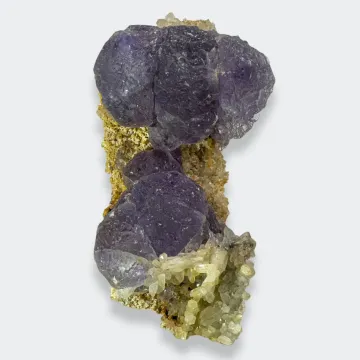
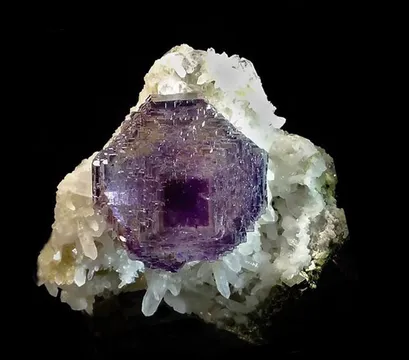
Geologically, Shangbao is a polymetallic skarn and granite-related system, not simply a fluorite vein. Its mineralization is developed where carbonate rocks were altered by granitic magmatism and associated fluids, producing iron, tungsten, tin, niobium, and tantalum interest as well as collector-quality cavities. That mixed setting is why good Shangbao specimens have such complete mineralogical architecture. The best pieces are not just colored fluorite crystals; they are miniature pocket interiors, with transparent purple, green, bluish, or color-zoned fluorite rising from porcelain-white dolomite, drusy to bladed quartz, amber or white calcite, and brassy pyrite.
Regional View
Country View
Historically, Shangbao is a late-twentieth-century classic. Exploration recognized the iron-skarn component in the mid-1900s, and later work showed that the district also had broader rare-metal and W-Sn potential. Specimen collectors, however, know it chiefly from the late 1980s onward, when fluorite, dolomite, quartz, calcite, pyrite, and bismuthinite specimens began reaching international markets. The late-2000s pockets, especially the 2008 fluorite-dolomite-quartz production, fixed the locality’s reputation. Those pockets produced the “Shangbao look” at its most refined: cuboctahedral or modified cubic fluorites, terraced faces, internal phantoms, purple cores, green-blue outer zones, and carefully balanced matrix pieces that seem designed rather than mined.

Photo: Wikimedia Commons

Photo: Wikimedia Commons
Search for specimens: View all specimens from Shangbao Mine, China
Shangbao Mine is recorded at Leiyang County-level City, Hengyang, Hunan Province, China, with the Chinese locality name 上堡矿. The coordinates given for the mine place it southeast of Leiyang and not far from Chenzhou, in the humid subtropical interior of southern Hunan. The mine is closely associated in modern visitor descriptions with the Cailun Bamboo Sea area, a bamboo-covered hill district that now frames the locality as much in photographs as in specimen labels.
The deposit is described as a skarn-type polymetallic iron, tungsten, and tin system at the contact between Carboniferous and Permian limestones and a granite stock, with separate niobium-tantalum orebodies in the granitic weathering crust. Later geochronological and geochemical work on the Shangbao rare-metal granites places important Nb-Ta mineralization in the Late Cretaceous, with zircon and columbite U-Pb ages around 87 Ma. For collectors, the practical result of that geological complexity is a rich skarn and hydrothermal assemblage: fluorite, quartz, dolomite, calcite, pyrite, bismuthinite, sphalerite, chalcopyrite, scheelite, cassiterite, wolframite-group minerals, columbite-tantalite-series minerals, feldspars, mica-group minerals, topaz, tourmaline, diopside, garnet-group minerals, epidote, tremolite, vesuvianite, magnetite, and other accessory phases.
The early mining story begins with exploration between 1959 and 1964, when the iron skarn was found but the broader potential of the district was not fully recognized because prospecting was focused heavily on pyrite ore. During granite-geology studies from 1969 to 1971, niobium-tantalum orebodies were recognized in weathered granite, and later drilling identified economic tungsten-tin skarn mineralization. In 1972 several smaller iron-sulfur or pyrite operations were consolidated into the Shangbao Pyrite Mine, which worked pyrite ore by open-pit and shallow underground methods. The ore phase of the mine was small by the standards of major Hunan metal mines, but it persisted at a time when pyrite was still being used in China as a source of both iron and sulfur.
Commercial ore production ended in the mid-1990s, commonly given as 1995 in collector accounts. After that, the specimen story became unusually important. A group of former miners leased or acquired parts of the workings and continued to recover specimens from scattered pockets. Early accounts describe ten or so miners working specifically for specimen recovery, with income dependent on unpredictable pockets rather than continuous ore. On average, only a limited number of significant pockets could be opened, but a single good pocket might yield material worth many thousands of dollars once selected by dealers and moved through Changsha and the international mineral trade.
The mine’s underground development has been described as roughly two kilometers of tunnels distributed over multiple levels, reaching to about 300 meters depth. By the time of a 2015 collector visit, active specimen recovery had largely slowed, but lower levels were reportedly kept pumped so the mine could be re-entered if worthwhile work resumed. The entrance had also changed from a plain adit in a bamboo-covered hillside into a formal portal surrounded by a wall and wrought-iron gate, reflecting plans to connect the mine with the Cailun Bamboo Sea tourist circuit. Current access should be treated as closed to casual collecting. A visitor may be able to see a tourist-oriented “crystal mine” attraction in the scenic area, but that is not the same thing as legal access to collect in an active specimen mine.
The most important finds for collectors include the early market material of the late 1980s and 1990s, later fluorite-quartz and fluorite-dolomite pockets, and especially the end-of-2008 fluorite-dolomite production. That 2008 material produced some of the finest known Shangbao pieces: isolated to clustered fluorites on complete dolomite plates, purple or blue-green crystals with internal zoning, floaters and near-floaters, and specimens in which quartz and pyrite add sparkle without crowding the main fluorite. Other production included unusual quartz-rich specimens, pyrite on dolomite, amber calcite, and far scarcer bismuthinite on quartz or in complex skarn associations.
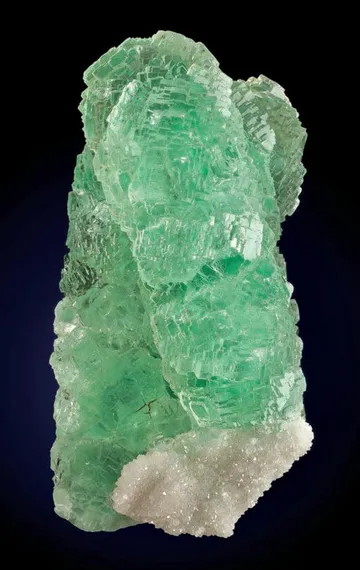
Fluorite is the signature mineral of Shangbao, and its best examples are instantly recognizable: modified cubes, cuboctahedra, dodecahedral and octahedral modifications, stepped faces, and transparent to translucent interiors with purple, violet, blue-green, sea-green, pinkish, colorless, or mixed zoning. Crystals commonly range from thumbnail size to 2–5 cm on better cabinet pieces, with exceptional individual crystals and clusters larger; the most desirable examples show sharp geometry, lively luster, visible phantoms, and a balanced matrix of dolomite, quartz, calcite, and pyrite. The celebrated end-2008 pockets produced some of the classic fluorite-on-dolomite specimens, including complete floaters and freestanding crystals perched on porcelain-white dolomite, while older purple-on-quartz pieces and fluorites with calcite or pyrite remain highly collectible. Ordinary Shangbao fluorite can be dull, bruised, or compositionally clumsy; top pieces have color suspended inside the crystal, crisp terraced architecture, and a matrix that makes the fluorite look elevated rather than buried.
Quartz from Shangbao is usually an associate rather than the headline species, but it is essential to the locality’s finest compositions. It occurs as milky to translucent sprays, drusy crusts, granular white crystal carpets, and sharper prismatic crystals that line skarn cavities before later fluorite, calcite, pyrite, and dolomite complete the pocket. Some Shangbao specimens show quartz forming bright white or pale greenish bases for purple fluorite, while others preserve hollow or cast-like quartz textures after earlier calcite scalenohedra, creating unusually sculptural surfaces. The best quartz-bearing pieces are those in which the quartz gives height, sparkle, and contrast to the fluorite or carbonate association; massive, broken, or sugary quartz matrix without well-placed accessory crystals is far less desirable.
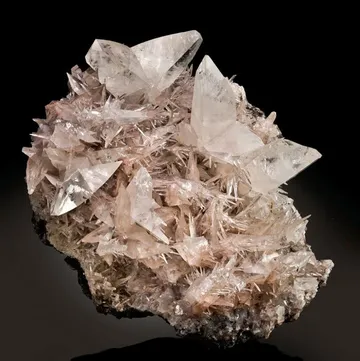
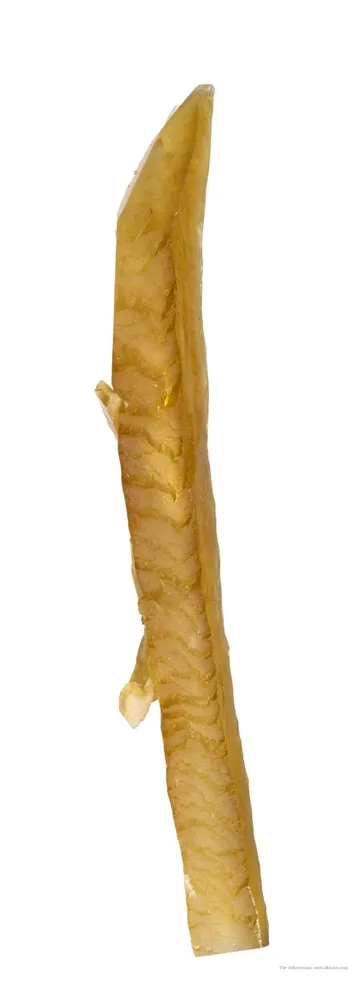
Calcite at Shangbao appears in several collector-relevant habits: amber to honey-colored scalenohedra, creamy-white dogtooth crystals, rhombohedral forms, and lustrous colorless to pale calcite associated with fluorite and quartz. In mixed specimens it commonly provides a warm or pale architectural counterpoint to purple and green fluorite, and in some larger multi-mineral pieces it forms prominent dogtooth clusters among quartz, dolomite, pyrite, and fluorite. Good Shangbao calcite is sharply crystallized, clean, and visibly integrated into the paragenesis rather than merely a late crust; it is most attractive when it sits beneath or beside fluorite in a way that preserves the three-dimensional pocket structure. Because calcite is softer and more vulnerable than fluorite or quartz, bruised points, cleaved edges, and etched-looking surfaces are common condition issues.
Dolomite is the mineral that gives many Shangbao fluorites their classic stage. It occurs as pearly to porcelain-white, cream, or pale pink saddle-shaped rhombohedra, blocky compound rhombs, curved twinned crystals, and snowball-like aggregates, commonly with quartz and pyrite and, in the finest pieces, with fluorite perched on top. Individual dolomite crystals are often in the centimeter range, with documented compound rhombs over 4 cm, and some large old specimens show extensive dolomite-quartz plates far beyond normal cabinet size. Good dolomite pieces have a clean, luminous, sculptural quality: curved rhombs with crisp edges, minimal bruising, and enough openness that associated fluorite, pyrite, or quartz is not lost in a white mass. The best fluorite-on-dolomite specimens from the 2008 pockets are prized because the dolomite itself is complete and aesthetic, not merely a support.
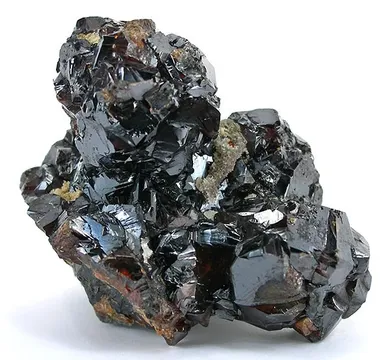
Pyrite is historically central to Shangbao’s identity and remains one of its most important accessory species. It occurs as bright brassy cubes, small lustrous grains and clusters, and pyrite set in or on dolomite, quartz, calcite, and fluorite; some documented specimens show pyrite cubes more than 1 cm across on mine-dump material, and specimen records include larger pyrite-rich plates and pyrite on dolomite combinations. In the best fluorite specimens, pyrite acts as a metallic accent, giving sharp flashes against white quartz and dolomite or appearing as inclusions and surface clusters near stepped fluorite faces. Collectors should distinguish fine, bright, sharp pyrite cubes from dull granular sulfide patches: the former adds value and locality character, while the latter can make a specimen look heavy and may create stability concerns if oxidation is present.
Bismuthinite is a much scarcer Shangbao collector mineral than fluorite, quartz, dolomite, calcite, or pyrite, but it is important because it reflects the bismuth-bearing polymetallic character of the skarn system. Specimens are known as silvery-gray bladed to acicular crystals, commonly on quartz and sometimes with pyrite or other sulfides; published and database records include quartz with bismuthinite cabinet pieces as well as bismuthinite noted in the broader Shangbao mineral assemblage. The best examples show distinct metallic blades rather than anonymous gray smears, are well isolated on a contrasting quartz matrix, and preserve their delicate terminations without crushing. Because bismuthinite can be visually confused with stibnite, jamesonite, or other gray acicular sulfides on incomplete labels, well-documented provenance or analytical confidence matters more here than it does for the common fluorite-dolomite material.
Beyond the six species above, Shangbao’s documented mineral list is unusually broad for a locality best known to collectors for fluorite. Ore and accessory species include cassiterite, scheelite, wolframite-group minerals, chalcopyrite, sphalerite, pyrrhotite, magnetite, columbite-(Fe)-columbite-(Mn) series, tantalite, microlite-group minerals, niobium-bearing rutile, monazite-group minerals, fergusonite-(Y), zircon, topaz, tourmaline, lepidolite, zinnwaldite, muscovite, phlogopite, albite, K-feldspar, kaolinite, baryte, celestine, diopside, epidote, tremolite, vesuvianite, spinel, and garnet-group minerals. Shangbao is also recorded for “Allevardite” in older Chinese mineralogical literature, but the locality’s collector importance rests less on type-locality status than on its rare combination of fine aesthetics and a genuinely complex W-Sn-Nb-Ta-Fe skarn/granite mineral system.
The main authenticity issue with Shangbao is not a well-known epidemic of artificial specimens, but locality confidence. Labels may read Shangbao Mine, Shangbao Pyrite Mine, Shang Bao, Shangbao Crystal Mine, Leiyang, Hengyang, Chenzhou District, or simply Hunan, China. Some of those variants are harmless historical or transliteration differences, while others can obscure confusion with other Hunan fluorite localities such as Xianghualing, Xianghuapu, Yaogangxian-area material, or other Chinese fluorite mines. Good Shangbao attribution should be supported by the association and style: stepped modified fluorite, purple-green or blue-purple zoning, white dolomite, quartz, calcite, and pyrite in the characteristic skarn pocket assemblage.
Documented repairs should be assumed possible on high-end fluorite matrix pieces, especially where heavy fluorite crystals sit on dolomite or quartz. Fluorite cleaves perfectly and chips easily along corners and edges; calcite points bruise; dolomite edges rub; quartz tips snap; and pyrite can detach from exposed matrix. Examine junctions under magnification, especially where a fluorite crystal appears too cleanly placed on a flat dolomite surface. Natural Shangbao attachments commonly show penetration, encrustation, or growth relationships, not a simple glued contact. Matrix trimming is also common and not inherently disqualifying, but broken sawed backs or ground bases should be reflected in price.
Fluorescence should not be used as a pass-fail test. Many fluorites, including numerous Chinese fluorites, may show weak or no visible response under common longwave UV lamps. Color behavior under different lighting is more relevant for some Shangbao pieces: blue-green, purple, and pale green fluorites can shift noticeably between daylight, fluorescent light, and halogen or LED illumination, and the most desirable zoning often appears best when the specimen is backlit or side-lit. Avoid prolonged strong sunlight for display, not because Shangbao fluorite is uniquely unstable, but because color-sensitive fluorites are best kept under controlled cabinet lighting.
Market availability remains good at the ordinary level and increasingly selective at the fine level. Small, later or less aesthetic Shangbao fluorites continue to circulate, but high-quality late-1990s to 2000s pieces with sharp phantoms, fine matrix, and undamaged crystals are increasingly collection material rather than mine production. Pieces with strong 2008-pocket style, older dealer provenance, published history, or association with known collections command a premium. Bismuthinite-bearing examples, stand-alone dolomite-quartz pieces of strong quality, and large complete multi-mineral plates are much less common than basic fluorite miniatures.
In May 2015, Mario Pauwels visited Shangbao during a trip through mineral-rich Hunan, pairing it in his itinerary with Yaogangxian. His account places the mine not in an industrial wasteland but beside the small village of Zhushan, at the edge of the Hunan Leiyang Cailun Bamboo Forest. That setting matters: Shangbao’s portal is not merely a hole in rock, but a mine tucked into green hills and bamboo, close enough to the tourist landscape that later plans tried to turn the mine itself into a visitor attraction.
Pauwels described Shangbao as small in scale but world-famous among fluorite collectors. By 2015, specimen searching had nearly stopped, yet the mine was not abandoned in the casual sense. Lower levels were still being pumped dry so the workings could be made operational again if necessary. He recorded about two kilometers of tunnels divided over several levels, descending to roughly 300 meters. The original entrance had been very simple: a tunnel driven straight into a green, bamboo-covered mountain slope. In 2010 the owners built a more formal entrance portal around it, giving the site a public face. A high wall and new wrought-iron gate enclosed the property, and from the road around the bamboo park the mine itself could not be seen.
The mine owners had hoped to combine specimen extraction with commercial underground tours, drawing on the visitors who came each year to the Cailun Bamboo Forest. The evidence Pauwels saw suggested the plan had not fully taken off. An old mine cart had been converted for visitor use, but its heavily rusted wheels and equally rusted rails made it look as if the little train had not run for years. That image captures Shangbao’s ambiguous later life: part mineral locality, part dormant mine, part tourist idea, with the great specimens already dispersed into the world.
The dumps still held enough to excite a field collector. Around the entrance, Pauwels noted rubble with small fluorite crystals, slightly iridescent pyrite cubes more than 1 cm across, and well-formed dolomite and calcite rhombohedra to about 4 cm glittering in the sun. Even the leftovers carried the locality’s signature: fluorite, pyrite, dolomite, calcite, and quartz together, the same vocabulary as the great cabinet specimens but written in smaller fragments.
The 2008 find remains the defining pocket story. It produced the fluorite-dolomite-quartz specimens that made Shangbao unmistakable on the world market: freestanding fluorites on white dolomite, blue-green and purple zoning, complete floaters, and pocket compositions clean enough to look almost arranged. In collector memory, that find was not merely another batch of Chinese fluorite. It was the moment when Shangbao became a locality name that could stand on a label by itself.