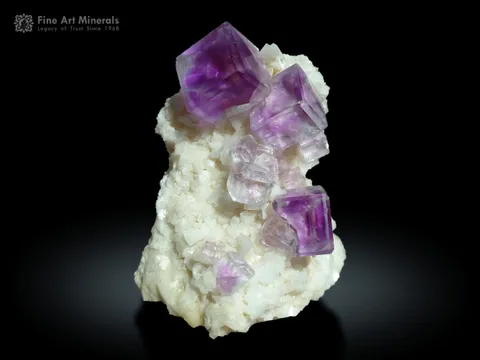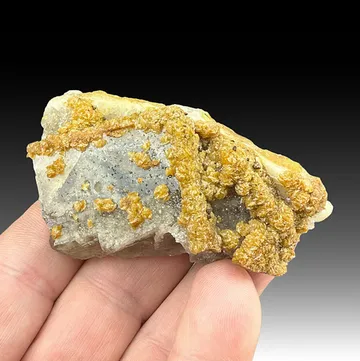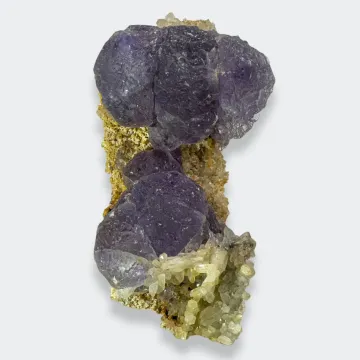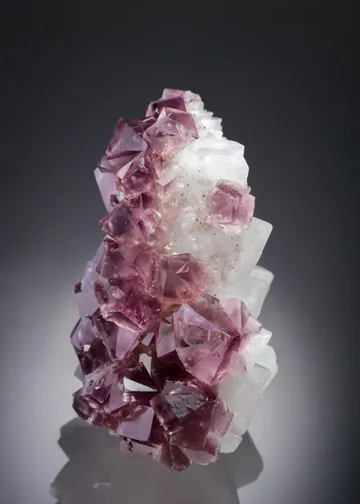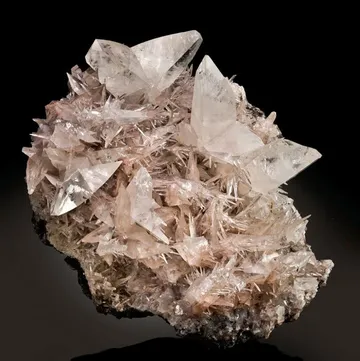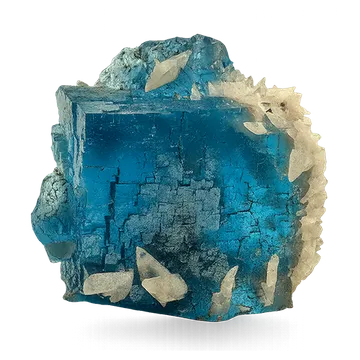
Fluorite from Shangbao Mine, China: architectural, glassy crystals with internal phantoms and vivid zoning; a modern classic prized by collectors.
Key facts
Shangbao fluorite is one of the unmistakable Chinese fluorites: sculptural, stepped, glassy, and often lit from within by purple, violet, teal-blue, or sea-green zoning. The finest pieces have a character quite unlike the big flat cubes of many classic fluorite localities. Shangbao crystals commonly look architectural—cubes modified by dodecahedral and octahedral faces, or cuboctahedra whose faces are broken into hundreds of tiny terraces. Under good light the best specimens show internal phantoms, violet corner zones, purple edge bands, green or bluish interiors, and a water-clear body that lets the color float inside the crystal rather than merely sit on the surface.

Photo: Wikimedia Commons
The locality is the Shangbao Mine, near Leiyang in Hengyang, Hunan Province. It is also known in older specimen labels as the Shangbao Pyrite Mine or Shangbao Pyrite mine. Geologically it is a skarn-type polymetallic deposit at the contact between Carboniferous–Permian limestones and a Jurassic granite stock, with iron, tungsten, tin, niobium, and tantalum significance in addition to its specimen fame. Fluorite, CaF2, occurs in open cavities with dolomite, quartz, pyrite, calcite, and accessory sulfides and skarn minerals. That setting explains the collector appeal: the fluorite is rarely alone, and the very best pieces are complete mineral compositions—transparent fluorite perched on pearly white dolomite, frosted quartz, brassy pyrite cubes, or cream-to-golden calcite.

Photo: Wikimedia Commons
Historically, Shangbao is a modern classic rather than a nineteenth-century one. The deposit was explored as an ore locality in the mid-twentieth century, but the fluorites that collectors prize today entered the western mineral market in quantity only from the late 1980s through the 1990s and early 2000s. The mine’s specimen reputation was built on a relatively small number of productive pockets, culminating in the celebrated late-2000s finds that produced some of the most complex and colorful examples. Today, the mine is not a normal producing specimen source in the way collectors sometimes imagine. Much of the material circulating now is older stock, deaccessioned collection material, or occasional pieces recovered from old workings.
What collectors look for first is the “Shangbao look”: modified cubic to cuboctahedral crystals with stepped faces, transparent to translucent interiors, strong color zoning, and an elegant matrix. A single undamaged 2.5–4 cm crystal on dolomite can be more desirable than a larger but dull or bruised cabinet piece. Saturated purple, blue-green with purple phantoms, sharply zoned violet edges, and freestanding crystals that are not buried in matrix all carry premiums. So do pieces with provenance to early production, published examples, or known collections.
Search for specimens: View all fluorite specimens from Shangbao Mine, China
The Shangbao Mine lies near Leiyang, in Hengyang, Hunan Province, at the edge of the Cailun Bamboo Sea region. Mindat gives the locality as Shangbao Mine, Leiyang Co., Hengyang, Hunan, China, with the local-language name 上堡矿. Older labels often read “Shangbao Pyrite Mine,” reflecting its early mining identity, while current tourism-oriented references may call it the Shangbao Crystal Mine.
The deposit is a skarn-type polymetallic system developed where Carboniferous and Permian carbonate rocks were intruded and altered by a Jurassic granite stock. In collector terms, that means Shangbao is not merely a fluorite vein locality: it is a mixed skarn and hydrothermal environment where fluorite formed with quartz, dolomite, calcite, pyrite, chalcopyrite, sphalerite, bismuthinite, cassiterite, scheelite, and other minerals. The important ore commodities recorded for the locality include iron, tungsten, tin, niobium, and tantalum. Exploration in 1959–1964 found the iron skarn, but early work focused strongly on pyrite and did not fully recognize the broader polymetallic potential. Later granite studies in 1969–1971 identified niobium-tantalum mineralization in weathered granite crust, and subsequent exploration drilling intersected tungsten-tin skarn mineralization.
For specimen collectors, the decisive chapter came after the ore history. Fluorite specimens began appearing on western mineral markets in the late 1980s and became much better known through the 1990s and early 2000s. The mine was eventually run in a notably specimen-oriented way by former miners rather than as a major industrial ore producer. Reports from collectors who visited the locality in the 2010s describe a relatively small mine with underground levels, a formal entrance portal built around the original adit, and a fenced property near the bamboo-forest tourist area.
Collecting access should be treated as closed unless arranged locally and explicitly. The site is now associated with the Cailun Bamboo Sea tourist circuit, where “Shangbao Crystal Mine” is listed as an attraction. Older workings have been used for tourist visits, and recent dealer descriptions make clear that the mine is not producing major new commercial specimen material. Occasional recoveries from old tunnels or old stock do occur, but they should not be confused with an active, accessible collecting locality.
The most notable specimen-production period spans the late 1980s through the 2000s. Early material includes green, purple, and color-zoned modified cubes and cuboctahedra, often on dolomite or quartz. The mid- to late-2000s material is especially prized for complex stepped faces, strong purple-and-green zoning, and handsome dolomite, quartz, calcite, or pyrite associations. A 2008 find is repeatedly singled out in collector accounts as a peak moment for Shangbao fluorite-dolomite-quartz specimens and as the find that fixed Shangbao’s status among the great Chinese fluorite localities.
Shangbao fluorite is best known for modified isometric forms rather than simple cubes alone. Mindat records the habit as cubes to 5 cm, dodecahedra, and octahedra, with spinel twins also noted. In hand specimens, the crystals frequently appear as cuboctahedra or cube-dodecahedron combinations, and many show dense stepped growth. These stepped surfaces are one of the locality’s signatures: instead of a single flat face, the crystal surface may be built from tiny terraces, giving a rounded, crenellated, or almost pagoda-like outline while still preserving sharp geometric order.
Color is a major part of the appeal. Shangbao crystals may be pale lavender, medium to deep violet, grape purple, blue-purple, green, sea-green, bluish green, colorless to water-clear, or combinations of these. The most desirable pieces show internal zoning: purple cores inside greenish crystals, violet corner ghosts, purple edge bands below pale outer faces, or octahedral phantoms suspended inside transparent fluorite. Some pieces show a color-change impression under different light sources, with purple zones shifting from cooler bluish purple in daylight or LED light to more magenta under warmer illumination.
Typical individual fluorite crystals range from about 1–5 cm, with 2–4 cm crystals being common on better miniature and small-cabinet specimens. Larger crystals exist and are avidly pursued, especially when exposed rather than half buried in matrix. Cabinet plates in the 8–15 cm range are the most familiar display format. Exceptional large cabinet pieces and isolated crystals above 5 cm are substantially scarcer and move into serious connoisseur territory.
The classic matrix is white to cream dolomite, commonly forming rhombic or saddle-shaped aggregates. Quartz is another defining associate, especially frosted to glassy prismatic crystals and the locality’s distinctive “artichoke” or “candle” quartz habits. Pyrite occurs as brassy cubes that make a strong visual contrast with pastel fluorite and white matrix. Calcite may form scalenohedra or small sparkling crusts, sometimes cream, white, honey-colored, or golden. Less common but mineralogically important associates include sphalerite, chalcopyrite, bismuthinite, cassiterite, scheelite, and skarn minerals such as diopside, garnet-group minerals, tremolite, vesuvianite, epidote, and magnetite.
Quality in Shangbao fluorite is a balance of crystal architecture, transparency, color placement, and matrix composition. A top piece should have crisp geometry, lively luster, a clear view into the internal zoning, and minimal chipping along edges or corners. Purple-on-green or purple-on-blue zoning is especially sought after. Matrix matters: a small, well-balanced fluorite on white dolomite, quartz, and pyrite may be much more desirable than a larger crystal on a clumsy, broken, or visually heavy matrix. Collectors also prize “floaters” or nearly complete-all-around pieces, but Shangbao’s strongest specimens are often matrix pieces with the fluorite elevated cleanly above the dolomite or quartz.
Shangbao fluorite is common enough that ordinary pieces still appear regularly, but fine classic material is no longer easy. The market today is dominated by older production: late-1990s, early-2000s, and late-2000s pieces from collections, dealer back stock, and occasional old stashes. Recent auction records show small miniatures and modest matrix pieces selling in the low hundreds of dollars, while better small-cabinet and cabinet examples with strong zoning, good condition, and provenance commonly sell for several hundred to a few thousand dollars. Exceptional published or “best of locality” pieces can be priced far beyond normal cabinet-specimen levels.
The main authenticity issue is not a widely documented Shangbao-specific treatment industry, but locality confidence. Many Hunan fluorites exist, and some green, purple, or color-zoned Chinese fluorites can be casually mislabeled or over-attributed. True Shangbao material should be judged by the whole specimen: stepped modified cubes or cuboctahedra, purple-green or purple-blue internal zoning, dolomite/quartz/pyrite/calcite matrix, and a style consistent with known Shangbao production. Pieces on white dolomite with brassy pyrite and artichoke quartz are easier to place than loose single crystals with no provenance.
Condition is critical. Fluorite has perfect octahedral cleavage and is vulnerable at corners, bevels, and stepped faces. Shangbao crystals often have many tiny terraces, so small bruises can hide in the architecture until viewed under magnification. Inspect the high points of the stepped faces, cube corners, attachment points, and any areas where quartz or dolomite contacts the fluorite. Repairs are possible on larger crystals and matrix plates; look for unnatural seams, excess glue, mismatched luster across a break, or a crystal sitting too perfectly on a fresh-looking matrix contact.
Natural etching and stepped growth should not automatically be read as damage. Many Shangbao faces are naturally complex, with growth terraces, frosted zones, or subtle dissolution textures. The collector’s task is to separate original growth character from later abrasion. A fine Shangbao fluorite should still have life: glassy windows, crisp edges where they ought to be crisp, and internal zoning that remains visible without harsh backlighting.
For buying, provenance adds value. Ex-collection labels, older dealer labels, publication history, and dated find references are useful because the locality’s best period has passed. Descriptions such as “1990s find,” “early 2000s,” or “2008 find” should be backed by labels or a credible dealer chain rather than taken as decoration. As with many Chinese classics, the safest purchases are from dealers who understand the locality and can explain why the piece is Shangbao rather than merely “China fluorite.”
Mario Pauwels’s 2015 visit gives Shangbao a setting that is almost too vivid for a mineral label. The mine sits near the small village of Zhushan, at the margin of the Hunan Leiyang Cailun Bamboo Forest, a green landscape of bamboo-covered hills. From Leiyang, Pauwels described the last 40 kilometers to the mine as more ordeal than commute. He reached Leiyang from Changsha by high-speed train, then hired a taxi for the remaining hour-plus drive. Before leaving town, the driver stopped at a local garage and had the tires checked and inflated, then passed the bill to Pauwels with a look that seemed to say: “Yes, you wanted to go to Shangbao, didn’t you?”
The road followed lower banks of the Leishui River, passing small worn villages, many no more than a few houses or a single street. Rice plots lined the roadside. The weather was beautiful and tropically warm, but the rural roads were in poor condition, turning distance into time. Pauwels contrasted the lush green landscape with nearby areas that seemed scarred by pollution, possibly from coal mining. It is a reminder that Shangbao’s airy pastel fluorites came from a real working district, not from the tidy abstraction of a mineral cabinet.
The mine’s early story is also more complicated than the elegant specimens suggest. It was discovered and developed after Chinese government prospecting in the first half of the 1960s. Early names included Shangbao Huang Mine and later Shangbao Pyrite Mine. The plan to profit from iron in pyrite did not succeed as hoped, and the fluorite itself was not well suited to industrial use. The specimens, however, were another matter. Geologists from the Geological Institute of Hunan began commercializing notable fluorite specimens at larger western mineral shows at a time when the Chinese domestic market for mineral specimens barely existed.
According to Pauwels, the mine was never truly profitable, despite that specimen initiative, and was closed by the Chinese government in 1995. That same year it was sold to five former miners, who kept the mine open for specimen recovery—a relatively unusual model in China at the time. Even at its peak, Shangbao employed only about one hundred people, tiny by comparison with great Hunan ore mines such as Yaogangxian. Yet this small mine produced a mineral identity strong enough to stand beside China’s famous fluorite names.
The physical mine Pauwels saw had about two kilometers of tunnels distributed over different levels, reaching roughly 300 meters deep. The original entrance had been little more than a tunnel cut straight into a green bamboo-covered hillside. In 2010 the owners built a more formal entrance portal, giving the mine a public face. A high wall and new wrought-iron gate enclosed the site. From the road around the bamboo park, the mine itself was not visible.
There were also plans to combine specimen extraction with underground tourist visits, taking advantage of the visitors who came each year to the Cailun Bamboo Forest. Pauwels found signs that the plan had not fully taken off: an old mine cart converted for visitors stood on the site, but its heavily rusted wheels and rails suggested that the little train had not run for years. That image has become even more telling today, now that tourist references list Shangbao Crystal Mine as part of the Cailun Bamboo Sea experience and dealers repeatedly describe the locality as a tourist mine rather than an active producing specimen mine.
The dumps around the entrance still had enough visual mineral life to make a field collector pause. Pauwels described rubble and rock pieces with small fluorite crystals, slightly iridescent pyrite cubes more than 1 cm across, and well-formed dolomite and calcite rhombohedra to about 4 cm, glittering in the sun. Even the leftovers at Shangbao carried the signature paragenesis: fluorite, pyrite, dolomite, calcite, quartz—small fragments of the same mineral architecture that made the great specimens famous.
The find that collectors still talk about is the 2008 fluorite-dolomite-quartz production. Pauwels called it the best fluorite/dolomite/quartz find in the mine’s history and the discovery that put Shangbao on the world map as a locality. Since that find, he wrote, little of similar importance had been recovered. That is the core of Shangbao’s modern collecting story: a small mine, a short period of remarkable pockets, and then the gradual movement of the best pieces into private collections where they now reappear only occasionally.
Berthold Ottens, “The Shangbao mine, Hunan Province, China,” The Mineralogical Record, Vol. 43, No. 5, September–October 2012, pp. 587–603 — The key English-language locality article for Shangbao specimens and mineralogy.
Chen Xiaojun (John), “A recent visit to the Shangbao mine,” The Mineralogical Record, Vol. 43, No. 5, 2012, pp. 604–605 — Short field-visit article paired with the 2012 Shangbao locality treatment.
Zeheng Lei, Yusheng Qiao, and Yiming Xu, “W-Sn Mineralization Characteristics and Exploration Potential of the Shangbao Mineral District, Hunan Province,” Geology and Exploration, Vol. 45, No. 2, 2009, pp. 44–52 — Geological reference for the tungsten-tin mineralization and broader polymetallic setting.
Dengfeng Tu, Dizhi Lumping, Vol. 30, No. 3, 1984, pp. 270–274 — Early cited reference for Shangbao fluorite and pyrite occurrences in the Mindat locality record.
Liu, Yang; Guo, Qingfeng; Liu, Liangyu; Zhang, Sixue; Li, Qingling; and Liao, Libing, “Comparative Study on Gemological and Mineralogical Characteristics and Coloration Mechanism of Four Color Types of Fluorite,” Crystals, Vol. 13, No. 1, 2023, article 75 — Modern gemological and mineralogical study cited in connection with Shangbao fluorite.
Flawless Beauty: The Mineral World of Will Johnson, supplement to The Mineralogical Record, January–February 2023 — Includes a published Shangbao fluorite on calcite specimen from the Will Johnson collection, photographed by Tom Spann.
EarthWonders specimen record: Fluorite on Calcite, Shangbao Mine, 9.5 cm, Will Johnson collection — Documents a published Shangbao specimen listed in Flawless Beauty, page 166.
dmb0173 Fluorite, Shangbao Mine, China — Crystal Classics — Rotating video of a Shangbao fluorite specimen useful for seeing luster, transparency, and form in motion.
Fluorite with calcite, Shangbao Mine, Hunan Province, China; 9.5 cm across — exclusiveminerals2 on Flickr — Jeff Scovil photo record of a dark purple Shangbao floater specimen formerly in the Stephen Smale collection, with a linked video reference in the description.
FLUORITE - Shangbao Mine, Hengyang, Hunan, China — SZ Minéraux archive — Archived dealer media page for a blue-to-violet Shangbao fluorite with an embedded specimen video.
Mindat locality page: Shangbao Mine, Leiyang Co., Hengyang, Hunan, China — The central locality database entry, with coordinates, mineral list, geology notes, references, and photo links.
Mindat fluorite occurrence: Shangbao Mine — Fluorite-specific occurrence page with habit notes and a large photo gallery.
Mario Pauwels, “De Shangbao Mine, Leiyang, Hunan, China” — Detailed Dutch-language field account from a 2015 visit, rich in access, history, and mine-site observations.
Wikimedia Commons: Fluorite-234903.jpg — Open-license image of a sea-green Shangbao fluorite with vivid purple internal zones, photographed by Rob Lavinsky.
Wikimedia Commons: Fluorite-Dolomite-235533.jpg — Open-license image showing the classic fluorite-on-white-dolomite Shangbao association.
Wikimedia Commons: Fluorite-Quartz-Pyrite-235604.jpg — Open-license image of purple Shangbao fluorite with quartz, pyrite, and dolomite.
Hunan Provincial Department of Culture and Tourism: Cai Lun Bamboo Sea — Official tourism reference noting the Cailun Bamboo Sea and the Shangbao crystal mine producing fluorite crystals.
Mineral Auctions: Fluorite with phantoms on Quartz, Shangbao Mine — Recent auction record documenting early-production Shangbao material, condition, size, and current market behavior.
Mineral Auctions: Fluorite on Dolomite, illustrated Shangbao specimen — Market reference with detailed discussion of older material, tourist-mine status, and high-end color-zoned examples.
Heritage Auctions: Fluorite, Shangbao Mine — Auction description of a museum-quality Shangbao plate likely from the 2008–2009 period.