A collector's guide to Freiberg Mining District, Germany: its geology, mining history and notable minerals, illustrated with the 35 specimens documented from this locality on EarthWonders.
Key facts
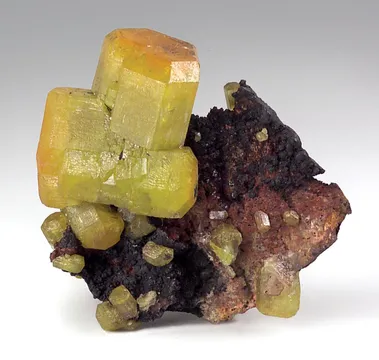
Freiberg is one of the great old names in European silver collecting: a dense, historically worked network of hydrothermal veins in the Eastern Erzgebirge of Saxony, centered on a gneiss dome and famed for specimens that look as old as the mining civilization that produced them. The district’s classic collector identity is silver-rich polymetallic vein mineralization—native silver, acanthite, pyrargyrite, proustite, stephanite, freibergite-group minerals and other sulfosalts—set with quartz, calcite, siderite, ankerite, rhodochrosite, barite and fluorite. The best pieces are not merely mineral specimens but historical objects: dark patinated silver wires rising from calcite, compact black acanthite on pale carbonate, silver sulfosalts in old Freiberg matrices, and rare type-locality species whose labels read like a roll call of 18th- and 19th-century mineralogy.
Regional View
Country View
Geologically, the district is best understood as a long-lived, multi-pulse vein system. Early Permian low- to intermediate-sulfidation epithermal stages produced pyrite-dominated, silver-dominated and silver-lead-carbonate assemblages; a later Cretaceous barite-fluorite stage added Pb-Ag-Cu, Pb-Cu-Zn and locally Ag-Ni-Co-As-Bi “five-element” mineralization. That paragenetic complexity is why old Freiberg specimens can be so satisfying under the lens: a silver wire specimen may carry acanthite or polybasite; a calcite matrix may hide stephanite; a dark sulfosalt mass may be part of a much more complicated Ag-Pb-Sb-As assemblage than a simple label suggests.

Photo: Didier Descouens, Wikimedia Commons
The collecting importance of Freiberg also rests on institutions. The Bergakademie Freiberg, founded in 1765, grew beside the mines and helped make the district a European center for mining, metallurgy, analytical chemistry and mineral classification. The local ores contributed to the discovery of indium and germanium; argyrodite from Himmelsfürst carried the germanium that Clemens Winkler isolated in 1886. For collectors, this means that a Freiberg specimen with old provenance can sit simultaneously in three categories: a classic silver-mining specimen, a Saxon historical object, and a piece of mineralogical science history.

Search for specimens: View all specimens from Freiberg Mining District, Germany
The Freiberg Mining District lies in the northeastern Erzgebirge metallogenic province of Saxony, on the northern edge of the Bohemian Massif. Its local geology is organized around the Freiberg gneiss dome, roughly 25 km in diameter, with medium- to coarse-grained orthogneiss in the core and paragneiss, schist and phyllite around it. The veins exploited by miners occupy fault and fracture systems in and around this domal structure, particularly where competent gneiss, graphitic mica schist, mafic volcanic rocks and lithologic contacts provided open fractures, jogs, flexures and chemically favorable wall rocks.
The deposit is a polymetallic epithermal vein district rather than a single mine. Historic and modern descriptions distinguish several principal Freiberg vein assemblages. The pyrite-dominated “kb” type carries sphalerite, galena, arsenopyrite, pyrite, pyrrhotite and chalcopyrite in quartz with chlorite and carbonate. The silver-dominated “eq” type carries silver sulfosalts, acanthite, arsenopyrite, pyrite, galena, sphalerite and antimony sulfides, commonly with dense to fine crystalline quartz and chalcedony. The silver-lead-carbonate “eb” type carries sphalerite, galena, fahlore and silver sulfosalts in quartz-carbonate gangue including dolomite, rhodochrosite, siderite and ankerite. Later barite-fluorite “fba” veins add galena, sphalerite, pyrite, chalcopyrite, Pb-Sb-Ag sulfosalts and, in the five-element subtype, Co-Ni-Fe arsenides such as safflorite, skutterudite, loellingite, rammelsbergite and nickeline, with native silver, native arsenic, native antimony, native bismuth and locally uraninite.
The geometry explains both the scale of the mining and the patchiness of specimen recovery. Many veins strike northeast-southwest and dip steeply northwest, commonly about 45–75 degrees, though local variations are important. Ore shoots were controlled by vein intersections, cross structures, changes in host-rock competency and, in places, carbonaceous wall rocks. In the Bräunsdorf area, historical and modern work records epithermal quartz veins from decimeters to about a meter thick, locally much wider, with pinch-and-swell behavior and ore shoots far more persistent down dip than along strike. This is the geological reason why Freiberg’s finest silver specimens were not uniformly distributed through the district; they came from favorable shoots, crossings and carbonate-rich silver zones.
Mining began in the late 12th century, traditionally linked to the silver discoveries around Christiansdorf and the first great Saxon “Berggeschrey,” the mining rush that helped create Freiberg itself. Shallow early workings attacked rich oxidized and supergene silver ores, but the district’s long life depended on centuries of increasingly deep underground mining, drainage, mechanized hoisting and central smelting. The broader district ultimately contained more than 1,000 ore lodes and a mine network measured in thousands of kilometers of workings. Silver mining in the district ceased in 1913, but base-metal mining continued intermittently and under modernized operations until final closure in 1969.
Among the district’s major names, Himmelfahrt and Himmelsfürst matter especially to collectors. Himmelfahrt Fundgrube, with the Reiche Zeche, Alte Elisabeth and Abraham workings, became one of Freiberg’s great 19th-century mines after rich silver discoveries in the early 19th century, especially in the newly recognized Neue Hoffnung Flacher vein. The Reiche Zeche and Alte Elisabeth shafts survive today as part of the TU Bergakademie Freiberg research and teaching mine, with visitor access administered through the local mining association. Himmelsfürst, near Brand-Erbisdorf, was one of Saxony’s richest and most celebrated silver mines, famous for native silver and for type-locality species. It produced exceptionally rich native-silver finds in the 18th century and, in the 19th century, became a cornerstone of Freiberg mineralogy through argyrodite, freieslebenite, xanthoconite and other rarities.
Collecting access today is essentially historical, institutional and market-based rather than a matter of entering old workings with a chisel. The Reiche Zeche is an active research and teaching mine and a guided visitor site, not an open collecting mine. Many old dumps, shafts and surface remains are protected, private, reclaimed, unstable or part of the UNESCO Erzgebirge/Krušnohoří Mining Region. Serious collectors should treat modern field collecting in the Freiberg district as permission-only and highly restricted. The best specimens available today usually come from old collections, dealer inventories, museum deaccessions, inherited Saxon material, and pieces carrying 19th- or early 20th-century labels from Freiberg dealers, institutions or mining collections.
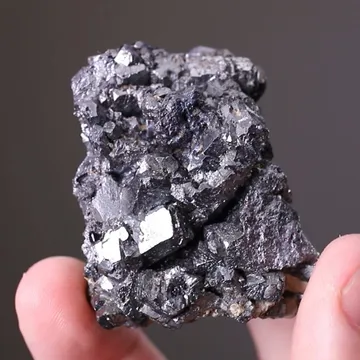
Freiberg acanthite is the old “silver glance” of the district, most prized when it occurs as sharp, black to lead-gray metallic crystals or sculptural aggregates on contrasting calcite, quartz or sulfide matrix rather than as massive ore. The classic Abraham Shaft, Himmelfahrt Mine material shows lustrous acanthite on pale calcite in cabinet-to-miniature scale, while Himmelsfürst and other district mines produced acanthite in the silver-sulfosalt assemblages with native silver, stephanite, polybasite, pyrargyrite, galena, sphalerite, pyrite and arsenopyrite. Good Freiberg examples have three things ordinary pieces lack: clear crystal form or well-defined sculptural surfaces, a credible old-mine provenance, and enough matrix contrast to separate the black Ag2S visually from the surrounding ore.
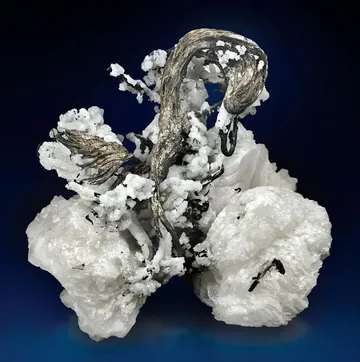
Native silver is the emblematic Freiberg specimen species, occurring as dark tarnished wires, curls, arborescent sprays, twisted ropes, leaves and compact masses in calcite- and sulfide-bearing vein material. The finest examples, especially from Himmelsfürst and the Himmelfahrt system, are miniature to cabinet specimens with wiry or ropy silver rising freely from calcite or dark ore matrix, sometimes accompanied by acanthite, polybasite, stephanite, pyrargyrite, arsenic minerals or rhodochrosite. Strong Freiberg silver is judged by natural patina, undisturbed wire form, three-dimensional display, visible attachment to matrix and provenance; loose or overly brightened wires without an old label or mine attribution are much less convincing than an old Saxon specimen with calcite matrix and a sober gray-black surface.
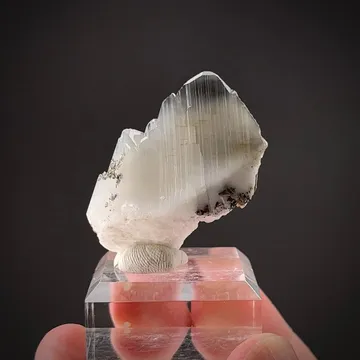
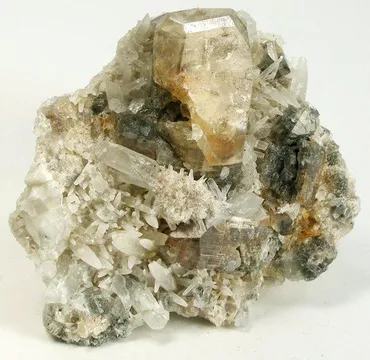
Calcite at Freiberg is both a specimen mineral and the stage on which many of the great silver pieces perform. In the silver-lead-carbonate vein assemblage it occurs with siderite, ankerite, dolomite, rhodochrosite, galena, sphalerite, acanthite, native silver and silver sulfosalts; in collector pieces it may form white to cream crystalline crusts, scalenohedral or rhombohedral crystals, cleavable carbonate masses, or pale matrices cut by dark ore. Himmelfahrt, including the Thurmhof and Abraham areas, is especially associated with collectible calcite-bearing silver and acanthite specimens, and some Freiberg calcites show fluorescence under longwave and shortwave ultraviolet light. The best pieces are not merely chunks of carbonate but balanced combinations: bright or sculptural calcite carrying black acanthite, gray silver curls, galena, stephanite or other Freiberg ore minerals in a way that preserves the vein context.
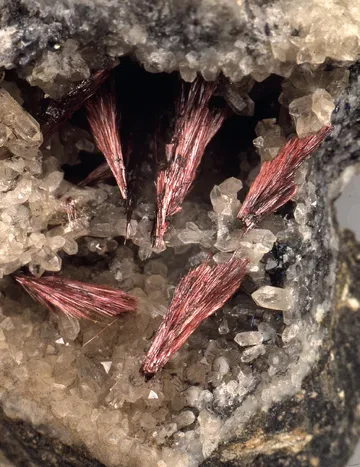
Beyond these three, Freiberg’s mineral list is extraordinary because so many species are historically important rather than merely present. The district is tied to type-locality or early-definition material for argyrodite, freibergite, freieslebenite, xanthoconite, jordisite, miargyrite, polybasite, pyrostilpnite, stephanite, pearceite-T2ac, kermesite, nakrite, diaphorite and cuprite, among others reported in the Freiberg literature. Argyrodite, Ag8GeS6, from Himmelsfürst is particularly famous because it led to the discovery of germanium; freibergite preserves the district’s name in the tetrahedrite-group silver-rich fahlores; and the red silver minerals pyrargyrite, proustite, xanthoconite and pyrostilpnite give Freiberg a place among the classic sulfosalt localities of Europe.
Freiberg specimens demand a provenance-first approach. The mines have been closed to commercial specimen production for decades, and modern “finds” from the district are not a routine market category. The most desirable pieces should carry old labels, collection history, or a plausible mine attribution such as Himmelsfürst, Himmelfahrt, Reiche Zeche, Abraham Shaft, Alte Elisabeth, Thurmhofschacht, Brand-Erbisdorf, Halsbrücke or Bräunsdorf. A label that says only “Freiberg, Saxony” is historically common and not automatically suspicious, but the more exceptional the specimen, the more one should want supporting documentation.
The most common problem is broad or incorrect locality assignment. Old European silver wires from Freiberg, Kongsberg, Schneeberg, Batopilas, Imiter and other localities can be confused in trade, especially when detached from matrix. Freiberg silver is often darkly patinated and may sit on calcite or sulfide-rich matrix, but appearance alone is not enough. Be wary of loose wires sold as Freiberg without old provenance, and be especially cautious when a specimen’s style is inconsistent with the stated mine or when a modern label upgrades a vague “Saxony” locality into a famous Freiberg mine without evidence.
Condition is central. Native silver is malleable and easily bent; old wires may have been reshaped, reattached, cleaned or brightened. A completely fresh, brilliant silver surface can be natural on protected breaks but should invite questions if the whole specimen is aggressively bright. Acanthite is soft and prone to bruised edges, rubbed crystal faces and dull abrasion on high points. Calcite matrices chip readily and are vulnerable to acid; any silver-on-calcite specimen with etched, frosted or unnatural carbonate surfaces should be examined closely for cleaning. Old Freiberg combinations often show dark tarnish, dust in protected recesses, old break surfaces and imperfect edges; these signs can be part of their authenticity rather than defects.
Fluorescence can add interest to Freiberg calcite-bearing pieces, but it is not a diagnostic test for locality. Handle silver and acanthite combinations with nitrile gloves or by the matrix, avoid repeated polishing, and keep them away from sulfurous storage materials, rubber bands and unstable foams that can accelerate tarnish. For silver sulfosalts and arsenic-bearing assemblages, normal mineral-collection hygiene is appropriate: do not grind, soak or acid-clean without expert reason, and wash hands after handling friable ore.
Market availability is limited but not nonexistent. Small acanthite-on-calcite and silver-on-calcite specimens appear periodically, often from old European collections. Fine native silver curls from Himmelsfürst or Himmelfahrt with strong three-dimensional form, matrix and old labels are genuinely scarce and priced as classic European silver specimens. Type-locality argyrodite, freieslebenite, xanthoconite, pyrostilpnite and similar rarities are much more specialized; attractive examples may be small, dark and visually modest, but their historical and mineralogical importance makes them highly competitive when accurately labeled.
The story of Freiberg begins, as so many mining districts wish theirs did, with a damaged wagon and glittering stones. The traditional account places salt merchants on the road near the Münzbach, their wagon in need of repair. Stones gathered for the job caught the eye because they shone. Whether the episode happened exactly that way is beyond proof, but the result is not in doubt: by the late 12th century the news of silver had triggered the first Saxon mining rush, and a town grew around the promise that the mountain was “free” for mining. Freiberg’s name still carries that idea.
Himmelfahrt Fundgrube was not always the giant its name now suggests. In its early decades it was a modest concern, but in the second half of the 18th century it absorbed the Abraham Fundgrube and later the Alte Elisabeth Fundgrube, enlarging the ground that would make it famous. The turning point came in 1828, when rich silver was struck at vein intersections and in the newly discovered Neue Hoffnung Flacher vein. After that, Himmelfahrt became one of the most important mines in Freiberg. Between 1840 and 1896 it produced 448 tonnes of silver. Its workforce grew from 165 men in 1831 to 2,882 men in 1856/60, and by the end of the 19th century an average of 1,500 to 2,000 men were going underground there.
The Himmelsfürst Mine produced one of the most vivid specimen stories in Saxon mining. On 12 August 1749, miners working the Teich Flacher vein in the Kunstschacht broke into a mass of native silver weighing 68 kg, valued at 2,500 talers. The following year they did even better: a silver specimen of 141 kg and more than 4,800 talers in value. These were not cabinet specimens in the modern sense; they were treasure, ore, money and propaganda all at once. Yet for collectors they explain why Himmelsfürst silver has such aura. A small dark wire from that mine is connected to an era when native silver could still emerge from the Erzgebirge in masses heavy enough to change the reputation of an entire mine.
Freiberg also gave chemistry one of its most satisfying detective stories. In the summer of 1885, an unusual rich silver ore was found at Himmelsfürst. Albin Weisbach recognized it as a new mineral and named it argyrodite. Clemens Winkler analyzed it and found the arithmetic would not close: silver, sulfur, iron, arsenic and traces of other constituents left a persistent missing fraction of about 6 to 7 percent. After weeks of separation work among troublesome arsenic and antimony minerals, Winkler announced that argyrodite contained a new element. He named it germanium. The discovery helped confirm Mendeleev’s predicted eka-silicon, turning a dark silver sulfide from a Saxon mine into evidence for the periodic table itself.
There is a darker story at the Abraham Shaft. On 29 February 1880, thirteen miners were entering for the night shift when the rods of the Fahrkunst—the mechanical man-engine used for vertical travel in the shaft—failed. The men fell with the wreckage about 20 meters. Eight died immediately, three more soon after; two survived with severe injuries. Later investigations blamed the poor condition of the apparatus, neglected maintenance and improper use. A memorial plaque at the Abraham Shaft now marks the accident, the worst mine disaster in the history of the Freiberg district.
The modern visitor who descends at Reiche Zeche enters a mine that is no longer an ore producer but is still alive. TU Bergakademie Freiberg operates the Himmelfahrt workings as a research and teaching mine, and the underground space holds experimental, teaching and training stations rather than stopes full of fresh ore. That continuity is unusual: a medieval silver district, a 19th-century industrial mine, a 20th-century base-metal operation and a 21st-century teaching mine all occupy the same underground landscape. For a collector, it is a reminder that Freiberg is not only a locality printed on labels; it is a city and institution built directly on the veins.