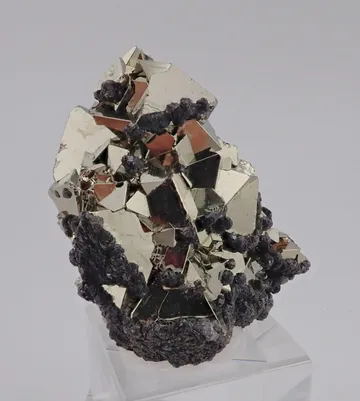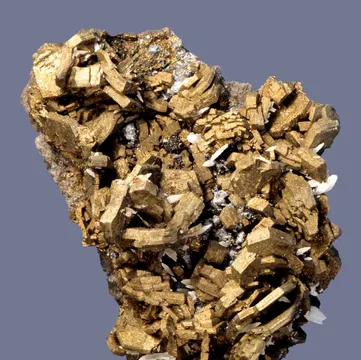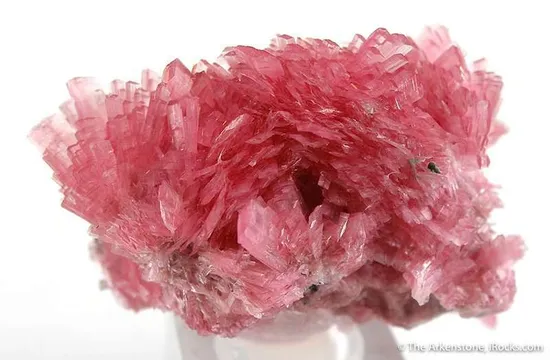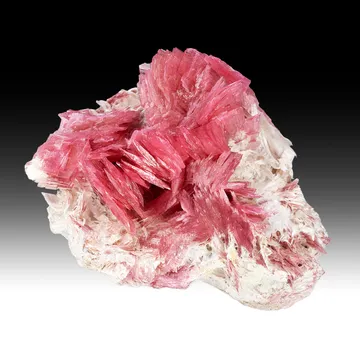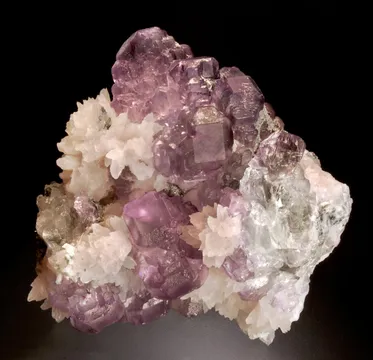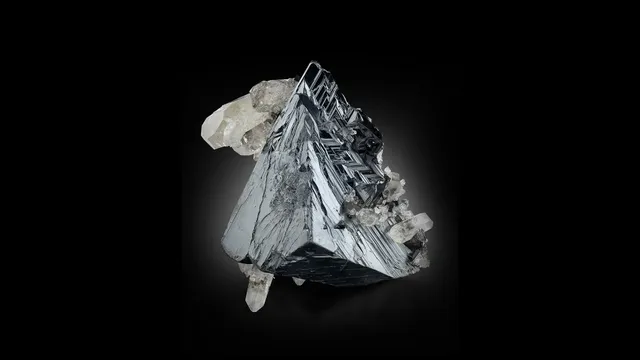
Huanzala Mine, Peru — a defining locality for cabinet pyrite, yielding brassy cubes with fluorite octahedra, sphalerite, and sculptural, collectible specimens.
Key facts
Huanzala is one of the defining modern localities for cabinet pyrite: a working Andean Zn-Pb-Cu-Ag mine whose specimen output has been so voluminous, so lustrous, and so visually distinctive that “Huanzala pyrite” has become a collector category of its own. The mine lies high in the Huallanca District of Bolognesi Province, Ancash, in the carbonate-rich belt of the central Peruvian Andes, where Lower Cretaceous limestone and shale were mineralized by a complex system involving skarn formation, carbonate replacement, pyritization, hydrothermal alteration, and later polymetallic sulfide deposition. Economically, Huanzala is a zinc-lead-copper-silver mine; aesthetically, it is the source of brassy pyrite cubes and pyritohedrons, pink-to-green fluorite octahedra, black to reddish-brown sphalerite, bright galena, quartz, calcite, barite, fluorapatite, and a suite of rare Cu-Ag-Sn-W-Bi-Te minerals that reward close mineralogical study.
The best Huanzala specimens have a look that is difficult to mistake once seen: mirror-bright, deeply striated pyrite crystals in intergrown mounds; fluorite octahedra with pink outer zones and green cores perched on sulfide matrix; smoky or colorless quartz needles rising from dark sphalerite; cuboctahedral galena adding cold lead-gray reflections; and, in richer association pieces, white calcite or barite acting as a pale counterpoint to the metallic field. Many specimens are visually “architectural”—clusters with sharp cubic geometry, stepped faces, and repeated angular rhythms—yet the locality is also famous for large, sculptural pieces that made their way into mineral rooms, decorators’ inventories, and institutional collections.
Regional View
Country View
Huanzala’s importance is not just abundance. It is a mine where the collector’s specimen and the economic geologist’s polished section overlap unusually well. The principal ore minerals—sphalerite, galena, chalcopyrite, and pyrite—are the same species that dominate the best cabinet combinations. The deposit has been repeatedly discussed in the geological literature because its ores preserve evidence for early skarn and later polymetallic replacement mineralization, mineral zoning, pyrite-rich bodies, red and black sphalerite generations, and a late hydrothermal suite rich in copper, silver, tin, tungsten, bismuth, and tellurium.

Photo: Wikimedia Commons

Photo: Wikimedia Commons
Search for specimens: View all specimens from Huanzala Mine, Peru
Huanzala Mine is in the Huanzala area of Huallanca District, Bolognesi Province, Ancash, Peru. Older labels, articles, and dealer tags often place the mine in Huánuco or Dos de Mayo Province, and those labels are common in the specimen trade; modern locality usage places it in Ancash, near the administrative border with Huánuco. Serious collectors should preserve old labels but update database entries to “Huanzala Mine, Huanzala, Huallanca District, Bolognesi Province, Ancash, Peru,” while noting any historic Huánuco/Dos de Mayo wording as label history rather than discarding it.
Geologically, Huanzala is a polymetallic Zn-Pb-Cu-Ag deposit hosted chiefly by carbonate-rich Lower Cretaceous strata, especially limestone and limestone-shale sequences. Early descriptions emphasized the Huanzala Ore Formation: an alternation of limestone and shale, with finely banded limestone-shale horizons especially favorable for mineral deposition. Ore bodies are stratabound to bedding-controlled in broad terms, but they occur as lenses, veins, irregular masses, mantos, and replacement bodies, and later work has stressed the role of intrusive activity, skarnization, hydrothermal replacement, and alteration. Quartz-porphyry dikes and sills intrude along bedding planes near the ore horizons; modern interpretations treat the deposit as the product of early skarn-related mineralization and later polymetallic carbonate replacement.
The mine’s ore assemblage is dominated by sphalerite, galena, chalcopyrite, and pyrite, with bornite, chalcocite, digenite, covellite, tennantite-tetrahedrite group minerals, enargite, luzonite, arsenopyrite, scheelite, cassiterite, stannite-kesterite, canfieldite-hocartite, hessite, pyrargyrite, polybasite, stephanite, electrum, native silver, wurtzite, alabandite, rhodonite, rhodochrosite, fluorite, quartz, calcite, dolomite, chlorite, sericite, kaolinite, halloysite, montmorillonite, talc, sellaite, anhydrite, and gypsum documented in the mineralogical literature. The paragenesis is not a simple one-stage story: fine-grained pyrite, skarn minerals, iron-rich sphalerite, galena, chalcopyrite, altered “shiroji” ore, iron-poor black sphalerite, bornite-chalcocite mineralization, and tennantite-group mineralization all belong to the layered history of the mine.
The Japanese company Mitsui Mining & Smelting began systematic exploration in the area in the 1960s through Compañía Minera Santa Luisa S.A. Detailed mapping, drilling, and tunnel development preceded production, and the mine entered operation in 1968. Compañía Minera Santa Luisa, part of the Mitsui Kinzoku Group, continues to operate Huanzala and Pallca as Peruvian mining units producing zinc, lead, and copper concentrates. Huanzala is therefore not an abandoned collector locality but an active industrial mine; specimen recovery depends on mine operations, permitted access, company policy, relationships with workers and dealers, and whatever pockets or ore faces happen to be exposed.
Specimen production began to affect the international market strongly in the 1980s, first through the now-famous pink fluorite discoveries and then through an enormous stream of pyrite and sulfide combinations. The November 1980 pink fluorite find produced octahedral fluorite crystals from vugs in sulfide ore, ranging from nearly colorless through pink to intense pink, commonly with grass-green cores. Additional high-quality fluorite appeared in the early 1980s, and the best old pieces remain among the classics of Peruvian mineral collecting. Pyrite followed in such quantity and quality that Huanzala became, by common collector reckoning, the world’s most prolific pyrite specimen mine.
The mine is not a casual field-collecting locality. Access is controlled by an operating company, underground work is industrial and hazardous, and specimen availability is almost entirely through Peruvian miners, mine-linked sources, exporters, established dealers, and resold older collections. Modern finds still reach the market—galena miniatures from a May 2025 find, late-2021 fluorapatite, and periodic pyrite lots are examples—but the best historical pink fluorites, large balanced pyrite combinations, and unusual rare-species pieces are much scarcer than ordinary pyrite groups.
Pyrite is the signature mineral of Huanzala and occurs in a range of habits from sharp cubes and modified cubes to pyritohedrons, octahedral forms, cuboctahedral crystals, intergrown mounds, and replacement forms after earlier sulfides such as pyrrhotite. The color on fresh material is a rich brass-yellow to golden metallic, and the finest crystals show mirror luster, crisp edges, strong striations, and an absence of bruising on the high points; ordinary examples are abundant, but elite Huanzala pyrite is separated by sculptural balance, sharpness, complex modified forms, bright unoxidized surfaces, and attractive associations with black sphalerite, silvery galena, colorless to smoky quartz, calcite, fluorite, barite, or fluorapatite. Crystals range from small sparkling coatings to large cabinet-scale individuals and groups; the locality is famous not only for quality but also for sheer specimen tonnage, and collectors often distinguish classic brassy cubic pieces from rarer octahedral or pseudomorph material.
Fluorite from Huanzala is best known for pink octahedra with green cores, a style documented from the November 1980 discovery and subsequent early-1980s finds, but the mine also produced colorless, pale green, purple, and multicolored crystals. The classic specimens are octahedral or modified octahedral, commonly stepped or complex on the faces, with crystals reaching several centimeters on sulfide matrix; associations include pyrite, sphalerite, galena, chalcopyrite, quartz, calcite, and locally barite. Most Huanzala fluorite is not the glass-clear Alpine pink ideal—many crystals have matte or etched faces—but the best examples combine strong color zoning, translucency to transparency, complete octahedral geometry, and balanced contrast against dark metallic sulfides. Older pink-and-green fluorites from the 1980–1982 period are now far scarcer than ordinary pyrite and are among the most desirable Huanzala specimens.
Galena is one of Huanzala’s principal ore minerals and a frequent collector species, appearing as lustrous lead-gray cubes, cuboctahedra, and modified crystals on pyrite, sphalerite, quartz, calcite, and fluorite. Good crystals may be sharp and highly reflective, but galena’s perfect cleavage makes edge damage common, so the best specimens are judged by undamaged corners, bright metallic luster, clean geometric form, and strong visual contrast with brassy pyrite or pale gangue. A notable recent May 2025 find produced small groups and miniatures of sharp, lustrous cuboctahedral galena with minor pyrite, reminding collectors that Huanzala is still capable of producing fresh, high-quality sulfide specimens even after decades of mining. Older fluorite-galena combinations, especially with pink fluorite octahedra, remain especially attractive and much less common than pyrite-dominant pieces.
Quartz at Huanzala is an important gangue and specimen mineral, typically appearing as colorless, white, smoky, or grayish prismatic crystals associated with pyrite, sphalerite, galena, fluorite, calcite, and chalcopyrite. In the best collector pieces, quartz does not merely fill space; it gives the specimen vertical rhythm and brightness, with terminated crystals rising from dark sphalerite or brassy pyrite and providing contrast to the massive-looking sulfide assemblage. The most appealing pieces show clean terminations, undamaged points, and a natural arrangement of quartz sprays or individual prisms that enhance rather than obscure the sulfides. Quartz-sphalerite-galena combinations from Huanzala have become a recognizable market type, usually more modest than the great pyrite sculptures but often elegant, cabinet-friendly, and strongly representative of the mine’s polymetallic character.
Sphalerite is central to Huanzala both as ore and as specimen architecture, occurring in reddish-brown iron-rich generations linked with pyritic and skarn ores and in darker iron-poor “black sphalerite” associated with altered “shiroji” ore and microscopic chalcopyrite inclusions. Collector specimens show sphalerite as black, brown, reddish-brown, honey-brown, or resinous crystals and crystal masses with pyrite, galena, quartz, fluorite, calcite, chalcopyrite, and less common species; good pieces are distinguished by luster, transparency at the edges where present, sharp crystal definition, and the way the sphalerite provides a dark, reflective base for brighter pyrite or quartz. Many ordinary Huanzala specimens include sphalerite as matrix, but high-grade sphalerite specimens make the species itself visually important, especially when lustrous dark crystals are balanced by quartz points or sharp pyrite cubes.
Calcite is a common gangue and alteration-related mineral at Huanzala, documented in the main paragenetic studies and frequently seen on collector specimens with pyrite, galena, sphalerite, quartz, fluorite, and chalcopyrite. It may occur as white to colorless crystals, cleavages, coatings, and late-stage accents, and its collector value here is usually as an aesthetic partner rather than as a standalone species. The best Huanzala calcite pieces use pale calcite to frame or contrast bright sulfides—white calcite beside brassy pyrite and dark sphalerite can make an otherwise heavy metallic specimen look open and balanced. Because calcite is soft and cleavable, bruising, broken edges, and etched-looking surfaces are common; fine examples require clean crystal form, fresh luster, and an association that clearly reads as Huanzala rather than as a generic sulfide-calcite piece.
Fluorapatite is a much rarer Huanzala specimen species than pyrite, fluorite, galena, or sphalerite, but it has appeared in attractive crystals with pyrite, quartz, and calcite, including a small late-2021 find noted by dealers. Specimens may show transparent to translucent apatite crystals on sulfide-rich matrix, and at least some examples have been marketed with fluorescence as a point of interest. Good Huanzala fluorapatite is judged first by confirmed locality and species identity, then by crystal clarity, sharpness, size, and placement against the darker matrix; pieces where apatite is only a minor or ambiguous accessory should be valued cautiously. Because “apatite” is often used loosely in older labels, collector-grade pieces are best described as fluorapatite only when the source or analysis supports that identification.
Barite is a documented but relatively uncommon Huanzala collector mineral, occurring in tabular, bladed, and clustered crystals, locally with fluorite and sulfides. The best pieces are small to miniature clusters with clean, three-dimensional form, pale gray, greenish, or whitish color, and enough openness to show the barite habit clearly; ordinary examples can be visually lost among brighter pyrite or darker sulfide matrix. Barite associated with fluorite is especially desirable because it ties the species to one of the mine’s most recognizable specimen assemblages. As with calcite, condition matters: bruised blade edges and incomplete terminations are common, and a fine Huanzala barite should have crisp blades, pleasing balance, and a label that distinguishes it from the far more abundant barites of Peru’s many other polymetallic districts.
Pyrrhotite is a scientifically important but collector-scarce Huanzala species, tied to the early hotter part of the system and to the pyrite-pyrrhotite stability path described in paragenetic work. It is best known to collectors through rare preserved crystals and, especially, pseudomorphs or replacements involving pyrite and arsenopyrite after pyrrhotite, including hexagonal-looking forms from the Reliquia area. Fine pyrrhotite-related specimens are valued less for bright beauty than for mineralogical story: former pyrrhotite shapes, replacement textures, and association with pyrite, arsenopyrite, sphalerite, quartz, and other sulfides. Because pyrrhotite can oxidize and because replacements may no longer contain much original pyrrhotite, labels should be precise—“pyrite after pyrrhotite,” “arsenopyrite after pyrrhotite,” or “pyrrhotite with…” should not be used interchangeably.
Tetrahedrite-group minerals at Huanzala belong to the copper-rich sulfosalt side of the deposit’s paragenesis and appear in dark metallic crystals or masses associated with pyrite, sphalerite, galena, chalcopyrite, quartz, calcite, and fluorite. In collector specimens, “tetrahedrite” is often a label inherited from appearance and association rather than from analysis, so better pieces are those with credible provenance, crystal form, and a paragenetic context consistent with Huanzala’s Cu-bearing ores. Sharp black crystals against brassy pyrite or pale calcite are visually effective, but the species is scarcer and more identification-sensitive than the major sulfides. Because tennantite is also documented in the mine, and because tetrahedrite-tennantite group nomenclature has become more analytical, serious collectors should treat old labels as useful but not definitive unless supported by testing.
Chalcopyrite is a principal copper mineral in parts of the Huanzala ore system and occurs with pyrite, sphalerite, galena, bornite, tennantite-group minerals, quartz, calcite, and fluorite. Collector specimens usually show chalcopyrite as brassy to golden crystals, grains, or coatings, sometimes iridescent from surface alteration, but it is less often the dominant display species than pyrite. The best Huanzala chalcopyrite pieces have sharp, recognizable crystals or lively accents that add color and complexity without being confused with pyrite; distinguishing the two is important because both can be brassy, but pyrite’s cubic or pyritohedral geometry and paler brass color usually contrast with chalcopyrite’s warmer tone and different crystal habit. Association pieces with fluorite, galena, or sphalerite are especially useful for representing the mine’s Cu-Zn-Pb character.
Bournonite from Huanzala is a scarce sulfosalt species in the specimen trade, reported in association with fluorite, muscovite or mica-like matrix, jamesonite in some dealer descriptions, pyrite, galena, sphalerite, and quartz-rich sulfide assemblages. It is not a common “cogwheel bournonite” locality in the classic Herodsfoot or Machacamarca sense; Huanzala bournonite is more often valued as a rare locality and association mineral than as a source of large textbook crystals. Good pieces require credible identification, sharp metallic crystal form where visible, and a balanced association—especially with fluorite or pyrite—that roots the specimen in the Huanzala assemblage. Because black sulfosalts in Peruvian fluorite-sulfide specimens have sometimes been confused among bournonite, geocronite-jordanite, tetrahedrite-tennantite group minerals, and galena, analytical caution is warranted on any expensive example.
Other documented minerals from Huanzala include arsenopyrite, bornite, chalcocite, digenite, covellite, enargite, luzonite, scheelite, cassiterite, stannite-kesterite, canfieldite-hocartite, argentite/acanthite-type silver sulfide references in older paragenetic tables, hessite, pyrargyrite, polybasite, stephanite, electrum, native silver, wurtzite, alabandite, rhodonite, rhodochrosite, dolomite, chlorite, talc, sellaite, kaolinite, halloysite, montmorillonite, anhydrite, gypsum, and the type-locality mineral huanzalaite, MgWO4. Huanzalaite is a microscopic wolframite-group mineral occurring as orange to reddish-brown aggregates of minute crystals included in scheelite from Mg-metasomatized contact skarn; it is not a cabinet species, but it gives the mine a permanent place in systematic mineralogy.
Huanzala specimens are abundant on the market, but quality varies enormously. The mine produced everything from inexpensive student pyrite to world-class cabinet pieces, and price should track aesthetics, condition, crystal sharpness, association, and provenance—not merely the locality name. Ordinary pyrite clusters are common; balanced pyrite with excellent luster, undamaged high points, large modified crystals, and elegant matrix is much scarcer. Pink-and-green fluorite from the 1980–1982 discoveries is genuinely rare in fine condition, especially with large, complete, transparent octahedra and strong color zoning.
The most persistent locality problem is mislabelling. Older labels commonly say Huánuco, Dos de Mayo Province, or simply “Huanzala, Peru”; these may be historically understandable rather than wrong in the collecting sense, but modern locality data should use Ancash, Bolognesi Province, Huallanca District. A separate and more serious problem affects some recent Peruvian green fluorite with dark sulfides: material first reported or circulated as Huanzala was later argued by well-informed dealers and show reporters to be from the Milpo or Atacocha area in Pasco. If a specimen is a gemmy green cuboctahedral fluorite on black sulfosalt-rich matrix from the 2022–2024 market wave, do not assume Huanzala without strong provenance.
Treatments and outright fakes are not the main issue with Huanzala; the bigger concerns are over-cleaning, oiling or wet-looking enhancement on sulfides, repaired fluorite crystals, glued matrix fragments, and vague species names applied to complex black sulfide/sulfosalt mixtures. Pyrite is sometimes cleaned aggressively to brighten surfaces, and residues can lodge between crystals. Galena and fluorite are easily bruised; look closely for chipped fluorite octahedron tips, cleaved galena corners, missing pyrite points, and dull gray abrasion on exposed metallic edges. Large pyrite specimens are heavy and can shed smaller attached crystals if poorly mounted or shipped.
Fluorescence should be treated species by species, not assumed for the whole locality. Some fluorite may fluoresce, and some Huanzala fluorapatite has been marketed as fluorescent, but fluorescence is not a universal diagnostic for Huanzala specimens. Huanzalaite itself is reported to show bluish fluorescence under UV in microscopic material, but that has no practical bearing on ordinary cabinet specimens. Handle sulfide-rich pieces dry; avoid prolonged humidity, acidic storage materials, and sealed damp display cases. Stable Huanzala pyrite is generally cabinet-friendly, but any pyrite with powdery alteration, sulfur smell, weeping surfaces, or crumbling matrix should be isolated and monitored.
The story collectors repeat first is the pink fluorite discovery. In November 1980, vugs in the Huanzala sulfide ore produced fluorite unlike the ordinary crude pale-green material already known from the mine. The new crystals ranged from nearly colorless to intense pink, with soft grass-green zones in their centers. Instead of being scattered loose in a pegmatite or alpine fissure, these fluorites came from the working ore environment of a Cu-Pb-Zn mine, perched with pyrite, galena, sphalerite, and chalcopyrite. The best crystals were octahedra, some reaching about 5 cm, and the number of truly good specimens was small enough that the finest survivors still feel like historical objects rather than just attractive fluorites.
Huanzala’s second great collector story is one of scale. Mineral importer Rock Currier repeatedly credited the mine with what may be the world record for the total tonnage of mineral specimens produced by a single mine. That is a remarkable claim because it does not rest on a single great pocket; it rests on decades of industrial mining cutting through pyrite-rich ore zones and releasing a near-continuous stream of specimens. By the late 1980s and early 1990s, Huanzala pyrite had moved beyond the specialist mineral trade. Large golden clusters appeared not only in collector cabinets but also in offices, showrooms, and decorators’ inventories, helping shape the global public image of “Peruvian pyrite.”
There is a language to the old Huanzala trade. Buyers in Peru encountered informal categories used by local sellers: “chispas” for sparkling pyrite pieces, “cocos” for rounded or nodule-like forms, “cuadros” for square or cubic pieces, and “triangulos” for triangular or octahedral-looking crystals. Those words belong to the working-market culture around the mine, where geology, mining, and street-level specimen sorting met. A collector could move from an economic geology paper describing pyritic ore and sphalerite generations to a tray of glittering “chispas” in a dealer’s room and realize that both were describing the same mineral system, just in different dialects.
Reliquia, on the northern side of the Huanzala complex, adds a quieter but more mineralogically subtle chapter. Material from that area is associated with pyrite and arsenopyrite replacements after pyrrhotite, pale green to pastel pink and colorless fluorite, curved gray dolomite on black sphalerite, and rare crystallized pyrrhotite. These are not the bright decorator pyrites that made the mine famous; they are specimens for collectors who like paragenesis preserved in shape. A former pyrrhotite crystal replaced by pyrite or arsenopyrite is a small fossil of changing sulfur and oxygen conditions in the ore fluid.
Huanzala is also a lesson in how mineral knowledge matures after specimens first appear. Modern Peruvian fluorites with dark sulfide matrices circulated on the international market in the early 2020s with uncertain attributions, including Huanzala on some early information. Over successive shows, dealers and reporters compared labels, matrix minerals, analyses, and field reports, and the locality picture shifted toward the Milpo and Atacocha area rather than Huanzala. For collectors, the episode is a useful warning: an attractive Peruvian sulfide-fluorite combination can look plausible under a famous mine name, but the label may lag behind the evidence by months or years.