






A collector's guide to Pachapaqui mining district, Peru: its geology, mining history and notable minerals, illustrated with the 115 specimens documented from this locality on EarthWonders.
Key facts
Pachapaqui is one of the classic polymetallic specimen localities of the central Peruvian Andes: not a single “Pachapaqui Mine” in the strict collecting sense, but a mining district in the Aquia District of Bolognesi Province, Ancash, whose specimens have circulated for decades under the convenient mine name. For collectors, its importance rests on a distinctive combination of sulfide ores, manganese-rich carbonates and skarn-related silicates: pale to rose-pink rhodochrosite and manganese-bearing calcite on quartz, brassy pyrite, dark sphalerite, galena, chalcopyrite, fluorite, bournonite, tetrahedrite-group minerals, rhodonite, axinite-(Mn), helvine and the much rarer alabandite.
Geologically, Pachapaqui sits in the high Andes of Ancash, in a belt of sedimentary, volcanic and intrusive rocks that has produced many of Peru’s best-known polymetallic deposits. The mineralization includes mantos, veins and irregular replacement bodies developed in and around Cretaceous sedimentary sequences and later intrusions. The most collectible material comes from open spaces and late-stage vein or replacement environments, where quartz, carbonates and sulfides had room to crystallize. This is why the best Pachapaqui specimens have such an unmistakable cabinet presence: bright metallic sulfides set against white to colorless quartz and blush-pink carbonate, sometimes with the old-world look of Romanian Cavnic pink calcite pieces, but with a Peruvian sulfide association.
Regional View
Country View
The district is especially beloved for the contrast specimens: rhodochrosite rosettes or rhombs with quartz and pyrite; sharp, pale pink manganese-bearing calcite sprays on quartz; dark bournonite crystals on quartz, pyrite or carbonate; and small but sharp yellow helvine tetrahedra that rank among Peru’s most desirable rarities. Pachapaqui never achieved the global name recognition of nearby Huanzala for pyrite or fluorite, yet among Peruvian collectors it occupies a special niche: more intimate, more varied, and far more dependent on well-labeled old specimens and episodic pocket production.

Photo: Géry Parent, Wikimedia Commons

Photo: DerHexer, Wikimedia Commons
Search for specimens: View all specimens from Pachapaqui mining district, Peru
The Pachapaqui mining district lies near the village of Pachapaqui in the Aquia District, Bolognesi Province, Ancash Region, at high elevations in the Cordillera. The mine area is commonly described at roughly 4,000 to 4,900 meters elevation, with camp and plant installations lower than the principal underground workings. Modern technical descriptions place the operation in the central Peruvian metallogenic belt, where Zn-Pb-Cu-Ag mineralization is hosted in sedimentary sequences and cut or overprinted by intrusive activity.
The local geology is built largely on Jurassic to Cretaceous sedimentary rocks, with the Goyllarisquizga Group prominent in regional descriptions, along with formations such as Carhuaz, Farrat and Pariahuanca in the mineralized structural corridor. Cenozoic volcanic rocks of the Calipuy Group occur in the region, and acidic intrusions in stocks, dikes and sills cut the sedimentary package. Pachapaqui’s ore occurs as mantos, veins and irregular replacement bodies. Older literature emphasized lead-zinc replacement deposits and fissure veins; later Peruvian summaries place the mine among polymetallic systems with skarn and replacement features, and modern mine descriptions refer to zones of mantos and breccias.
The dominant ore minerals are sphalerite, galena, chalcopyrite, tennantite-tetrahedrite-group minerals, pyrite, marcasite and locally bornite or tungsten-bearing species reported in Peruvian mine summaries. The gangue and specimen-forming assemblage is what matters most to collectors: quartz, calcite, manganese-bearing calcite, rhodochrosite, rhodonite, fluorite, barite, siderite, kutnohorite, grossular, epidote, diopside, wollastonite, axinite-(Mn), helvine and sulfides. Replacement veins described in the classic USGS account contain abundant quartz, rhodochrosite and rhodonite with pods, veinlets and disseminated grains of galena, sphalerite, chalcopyrite and pyrite; fissure veins are dominated by quartz and pyrite with lesser galena, sphalerite, chalcopyrite and tetrahedrite.
Historically, Pachapaqui has passed through several distinct mining lives. A 1950s USGS study described a Pachapaqui concentration plant on the north side of the town at about 3,800 meters elevation, with a 30-ton-per-day mill owned and operated by Compañía Minera Argenta Bolognesi; construction had been completed in early 1949 and operation began in March of that year. Later mine histories state that the concession was acquired in 1971 by Jorge Bustamante of Minera Pachapaqui S.A., that production began in 1981, and that operations ceased in 1994 during the period of terrorism in Peru, leaving substantial debt. The assets then changed hands repeatedly before acquisition by International Consolidated Minerals in 2006, and ICM Pachapaqui S.A.C. subsequently became associated with KZ Group/Korea Zinc interests.
Modern mining has been underground and mechanized, with published mine-planning work discussing mantos, breccias, adits, trackless methods, production ramp-up targets and the Manto Intermedio. Environmental permitting documents record ICM Pachapaqui as the holder of the Pachapaqui mining unit, and recent Peruvian regulatory records include approvals and updates for the Pachapaqui environmental studies, including a 220 kV electrical substation EIA and an update to the mining unit’s environmental impact study. The practical collecting implication is straightforward: Pachapaqui is an active or controlled mining property, not a casual rockhounding locality. Collector specimens reach the market through mine-related recovery, older stocks, dealer inventories and collection dispersals; access to the workings or dumps should be assumed closed without formal permission.
Specimen production has been episodic. The most important classic pieces appear to have come from late 1990s to early 2000s finds, when attractive pink rhodochrosite, manganese-bearing calcite, helvine, fluorite and bournonite reached collectors. The Santa Benita Prospect, about five kilometers northeast of the town of Pachapaqui, is especially important for tetrahedrite-group specimens: the USGS description notes vuggy veinlets lined with quartz and tetrahedrite crystals, and later locality notes emphasize that collectible tetrahedrite crystals from the district probably came from Santa Benita rather than from the broad, nonspecific “Pachapaqui Mine” label. Arabia and Chiurucu are also important names in the district, particularly for Mn-rich assemblages and rarer species.
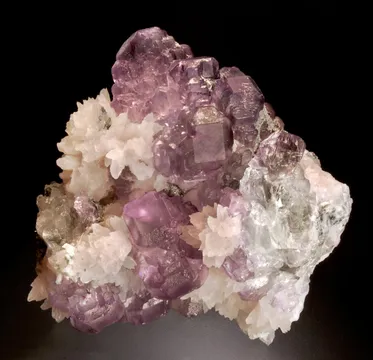
Pachapaqui calcite is most prized in its manganese-bearing form: pale pink to more saturated rose scalenohedra, often very acute and lustrous, standing on quartz, pyrite, galena or sphalerite-rich matrix. Good pieces show a clean sculptural spray or isolated sharp crystals rather than a sugary carbonate crust; documented examples include clusters of slender pink scalenohedra on gemmy colorless quartz, specimens around 5 to 9 cm across, and 2003 material described with very strong longwave and shortwave UV fluorescence. The most desirable Pachapaqui calcites have enough Mn to give both color and fluorescence, but still retain transparency, luster and separation from the sulfide or quartz matrix; ordinary pieces tend to be bruised, crowded, chalky or visually lost among massive sulfides.
Quartz is the essential stage on which much of Pachapaqui’s best mineral collecting story is set: colorless to white prismatic crystals and drusy linings in the veins and replacement cavities, commonly carrying rhodochrosite, manganese-bearing calcite, pyrite, bournonite, sphalerite, galena, chalcopyrite or tetrahedrite-group minerals. The district’s quartz is not usually pursued as a standalone Peruvian quartz locality; its value is compositional and aesthetic, especially when transparent points rise through pink carbonate or support isolated metallic crystals. Better specimens have clean, glassy quartz with open spacing and undamaged terminations, while lesser examples are massive white vein quartz carrying only small sulfide blebs or carbonate smears.
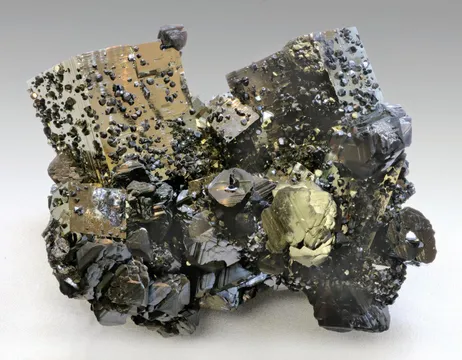
Pyrite is abundant in the Pachapaqui assemblage and is one of the minerals that gives the district’s pink carbonate specimens their visual snap: bright brassy microcrystals to small sharp crystals scattered on quartz, calcite, rhodochrosite, sphalerite, galena, bournonite and tetrahedrite-group matrix. Unlike Huanzala, where pyrite can be the commanding showpiece, Pachapaqui pyrite is usually valued as an accent mineral or as a sparkling sulfide carpet beneath pink scalenohedral calcite and rhodochrosite. Fine pieces show fresh metallic luster, crisp faces and balanced association rather than dull granular pyrite; the common condition problem is bruising or oxidation on exposed pyrite points, especially where pieces were mined or trimmed from sulfide-rich ore rather than carefully extracted from open vugs.
Fluorite from Pachapaqui is a subordinate but collectible component of the district, documented with calcite, manganese-bearing calcite, quartz, sphalerite, pyrite and galena. The best examples are small, clean fluorite crystals or translucent pale masses in balanced association with the pink carbonate assemblage rather than large isolated fluorite cabinets; this is one reason Pachapaqui fluorite is far less familiar than Huanzala fluorite despite the neighboring regional setting. Stronger specimens are those where fluorite contributes color, geometry and contrast without overwhelming the rhodochrosite-calcite-quartz-sulfide composition; ordinary examples are difficult to distinguish visually from common vein fluorite unless the locality and association are well documented.
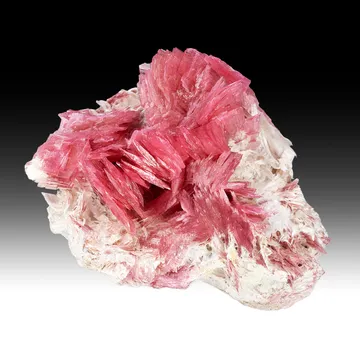
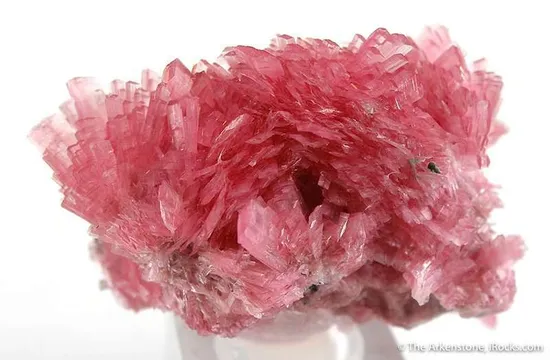
Pachapaqui rhodochrosite ranges from very pale pink to attractive richer pink rhombs and rosettes, most characteristically on quartz with pyrite, sphalerite, galena, chalcopyrite, kutnohorite, calcite or bournonite. The district produced enough rhodochrosite that older Peruvian material was once seen in quantity, but the better pieces are much scarcer: open, lustrous rhombs or rosette clusters with pleasing pink color, sharp geometry and a clean quartz or sulfide matrix, including miniature to cabinet specimens in the 3 to 13 cm range recorded in major photo archives. The main separation between a fine Pachapaqui rhodochrosite and a routine one is color and freshness; pale or chalky pieces can be visually ambiguous, while good examples show obvious pink carbonate character and a lively association with quartz and bright pyrite.
Sphalerite is one of Pachapaqui’s principal ore minerals and a frequent associate on collectible pieces, occurring as dark brown to black lustrous crystals or crystal aggregates with quartz, manganese-bearing calcite, pyrite, galena, bournonite, rhodochrosite, chalcopyrite, wurtzite, kutnohorite, fluorite and tetrahedrite-group minerals. Specimens are most appealing when the sphalerite provides a dark architectural base or isolated lustrous accents beneath pale pink calcite or rhodochrosite; less attractive examples are simply massive sulfide ore with little open-space crystallization. Pachapaqui sphalerite should be judged by luster, crystal definition, balance with carbonates and the absence of crushing along exposed cleavage surfaces.
The best tetrahedrite-labeled specimens from Pachapaqui are tied to the Santa Benita Prospect, where vuggy veinlets were described as being lined with quartz and tetrahedrite crystals. Collectors should understand that older labels commonly used “tetrahedrite” broadly, while modern work on Peruvian tetrahedrite-group minerals has shown the importance of precise group classification and records tennantite-(Fe) from Pachapaqui; for display purposes, the classic pieces remain sharp, dark metallic tetrahedral to complex crystals on quartz, calcite, pyrite or rhodochrosite-bearing matrix. The better examples are isolated, lustrous and visibly crystallized rather than massive gray sulfosalt ore, and locality precision matters greatly because “Pachapaqui” has often been used as a district label rather than a mine-specific one.
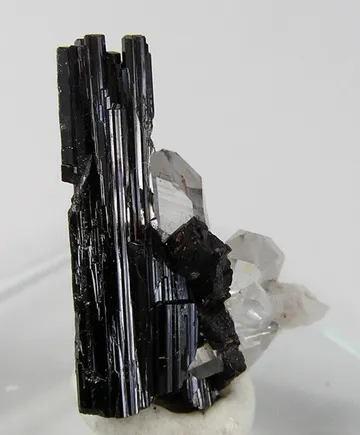
Bournonite is one of Pachapaqui’s signature sulfide collectibles, occurring as dark lead-gray metallic orthorhombic crystals, penetration twins and partial “cogwheel” forms on quartz, pyrite, sphalerite, galena, rhodochrosite or manganese-bearing calcite. Published collector notes and photo records document Pachapaqui bournonite crystals from a few millimeters to roughly 2.5 cm, with some aggregates forming cogwheel clusters to several centimeters; many pieces are miniatures, but the best have sharp, undamaged twinned crystals lifted clear of the matrix. Top Pachapaqui bournonites combine clean form, metallic luster and a contrasting pale carbonate or quartz base, while ordinary examples are small, crowded, dull, partly massive or visually swallowed by dark sulfide matrix.
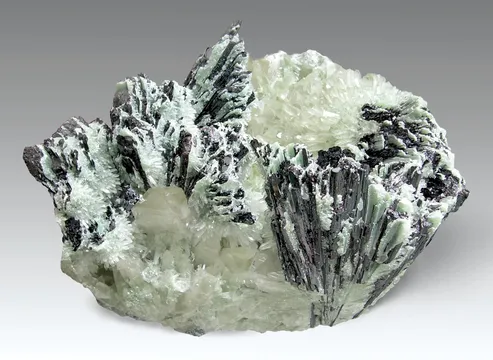
Other documented Pachapaqui minerals give the district much of its specialist appeal. Helvine is a standout rarity, known as sharp lemon-yellow tetrahedral crystals to several millimeters on manganese-bearing calcite and quartz from a limited early-1990s find; such pieces are now genuinely hard to obtain. Alabandite from Pachapaqui, including the Arabia Mine, has been specifically written up in Japanese literature. Axinite-(Mn), rhodonite, kutnohorite, siderite, arsenopyrite, chalcopyrite, galena, wurtzite, ankerite, dolomite, barite, pyrrhotite, marcasite, magnetite, native copper, native silver, native gold, azurite, malachite, muscovite/sericite and skarn minerals such as grossular, epidote, diopside and wollastonite round out the assemblage. No type-locality mineral is established for Pachapaqui in the sources consulted, but the district’s helvine, alabandite, bournonite and Mn-carbonate combinations are enough to keep it firmly on the radar of advanced Peru collectors.
The chief authenticity issue with Pachapaqui is not widespread faking so much as locality looseness. Many specimens were sold simply as “Pachapaqui Mine,” but the locality is a mining district with multiple workings, prospects and named areas; in many older specimens the precise source is unrecoverable. A well-labeled Santa Benita tetrahedrite-group specimen, Arabia Mine Mn-assemblage piece or Chiurucu-associated rhodochrosite is more informative than a generic “Pachapaqui” label, but generic district labels are still normal in the trade.
Mislabelling between pale rhodochrosite and manganese-bearing calcite deserves special attention. Pachapaqui produced both, and pale pink carbonate on quartz can be visually deceptive. Calcite will effervesce in dilute acid far more readily than rhodochrosite, has a lower hardness, and the Mn-bearing calcite commonly shows strong pinkish-orange fluorescence under both longwave and shortwave UV. Rhodochrosite may be weakly fluorescent or not obviously fluorescent, and richer pink rhombs are usually easier to recognize, but very pale material should be treated cautiously unless the morphology and provenance are convincing.
Condition is a serious grading factor. Many Pachapaqui pieces came from sulfide-rich underground ore, and crystals were often attached to dense, brittle matrices. Look for bruised calcite tips, broken quartz terminations, contacted rhodochrosite edges, pyrite oxidation, chipped bournonite twins and cleaved sphalerite faces. The attractive pink calcite sprays are especially vulnerable at the tips; even a few missing scalenohedral points can change a specimen from fine to merely representative.
For handling, avoid water soaking of mixed sulfide-carbonate specimens unless absolutely necessary, and never use acids on display specimens without testing, because calcite, manganese-bearing calcite and rhodochrosite associations may be present together. Pyrite-rich pieces should be stored dry and stable; obvious pyrite disease is not a defining Pachapaqui problem, but damp storage is never kind to mixed sulfide ore. Fluorescent calcite specimens should be enjoyed under UV, but not exposed needlessly to strong UV for prolonged periods.
Market availability is moderate but uneven. Rhodochrosite and manganese-bearing calcite from Pachapaqui still appear with some regularity, especially as miniatures and small cabinets, while superior bournonite, helvine and well-crystallized tetrahedrite-group pieces are far less common. The best specimens are usually older collection pieces or material from episodic finds rather than continuous current supply. For serious collectors, the most desirable Pachapaqui specimens combine three things: an unmistakable district aesthetic, strong species identity, and a label that preserves as much mine or prospect detail as possible.
Pachapaqui’s mining story has the rhythm of a high-Andean district that repeatedly seems to fade, then reappear. Modern mine histories preserve a striking claim: silver at Pachapaqui was probably known before the Spanish period, then worked on a small scale by Spaniards as early as 1535. Whether every detail can be proven in the way a modern mine ledger can be proven is another matter, but the tradition fits the Andes, where old mineralized ground often accumulated Inca, colonial, republican and modern histories in the same ravines.
By the late 1940s, Pachapaqui had become industrial enough to justify its own small concentration plant. The USGS account places that plant on the north side of the town at an altitude of about 3,800 meters, rated at only 30 tons per day. Construction was completed early in 1949, and operation began in March. That image is important for collectors because it reminds us what kind of place produced many old Peruvian sulfide specimens: not an open tourist dig, not a giant modern pit, but a selective underground lead-zinc-copper-silver district where hand sorting, small mills and difficult transport shaped what was mined and what was saved.
The late twentieth-century chapter was harsher. In 1971 the concession passed to Jorge Bustamante of Minera Pachapaqui S.A., and production began in 1981. Operations stopped in 1994 during Peru’s period of terrorism, leaving a reported debt of 16 million dollars. After that came a chain of ownership changes: Plata Perú Resources in 1997, Haviland International Resources, Empresa Minera Pachapaqui, Haviland again, and then International Consolidated Minerals in 2006. It is a familiar Andean mining pattern, but Pachapaqui’s specimen record makes it more tangible: pieces in today’s collections may have been mined under one owner, exported or sold under another, and labeled simply with the district name long after the original pocket name had vanished.
The restart under ICM and KZ Group brought a different mining world. Mine-planning documents discuss mechanized work in the Mantos and Breccia zones at the 4260 level, production targets of hundreds and then thousands of tonnes per day, and technical decisions about stopes, dilution and ground support. Those details matter to collectors because specimen recovery in a mechanized underground mine is opportunistic: pockets are exposed by production, development or rehabilitation, and a specimen survives only if someone recognizes it before the ore stream does its work. Pachapaqui’s best pink calcite and rhodochrosite specimens feel delicate precisely because they come from a hard, industrial setting.
Among collectors, one of the great Pachapaqui mini-stories belongs to helvine. A specimen photographed from the Cal and Kerith Graeber Peruvian subcollection was described as coming from a one-time early-1990s find and carrying two sharp lemon-yellow tetrahedral crystals only 4.5 to 6 mm across. The description compared the best-known example with a famous thumbnail in the Ralph Clark Collection and noted that the crystals looked almost unreal because of their sharpness and color. That is the kind of Pachapaqui rarity that separates the district from a simple list of ore minerals: tiny, improbable, and now almost unobtainable.
Alfred J. Bodenlos and George E. Ericksen, “Lead-zinc deposits of Cordillera Blanca and northern Cordillera Huayhuash, Peru,” U.S. Geological Survey Bulletin 1017, 1955 — The foundational English-language geological account for Pachapaqui and neighboring districts, including descriptions of replacement deposits, fissure veins, the Santa Benita Prospect and the early Pachapaqui concentration plant.
INGEMMET repository record for Bodenlos and Ericksen, “Lead-zinc deposits of Cordillera Blanca and northern Cordillera Huayhuash, Peru” — Open-access metadata and downloadable files for the USGS bulletin and plates as held by the Peruvian geological institute.
R. Carrascal and J. Sáez, “Stratabound Polymetallic Ore Deposits of the Santa Metallotect in the Huanzalá and Pachapaqui Mining Areas in Central Peru,” in Stratabound Ore Deposits in the Andes, Springer, 1990, pp. 555–568 — A key regional metallogenic paper tying Pachapaqui to the Santa metallotect and the stratabound polymetallic systems of central Peru.
Jaroslav Hyršl and Zolina Rosales, “Neue Mineralienfunde aus Peru,” Mineralien-Welt, 11(5), 2000, pp. 23–31 — Frequently cited for Pachapaqui collector minerals including arsenopyrite, bournonite, manganese-bearing calcite and other late twentieth-century Peruvian finds.
Jaroslav Hyršl and Zolina Rosales, “Peruvian Minerals: An Update,” The Mineralogical Record, 34(3), 2003, pp. 241–254 — Important collector literature for Pachapaqui updates, including helvine and other rarer species from the district.
Jaroslav Hyršl and Zolina Rosales, “Rote Schönheit Südamerikas: Rhodochrosit-Vorkommen in Peru,” Mineralien-Welt, 16(1), 2005, pp. 54–61 — A focused treatment of Peruvian rhodochrosite occurrences, cited for Pachapaqui rhodochrosite.
A. Gomi, “Alabandite from the Pachapaqui mine, Ancash Department, Peru,” Chigaku Kenkyu, 58(2), 2009, pp. 115–120 — A locality-specific paper on Pachapaqui alabandite.
Jaroslav Hyršl, Jack A. Crowley, Rock H. Currier and Terry Szenics, Peru: Paradise of Minerals, Asociación Andrés Del Castillo, 2011 — Major modern collector reference on Peruvian minerals, cited by Mindat for Pachapaqui.
Dalibor Velebil, Jaroslav Hyršl, Jiří Sejkora and Zdeněk Dolníček, “Chemismus a klasifikace minerálů skupiny tetraedritu z ložisek v Peru,” Bulletin Mineralogie Petrologie, 29(2), 2021, pp. 321–336 — Modern compositional and classification work on Peruvian tetrahedrite-group minerals, including Pachapaqui material and tennantite-(Fe).
Smithsonian National Museum of Natural History, Calcite specimen record from Pachapaqui district — Museum record for a Pachapaqui calcite specimen with pyrite association.
Mindat: Pachapaqui mining district, Aquia District, Bolognesi Province, Ancash, Peru — The central locality database entry, with mineral list, sublocalities, coordinates and references.
Mindat: Rhodochrosite from Pachapaqui mining district — Useful for associations, photo data and references specific to the district’s rhodochrosite.
Mindat: Calcite from Pachapaqui mining district — Occurrence page for Pachapaqui calcite, including the key association list and collector references.
Mindat: Pyrite from Pachapaqui mining district — Helpful for understanding pyrite’s role in the common Pachapaqui specimen assemblage.
Mindat: Fluorite from Pachapaqui mining district — Occurrence page for the district’s fluorite and its principal specimen associations.
Mindat: Sphalerite from Pachapaqui mining district — Occurrence page documenting sphalerite associations and references.
Wikimedia Commons: Minerals of Pachapaqui District — A useful image category with rhodochrosite, calcite, quartz, bournonite, tetrahedrite, sphalerite and helvine specimens.
Wikimedia Commons: Rhodochrosite, quartz and pyrite from Pachapaqui — High-resolution reference photograph of a classic Pachapaqui pink carbonate-quartz-pyrite association.
Wikimedia Commons: Calcite from Pachapaqui in the Harvard Museum of Natural History — Museum-display example of Pachapaqui calcite.
USGS: Lead-zinc deposits of Cordillera Blanca and northern Cordillera Huayhuash, Peru — Classic geological bulletin with early descriptions of Pachapaqui ore bodies and the Santa Benita Prospect.
CENEPRED/INGEMMET: Informe geoeconómico Región Ancash — Peruvian regional economic geology report summarizing Pachapaqui’s setting, structures and mineral assemblage.
UNSCH thesis on mining-method selection at Pachapaqui — Detailed modern mine-planning source with location, access, mining history, geology and operational context.
Gob.pe/MINEM: 2025 update to the Pachapaqui mining unit environmental impact study — Current official Peruvian regulatory source for the Pachapaqui mining unit.
Gob.pe/MINEM: EIA for the Pachapaqui 220 kV electrical substation — Official record of infrastructure permitting tied to ICM Pachapaqui.
OEFA: 2012 environmental enforcement notice for ICM Pachapaqui — Regulatory background on environmental compliance at the modern operation.

_2012-07-20.jpg)