Huanzala, Peru — famed Andean locality yielding brassy pyrite, green-to-pink fluorite, and rhodonite; prized for aesthetic variety and collector-historical val…
Key facts
Huanzala is one of the great Andean specimen names: a productive polymetallic ore system in the high country of central Peru, best known to collectors for pyrite and fluorite, but tied to a wider Huallanca–Huanzala mineral district that also yielded superb crystalline rhodonite from the San Martín Mine at Chiurucu. The main Huanzala Mine is a zinc-lead-copper-silver deposit developed in carbonate-rich Cretaceous strata, where limestone and shale were replaced and overprinted by skarn and hydrothermal mineralization associated with quartz-porphyry and granodiorite-porphyry intrusions. That geologic complexity is exactly why the specimens are so varied: mirror-bright pyrite, green to pink fluorite, dark sphalerite, galena, quartz, calcite, chalcopyrite, tennantite-group minerals, scheelite, and rare tungsten-bearing species occur not as isolated curiosities but as parts of a long-lived ore-forming system.
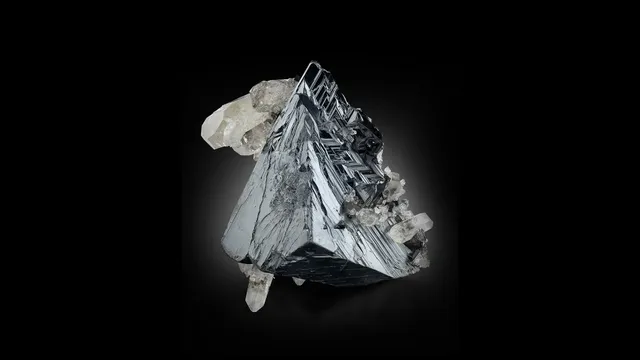
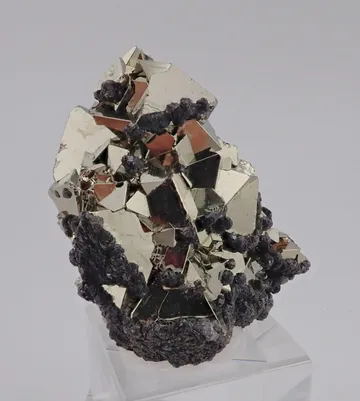
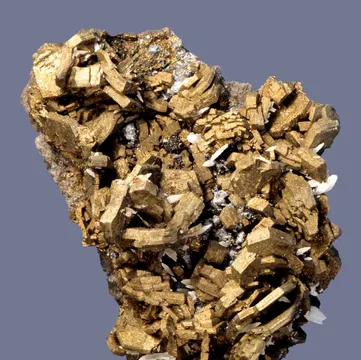
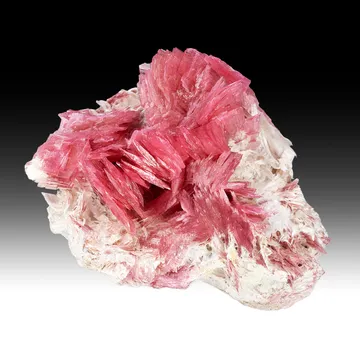
For collectors, Huanzala’s importance is both aesthetic and historical. A single fine specimen can show brassy pyrite cubes or octahedra set against black sphalerite, silvery galena, white quartz, or pastel fluorite; a top fluorite can show the famous pink octahedra with green cores; and a good regional rhodonite can carry thin, bright, raspberry-pink blades on contrasting quartz, calcite, sphalerite, or pyrite. Few localities combine so much quantity with so much quality. Huanzala pyrite in particular became one of the staples of the international mineral trade, ranging from inexpensive sparkling “chispas” masses to museum-scale octahedral groups weighing tens of kilograms.
Regional View
Country View
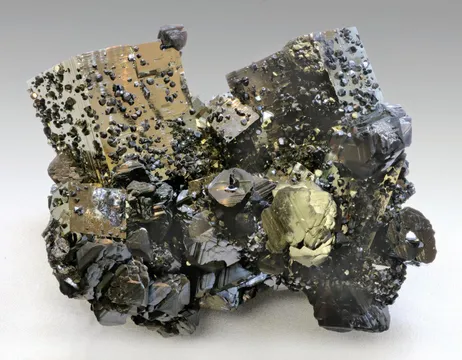
The finest Huanzala specimens have a look that is hard to confuse once you have handled enough of them: bright metallic faces, dense sulfide matrix, abrupt contrasts between pyrite and dark zinc-lead ore, and a frequent dusting of small quartz or carbonate crystals. The best pieces do not merely display a mineral; they display the orebody. Even ordinary specimens can be instructive, but the great examples are architectural—stepped pyritohedra, clean cubes with striated faces, octahedral pyrite clusters, transparent fluorites, and sharply contrasting sulfide combinations that read instantly from across a room.

Photo: Wikimedia Commons
Search for specimens: View all specimens from Huanzala, Peru
Huanzala lies in the Huallanca District of Bolognesi Province, Ancash, in the central Peruvian Andes, historically often labeled on older specimens as Huallanca, Dos de Mayo Province, Huánuco. That old label form is part of the locality’s collecting history rather than an automatic error; administrative boundaries and locality usage have changed, while the classic specimens continued circulating with earlier tags. The mining area is high, remote, and industrial, and the modern Huanzala Mine is not a public collecting locality.
Geologically, the main Huanzala ore system is a carbonate-replacement and skarn-related polymetallic deposit. The host succession includes Lower Cretaceous sedimentary rocks: chert of the Chimú Formation below, limestone of the Santa Formation, and sandstone-slate or sandstone-shale rocks of the Carhuaz Formation above. The most favorable beds are limestone and limestone-shale alternations, where mineralization developed as stratabound, lenticular, platy, veinlike, and irregular massive ore bodies. Quartz-porphyry sheets and related porphyritic intrusions occur close to ore horizons, and the classic Japanese studies of the mine emphasized pyritization, skarnization, and later hydrothermal replacement as the key processes.
The ore mineralogy is built around sphalerite, galena, chalcopyrite, and pyrite, with important accessory bornite, covellite, chalcocite, digenite, enargite, luzonite, and tennantite-group minerals. Gangue and alteration minerals include quartz, calcite, fluorite, dolomite, chlorite, mica, sericite, kaolinite, feldspar, and a suite of skarn minerals including diopside, garnet, vesuvianite, epidote, and prehnite. One of Huanzala’s most useful geological ideas is the distinction between pyritic ore, skarn ore, and “shiroji” ore, the latter an argillized, altered ore type. The zinc mineralization includes iron-rich “red sphalerite” earlier in the sequence and iron-poor “black sphalerite” associated with later shiroji alteration, a distinction that helps explain the appearance of many dark, chalcopyrite-included sphalerite associations on specimen pieces.
Mining history at Huanzala reaches well before the modern operation, but the present mine’s twentieth-century story is especially well documented. The Piaggio family held the property early in the century; Cerro de Pasco carried out exploration in the 1950s; Mitsui Mining & Smelting began serious examination and exploration in the 1960s; and Compañía Minera Santa Luisa, connected with Mitsui interests, brought the modern mine into production in 1968. Production began at roughly 500 tonnes per day, expanded through the 1970s and 1980s, and was later modernized. Mitsui Kinzoku still describes Huanzala as an operating mine of the Mitsui Kinzoku Group, run by Compañía Minera Santa Luisa, with the Pallca Mine developed as a branch operation in 2006.
The deposit is not a single simple vein. Japanese work divided the mine into northern and southern deposits, and other summaries describe a mineralized belt with zones such as Alberto, Recuerdo, Huanzala Main, Huanzala Upper, and Huanzala South. A later deep drilling program discovered a mineralized zone about 200 meters below the operating zone, in limestone blocks displaced downward by the so-called Lower Fault and then mineralized by hydrothermal metasomatism. For the collector, this matters because Huanzala specimens do not all look alike: different ore types, alteration states, and structural positions yielded different mixtures of pyrite, sphalerite, galena, fluorite, quartz, calcite, and copper minerals.
Specimen production has been extraordinary. The mine is famous for pyrite on a scale few localities can rival, from tons of glittering low-grade “chispas” material to large, highly aesthetic groups of cubes, pyritohedra, and octahedra. The late 1970s and 1980s brought major quantities of pyrite and mixed sulfide specimens to Lima and then to the international market. The 1980–1981 pink fluorite discoveries are among the legendary events in South American fluorite collecting: octahedral crystals, commonly pink with green cores, associated with pyrite, sphalerite, and galena. Later years continued to yield pyrite, galena, quartz, sphalerite, calcite, fluorite, and specialist material, though fresh access is controlled by the mine and the modern trade is mostly dealer- and miner-mediated rather than collector field collecting.
The broader Huanzala collecting name also intersects with the San Martín Mine at Chiurucu, in the Huallanca District, a locality famous for crystalline rhodonite. Those rhodonites are not the standard main-mine pyrite product; they come from a nearby manganese-rich prospect in the same regional collecting orbit. They became important because truly fine crystallized rhodonite is uncommon worldwide, and San Martín produced vivid, thin, bladed crystals with quartz, calcite, sphalerite, pyrite, and occasionally other manganese and sulfide minerals.
Huanzala-area rhodonite is best understood as San Martín Mine, Chiurucu material from the Huallanca–Huanzala district, where a few important finds produced thin, lustrous, bright pink to raspberry-red bladed crystals rather than massive lapidary rhodonite. The best pieces show sharp, transparent to translucent blades, commonly around thumbnail to miniature scale but with individual crystals reaching roughly 1–2 cm in strong examples, set with colorless quartz, white calcite, dark sphalerite, minor pyrite, and locally pyrrhotite or alabandite. Flat plates of parallel blades are more common than sculptural three-dimensional groups; the better specimens have saturated color, clean terminations, lively luster, minimal manganese-oxide dulling, and enough contrasting matrix to make the pink blades stand forward rather than disappear into a crowded sulfide surface.
Pyrite is the defining Huanzala collector mineral: bright brass-yellow cubes, pyritohedra, octahedra, and modified combinations occur as isolated crystals, intergrown sculptural groups, dense crusts, and massive sparkling “chispas” material. Fine Huanzala pyrite may show mirror luster, crisp striated cubic faces, broad octahedral faces, beveled edges, or complex stepped growth, with common associations including sphalerite, galena, quartz, calcite, fluorite, chalcopyrite, baryte, arsenopyrite, and tennantite-group minerals. Size ranges from small decorator crusts to cabinet and museum pieces; historically, some famous octahedral groups carried individual crystals in the 8–10 cm range and larger. What separates a good Huanzala pyrite from ordinary mine-run material is not simply size, but complete sharp crystals, bright unburned luster, strong form, attractive balance, limited bruising on edges and corners, and meaningful contrast with white quartz, black sphalerite, silvery galena, or fluorite.
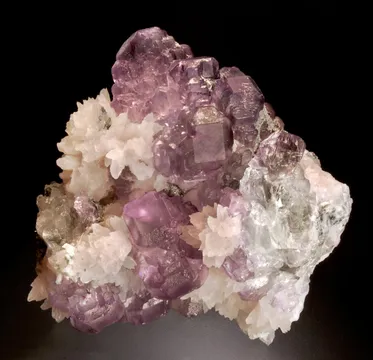
Fluorite from Huanzala ranges from common colorless to pale green crystals through far rarer pink and pink-green octahedra, with the celebrated 1980–1981 material forming one of the classic fluorite finds of Peru. The most prized specimens show gemmy octahedral or modified octahedral crystals, commonly pastel to hot pink with grass-green or mint-green cores, associated with pyrite, sphalerite, galena, and sometimes quartz or calcite; good crystals can reach several centimeters, with the best-known fine examples admired as much for color zoning as for form. Ordinary Huanzala fluorite may be pale green, crude, chipped, or partly embedded in sulfide ore, while top pieces are transparent, sharply shaped, cleanly isolated, strongly zoned, aesthetically placed on contrasting matrix, and not overwhelmed by damaged pyrite or dull sphalerite.
Quartz is a common and important Huanzala associate rather than the locality’s showiest headline mineral, but it gives many specimens their sparkle and contrast. It occurs as colorless to white prismatic crystals, drusy coatings, and small sharp sprays on pyrite, sphalerite, galena, fluorite, and calcite-bearing matrix; on some pieces, quartz forms bright needles or stubby glassy crystals that frame larger sulfides, while on others it appears as pale druse tucked into pyrite growth pits or along ore seams. The best Huanzala quartz specimens are really combination pieces: clean, undamaged quartz crystals placed prominently against lustrous pyrite or dark sphalerite, with enough separation to avoid looking like a sugary crust and enough brilliance to enliven the heavier sulfide assemblage.
Beyond these four collector staples, Huanzala is mineralogically deep. Galena and sphalerite are major ore and specimen minerals, often forming the dark and silvery architecture beneath pyrite and fluorite. Chalcopyrite, bornite, chalcocite, covellite, digenite, enargite, luzonite, and tennantite-group minerals record the copper-rich stages of the system. Scheelite, cassiterite, hessite, acanthite, aikinite, bismuthinite, bournonite, alabandite, dolomite, calcite, baryte, fluorapatite, and skarn silicates add specialist interest. The locality is also the type locality for huanzalaite, MgWO4, a rare wolframite-group mineral found as minute orange to reddish-brown inclusions in scheelite from the Huanzala Mine—far too small to be a showy collector species, but important evidence of the mine’s unusual tungsten-bearing paragenesis.
The first collector issue with Huanzala is labeling. Older specimens commonly read “Huanzala Mine, Huallanca, Dos de Mayo Province, Huánuco,” while modern locality references place the mine in Bolognesi Province, Ancash. That older geography is normal on classic labels and should be preserved as part of provenance. More problematic are vague “Peru” pyrite labels upgraded to Huanzala without evidence, or San Martín rhodonite labels shortened so aggressively that the specimen seems to have come from the main Huanzala Mine rather than the nearby Chiurucu prospect.
Outright fakery is not the dominant Huanzala problem. Pyrite, sphalerite, galena, quartz, and fluorite combinations are generally difficult to fake convincingly at serious-specimen level because weight, luster, fracture, crystal form, and matrix relations are so diagnostic. The real risks are repaired crystals, glued combinations, acid-cleaned sulfides with residues left in cracks, stabilized or reconstructed matrix, and decorator-grade pyrite represented as fine cabinet material. Examine crystal bases under magnification, especially where fluorite, quartz, calcite, or galena appears perched on pyrite or dark sphalerite. Glue can hide well in black sulfide recesses.
Pyrite condition is everything. Huanzala pyrite can have dazzling luster, but corners, octahedral points, pyritohedral ridges, and cubic edges bruise easily. On bright specimens, small contacts may hide in glare; inspect with light from multiple angles. Slight edge wear is common on large, heavy pieces and may be acceptable if the composition is strong, but broken terminations and abraded high points dramatically reduce quality. Fine cabinet specimens should have sharp, complete, visually dominant crystals, not just weight and shine.
Fluorite from Huanzala needs separate scrutiny. The famous pink-green octahedral fluorites are genuinely rare and have been coveted for decades; chips and cleaves are common because fluorite has perfect cleavage and the crystals were often embedded in tough sulfide ore. A small cleave on a minor crystal may be tolerable on an otherwise rare 1980–1981 piece, but clean transparency, distinct green cores, attractive placement, and old provenance matter greatly. Be cautious with vague “pink Huanzala fluorite” claims if the piece lacks octahedral form, association, and reliable history.
Rhodonite from the San Martín–Chiurucu part of the Huanzala collecting sphere is fragile. The desirable crystals are thin blades, often only millimeters thick, and they chip along edges or lose tips easily. Color can be dulled by manganese-oxide films, and flat plates may have many small bruises that are invisible until tilted in strong light. Calcite associated with these pieces may fluoresce, and calcite from Huanzala-related material can show strong UV response; fluorescence is a bonus, not a substitute for form, color, and condition.
For storage, keep Huanzala sulfides dry and stable. Pyrite is generally stable when well crystallized, but any sulfide-rich specimen can suffer in humid storage, especially porous, altered, or acid-cleaned material. Avoid repeated washing, ultrasonic cleaning, acid treatment by amateurs, and long-term storage in damp foam. Heavy pyrite specimens should be supported well; a broken mount can do more damage than decades in a drawer.
Market availability is uneven. Common Huanzala pyrite remains widely available, but genuinely fine pyrite is selective and increasingly competed for: clean large crystals, strong octahedral groups, excellent pyrite-quartz combinations, and old-provenance pieces are not the same market as bulk decorator material. Pink-green fluorite from the classic find is rare and expensive when good. San Martín rhodonite is available intermittently, but top examples with saturated color, transparency, three-dimensional form, and minimal damage command strong prices. The best approach is to buy the specimen, not merely the locality name: Huanzala produced mountains of ordinary material and a small proportion of truly great pieces.
Huanzala’s specimen history reads less like the discovery of a single pocket and more like a parallel economy growing beside a major mine. The ore was being extracted for zinc, lead, copper, and silver, but underground the miners were also encountering pyrite groups so brilliant and abundant that they became a commodity of their own. Local buyers and Lima dealers learned the mine’s specimen vocabulary: “chispas” for sparkling pyrite masses, “cuadros” for cubes, “triangulos” for octahedra, and “cocos” for pyritohedral forms. At times, when buyers were known to be present, women would gather around and call out what they had that day, a high-Andean mineral market conducted in the language of crystal habits.
The most dramatic pyrite episode came in the late 1980s. Rock Currier later described arriving in Lima in August 1988 and thinking he had bought the end of a great lot of octahedral Huanzala pyrite. Instead, he had seen only the beginning. A strike at the mine changed the tempo of specimen recovery. During ordinary work, miners could collect only in snatched intervals—lunch breaks, shift changes, Sundays, and moments when production allowed. During the strike, people could devote full days to collecting underground. The result was an outpouring of huge octahedral pyrite groups, with average crystals reported in the 8–10 cm range and the largest crystal Currier measured in Lima reaching 20 cm along an edge.
Those pyrites did not behave like normal mineral-show flats. Many were simply too large. The specimen world’s usual categories—thumbnail, miniature, small cabinet—almost collapsed in front of them. Some pieces weighed so much that moving them became a logistical problem, and the largest attractive examples were destined for major collections or museums almost from the moment they appeared. Yet plenty of the material was imperfect: dull faces, truncated points, growth pits, patches of drusy quartz, rehealed fractures, bruised corners, and black tetrahedrite-group coatings could all occur. Huanzala’s abundance never eliminated selection; it sharpened it.
One of the most vivid accounts from the specimen trade concerns a late-night purchase in the mining camp. Fine pyrites were sometimes hidden under dirt floors, buried until a trusted buyer arrived. In one story, a buyer reached a miner’s house around 2 a.m., a practical hour because specimen selling was not permitted. The miner, drunk but still functional, dug into the floor until his shovel struck pyrite with a metallic “ting.” Three large pieces came out of the ground, the biggest around 30 kg. A deal was made quickly, before police could interfere. Then came the problem of transport: a storekeeper with a three-wheeled bicycle was recruited, the pyrite was placed in the front basket, covered with burlap, and pushed away in the dark.
Another side of Huanzala was less romantic and more industrial. At shift changes during the height of chispas production, miners reportedly emerged with specially sewn knapsacks loaded with pyrite, each man carrying around 50 kg. Black pyrite dust covered them from head to foot. A single shift could bring out a ton or more of specimen pyrite, sorted quickly by size and quality, then sent onward through buyers, Lima dealers, exporters, and show circuits. That is why Huanzala pyrite became familiar even to casual collectors: the low- and middle-grade supply was immense. Yet the very best pieces remained scarce because exceptional form, undamaged luster, and good composition were always a small fraction of total output.
The fluorite story is quieter but, for fluorite specialists, even more legendary. Before the early 1980s, Switzerland was the classic name for fine pink fluorite octahedra. Then Huanzala produced pink octahedral fluorites in sulfide ore—some almost colorless, some pastel, some intensely pink, many with soft green cores. The famous discovery is generally tied to late 1980 and the 1981 collecting season, with only a limited number of excellent specimens recovered. Their look is unmistakable: pink octahedra, internal green, black sphalerite, bright pyrite, and occasionally galena, all from a mine better known to the public for pyrite. They remain among the most desirable South American fluorites.
The rhodonite chapter belongs to the nearby San Martín Mine at Chiurucu, but it has become inseparable from the Huallanca–Huanzala collecting landscape. San Martín was not a great long-lived specimen mine; it was a prospect whose economic promise disappointed. Yet near the end of its activity, vivid crystallized rhodonite appeared—thin red-pink blades, often on sulfide or calcite-rich matrix. Later material, including a 2007 find, added bright rhodonite with quartz, sphalerite, pyrite, and calcite. For collectors, the irony is delicious: a prospect that failed as a major mine succeeded by producing one of Peru’s finest crystallized manganese-silicate specimens.