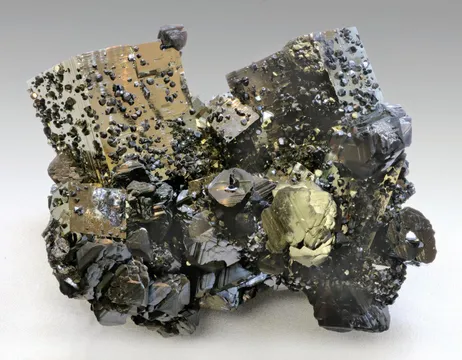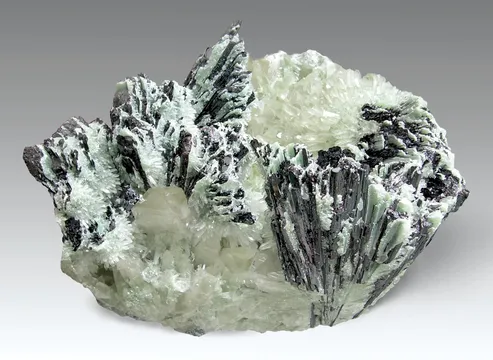
Huayllapon Mine, Peru — renowned for lustrous hübnerite blades, deep red rhodochrosite on quartz, and open-pocket specimens that captivate collectors.
Key facts
Huayllapon is the specimen heart of the Pasto Bueno tungsten district, a high Andean vein system in the Pampas District of Pallasca Province, Ancash, northern Peru. In economic-geology terms it is part of a tungsten–base-metal deposit related to a quartz-monzonite intrusive system at the northern end of the Cordillera Blanca; in collector terms it is one of those rare mines where ore mineralogy, open-space vein growth, and just the right late-stage chemistry combined to make classics. The mine is best known for lustrous, bladed to prismatic hübnerite, often nearly black in reflected light but showing deep cherry-red translucence on thin edges or under strong backlighting, set among glassy quartz sprays and sometimes dressed with pale green to lavender fluorite, pyrite, sphalerite, galena, tetrahedrite-group minerals, native arsenic, and late carbonates. Its finest rhodochrosites—transparent to translucent pink-red and raspberry-red rhombohedrons on quartz—are among the great Peruvian rhodochrosites and were scarce even when the celebrated pockets were fresh.
Regional View
Country View
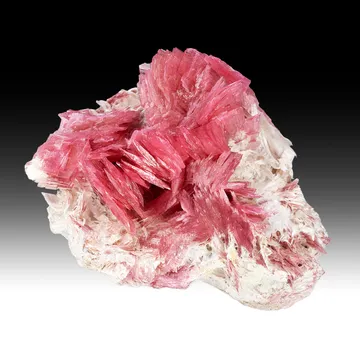
The look of a first-rate Huayllapon specimen is unmistakable: a spiky, three-dimensional architecture of quartz needles or small glassy prisms, pierced by black-red hübnerite blades or carrying red rhodochrosite rhombs with sharp stepped faces. The best pieces are not massive ore souvenirs; they are open-pocket specimens, with crystals separated enough to read individually. Hübnerite gives the mine its gravitas, rhodochrosite gives it color, quartz gives it the skeletal framework, and fluorite supplies the pale cool counterpoint that makes the finest combinations so elegant.

Photo: Wikimedia Commons

Photo: Wikimedia Commons
Search for specimens: View all specimens from Huayllapon Mine, Peru
Huayllapon Mine is one of the principal workings of the Pasto Bueno district, near Pampas in Pallasca Province, Ancash. The locality is commonly seen on old specimen labels as Huallapon, Huayllapon, Pasto Bueno, or simply “Pasto Bueno Mine,” but the last name is imprecise: Pasto Bueno is a mining district or unit made up of several zones and mines, notably Huayllapon, Huaura, and Consuzo. For specimens, that distinction matters, because Huayllapon is the source most strongly associated with the district’s classic hübnerite and rhodochrosite specimens.
Geologically, Pasto Bueno is a high-altitude tungsten–base-metal vein system related to quartz monzonite of the Cordillera Blanca intrusive belt. The district’s mineralization occurs in steeply dipping quartz veins developed in and around the intrusive contact, with host rocks including sedimentary units of Jurassic–Cretaceous age, especially the Chicama Formation and quartzitic units assigned in district work to the Chimú Formation. The hydrothermal system is zoned and multiphase: early high-temperature alteration and molybdenite-bearing assemblages are followed by the main wolframite–hübnerite stage, then base-metal sulfides, fluorite, and late carbonates. For collectors, the crucial feature is that the veins locally opened as vugs, allowing hübnerite, quartz, fluorite, and rhodochrosite to grow freely rather than as massive ore.
In the Huayllapon sector the Chabuca vein is the key structure, with Santa Isabel also recorded from the area. Published district descriptions give Chabuca a roughly north-south to N 10° E strike, steep easterly to southeasterly dip, and variable width; it is the vein most often invoked when serious collectors discuss the origin of the best Huayllapon hübnerite material. Modern exploration summaries and older mine studies describe the vein system as pinching and swelling, a behavior familiar to anyone who has handled Huayllapon specimens: some pockets produced loose, elegant crystal groups, while much of the mine yielded ore or compact vein material of little display value.
The district’s modern mining story begins in the early twentieth century, when tungsten demand and the recognition of hübnerite-bearing veins drew attention to the area. Historic accounts credit the 1910 recognition of the tungsten mineralization to samples from Cerro Huayllapon that were identified as hübnerite in Lima. Early companies formed around the deposits in the years immediately before World War I, and the Málaga Santolalla mining interests became central to Pasto Bueno’s long development. Production continued, with interruptions, through much of the twentieth century. Later operators included Avocet Resources in the 1990s and Dynacor/Malaga in the twenty-first century, with the district later promoted again as a redevelopment target because of its high-grade tungsten veins and existing underground infrastructure.
Huayllapon’s specimen reputation rests especially on the finds of the 1970s and early 1980s. The great hübnerite pieces from that period show lustrous, striated, bladed crystals in parallel bundles or sprays, commonly on quartz and sometimes with pale fluorite. The best rhodochrosites—far rarer—formed as transparent to translucent rhombohedrons, commonly pink to deep red and often perched on quartz. Fine fluorite–quartz combinations, pyrite on hübnerite, and unusual associations with native arsenic also entered collections, but in much smaller numbers than ordinary quartz–hübnerite pieces. Today, the mine should be treated as a private industrial site rather than a casual collecting locality; field access depends on ownership, safety, and mine permissions, and most collector specimens now trade from old collections, dealer inventories, and occasional releases of historic material.
Quartz is the architectural mineral of Huayllapon specimens: it forms the clear to milky, prismatic sprays and “jackstraw” clusters that give the mine’s hübnerite and rhodochrosite combinations their shape. Good pieces show bright, glassy, individualized points rather than a sugary crust, with slender crystals standing upright around bladed hübnerite or forming a sparkling bed for red rhodochrosite rhombs; several described specimens from the locality show quartz points in the centimeter range, with some larger second-generation crystals adding balance to hübnerite groups. The most desirable quartz from Huayllapon is not usually collected as isolated quartz for its own sake, but as clean, undamaged, transparent to translucent support for the ore minerals—especially when the quartz makes a three-dimensional pocket sculpture rather than a flat plate.
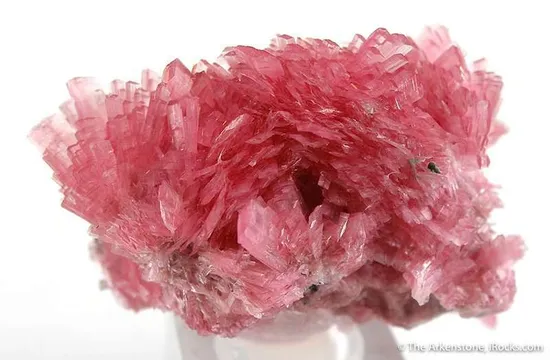
Huayllapon rhodochrosite is famous because truly fine examples are both beautiful and rare: pink, rose-red, raspberry-red to cherry-red rhombohedrons, locally gemmy at the edges, most characteristically on quartz and occasionally with fluorite, galena, pyrite, tetrahedrite-group minerals, or calcite. Mindat records rhombohedrons to 15 cm for the mine, and collector literature has long emphasized that only a small number of outstanding Huayllapon rhodochrosites emerged compared with the more abundant hübnerite–quartz material. The best pieces show sharp, lustrous, saturated rhombs sitting naturally in quartz rather than massive pink carbonate; strong specimens are judged by color intensity, transparency at edges, undamaged corners, and the elegance of the quartz association.
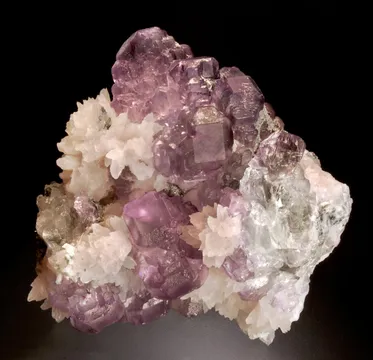
Fluorite from Huayllapon is a supporting actor that can turn a good combination into a memorable one. It occurs as pale green, sea-foam, colorless, bluish-green, or light lavender crystals on quartz, hübnerite, and rhodochrosite, commonly as modified cubic to octahedral-looking forms rather than large simple cubes. The better examples are valued for placement and contrast: small translucent fluorites tucked among quartz points, perched near dark-red hübnerite blades, or accompanying red rhodochrosite rhombs. Ordinary Huayllapon fluorite can be modest and pale, but a sharply formed, undamaged crystal in a balanced association is highly collectible because it records the later open-space stages of the Pasto Bueno vein system.
Hübnerite is Huayllapon’s signature mineral and the reason the mine is routinely mentioned among the world’s classic sources for the species. The typical collector crystal is a lustrous, striated, bladed to prismatic MnWO4 crystal, black to reddish black in reflected light but capable of showing a deep blood-red or cherry-red glow when thin edges are strongly backlit; documented Huayllapon crystals reach cabinet scale, with Mindat listing prisms to 15 cm and classic literature noting still larger Pasto Bueno hübnerite-ferberite crystals. The finest pieces are sharp, highly lustrous, undamaged, and three-dimensional, often as parallel-growth sprays or bundles on clear quartz, with fluorite, pyrite, native arsenic, or carbonates adding distinction; dull, broken, massive wolframite on quartz is far more common and far less desirable.
Other documented minerals from Huayllapon include calcite, dolomite, siderite, pyrite, sphalerite, galena, molybdenite, enargite, scheelite, native arsenic, and tetrahedrite-group minerals, with apatite also reported. No verified type-locality mineral is documented for Huayllapon in the standard locality records consulted; the mine’s mineralogical importance is instead as a world-class occurrence for hübnerite and a scarce classic source of rhodochrosite. Native arsenic on Huayllapon hübnerite–quartz specimens is especially noteworthy as a rare association, while enargite, scheelite, and molybdenite help tie the display specimens back to the district’s broader tungsten–base-metal paragenesis.
Huayllapon specimens require careful locality discipline. “Pasto Bueno” on an old label may be correct in a district sense but still insufficient for a specimen-level attribution; serious collectors should look for labels naming Huayllapon or Huallapon, and should be cautious when material is simply offered as Pasto Bueno without a mine, vein, or collection history. Mundo Nuevo, Huaura, Consuzo, and other nearby or historically associated Pasto Bueno-area names have all appeared in literature and commerce, and they should not be casually collapsed into Huayllapon.
The main authenticity issue is not a widely documented industry of treated or manufactured Huayllapon fakes, but mislabelling and overconfident species naming. Dark wolframite-series crystals may be sold as hübnerite or ferberite depending on habit, color, and dealer convention, but chemistry determines the species boundary. The classic Huayllapon look—dark lustrous blades with red translucence on edges, usually with quartz—is strongly associated with hübnerite, yet very dark, iron-rich material should not be upgraded by appearance alone. Likewise, pale green fluorite on quartz can be confused with other Peruvian localities if the specimen lacks an old label or distinctive association.
Condition is crucial. Hübnerite blades are brittle and commonly contacted, chipped, or rehealed along terminations and edges; quartz sprays lose points easily; fluorite corners bruise; and rhodochrosite rhombs often show nicks, cleaves, or contacted backs. A small, complete, well-composed Huayllapon specimen is preferable to a larger piece with a forest of broken quartz and rubbed hübnerite. Backlighting should be used gently as an inspection tool for hübnerite color, not as a handling routine—thin edges and protruding blades are vulnerable. Rhodochrosite should be kept from acids and unnecessary water exposure, and all specimens with native arsenic or arsenic-bearing sulfides should be handled sensibly, washed after handling, and kept away from abrasion or children.
Market availability is uneven. Hübnerite–quartz specimens appear regularly enough that a patient collector can still choose among thumbnails, miniatures, and small cabinets, but top 1970s–early 1980s pieces with high luster, red translucence, and undamaged quartz command strong competition. Huayllapon rhodochrosite is much scarcer; fine examples from old pockets are now collection pieces and surface only occasionally, often with premium pricing driven as much by locality and historical scarcity as by size. Fluorite combinations remain attainable but are best bought for aesthetics and association rather than for fluorite size alone.
The most satisfying origin story of Pasto Bueno begins not with a collector’s pocket but with a set of samples carried out of Cerro Huayllapon. In 1910, mining engineer Elías Ganoza Bracamonte, serving as an expert for the Conchucos mining delegation, traveled into the area while possession was being granted for mines intended for copper and silver. He took samples from Huayllapon and sent them to José J. Bravo of the Cuerpo de Ingenieros de Minas, who identified them as hübnerite. The identification was then checked chemically by Dr. Eugene Weckward at the laboratory of the Escuela de Ingenieros in Lima, the institution that became Peru’s Universidad Nacional de Ingeniería. That moment—ore samples from a remote Andean hill, tested in Lima and recognized as manganese tungstate—set the district on the path from obscure copper-silver ground to one of the classic tungsten names in mineral collecting.
Demand before the First World War moved quickly. Companies including Minera Wolfram and Minera Pelagatos were organized in 1911, and by 1913 additional ventures such as Conchucos Tungsten Co. and Compañía Minera Mundo Nuevo had appeared. The later Málaga Santolalla era gave the district its long industrial continuity, and by the 1970s the same tungsten veins that supplied the mill were also supplying the crystals collectors remember: sharp, striated, dark hübnerite blades with quartz and, much more rarely, rhodochrosite of a quality that could stand beside the best names in the species.
The scale of the place is part of its aura. Pasto Bueno is not a roadside locality; descriptions of the district place workings and roads in the 3,200–4,350 m elevation range, with the Huayllapon workings high above the Pelagatos River infrastructure. A later Mineral Explorers visit framed it memorably as a return to a mine at about 15,000 feet, reached by difficult mountain roads, where the crew arrived exhausted and oxygen-deprived before climbing through narrow workings to see a newly exposed quartz-and-tungsten pocket. That is very much the Huayllapon collecting reality: the specimens are elegant cabinet objects now, but they came from hard, steep, thin-air mining in veins where a productive pocket could be separated from barren quartz by only a short distance.
The famous rhodochrosites are the great scarcity story. Gem-quality rhodochrosite was noted from Huayllapon in the same broad era that South Africa’s Kalahari manganese fields were revealing their own great crystals, but Huayllapon never produced in large numbers. GIA’s account of important gem rhodochrosite localities summarized the Pasto Bueno output as fewer than two dozen truly outstanding specimens. That figure explains why a fine Huayllapon rhodochrosite, even if small by Sweet Home or N’Chwaning standards, can stop a seasoned collector: the locality is not merely old, it is intrinsically limited.