San Carlos Mine, Mexico - Chihuahua locality notable for caramel vanadinite, glassy calcite, and rare wulfenite, prized for distinctive oxidized minerals.
Key facts
San Carlos Mine, as the name appears on specimen labels, refers in collector usage to the Apex Mine at San Carlos in Manuel Benavides Municipality, northeastern Chihuahua. It is a compact but highly distinctive Mexican lead-zinc-silver locality, set in the Sierra San Carlos/Sierra Azul region along the San Carlos caldera system. Unlike the huge specimen-producing districts that dominate Mexican collecting lore, San Carlos matters because of a comparatively narrow suite of oxidized lead-zone minerals whose best examples have a style all their own: caramel to orange-brown vanadinite, sharp glassy calcite, rare electric orange-red wulfenite, and small but serious rarities such as descloizite and hedyphane.
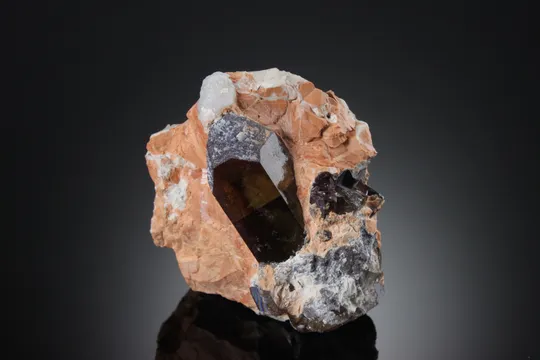
Geologically, the mine is best understood as a small oxidized magnetite-rich zinc-lead skarn and carbonate-replacement deposit. The primary mineralization involved magnetite, calcite, galena, sphalerite, and associated base-metal sulfides in altered carbonate rocks; later oxidation converted parts of that system into the showier suite collectors know today. The resulting specimens do not look like Moroccan vanadinite on barite, nor like the abundant red-brown vanadinite from Los Lamentos. San Carlos pieces are generally more architectural: elongated hexagonal prisms, hoppered or hollow terminations, spindled crystals, parallel bundles, and orange-brown crystal groups held in white to colorless calcite.
Regional View
Country View
Historically, San Carlos was an ore mine before it was a specimen locality. The argentiferous galena deposit was worked briefly in the late nineteenth century and again in the twentieth century, with ASARCO-era mining especially important from the 1940s into the early 1950s. The locality remained less visited than its fame might suggest, despite its relative nearness to the United States border and the Big Bend region. That semi-obscurity helped preserve its aura: good old specimens were never abundant, and the best pieces often surfaced through mid-century collections, old Mexican dealer stock, or later pocket recoveries rather than from a steady commercial specimen pipeline.

Photo: Wikimedia Commons / Rob Lavinsky, iRocks.com
The finest San Carlos specimens are prized less for sheer color saturation than for proportion and structure. A first-rate thumbnail or miniature may show only a few vanadinite crystals, but if those crystals are lustrous, sharp, hollow-ended, undamaged, and perched naturally on gemmy calcite, the piece can be far more desirable than a larger crowded mass. San Carlos rewards close looking: the crystals often have subtle zoning, open terminations, and skeletal growth forms that come alive under magnification.

Search for specimens: View all specimens from San Carlos Mine, Mexico
The collector locality is the Apex Mine at San Carlos, Manuel Benavides Municipality, Chihuahua, Mexico, commonly labeled “San Carlos Mine,” “Mina San Carlos,” or “San Carlos Mine (Apex Mine).” Modern locality references distinguish the specific mine as Apex Mine and treat “San Carlos Mine” as the entrenched historical and commercial name. For the collector, that distinction matters because “San Carlos Mine” is also the name of a different famous mineral locality at La Luz, Guanajuato; the Chihuahua locality is the vanadinite-calcite-wulfenite source discussed here.
The mine lies in the Sierra San Carlos/Sierra Azul area of northeastern Chihuahua, near Manuel Benavides, in the broader San Carlos caldera region. The skarn deposit formed at the crest of a Laramide anticlinal fold intruded and uplifted by a granitic pluton related to San Carlos caldera development at about 31 Ma. Lower Cretaceous dolomitic limestone and calcareous siltstone around the intrusive core were thermally and chemically altered, producing a metamorphic and metasomatic environment favorable for magnetite-rich skarn and Pb-Zn-Ag mineralization.
The ore system is not a simple open vein but a skarn and carbonate-replacement deposit. In practical mineral-collector terms, the earlier ore stage supplied magnetite, calcite, galena, sphalerite, and associated sulfides in altered carbonate rocks. Later oxidation of the lead-bearing system produced vanadinite, wulfenite, mimetite, descloizite, hedyphane, goethite, hematite, and other secondary minerals. This is why the classic specimens typically show vanadinite with calcite or gossanous matrix rather than thick white barite.
Published geological summaries describe San Carlos as part of a suite of northern Mexican high-temperature carbonate-hosted Ag-Pb-Zn(Cu) deposits, but San Carlos has its own personality within that group. Serpentine alteration is especially associated with the San Carlos skarn literature, and the mine’s collector suite reflects the intimate connection between carbonate wall rocks, skarn minerals, base-metal sulfides, and desert-zone oxidation.
Mining history is compact but consequential. The argentiferous galena deposit was mined briefly in the late nineteenth century, then worked again from about 1930 to 1952. Mexican geological-survey reporting identifies ASARCO exploitation from 1942 to 1952, with production of about 1,500,000 tonnes of mineralized material. The ore was described as iron minerals associated with Pb, Zn, Cu, Au, and Ag sulfides; the mineralized structure was reported at about 3.0 meters thick and 200 meters long, with reported values of 2.55 to 40% Fe, 5 to 71 g/t Ag, 1.15 to 3.38% Pb, and 1.25 to 3.38% Zn.
The best-known specimens came not from a tourist collecting operation but from old workings, oxidized pockets, and later recoveries. Classic pieces circulated by the 1950s and 1960s, sometimes with old Folch Collection, Elbert Barron, or other collector provenance. These older specimens commonly have smaller vanadinite crystals, often a few millimeters across, but strong historical value when the crystal form is sharp and the paperwork is good.
Later finds renewed interest in the locality. Important vanadinite finds in 2018 and 2019 produced fresh orange-brown hoppered crystals and small sculptural specimens that broadened the supply beyond old collection pieces. These finds also confirmed what advanced collectors had long recognized: San Carlos vanadinite may not be the reddest vanadinite on the market, but the best examples are among the most distinctive Mexican vanadinites by form.
San Carlos is not a public fee-collecting locality. It should be treated as an old mine and mineralized district where access depends on permission, current land and concession status, and serious mine-safety judgment. Old underground workings, collapsed stopes, unstable dumps, and oxidized lead-zinc mine environments are not places for casual collecting. Most collectors should acquire documented specimens through reputable dealers, auctions, and old collections rather than attempting field recovery.
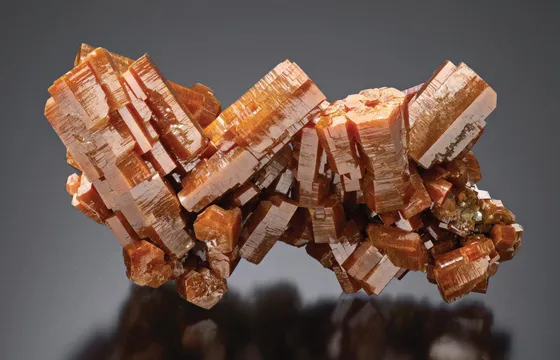
Vanadinite is the signature San Carlos collector mineral, occurring as lustrous elongated hexagonal prisms, spindled crystals, parallel to subparallel clusters, and distinctive hoppered or hollow-ended forms. Colors range from pale cream-orange and honey-brown through caramel, butterscotch, orange-brown, rust-brown, and reddish brown; some pieces show the earthy olive-brown cast that helps separate the locality from more familiar Moroccan and Los Lamentos material. The best documented specimens show crystals commonly in the millimeter to low-centimeter range, with fine examples around 1 cm and exceptional pieces reported with much larger crystals; calcite is the key associate, either as colorless rhombohedra, white druse, gemmy matrix, or later overgrowth around the vanadinite. Top San Carlos pieces are judged by crystal sharpness, hollow or skeletal architecture, three-dimensional placement, luster, clean calcite contrast, undamaged terminations, and reliable Apex/San Carlos provenance rather than by red color alone.
Calcite from San Carlos is usually valued as the essential stage on which the vanadinite performs, but good calcite is not just background here. It occurs as glassy, colorless to white rhombohedral crystals, drusy coatings, flattened or blocky crystals, and gemmy matrix that may partly enclose vanadinite prisms or grow around them after the vanadinite formed. The most attractive combinations show orange-brown vanadinite standing upright through transparent to translucent calcite, creating the “crystals in ice” effect that is one of the locality’s signatures. Calcite also appears with wulfenite and descloizite in the oxidized suite, and some documented San Carlos calcite-bearing specimens show minor fluorescence under both longwave and shortwave ultraviolet light. As a collectible species from this mine, calcite is strongest when it preserves sharp rhombohedral form, transparency, sparkle, and undamaged contrast with vanadinite rather than appearing as a dull crust.
Other minerals documented from the Chihuahua Apex/San Carlos locality include wulfenite, mimetite, arsenic-bearing vanadinite, descloizite, hedyphane, dolomite, galena, sphalerite, magnetite, hematite, goethite, quartz, chalcopyrite, bornite, pyrite, jarosite, hydrozincite, magnesite, brucite, and skarn minerals such as actinolite, andradite, vesuvianite, serpentine-subgroup minerals, and staurolite. Wulfenite is the great rarity of the locality: far scarcer than vanadinite, but reported in superb electric orange-red, gemmy tabular crystals, with the best examples cited to about 7 cm. Descloizite is another important rarity, reported as small gemmy crystals around 4 mm, and mimetite or mimetite-like orange-red material occurs in association with wulfenite. No valid type-locality mineral is known from this Chihuahua Apex/San Carlos locality; the San Carlos Mine that is the type locality for aguilarite is a different mine at La Luz, Guanajuato, and should not be confused with the vanadinite-producing San Carlos of Chihuahua.
The first collector issue is labeling. A real Chihuahua specimen may legitimately carry any of several old-style labels: “San Carlos Mine,” “Mina San Carlos,” “Apex Mine,” “San Carlos Mine (Apex Mine),” or simply “San Carlos, Chihuahua.” That variation is normal. A label saying only “Mexico” or “Chihuahua” is weaker, because several Mexican localities have produced vanadinite, wulfenite, mimetite, or arsenic-bearing vanadinite with overlapping colors.
The most serious locality confusion is with other Chihuahua lead-vanadate sources, especially Los Lamentos, and with the separate San Carlos Mine in Guanajuato. Los Lamentos material can include brownish arsenic-bearing vanadinite historically labeled “endlichite,” and some specimens may be visually close to San Carlos at first glance. San Carlos, Chihuahua vanadinite is usually strongest in elongated, spindled, or hoppered crystals with calcite; Los Lamentos and other districts have different matrix and growth styles. Guanajuato San Carlos labels belong to the silver-selenide locality famous for aguilarite, not to the Apex Mine vanadinite-calcite suite.
No widespread treatment problem defines San Carlos vanadinite. The chief risks are wrong locality, incomplete provenance, repaired crystals, glued-on individuals, and undisclosed damage. Examine crystal bases where vanadinite meets calcite or matrix. Genuine San Carlos crystals commonly emerge naturally from calcite or gossanous substrate; suspicious gaps, shiny adhesive films, repeated unnatural spacing, or mismatched matrix textures deserve caution. A loupe or microscope is especially useful because many fine San Carlos crystals have hollow terminations, and natural hoppered rims should not be mistaken for breakage.
Condition is critical. Vanadinite is brittle, the hoppered rims can be thin, and calcite chips easily. Many specimens show small edge nicks, contacted crystals, or minor pocket abrasion. On older pieces, slight wear may be acceptable if the specimen has strong form and provenance, but broken terminations on the principal crystals sharply reduce desirability. Always inspect down the c-axis of the vanadinite: the hollow or stepped termination is often the feature that makes the specimen special.
Calcite associations require their own judgment. Some vanadinite crystals are partly coated or enclosed by later calcite, which can mute the color but enhance locality character. A specimen should not be dismissed because the vanadinite is not blazing red; at San Carlos, a clean caramel crystal rising through colorless calcite may be more representative and more desirable than an over-bright but damaged crystal group.
Old San Carlos specimens are scarcer on the market than Moroccan vanadinite and less constantly available than material from the best-known Mexican vanadinite districts. Good thumbnails and miniatures appear periodically in auctions and dealer inventories, often from older collections. Provenance to mid-century collections, old Folch material, Rock Currier material, or labels from respected dealers adds real value. The 2018–2019 finds temporarily increased supply, but top examples from those pockets were absorbed quickly into collections.
Value is highly aesthetic. Modest brown clusters remain accessible, especially when crowded or damaged. Sharp miniatures with isolated orange-brown hoppered prisms on calcite move into a more competitive tier. Large crystals, 360-degree sculptural form, clean calcite contrast, rare wulfenite associations, documented old labels, and exceptional condition can push a San Carlos specimen well beyond what its size alone would suggest.
For a mine so near the United States border, San Carlos has always had an oddly quiet reputation. Thomas P. Moore’s locality article emphasized the paradox: the deposit is close enough to the border country to seem accessible, yet it remained a relatively unknown locality seldom visited by field collectors. That obscurity is part of its charm. San Carlos never became a mineral-tourism emblem like Ojuela or Naica. Its best pieces often traveled quietly: a small orange-brown vanadinite here, a calcite-rich miniature there, an old “Mina San Carlos” label tucked behind a specimen that later collectors would have to interpret.
One of the evocative mid-century examples passed through El Paso in 1959. The specimen had belonged to Elbert Barron and was later acquired by Joaquim Folch, retaining its original label and collection card. It measured 8.2 × 6.2 × 5.2 cm, with main vanadinite crystals only 0.4 × 0.2 cm, but the description is classic San Carlos: spindled prismatic crystals, very acute, reddish brown, many showing hollowed growths, set with calcite on matrix. For serious locality collectors, that is the whole package—physical style, correct mine, and a paper trail reaching back to the decade just after major mining ended.
Another Folch duplicate, dated around 1955, measured 7.8 × 6.7 × 3.3 cm and carried a handwritten Folch note and record. Its vanadinite crystals were also small, again about 0.4 × 0.2 cm, but the specimen captures the old San Carlos standard: well-defined prismatic crystals, many doubly terminated, a clear cream color, on a druse of rhombohedral calcite. The importance of such pieces lies not in cabinet-size drama but in the way they preserve a precise historical moment—San Carlos material already circulating as a classic Mexican specialty while the ore mine’s industrial life was still recent memory.
Modern collectors got a surprise when the 2018 and 2019 pockets brought fresh attention to the mine. Suddenly San Carlos was not merely an old-label locality. Newer specimens showed vivid orange-brown hoppered vanadinite with bright luster and fresh surfaces, some as complete all-around miniatures. Dealer descriptions from the period singled out 360-degree clusters, perfect hexagonal crystals, and colorless calcite rhombohedra accenting the orange-brown vanadinite. These pockets did not turn San Carlos into a mass-market locality, but they did reset expectations for how sharp and fresh a modern San Carlos piece could be.
Auction records tell the same story in miniature. A Rock H. Currier Collection specimen sold by Heritage Auctions on August 26, 2019, measured only 2.0 × 3.7 × 2.0 cm, yet carried orange vanadinite prisms reported at an impressive 1.5 inches high, lightly dusted with colorless sparkling calcite. The catalog writer could not resist comparing the form to “a couple of tall English Barristers,” a memorable phrase because it catches the real charm of the locality: not massive coverage, but tall, upright, characterful crystals that look composed rather than merely grown.
The biggest San Carlos vanadinites are outliers and should be understood as such. Documented large cabinet specimens exist, including examples around 18.5 × 13.9 × 9.4 cm and 15.0 × 11.5 × 7.4 cm, the latter carrying strongly hoppered butterscotch prisms to 3.8 cm with cream-colored calcite overgrowth. These pieces are not what most collectors will encounter. They are the exceptional specimens that explain why San Carlos remains in advanced conversations about Mexican vanadinite even though ordinary examples can seem modest beside the red vanadinite floods from Morocco.