Sakoany, Madagascar — a sedimentary celestine locality renowned for ice-blue geode crystals, strong collecting appeal, and lasting rarity.
Key facts
Sakoany is the Madagascar celestine locality: a low coastal field near Sakoany village, south of Katsepy, on the western side of the Betsiboka River where it opens into Bombetoka Bay. For collectors it matters not because it is mineralogically diverse, but because it is so singular. Since its discovery in 1967, this one sedimentary strontium-sulfate deposit has supplied the world market with crystal-lined blue celestine geodes in quantities and quality that made the locality a modern classic almost immediately.
Geologically, Sakoany sits in the Mahajanga basin of northwestern Madagascar. The celestine-bearing horizon is a Paleocene sedimentary unit, commonly described as a lens up to about 30 meters thick, enclosed between crinoidal fossiliferous limestones and sandy greywacke or marly-sandy beds. The specimens owe their appeal to that quiet sedimentary setting: cavities and nodules rather than fissure veins; celestine growing on celestine or pale limestone rather than in a busy gangue; clean, simple compositions that put the blue crystals forward.
Regional View
Country View
The best Sakoany specimens have a look that is instantly recognizable: ice-blue to sky-blue orthorhombic crystals lining geode cavities, with broad glassy faces, chisel-like terminations, and a watery transparency that can make the larger crystals seem suspended in a frozen hollow. Ordinary pieces are abundant—sawn or broken geode sections, pale druses, clusters with bruised rims—but fine specimens combine saturated blue color, intact exposed terminations, strong luster, and an aesthetic central crystal rising from a sparkling carpet of smaller celestines.
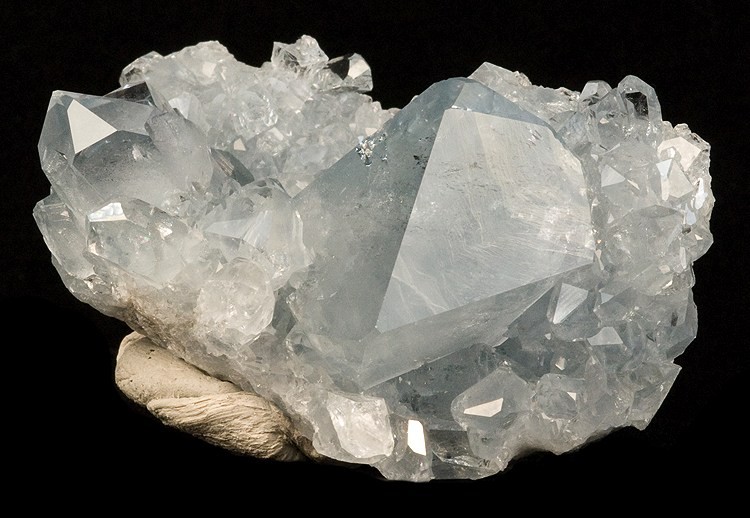
Photo: Rob Lavinsky, iRocks.com, via Wikimedia Commons
Search for specimens: View all specimens from Sakoany deposit, Madagascar
The Sakoany deposit is a sedimentary celestine occurrence in the Katsepy Commune of Mitsinjo District, Boeny Region, in the former Mahajanga Province of Madagascar. The accepted Mindat coordinates place the deposit at approximately 15° 51' 18" S, 46° 13' 50" E. It lies near Sakoany village, about 12 kilometers south of Katsepy, close to the Betsiboka estuary and the tidal flats of Bombetoka Bay.
The ore is strontium sulfate, SrSO4, developed in a Paleocene sedimentary package rather than in a hard-rock vein system. Descriptions of the deposit place the celestine-bearing layer within a lens that locally reaches about 30 meters in thickness. The enclosing sequence is described as crinoidal limestone below and sandy greywacke or marly-sandy beds above and around the mineralized horizon. Some accounts divide the deposit into an upper, thinner zone producing smaller clusters and isolated crystals, and a lower zone that carries the larger geodes and the most collectible material.
The two principal specimen modes are geodes and free or attached crystal clusters. Geodes range from hand-sized cavities to large masses; a published early report cited a geode about 60 centimeters in diameter weighing 54 kilograms, and later field summaries describe rare exceptional geodes even larger. The more familiar commercial pieces are broken or trimmed geode sections lined with blue celestine. Fine collector specimens are usually selected from the same geodes when crystal groups can be removed or trimmed without losing the main terminations.
Mining began after the deposit was recognized in 1967. Early digging was close to the seashore; later workings shifted several hundred meters inland and to a somewhat higher level, roughly 15 meters above the earlier coastal ground. Sakoany is not a single engineered mine in the usual sense. The field has been described as a broad artisanal area marked by numerous small irregular shafts and pits, commonly hand dug through soft sediments to reach the celestine-bearing layer. Public descriptions repeatedly emphasize local, small-scale work rather than a large mechanized operator.
Production has continued, intermittently and artisanally, for decades. Pezzotta reported annual production of about 15 tons in the late 1990s, while Wilson’s 2010 account described many hundreds of tons of geodes having been produced since 1967 and noted that the locality still showed no obvious sign of exhaustion. A BGR-related country profile later estimated Sakoany’s resource potential in the range of several hundred thousand tonnes of celestine, though specimen-grade recovery is a much narrower matter than ore potential.
Collecting access today should be treated as a permissions issue, not as an open rockhounding opportunity. The workings are local artisanal diggings on Malagasy land, and any visit requires permission from landholders and miners, attention to local customs, and serious safety caution around unsupported shafts, soft sediment, tides, heat, and transport. For most collectors, Sakoany is encountered through exported specimens rather than through field collecting.
The best documented “pockets” are not named in the manner of alpine clefts or pegmatite pockets; they are geodes from particular zones and shafts. Collectors should therefore pay more attention to specimen character than to romantic pocket names. Older labels may read Sakoany, Sankoany, Sakoany Mine, Sakoany Mines, Katsepy, Majunga, or Mahajanga Province. These usually refer to the same producing district, though labels that reduce the locality simply to “Madagascar celestite” lose important provenance.
Sakoany celestine is typically pale blue, medium sky-blue, ice-blue, blue-gray, or nearly colorless, with vitreous luster and crystals that range from blocky prisms to elongated tapering forms with classic chisel-shaped terminations; Mindat records well-formed crystals to about 15 centimeters, while fine market specimens commonly show main crystals in the 2–6 centimeter range set in geode cavities. The dominant habit is orthorhombic and prismatic, commonly with broad reflective faces, and the visual signature is blue celestine on celestine or on pale limestone-rich matrix with very little distracting associated mineralization. The best pieces from Sakoany are not merely blue geode fragments: they have a lively open pocket, transparent glassy crystals, crisp undamaged tips, good separation between major crystals, and enough matrix to show the geode context without becoming a heavy, clunky half-geode.
Specimens sold or catalogued as celestite from Sakoany are mineralogically the same SrSO4 species for which the IMA-approved name is celestine, but “celestite” remains deeply embedded in the gem, crystal, and specimen trade. In Sakoany material the name usually appears on geode sections and retail clusters: pale to sky-blue crystals lining cavities, commonly transparent to translucent, with broken outer rims where the geode was opened or trimmed. Strong celestite-labeled pieces from this locality show the same traits sought in celestine-labeled examples—saturated natural blue, glassy faces, sharp chisel terminations, minimal bruising, and a displayable geode architecture—whereas ordinary commercial pieces tend to be pale, crowded, sugary, or damaged along the exposed edges.
Beyond celestine, Sakoany is remarkable for its scarcity of verified accessory species. Mindat’s main locality page lists only celestine as a valid mineral from the deposit; its celestine occurrence page notes calcite and limestone only from photo-based association data, with limestone serving as matrix rather than a mineral species. No type-locality minerals are documented from Sakoany in the standard public records checked for this guide, and the absence of a diverse suite is part of the locality’s identity: the classic specimens are essentially blue SrSO4 geodes from a simple sedimentary strontium-sulfate system.
Sakoany celestine is abundant enough that modest geode pieces are always available somewhere in the market, but true fine-mineral examples are much scarcer than the tonnage suggests. Most production breaks down into pale geode sections, sawn halves, loose clusters, and bruised cabinet pieces. The premium is paid for undamaged focal crystals, richer blue color, transparency, high luster, and balanced composition; a single upright chisel-terminated crystal rising cleanly from smaller celestines can be far more desirable than a larger but shapeless geode half.
Condition is the central issue. Celestine has perfect cleavage and low hardness, and Sakoany crystals are commonly attached to fragile geode walls. Periphery wear is almost normal because miners remove whole geodes, transport them, open them, and trim them after extraction. Edge chipping, cleaved tips, rubbed high points, and sandy residue are common. On large geode sections, inspect the interior crystal tips, not only the outer rim; rim damage is tolerable if the main display crystals remain sharp and glassy.
No well-documented locality-specific fake industry is known for Sakoany comparable to the dyed agate and assembled “geode” problems seen elsewhere in the decorative mineral trade, but caution is still warranted. Vivid electric-blue color, dye pooled in cracks, color rubbing onto a damp swab, resinous shine on crystals, or a suspiciously uniform blue surface should raise questions. More common than outright fakes are vague or wrong labels: “Madagascar celestite,” “Sakoany Mine,” “Majunga,” “Katsepy,” and the older spelling “Sankoany” may all appear, while some online listings confuse Madagascar celestine with Moroccan or generic celestite material.
Treatments are not usually expected on good collector-grade Sakoany crystals because the natural color and luster are the selling points and the mineral is too fragile for aggressive enhancement. Stabilization or repair of geode exteriors is possible in the broader commercial trade and should be disclosed if present. Check for glue lines at the base of freestanding crystals, filled cracks in geode walls, and artificial mounting putty hidden under pale matrix.
Light exposure deserves restraint. Some sellers and collectors warn that celestine color may fade in strong sunlight; documented observations are mixed, but display in intense direct sun is unnecessary risk for a blue mineral whose appeal depends on delicate color. Published gemological work on a faceted Madagascar celestine reported inert behavior to both long-wave and short-wave ultraviolet light, and practical collector reports vary, so Sakoany material should not be bought for fluorescence. Handle it as a brittle, cleavage-prone sulfate: keep it dry, dust it gently, avoid ultrasonic cleaning, avoid acids, and give larger geode halves stable stands so their heavy mass does not rest on fragile crystal edges.
The Sakoany story begins, as many great specimen-locality stories do, with something pale and bright showing where it should not. The discovery is generally told as a chance observation in 1967: a local herder noticed blue crystals protruding from the ground near the coast. That small flash of color led to one of the most productive celestine specimen fields ever worked. Early pits were dug close to the shoreline, in low coastal ground affected by tides and difficult travel; later, as the near-surface ground was exhausted or became less practical, miners followed the horizon inland by several hundred meters and upward to a slightly higher level.
Descriptions of the workings are strikingly modest when set against the global fame of the specimens. This was not a great timbered adit or a mechanized open pit. Rock Currier described the “mines” as a considerable acreage peppered with small rectangular shafts dug by local people, often only 20 or 30 feet deep, descending through fine white sediment until the miners reached the productive layer. Other accounts mention pits as deep as about 15 meters. The image is intimate and repetitive: soft sediment, pick and shovel, narrow holes, geodes lifted out whole whenever possible, and then carried back to the village before being opened.
The geodes themselves explain both the abundance and the damage. A whole Sakoany geode may be a heavy, awkward, deceptively plain mass until it is opened. Inside, the cavity can be lined with pale blue prisms, sometimes with one or several dominant crystals standing above a carpet of smaller points. But extracting a clean specimen from a geode is unforgiving work. Many good crystals are sacrificed when a geode is split, and many surviving display pieces show acceptable bruising around the edge where the cavity wall was broken away. That is why collectors tolerate some peripheral wear on Sakoany pieces that would be objectionable from a hard-rock pocket: the very format that creates the beauty also creates the damage.
The village setting is part of the locality’s mineralogical identity. One popular collector account described Sakoany as a small settlement of roughly fifty families whose lives combined fishing, farming, and celestine mining. Later summaries emphasize the same artisanal pattern: local Sakalava communities, rice cultivation, fishing, zebu herding, and mineral extraction as supplementary income. Access from Mahajanga is not straightforward; the route may involve crossing toward Katsepy by ferry or small boat, timing movements around tide and track conditions, and then continuing by foot or four-wheel-drive vehicle. The remoteness that makes Sakoany difficult to visit is also one reason its mining has remained small-scale.
There is also a cultural rhythm to the work. Field summaries describe days when extraction is avoided and rituals made before new ground is opened. For the collector holding a polished dealer label in Tucson, Munich, Sainte-Marie-aux-Mines, or Denver, it is easy to see only a blue geode. At Sakoany, the specimen began in a coastal landscape of tides, cattle, soft sediment, hand-dug shafts, and local rules about when the earth should and should not be disturbed.