Rubtsovsk Mine, Russia — renowned locality for red cuprite octahedra on native copper with silver and iodides; modern classic for collectors of oxidized ores.
Key facts
Rubtsovsk Mine is one of the great short-lived modern specimen localities: a compact, rich Cu-Zn-Pb volcanogenic massive-sulfide orebody in the northwestern Rudny Altai whose oxidized crown produced a rush of world-class cuprite, native copper, copper-after-cuprite pseudomorphs, native silver associations, azurite, malachite and rare copper-silver iodides. In collector usage the mine is usually called Rubtsovsk or Rubtsovskoe; older labels often say Poteryaevskoe or Poteryaevsky, after the nearby village of Poteryaevka, but the formal deposit name is Rubtsovskoye. Its best specimens have a distinctive look: sharp, heavy, dark red to black-red cuprite octahedra with ruby translucency on thin edges, perched on sculptural native copper, accompanied by native silver blebs or altered to sparkling copper while preserving the original cuprite form.
Geologically, Rubtsovskoye belongs to the Rudny Altai family of Kuroko-style pyrite-polymetallic deposits, formed in a Devonian volcanic-sedimentary island-arc to back-arc environment. The primary ore was not a specimen-maker in the usual aesthetic sense: it was dense sulfide material dominated by pyrite, chalcopyrite, sphalerite and galena, with tetrahedrite-tennantite-group minerals, quartz, carbonates and sericite. The collector miracle was the oxidized zone above and within that orebody, where copper, silver, iodine, sulfur and carbonate chemistry produced red oxides, native metals, vivid blue and green carbonates, lead sulfates and iodides in a small vertical slice of the deposit.
Regional View
Country View
For a serious collection, Rubtsovsk is important because it is both scientifically unusual and visually unmistakable. The mine’s cuprite finds entered the market mainly in the late 2000s and early 2010s, just as the oxidized ore was being mined through. That gives the locality a defined “modern classic” character: enough material was recovered for representative thumbnails and miniatures to circulate, but the top pieces—large undamaged octahedra, elegant cuprite-on-copper groups, copper pseudomorphs after cuprite, and cuprite with native silver—belong to a finite find.

Photo: Wikimedia Commons
The most memorable specimens from Rubtsovsk are not merely “red cuprite” or “native copper.” They are paragenetic objects. Some show black-red cuprite crystals sitting naturally on branching copper; some show later copper replacing cuprite while retaining sharp octahedral outlines; some carry small native silver aggregates tucked into fractures and hollows; some azurite pieces occur as rounded, saturated-blue nodules or geode-like masses, sometimes with malachite skins or sprays. The locality’s palette—coppery metallic orange, resinous black-red, midnight blue, bright malachite green, white kaolinitic clay and occasional silver-white metal—is unusually rich for such a small and recently exploited orebody.

Photo: Wikimedia Commons
Search for specimens: View all specimens from Rubtsovsk Mine, Russia
Rubtsovsk Mine worked the Rubtsovskoye Cu-Zn-Pb polymetallic deposit in Rubtsovsky District, Altai Krai, southwestern Siberia. The deposit lies southeast of the city of Rubtsovsk, near Poteryaevka, and close to the Russia–Kazakhstan border. Mineral labels may legitimately refer to Rubtsovsk, Rubtsovskoe, Rubtsovskoye, Poteryaevskoe, Poteryaevsky or Poteryaevka; for modern cataloguing, Rubtsovsk Mine or Rubtsovskoye deposit is the clearest and least misleading name.
The deposit is a volcanogenic massive-sulfide system of the Rudny Altai metallogenic belt, commonly compared with Kuroko-type deposits. It sits in a large volcanotectonic trough within an ancient island-arc-related volcanic-sedimentary terrane. The ore-bearing metasomatic rocks developed after acidic volcanic and volcanogenic-sedimentary rocks and include secondary quartzites and argillizites. In hand-specimen terms, this is why Rubtsovsk pieces so often include white to pale clayey material, limonite, gossanous matrix, quartz, and altered sulfide textures rather than the massive carbonate gangue typical of many classic copper localities.
Published descriptions of the orebody characterize it as a lens-like body complicated by flexural folding. Its extent is roughly hundreds of metres rather than kilometres: about 800 m along dip from west to east and about 400 m north to south, with thickness varying from about 0.5 to 12 m and averaging a little over 5 m. The pre-mining ore reserve was on the order of 2.5 million tonnes, with unusually high base-metal grades for a polymetallic system: copper, lead and zinc were all major economic components, with precious metals also present.
The primary ore assemblage is dominated by pyrite, chalcopyrite, sphalerite and galena. Later and subordinate minerals include tetrahedrite-tennantite-group minerals, quartz, carbonates and sericite. Microscopic work on the sulfide ores has described multiple generations of pyrite, chalcopyrite replacement textures, sphalerite with chalcopyrite inclusions, and differences between more sedimentary-exhalative textures in parts of the orebody and more overprinted hydrothermal-polymetallic textures near the fold-affected portions. For collectors, those details matter because the spectacular secondary minerals were not random surface stains: they developed from a metal-rich, sulfur-rich orebody with complex primary and overprinted textures.
Mining history was brief but eventful. Construction of the Rubtsovsk mine began in the late Soviet period, but work stalled in the 1990s while the project was still unfinished. Sibir-Polimetally was created in the late 1990s as part of a revival of Altai Krai polymetallic mining, and UMMC acquired the unfinished Rubtsovsk mine complex in 2004. The first ore was mined in December 2004, industrial development accelerated in 2005, and the Rubtsovsk processing plant was commissioned in 2006 with a nominal capacity of about 400,000 tonnes of ore per year. The small rich orebody was mined rapidly; by 2015 mining at the Rubtsovskoye deposit had stopped and the mine was liquidated, while the processing plant site continued to serve other Altai polymetallic ores.
The specimen-producing interval belongs mainly to that active mining window. The best cuprite, native copper and native silver material reached collectors around the 2008–2011 period, with show reports from Denver and Tucson recording immediate excitement over the new Russian cuprites. Copper-after-cuprite pseudomorphs followed in smaller numbers, and azurite and malachite pieces—especially blue nodules and polished azurite-malachite material—became better known as additional oxidized-zone pockets were encountered. A reported azurite pocket from the summer of 2013 produced unusually large, saturated-blue spherical aggregates for the locality, some with scattered small malachite spheres.
Collecting access today should be regarded as closed. This was an industrial underground polymetallic mine, not a public collecting site, and the mine workings have been closed. Any remaining dumps or plant areas are part of an industrial mining complex and require permission from the landholder and mineral-rights holder. Modern collector availability is therefore almost entirely old dealer stock, specimens brought out during the active mining years, and pieces recycled from private collections.
Several documented museum-grade pieces illustrate the scale of the best material. Fersman Mineralogical Museum acquisitions published shortly after the finds include a 24 cm dendritic aggregate of native copper with cuprite crystals, a 5 cm modified octahedral cuprite crystal, and a copper pseudomorph after cuprite with octahedral forms to about 1.5 cm. The same group of acquisitions included Rubtsovsk iodargyrite and marshite, emphasizing how the deposit’s fame rests not only on attractive cabinet specimens but also on an unusually rich oxidation-zone mineralogy.
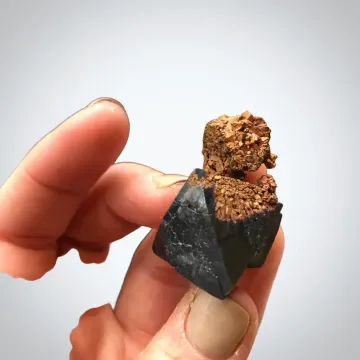
Rubtsovsk cuprite occurs chiefly as sharp octahedra and modified octahedra, commonly dark red to nearly black in reflected light but glowing deep ruby red on thin edges or under strong backlighting; crystals range from small bright grains on copper to substantial miniatures, with documented exceptional single crystals around 5 cm and show specimens reported with crystals in the 5–6 cm range. The finest pieces are not simply large: they are complete or nearly complete floaters, lustrous, sharply edged, undamaged at the octahedral points, and aesthetically associated with native copper or native silver rather than buried in dull gossan. Many specimens came from the oxidized zone during the late-2000s to early-2010s mining window, and the most characteristic Rubtsovsk look is cuprite on sculptural native copper or cuprite partly to wholly replaced by later copper while still preserving the original octahedral architecture.
Native copper from Rubtsovsk is best known as arborescent, branching, dendritic, spinel-twinned and richly crystallized masses, often with a natural brownish to coppery patina rather than a harshly stripped bright surface. It occurs with cuprite, native silver, kaolinite, malachite, azurite, limonite and other oxidation-zone minerals, and some of the most desirable pieces show sharp copper crystals carrying small red cuprite octahedra or, more unusually, copper pseudomorphs after earlier cuprite. Ordinary examples are small granular or rough copper masses; top specimens are three-dimensional, self-supporting floaters or sculptural groups with clearly crystallized surfaces, balanced form, attractive patina, visible cuprite accents and no repaired or crushed branches.
Azurite from Rubtsovsk is a secondary oxidized-zone mineral, much less abundant on the market than cuprite or copper, and is most recognizable as saturated blue rounded aggregates, nodules, geode-like masses and spherical rosette clusters made of fine sparkling crystals; some pieces are cut and polished to reveal vivid blue interiors, while others remain natural with drusy surfaces and malachite accents. Reported specimen material includes rosettes and spheres reaching centimetre scale, including a large summer-2013 pocket specimen with azurite rosettes to about 2 cm and small bright green malachite spheres scattered across the surface. The best Rubtsovsk azurites have strong color saturation, intact spherical or nodular form, sparkling crystal faces and minimal bruising; lesser pieces are pale, chalky, heavily polished without good pattern, or too altered to malachite to retain the locality’s intense blue character.
Native silver at Rubtsovsk is a prized accessory rather than the dominant visual species, occurring as white to grey, oxidized, granular, spongy, microcrystalline, semi-dendritic or blebby aggregates in cracks, cavities and surfaces of cuprite-rich material. The association with cuprite is especially collectible because it was present only in a smaller portion of the recovered material: documented specimens show native silver on or among dark red cuprite octahedra, including examples where silver forms pale granular coatings over substantial cuprite faces. Good silver-bearing pieces are valued for clear, natural placement of the silver, strong contrast with sharp red-black cuprite, and credible paragenetic association; ordinary pieces may show only tiny dull pale spots that add little visually unless the cuprite itself is excellent.
Malachite from Rubtsovsk accompanies the azurite-bearing and copper-rich parts of the oxidized zone, most often as bright green botryoidal, spherical, velvety, crustose or banded material with azurite, and as minor green accents on blue azurite rosettes or nodules. Much Rubtsovsk malachite is encountered in azurite-malachite nodules, slabs and polished decorative pieces rather than as freestanding crystallized malachite specimens; nevertheless, good collector pieces show rich grass-green color, fine velvety texture, attractive contrast with azurite blue, and natural rounded or botryoidal structure. The weakest examples are poorly labelled blue-green lapidary material with heavy coating, flat polish and little mineralogical texture, while the best preserve both the color contrast and the compact nodular habits characteristic of the Rubtsovsk oxidation zone.
Beyond these headline species, Rubtsovsk is especially important for copper and silver iodides in the oxidized orebody. Marshite, miersite and iodargyrite form the locality’s most scientifically distinctive rarity suite, with published work describing clear zoning: iodargyrite widespread higher in the oxidized orebody, marshite concentrated at a somewhat lower level, and miersite occurring more sporadically with both iodargyrite and low-silver marshite. Other documented minerals include cerussite, anglesite, beaverite, osarizawaite, brochantite, connellite, linarite, natrojarosite, jarosite, goethite, hematite, kaolinite, dickite, quartz, calcite, smithsonite, sphalerite, galena, chalcopyrite, chalcocite, covellite, bornite and tetrahedrite-tennantite-group minerals. Rubtsovsk is not known as the type locality for a major new display-specimen species; its importance lies instead in the rare abundance, quality and zoning of its secondary copper-silver assemblage.
Rubtsovsk material is well represented but finite. The mine’s best specimen-producing zones were mined through quickly, and new production from the original oxidized orebody should not be expected. Representative cuprite thumbnails and miniatures still appear from dealer stocks and collection dispersals, but large undamaged cuprite crystals, strong cuprite-on-copper combinations, copper-after-cuprite pseudomorphs and cuprite with visible native silver have become increasingly selective purchases.
Labels require attention. “Poteryaevskoe Mine,” “Poteryaevsky Mine,” “Poteryaevka,” “Rubtsovskoe,” “Rubtsovskoye,” and “Rubtsovsk Mine” are often used for the same specimen-producing system. That is not necessarily a red flag, but a good collection label should clarify the modern locality as Rubtsovsk Mine, Rubtsovsky District, Altai Krai, Russia, and can retain Poteryaevskoe as a historical label note.
There are no widely established, locality-specific fake Rubtsovsk cuprites comparable to famous problem categories in the specimen market, but misidentification and cosmetic issues deserve scrutiny. Dark cuprite can be confused with tenorite or generic copper oxides unless crystal form, red translucency, hardness and association are checked. Copper specimens from many localities are sometimes acid-cleaned, brightened or lacquered; Rubtsovsk copper is most desirable with a believable natural patina and no plasticky coating. Some modern azurite-malachite slices and nodules are explicitly sold as polished or varnished to reduce scratching and atmospheric alteration, which is acceptable only when disclosed and priced as lapidary or treated material rather than as a natural, uncoated specimen.
Condition is the chief value factor. Cuprite has vulnerable octahedral points and edges, and Rubtsovsk crystals are often exposed high on copper or in floater groups, making chips easy to miss in photographs. Inspect principal terminations under magnification, especially on large dark crystals where bruises can hide in reflections. Copper branches can be bent, cracked or reattached; look for glue in crotches, unnatural alignment, fresh bright breaks and bases that do not support the weight naturally. On copper-after-cuprite pseudomorphs, check whether the octahedral outline is complete and whether later microcrystalline copper sparkle is natural rather than an applied metallic dusting.
Azurite and malachite pieces raise different concerns. Natural Rubtsovsk azurite nodules can resemble dyed novelty “geodes” to casual buyers, especially when cut and polished, so provenance and surface texture matter. Strong uniform blue alone is not proof of dye, but suspicious bleeding into cracks, unnaturally blue matrix, bright color only at the surface of an otherwise pale substrate, or undisclosed resin should lower confidence. Good pieces show believable concentric or nodular mineral growth, drusy azurite where present, and natural malachite alteration rather than painted-looking green.
The rare iodides deserve conservative handling. Marshite, miersite and iodargyrite are soft and light-sensitive relative to most cabinet minerals, and published work on iodide minerals notes that such phases can darken or decompose under light and atmospheric exposure. Keep iodide-rich Rubtsovsk specimens in stable, dry, low-light storage and avoid repeated strong illumination, aggressive cleaning, ultrasonic treatment or water exposure. Even for ordinary cuprite-copper pieces, the safest approach is dry brushing only, stable humidity, and mounts that support the surprisingly heavy mass without stressing delicate copper growths.
The Rubtsovsk story has the feel of a mine that was nearly too late for collectors. Construction began in the Soviet period, but by the early 1990s the project had stalled, reportedly around 80 percent complete. Equipment sat unused or was removed, and the mine might have remained one more unfinished industrial project of the post-Soviet transition. The revival came in the 2000s, when Sibir-Polimetally and UMMC pushed the mine and plant back into development. In April 2004 the ventilation shaft was opened, in December 2004 the first ore was mined, in May 2006 the concentrator began commissioning, and by June 2006 the first saleable concentrate had been produced. Within only a few years, the same operation that had been a dormant construction site was feeding a processing plant and, unexpectedly, the international mineral market.
At the 2010 Denver show, the new Rubtsovsk cuprites were the material “everyone” seemed to be discussing. Dealers had bright, lustrous dark-red cuprite crystals with native silver, and the locality was not yet fully digested by collectors. The mine itself was not new, but a specimen-producing zone had been hit at exactly the right moment for the show circuit. Russian dealers and specialty dealers had selections; prices were already strong; and collectors quickly understood that these were not minor curiosities but serious competitors among the world’s modern cuprite finds.
Tucson 2011 brought another wave. Reports from the show described Russian cuprite crystals with varying amounts of copper or silver, including examples partly to nearly completely replaced by copper. Some crystals were 5 or 6 cm across, and the material ranged from one-centimetre miniatures to major display pieces. One observer made the practical point that the crystals were “by and large quite dark,” not because they were poor specimens, but because their paragenesis passed through dark copper-oxide conditions; there was no magic treatment that would make them all bright cherry-red. That darkness—almost black until the edge flares ruby—is now part of the locality’s identity.
The Fersman Mineralogical Museum acquisitions give the find a museum-scale anchor. Among the published pieces were a 24 cm dendritic native copper with cuprite crystals, a 5 cm modified octahedral cuprite, and a copper pseudomorph after octahedral cuprite crystals to 1.5 cm. In the same acquisition suite were tiny but scientifically remarkable iodide minerals: a twinned iodargyrite crystal on limonite, and marshite as a partial pseudomorph after an azurite concretion. Rubtsovsk’s drama is that the same oxidation zone could produce a large sculptural copper for display, a single world-class cuprite crystal, and millimetre-scale iodides important enough for specialist literature.
The azurite story is quieter but no less memorable. Collectors accustomed to Rubtsovsk as a cuprite locality began seeing intensely blue spherical nodules and geode-like pieces, some polished open like mineral blueberries. One large reported specimen from a 2013 pocket was described as a near-floater of sparkling neon-blue azurite rosettes, with rosettes to about 2 cm and tiny malachite spheres scattered across the surface. The piece was partly hollow enough to rattle when shaken—an irresistible detail, and a reminder that these were not merely colored slabs but cavity-grown products of a lively oxidation zone.