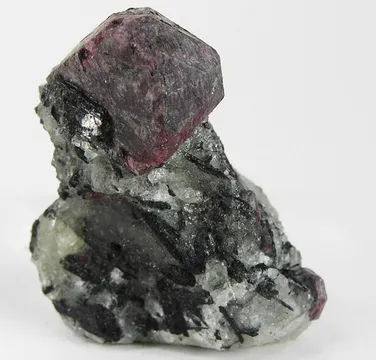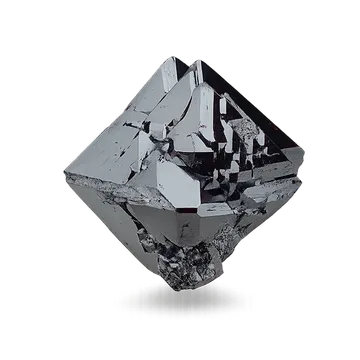
Cuprite from Rubtsovsk Mine, Russia — striking red-black octahedra on native copper with silver; a modern classic from a brief, collectible locality.
Key facts
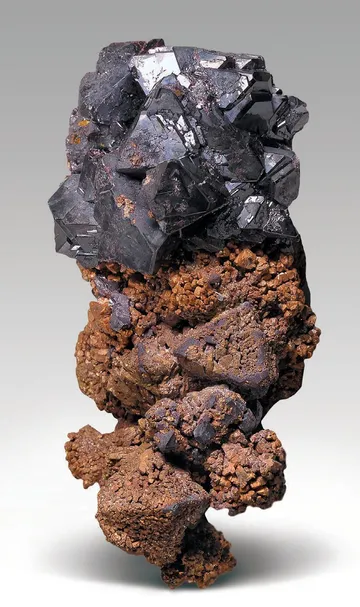
Rubtsovsk cuprite is one of the modern classics of the species: heavy, metallic-looking, red-black crystals that flash deep ruby at thin edges or under backlighting, often perched on bright native copper or accompanied by native silver. The best pieces are instantly recognizable—sharp octahedra and modified octahedra, sometimes partially replaced or overgrown by copper, with a peculiarly Russian combination of sculptural native copper and glossy, almost black cuprite.

Photo: Wikimedia Commons
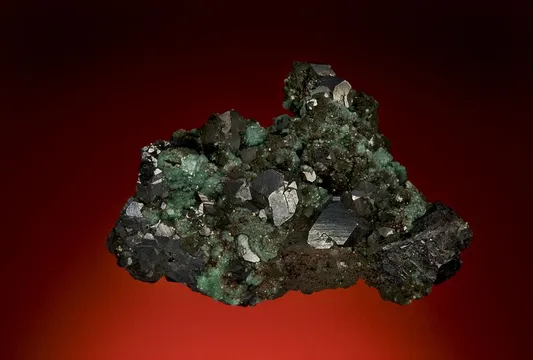
The mine exploited the Rubtsovskoye Cu-Zn-Pb deposit in the Rudny Altai of western Siberia, a volcanogenic massive sulfide system whose upper oxidized zone produced the collector minerals. That oxidation zone was small in terms of ore reserves, but mineralogically extravagant: cuprite, native copper, native silver, azurite, malachite, miersite, marshite, iodargyrite, kaolinite, cerussite, connellite and other secondary species occur in close association. This is why Rubtsovsk specimens can look less like ordinary cuprite and more like tiny mineralogical tableaux—black-red oxide crystals, copper dendrites, white clay, green films of malachite, and occasional silver.

Photo: Wikimedia Commons
For collectors, the locality sits in a narrow but important window of time. The mine was launched in the mid-2000s, the spectacular secondary copper material reached the international market around the late 2000s, and mining of the Rubtsovskoye orebody was finished by the mid-2010s. That short life gave the locality a defined “find” character: the supply was large enough for many collectors to obtain representative pieces, yet finite enough that top examples—large undamaged octahedra, aesthetic cuprite-on-copper combinations, cuprite with silver, and copper pseudomorphs after cuprite—are now treated as modern classics.
Search for specimens: View all cuprite specimens from Rubtsovsk Mine, Russia
Rubtsovsk Mine is the collector name generally used for the Rubtsovskoye deposit, in Rubtsovsky District, Altai Krai, Russia. It lies about 20 km southeast of the city of Rubtsovsk, near the village of Poteryaevka, and about 35 km from the Kazakhstan–Russia border. Older specimen labels commonly say “Poteryaevskoe Mine,” “Poteryaevsky Mine,” or “Poteryaevka,” but those names refer to the nearby settlement rather than the formal deposit name. For modern cataloguing, Rubtsovsk Mine or Rubtsovskoye deposit is the cleaner locality designation.
Geologically, Rubtsovskoye is a pyrite-polymetallic Cu-Zn-Pb volcanogenic massive sulfide deposit in the northwestern Rudny Altai. The ore district is part of an ancient island-arc-related volcanic-sedimentary terrane, with lavas, lava breccias, rhyolitic tuffs, siltstones, sandstones, carbonaceous-argillaceous beds and related Devonian volcanic units. The primary economic ore was not cuprite but sulfide ore—chiefly zinc-lead-copper material, locally very sulfide-rich. The cuprite belongs to the supergene story: oxidation of copper-bearing sulfides in the upper part of the orebody, beneath a substantial cover of younger clay-rich sediments.
That oxidized cap was only a small part of the deposit volumetrically, but it was disproportionately important for collectors. It yielded the world-class secondary copper suite for which Rubtsovsk is famous: cuprite, native copper, azurite and malachite, plus native silver and unusually rich iodide mineralization. The iodide assemblage—especially marshite, miersite and iodargyrite—makes the locality scientifically exceptional as well as visually memorable.
Mining history is brief. Development moved ahead in the mid-2000s under Sibir-Polimetally, connected with UMMC’s redevelopment of the Altai polymetallic assets. Ore production from the Rubtsovskoye deposit began in 2005, and mining was stopped in 2015 after the small rich orebody had been worked out. The Rubtsovskaya processing plant continued afterward using ore from other regional operations, but the specimen-producing oxidized zone was no longer an active collecting source.
Collecting access should be regarded as closed. This was an industrial underground mining operation, not a public dig site, and the orebody itself has been exhausted. Nearly all legitimate collector specimens came out through mine production and mineral-dealer channels during the short active period of the finds. Fresh mine-run material should be viewed cautiously unless supported by old labels, credible dealer provenance or a documented collection history.
Rubtsovsk cuprite most often appears as sharp octahedra and modified octahedra. Crystals may show beveled edges, dodecahedral modifications, stepped growth and intergrowths into dense clusters. The color in reflected light is typically dark metallic red, silvery red, brownish black or nearly black; the diagnostic red appears at broken edges, thin crystal margins, or with strong transmitted light. Top specimens combine this dark metallic exterior with an inner cherry-red glow.
Size is one of the locality’s great strengths. Small individual crystals of a few millimeters are common on combination pieces, but crystals around 1 cm are well documented, and fine pieces may carry crystals in the 1–2 cm range. Exceptional crystals and crystal groups reach several centimeters; the Fersman Mineralogical Museum documented a 5 cm modified octahedral cuprite crystal from Rubtsovsk in its 2009–2010 acquisitions. Rubtsovsk is therefore not merely a locality for pretty thumbnails—it is a source of genuinely major cuprite crystals.
Associations are crucial to the locality’s personality. Native copper is the classic partner: bright, arborescent, dendritic, skeletal, spinel-twinned or blocky, sometimes carrying dark cuprite caps or crystal groups. Native silver is also important, occurring as wiry, mossy or spongy aggregates in and around cuprite. White kaolinite or clayey alteration material may set off the crystals; green malachite films, azurite, cerussite, connellite and rare iodides add mineralogical interest.
A particularly desirable Rubtsovsk style is cuprite on crystallized copper, where the two minerals contrast in both color and habit: red-black oxide octahedra on orange to coppery metallic branches. Another is cuprite with silver, less common and especially attractive when the silver is well crystallized rather than merely spongy. A third is replacement material: native copper pseudomorphs after cuprite, where the original octahedral form survives but the substance has changed to copper. These pseudomorphs are distinctive and widely associated with the locality.
Quality depends on several factors at once. For cuprite-dominant pieces, collectors look for complete, sharp, lustrous crystals with minimal bruising on exposed octahedral points. For combinations, aesthetics matter as much as crystal size: the best pieces show spatial separation between copper and cuprite, a balanced silhouette, and visible red translucency. For specimens with silver, the value rises sharply when the silver is easily visible and not hidden in cracks. For pseudomorphs, crystal form, completeness and the sparkle of replacement copper determine desirability.
Rubtsovsk cuprite is well represented on the market, but the source is finite. Representative thumbnails and miniatures still appear from dealer stock and older collections; large, undamaged, aesthetic cabinet pieces are much less common. Pieces sold in the late 2000s and early 2010s often moved through Tucson and European show circuits, and many still carry older Russian, Czech, German or American dealer labels. Provenance is worth preserving, because the mine name has been inconsistent on labels and because “Poteryaevskoe” material is usually the same Rubtsovskoye find.
There are no widely documented, locality-specific fake Rubtsovsk cuprites in the way that some other mineral fakes have become notorious, but several practical cautions apply. First, verify the association and morphology: Rubtsovsk cuprite should make sense with native copper, native silver, kaolinite, malachite, azurite or related secondary minerals, and the crystals should show isometric habits rather than random red coatings. Second, be cautious with unusually glossy copper surfaces. Some native copper specimens from many localities have been cleaned, brightened or otherwise altered; Rubtsovsk pieces are most desirable when they retain a natural patina rather than an aggressively bright, freshly stripped appearance. Third, distinguish real cuprite from dark tenorite or copper oxides on copper; strong red translucency at thin edges is a useful field clue.
Condition is the main issue. Cuprite has only moderate hardness, and octahedral points and edges are vulnerable. The best Rubtsovsk crystals are commonly perched high on copper or exposed on all sides, which makes contact marks easy to spot under magnification. Look for bruised points, cleaved-looking flats, repaired copper stems and glued reattachments where heavy native copper branches have broken. A few small contacts may be acceptable on large or highly aesthetic specimens, but damage to the principal cuprite face or termination strongly affects value.
The heavy density of cuprite and native copper gives even small specimens surprising mass; make sure display mounts support the piece without stressing delicate copper branches. Avoid acidic cleaning, prolonged humidity and unnecessary handling. Silver-bearing pieces may tarnish, and copper surfaces can continue to darken naturally. That patina is part of the locality’s character, not necessarily a flaw.
In the Tucson show circuit, Rubtsovsk arrived with the kind of electricity collectors remember years later. Around 2009 and again in the early 2010s, dealers’ rooms began filling with Russian copper and cuprite: flats of partial crystals, thumbnails, miniatures and a few exceptional pieces that did not look quite like anything from the older classic copper localities. The material had the immediacy of a new find but the visual authority of a future classic—sharp copper crystals, black-red cuprite caps, occasional silver, and a patina that dealer descriptions repeatedly called distinctive.
One Tucson account from 2011 captured the mood neatly: cuprite on copper from Russia was the “hot mineral” of that year’s Tucson Gem & Mineral Show. The official show lasted four days, but activity around the material had already been building for two weeks in hotel rooms and satellite shows. Dr. Ivo Szegeny of Karp Minerals told the writer that the Rubtsovsk source was effectively depleted, meaning collectors were watching a new classic enter the market while already being warned that the supply would not last.
The Fersman Mineralogical Museum’s 2009–2010 acquisitions show the scientific side of the same moment. The museum obtained a characterizing Rubtsovsk collection of more than 70 specimens, largely through a joint donation by Igor V. Pekov, Mikhail Yu. Anosov, Viktor V. Levitskiy and Alexander B. Nikiforov, with additional purchases. The report notes that dendritic native copper had appeared several years earlier, but the “most gorgeous material” was mined in 2010. Among the pieces were copper with cuprite, well-terminated cuprite crystals, copper pseudomorphs after cuprite, iodargyrite crystals several millimeters to 1 cm, marshite crystals up to 2 cm, and marshite pseudomorphs after azurite and cuprite. The museum’s illustrated 5 cm cuprite crystal and 24 cm dendritic copper-with-cuprite specimen underline how quickly the find moved from mine production to institutional record.