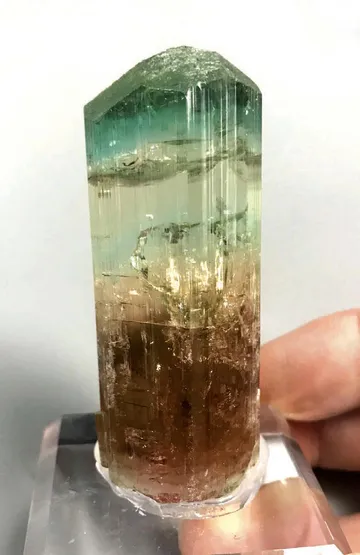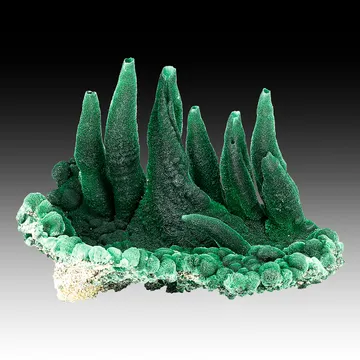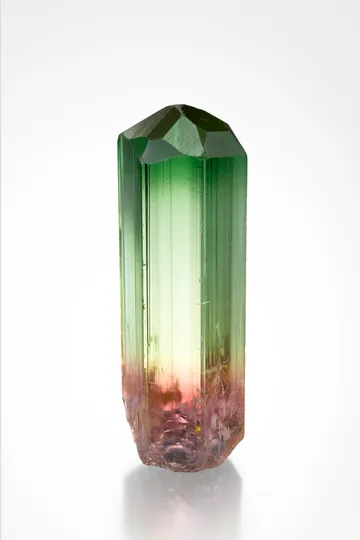
Rubaya, DR Congo: renowned for elbaite tourmaline from rare-metal pegmatites; transparent, color-zoned crystals with glassy luster, prized by collectors.
Key facts
Rubaya is a rare case where a locality better known in strategic-minerals reports has also become a first-rank name for specimen collectors. The mining district lies in Masisi Territory, North Kivu, in the eastern Democratic Republic of Congo, in the highland belt west of Lake Kivu and northwest of Goma. Its economic fame rests on coltan and cassiterite from rare-metal pegmatites and related eluvial workings, but its collector fame rests on the Rukaza–Rubaya tourmaline occurrence: a pockety pegmatite source that, since the mid-2010s, has produced remarkably transparent elbaite crystals in pink, red-pink, green, bluish green, pale yellow, peach-brown, brownish pink, and sharp bi- to tricolored zoning.
The best Rubaya specimens are not matrix classics in the old Brazilian or Afghan sense. They are more often loose crystals or small crystal groups, recovered from artisanal pits, trenches, and short tunnels cut through laterite into weathered and locally fresh pegmatite. Their virtue is glass: clear prisms, bright luster, clean terminations, and color transitions that can run from a rose-pink body into green or yellow-green caps, or from darker green into paler green. A fine Rubaya crystal may be only a few centimeters long, but the locality has produced crystals to approximately 15 cm and clean gem rough reaching around 100 g. The most desirable pieces combine strong transparency, distinct zoning, undamaged terminations, and an undulled, natural surface; ordinary pieces are commonly chipped, frosted, internally cracked, or simply too dark and fractured to read well as specimens.
Regional View
Country View
Mineralogically, Rubaya belongs with the Central African rare-metal pegmatite province rather than with volcanic or metamorphic gemstone placers. The district is part of the broader Kivu–Maniema/Karagwe-Ankole metallogenic environment, where granitic pegmatites and associated tin-tantalum mineralization yield cassiterite, columbite-tantalite, microlite-group minerals, lithium micas, feldspar, quartz, and colored tourmaline. The Rubaya material studied gemologically has been described as elbaite with a modest liddicoatite component, with iron and manganese as principal chromophores and no copper detected in the blue-green Rubaya samples examined in the 2017 Journal of Gemmology note. That point matters on the market: Rubaya can be intensely attractive, but its documented color mechanism is not the same as copper-bearing “Paraíba-type” tourmaline.
Search for specimens: View all specimens from Rubaya, DR Congo
Rubaya is a town and mining area in the Bahunde sector of Masisi Territory, North Kivu. In mineral-collector usage, “Rubaya” usually refers not simply to the town but to the surrounding pegmatite and eluvial mining district, especially the Rukaza–Rubaya tourmaline workings and the broader Bibatama/Rubaya coltan field. The district’s rare-metal character is expressed in a straightforward assemblage: pegmatite, laterite, columbite-tantalite, cassiterite, quartz, albite including cleavelandite, lepidolite, microlite-group minerals, and elbaite tourmaline.
The ore bodies are pegmatitic and weathered pegmatitic systems exploited both for heavy minerals and, where pockets or eluvial concentrations have preserved gem material, for tourmaline. The principal industrial products are coltan and cassiterite, with mining centered on named sites and sectors including Lowowo or Luwowo, Muderi, Muchache, Kowete, Muvumbuko, Gakombe, and Bibatama-related workings. Rukaza–Rubaya is the specimen locality of greatest interest to tourmaline collectors. There, numerous artisanal pits, trenches, and short tunnels cut through lateritic cover, sometimes reaching less-altered portions of pegmatite dike material. Tourmaline is usually recovered loose, not on matrix, though minor associations with quartz, cleavelandite, lepidolite, microlite-group minerals, and cassiterite are documented.
The district’s mining history is inseparable from eastern Congo’s coltan economy. Edouard Mwangachuchu obtained a license to exploit mines around Rubaya in 2001; the concession was later registered as PE4731 under Société Minière de Bisunzu, or SMB, covering roughly 3,000 hectares. COOPERAMMA, the Coopérative des Exploitants Artisanaux Miniers de Masisi, was established in 2004 and became the principal artisanal-mining cooperative associated with the field. In November 2013, COOPERAMMA and SMB, then operating under the Mwangachuchu Hizi International name, reached an agreement under which artisanal mining could continue while production was to be sold to MHI/SMB. That arrangement, and subsequent agreements, did not eliminate long-running disputes over land, concession boundaries, production rights, and mineral traceability.
For collectors, the crucial production history begins around 2014, when Rukaza–Rubaya began yielding high-transparency colored tourmalines. In the first years, much of the tourmaline appears to have been a by-product of industrial-mineral mining. By mid-2017, new ventures were deliberately targeting gem tourmaline, and production improved in both volume and quality. The June 2017 output included several kilograms of crystals, commonly tricolored green, pale yellow, and brownish pink, or bicolored light and dark green. From late June into August, further tricolored crystals and bluish-green material appeared, with tens of kilograms produced and many crystals showing excellent transparency. By September and October 2017 the palette shifted toward peachy to brownish-pink and pale brownish-green material, much of it facet grade, with clean pieces around 100 g and somewhat larger clean pieces reported.
Collecting access today should be understood realistically: Rubaya is not a casual field-collecting destination, and it is not a stable fee-dig locality. The workings are artisanal and commercial, the terrain is politically sensitive, and the area has repeatedly been affected by armed control, supply-chain disputes, smuggling allegations, and deadly mine accidents. Since the M23/AFC seizure of the Rubaya area in 2024, international reporting and United Nations documents have described rebel control over mineral production, trade routes, and taxation. For specimen collectors, Rubaya material reaches the market through miners, local traders, Goma and regional trading channels, and international dealers; provenance documentation and responsible-sourcing scrutiny are therefore far more important here than they are for older, inactive classic localities.
Rubaya tourmaline is prized for loose, sharply terminated, highly transparent prismatic crystals, most commonly elbaite-group material in pink to red-pink, green, bluish green, pale yellow, peach-brown, and bicolored or tricolored combinations. Documented production from the Rukaza–Rubaya site includes crystals up to about 15 cm, with many recovered as single loose crystals from lateritic artisanal workings that intersect pegmatite; matrix specimens are uncommon and tend to involve minor quartz, cleavelandite, lepidolite, microlite-group minerals, or cassiterite. The best pieces show bright glassy luster, an intact termination, obvious color zoning, and enough internal clarity for light to move through the crystal; lesser pieces may still be colorful, but face damage, chipped terminations, excavation bruising, deep veils, and dark tone quickly move them from specimen grade toward cutting rough.
Elbaite is the principal mineral species behind Rubaya’s collector tourmalines, and the locality’s best elbaites are slender to moderately stout trigonal prisms with glassy faces, clean pyramidal terminations, and attractive zoning from pink or rubellite-colored lower sections into green, yellow-green, or paler caps. The 2017 analytical work on blue-green Rubaya stones indicated a Ca-bearing elbaite composition, with iron as an important chromophore and no detectable copper; broader locality descriptions note elbaite with a modest liddicoatite component and Fe-Mn coloration. Rubaya elbaite is especially compelling when a crystal is bright enough to read as a gem object rather than merely a colorful rough crystal: strong color separation, freedom from distracting internal bruises, undamaged tips, and well-preserved prism faces are the value drivers, while associated cleavelandite or lepidolite is a bonus because most production is detached before it ever becomes a matrix specimen.
Other documented Rubaya minerals are those expected from a rare-metal pegmatite and its weathering products: albite, cleavelandite, quartz, lepidolite, cassiterite, columbite-tantalite, microlite-group minerals, pegmatite, and laterite. For species collectors, the heavy-mineral suite is important context but seldom yields the display-quality objects that define Rubaya in cabinets. No verified type-locality mineral from Rubaya has emerged from the standard locality references; its status is instead that of a modern, high-quality elbaite occurrence within one of the world’s most consequential tantalum-producing districts.
Rubaya specimens demand unusually careful labeling. In older dealer usage, high-quality Kivu tourmalines were often sold as “Goma,” because Goma functioned as the collecting and export hub rather than the actual source. Some material from North and South Kivu has also circulated under broad labels such as “Congo,” “Kivu,” “Masisi,” or “Rwanda/Congo border.” For serious collectors, a meaningful label should distinguish Rubaya, Bahunde, Masisi Territory, North Kivu, DR Congo, and ideally should mention Rukaza–Rubaya if that is supported by provenance.
The most common scientific mislabel is not “tourmaline” versus “not tourmaline,” but the exact tourmaline species and variety. Rubaya’s documented gem material is principally elbaite with some liddicoatite component; “liddicoatite” labels should not be accepted unless backed by analysis, and “Paraíba,” “cuprian,” or copper-bearing claims deserve laboratory evidence. Published testing of blue-green Rubaya samples found no detectable copper, so attractive blue-green color alone is not evidence for copper-bearing tourmaline. Conversely, “rubellite” is a color-variety term for pink to red elbaite and should not be treated as a separate mineral species.
Condition is the central collecting issue. Many crystals were damaged directly at the excavation face because miners were focused on gem rough, not crystallized mineral specimens. Look closely at both ends of a crystal: the termination may be sharp while the base is broken, repaired, rehealed, or naturally etched. Rehealed bases can be attractive and fully natural, but they are not the same as complete, undamaged terminations. Inspect for glued repairs, polished or sawn bases presented as natural, oiled-looking fractures, and cleaning residues in crevices. Rubaya tourmaline is hard enough for normal specimen handling, but elongated transparent crystals are vulnerable to shock, point pressure, and rolling in a case; mount them securely and avoid ultrasonic cleaning.
Market availability is better than for many classic gem-tourmaline localities because Rubaya is a modern producer, but the finest specimen-grade crystals remain scarce relative to the volume of rough. Small damaged singles and cutting fragments appear regularly. Clean, sharply terminated, strongly zoned crystals in the 4–8 cm range are much more selective purchases. Larger crystals with excellent transparency, vivid zoning, and minimal damage are major modern tourmalines and trade accordingly. Buyers should also consider ethical provenance: Rubaya’s coltan trade has been repeatedly linked to conflict financing, smuggling, and contested control, so recent purchases should be made from dealers who can discuss sourcing history frankly rather than offering only a vague “Congo” label.
The most revealing early snapshot of Rubaya tourmaline came not from a romantic expedition to a quiet pegmatite pocket, but from the border trade. In late 2016 and 2017, rough-stone dealer Farooq Hashmi traveled to Gisenyi, Rwanda, immediately across the border from Goma and about 50 km southeast of the Masisi mining area. The material he encountered told a compressed story of a new locality finding its place in the gem world. At first, Rubaya had yielded only sporadic kilograms of cabochon- and facet-grade rough while miners chased industrial minerals. Then, in June 2017, several kilograms of true crystal material appeared: tricolored stones in green, pale yellow, and brownish pink, and bicolored stones in light and dark green. Over the next two months the production broadened into more tricolored crystals and bluish-green material. By September and October, the color had changed again, toward peachy and brownish-pink stones. The numbers were small by coltan standards but large by specimen-tourmaline standards: tens of kilograms in the best part of the season, with clean pieces around 100 g, enough to make cutters, dealers, and specimen collectors all pay attention at once.
The paradox of Rubaya is that the same district can produce an elegant, transparent elbaite crystal for a cabinet and, a few pits away, supply ore bound for the electronics chain. Reporting from Rubaya in May 2025 described the site as a place of green hills, generators, white dust, and hundreds of men working by hand. Ore moved through a human system as much as a geological one: dug from pits and tunnels, washed, carried, sold, re-sold, and routed toward Goma, Rwanda, Uganda, or farther export channels. In such a landscape, a tourmaline crystal survives almost by accident. It must come free cleanly, avoid hammer blows, avoid being broken for cutting, avoid the rough sack, and eventually pass into the hands of someone who recognizes that its intact termination is worth more than its weight as gem feed.
The darker field story belongs to the mine itself. In 2020, United Nations investigators interviewed 61 people connected to Masisi’s coltan mines and reviewed 67 documents and 39 videos while examining events around Rubaya. Their account named Rukaza/Luwowo not just as part of a coltan field, but explicitly as a tourmaline mine caught in the same disputed concession landscape. The report described more than seven armed clashes during 2020 on PE4731, crossfire involving mining police and armed individuals, and accounts of machetes and AK-type rifles being distributed to diggers. For collectors, those details are uncomfortable but essential. Rubaya is not merely a label beneath a beautiful crystal; it is a living mining district where land, mineral rights, livelihoods, and armed power have collided repeatedly.
The 2026 landslides fixed Rubaya in the world’s attention for reasons no collector would wish. After heavy rains, networks of hand-dug tunnels in the Rubaya mining complex collapsed, and authorities reported at least 200 deaths, while those controlling the area disputed the number. Bellingcat later examined social-media footage and satellite imagery and reported that at least four landslides had struck the Rubaya mines since the beginning of 2026, including incidents in which villages or residences near the mine were affected. The tragedy underlined what any careful reading of the locality already suggests: the same lateritic, hand-dug, high-rainfall terrain that produces loose crystals can also be lethally unstable when mined at scale.