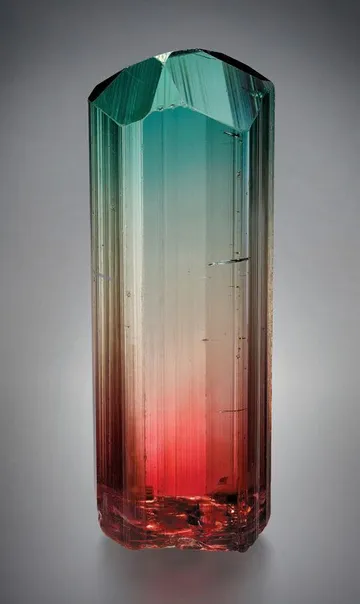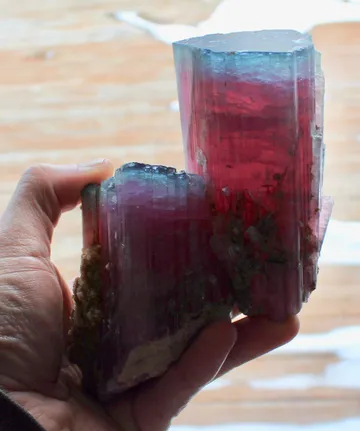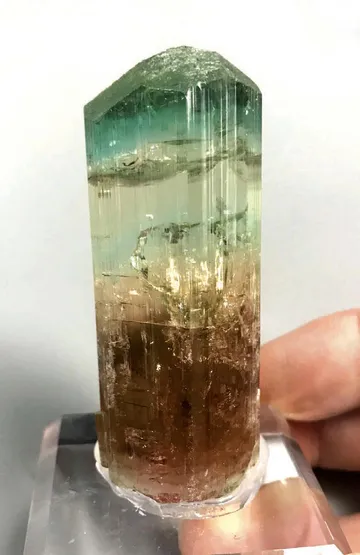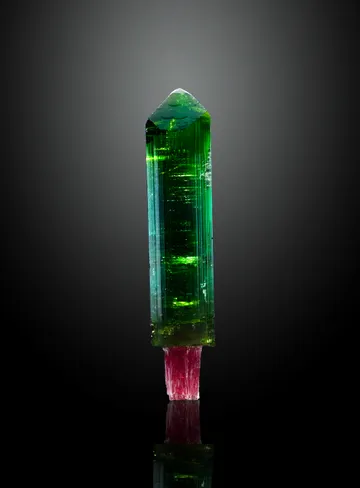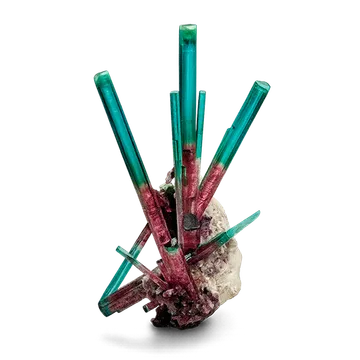
Rubaya tourmaline, North Kivu, DRC, elbaite crystals with glassy luster, sharp terminations, and vivid pink to green colors prized by serious collectors.
Key facts
Rubaya has become one of the most compelling modern names in collector tourmaline: a North Kivu pegmatite district better known to the wider world for coltan, yet capable of producing astonishingly clear, sharply formed elbaite crystals in pink, red-pink, green, bluish green, peach-brown, and bi- to tricolored zoning. The best specimens have the immediate visual language collectors prize in tourmaline: glassy luster, transparent prisms, clean color transitions, and complex, crisp terminations that look more like carefully cut gemstones than minerals recovered from lateritic pits.
The locality is properly placed at Rubaya, Bahunde, Masisi Territory, North Kivu, Democratic Republic of the Congo, with the specimen-producing area commonly discussed as Rukaza-Rubaya within the broader Rubaya mining district. Older dealer labels often used “Goma,” not because the crystals came from the city, but because Goma is the principal commercial gathering point for gem rough and mineral specimens moving out of North and South Kivu. For serious collectors, that distinction matters: “Goma” is a trading label; “Rubaya” or “Rukaza-Rubaya” is the meaningful mineral locality.
Mineralogically, the material is principally elbaite, with published work describing a modest liddicoatite component and iron and manganese as the main chromophores in the Masisi/Rubaya stones studied. The geological setting is a lithium-bearing granitic pegmatite environment within the broader Kivu metallogenic province, a region where rare-metal pegmatites and related deposits carry cassiterite, columbite-tantalite, microlite-group minerals, cleavelandite, lepidolite, quartz, and tourmaline. This is not a classic open-pocket, matrix-specimen locality in the manner of Pederneira or Stak Nala. Rubaya’s reputation rests mainly on loose, individual crystals recovered from artisanal workings in laterite and pegmatite, many of which entered the gem trade before collectors realized how good the intact crystals could be.
The modern collector story begins in the mid-2010s. Since about 2014, Rubaya-area workings have produced transparent, gemmy tourmaline crystals of unusual color variety. The 2017 Journal of Gemmology report on Masisi tourmaline records a sharp improvement in output during 2017, when mining ventures began targeting gem tourmaline rather than treating it merely as a by-product of industrial-mineral work. Early 2017 production included tricolored crystals with green, pale yellow, and brownish pink zones, and bicolored crystals in light and dark green. Later that year, production shifted toward “peachy” or brownish pink and pale brownish green material, with some large clean pieces of facet-grade rough and fine crystal specimens.
For the specimen collector, Rubaya’s appeal is highly specific. The finest crystals can combine true gem transparency with naturally terminated, lustrous prism faces, and some show the kind of watermelon-like zoning that is often lost when rough is cut. High-quality Rubaya tourmaline is therefore fought over by two markets at once: cutters who see clean grams of elbaite, and mineral collectors who see a contemporary classic locality still young enough to be underrepresented in many advanced cabinets.
Search for specimens: View all tourmaline specimens from Rubaya, Dr Congo
Rubaya is a mining town and district in Bahunde, Masisi Territory, North Kivu, in the highlands northwest of Lake Kivu. The district is internationally known for coltan and cassiterite production, but the Rukaza-Rubaya tourmaline occurrence has made it important to mineral collectors as well. Mindat records the locality as Rubaya, Bahunde, Masisi Territory, North Kivu, DR Congo, and notes historical or alternative locality usage including the Rubaya mines, Lowowo/Luwowo, and the Bibatama Mining Concession.
The tourmaline deposit is pegmatitic. The workings consist of numerous artisanal pits, trenches, and short tunnels dug through laterite, in places reaching unaltered pegmatite dyke material. This lateritic setting helps explain why many specimens reach the market as loose crystals rather than as crystals standing on matrix. Associated minerals recorded for the Rubaya locality include albite, cleavelandite, quartz, lepidolite, microlite-group minerals, cassiterite, and columbite-tantalite, a paragenesis consistent with a rare-metal, lithium-bearing granitic pegmatite system.
The broader Kivu Belt is a major tin–tantalum–niobium metallogenic province. In the Masisi district, published regional geological reviews describe host rocks of K3 and K4 units, NW-SE structural trends, granitic intrusions likely related to the G4 granite group, and mineralization dominated by cassiterite, columbite-group minerals, wolframite, and tourmaline. Rubaya’s tourmaline should be understood within this larger rare-metal pegmatite and tin-granite context rather than as an isolated gemstone curiosity.
Mining is overwhelmingly artisanal. In the Rubaya mining area, work has long focused on coltan and cassiterite, with tourmaline recovered both as a by-product and, during productive windows, as a targeted gem and specimen commodity. The Rukaza-Rubaya tourmaline site has produced gemmy crystals since about 2014, while the broader Masisi tourmaline rush documented by IPIS and SaveActMine saw major surges in artisanal activity during 2014 and 2015. The Journal of Gemmology report records a further step change in 2017, when new ventures specifically targeted gem tourmaline in the Rubaya area and produced tens of kilograms of transparent rough and crystals in several color styles.
Collecting access should be considered effectively closed to normal recreational collectors. This is an active artisanal and commercial mining district in a conflict-affected part of eastern DRC, not a fee-dig locality. Permission, mineral rights, safety, security, and chain-of-custody questions are all serious. Since April 30, 2024, Rubaya and the surrounding mining area have been reported by United Nations experts and international news agencies as controlled by AFC/M23. AP reported the seizure of Rubaya in May 2024, and subsequent reporting described the rebel group’s revenue from the area’s mineral production. AP also reported a catastrophic January 2026 landslide at the Rubaya mines, with rebel authorities saying at least 200 people were killed and mining temporarily halted after heavy rains caused collapses.
For collectors, the practical route to Rubaya tourmaline is therefore through vetted dealers, established auctions, and documented old stock. The market has seen waves of material labeled Rubaya, Rukaza-Rubaya, Masisi, North Kivu, or formerly Goma. Labels should be read critically: “Goma” may indicate a trading point, while “Rubaya” or “Rukaza-Rubaya” is the desired locality attribution for these high-quality modern elbaites.
Notable finds include sharp, gemmy single crystals up to 15 cm, fine bicolored and tricolored crystals, rubellite-red examples, and rare clusters. Most Rubaya specimens are singles; matrix examples and undamaged clusters are significantly less common. A documented Heritage Auctions specimen sold in October 2024 measured 5.1 x 3.0 x 2.7 cm and weighed 69 grams, with deep red-pink color and transparency strong enough that the auction description emphasized being able to read through the crystal. A Minfind listing from Marin Minerals documented a much larger pink tourmaline cluster measuring 130 x 45 x 35 mm and weighing 310 grams, notable specifically because cluster-form Rubaya material is far scarcer than single crystals.
Rubaya tourmaline is valued first for crystal quality. The best specimens are transparent to highly gemmy elbaite prisms with bright glassy luster, sharp vertical prism faces, and well-developed terminations. Some crystals are singly terminated, others doubly terminated, and the better pieces may show complex termination geometry with multiple terminal faces rather than a simple flat cap. Dealers and auction descriptions repeatedly emphasize sharpness: “very sharp crystal forms,” “excellent terminations,” and “rich in terminal faces” are recurring observations on documented specimens.
Color is one of the locality’s strengths. Pink to rubellite-red crystals occur, including wine-red and saturated red-pink specimens. Green material ranges from pale green through bright green to bluish green. Bicolored crystals may show green bodies with pink caps, pink lower prisms with pale green terminations, or green-to-pink transitions separated by pale yellow zones. Tricolored crystals from the 2017 production were described as green, pale yellow, and brownish pink; other material from the same year shifted toward peachy or brownish pink and pale brownish green. The most desirable specimens combine crisp crystal form, clarity, and attractive zoning rather than merely strong color.
Typical collector specimens are thumbnail to miniature size, commonly a few centimeters long. Mindat records loose crystals up to 15 cm from the locality. Published and dealer-documented examples include crystals around 2.1 cm, 3.4 cm, 4.2 cm, 5.0 cm, 5.5 cm, 6.0 cm, 7.1 cm, and larger cluster material exceeding 10 cm. Clean, sharply terminated crystals above miniature size are notably more desirable because many crystals are either damaged during mining or diverted into cutting rough.
Rubaya specimens are usually not matrix pieces. The site mainly yields loose crystals, rarely with minor quartz, albite var. cleavelandite, lepidolite, microlite, and cassiterite. This matters to grading: a superb single, complete all around, can be a top specimen even without matrix. Conversely, a matrix specimen or natural cluster from Rubaya deserves extra attention, provided it is not repaired or assembled.
The quality factors are straightforward but unforgiving. Look for full termination, uninterrupted prism faces, strong luster, clean transparency, pleasing color distribution, and undamaged basal or contact areas. Along the c-axis, fine red-pink crystals can show especially intense color. In multicolored pieces, the best examples have readable internal zoning without being too dark or cloudy. A crystal that is both gemmy and sculpturally complete is far more important than a slightly larger but bruised or opaque piece.
Condition is a major issue. Mindat notes that many crystals are damaged directly on the excavation face because miners are focused on gem rough rather than intact specimens. Rubaya tourmaline may show bruised terminations, nicked prism edges, basal breakage, internal stress cracks, repaired side crystals, or restoration around termination edges. Because the crystals can be very transparent, even small chips and repairs are visible. The most advanced collectors prize undamaged crystals because they are a minority of what the locality can produce.
Rubaya tourmaline is a modern classic in the making, but it is also a locality where disciplined buying matters. The first question is the label. Pieces historically sold as “Goma” may be Rubaya/Rukaza-Rubaya, because Goma functioned as a commercial confluence point for Kivu tourmaline rough. That does not make every “Goma” tourmaline a Rubaya specimen. Serious labels should ideally name Rubaya, Bahunde, Masisi Territory, North Kivu, DR Congo, and older labels should be preserved rather than rewritten without documentation.
The second concern is conflict sourcing. Since 2024, Rubaya has been prominent in international reporting not only as a mineral locality but as a rebel-controlled coltan district. Collectors should ask dealers when the specimen entered the market, whether the piece is old stock, whether the chain of custody is known, and whether the dealer has a stated policy on high-risk DRC material. Specimen collecting cannot solve the region’s political crisis, but collectors can avoid treating locality data as merely decorative. For Rubaya, provenance is part of the specimen.
There is no widely documented class of fake “Rubaya tourmaline” analogous to manufactured matrix jobs from some historic localities, but misattribution is a real risk. Similar-looking elbaite from other pegmatite districts can be relabeled as Congo or Rubaya, and older “Goma” labels can be overinterpreted. Because many Rubaya crystals are loose singles, locality verification often depends on dealer reliability, acquisition history, and comparison with known production styles rather than matrix geology.
Treatment is also mainly a disclosure issue. Tourmaline is commonly cut, polished, repaired, oiled, or cleaned in the broader gem and mineral trade, and Rubaya crystals are no exception. Documented specimen-market issues include repairs after cleaning and restoration around termination edges. Iron-staining removal can improve appearance but may also reveal or cause weaknesses in fractured crystals. Always inspect terminations, side crystals, and basal areas under magnification, and look for adhesive lines, mismatched luster, unnatural joins, or over-cleaned surfaces.
The best Rubaya pieces are not abundant. Small gemmy thumbnails appear with some regularity, but large, complete, highly transparent crystals with undamaged terminations are scarce. Clusters are much rarer than singles. Market availability is active but uneven: modest thumbnails may sell at accessible prices, while exceptional miniatures and small-cabinet specimens can reach thousands of dollars. A documented Mineral Auctions thumbnail from Rubaya sold for $220 in October 2024, while dealer and auction records show high-end miniature and cluster specimens priced or sold in the four- to five-figure range.
For a collection, Rubaya is strongest when represented by a crystal that could not be mistaken for ordinary pegmatite tourmaline: transparent, lustrous, sharply terminated, and visibly zoned. A small perfect crystal is preferable to a larger bruised one. If the piece is pink-red, look for even saturation and transparency; if green-pink, look for clean zoning and a complete termination; if tricolored, avoid pieces whose pale yellow or brownish zones make the whole crystal look muddy. The locality rewards connoisseurship more than size alone.
The Rubaya story is inseparable from the Kivu highlands. In the 2015 IPIS and SaveActMine fieldwork, the route into the Masisi tourmaline country read less like a mineral excursion than a logistical test. From Goma, the research team drove about 60 km by 4x4 into the Masisi highlands toward Ngungu. The way was marked by official roadblocks: Mubambiro at 23 km, Sake at 25 km, and Karuba at 36 km. At Sake, vehicles had to stop, produce papers, and pay; the report records 3,600 Congolese francs paid there. In rainy season, the road could deteriorate so badly that the final approach near Ngungu was practicable only on foot or by motorbike.
Beyond the road, the work became a climb. From Ngungu, access to the Rwangara/Shakubangwa tourmaline site documented by IPIS required a 6 km motorbike ride to Luzirantaka village, then a one-hour walk following the Luzirantaka River to a hilltop at 2,719 meters elevation, roughly another 5 km. There was a support village about half a kilometer from the mine, a place for commerce and domestic life beside the digging. Below the site, along the river, bags of sand were carried down to be washed by women. The landscape was not merely a mine: it was a temporary economy draped over a highland slope.
The 2014 rush was remembered locally as “the Boom.” During that burst of activity, the site drew an estimated 400 to 700 artisanal workers and perhaps 3,000 to 4,000 dependants, with hundreds more people trading stones. It was a chaotic rush driven by tourmaline prices and the contraction of the 3T mineral economy after the 2010 presidential mining ban. By September 2015, the fever had cooled. Digger numbers had reportedly fallen from around 700 to around 100, and on the day of the IPIS team’s midweek visit only about 50 to 60 diggers appeared to be working. Washerwomen had dropped from an estimated 300 during the boom to about 20.
The Boom also had a darker rhythm after sundown. IPIS recorded reports that in 2014, night exploitation took place with involvement from the Mining Police, POLIMINES. The point of the after-dark work, as relayed to the researchers, was to gain access to the most productive pits and collect the best stones. The arrangement caused conflict between POLIMINES and pit captains, and earlier that year there had reportedly been incidents after the killing of a miner. Local stakeholders told the research team that talks with the TUUNGANE cooperative helped resolve the problem, and that a new POLIMINES contingent deployed in December 2014 ended the night exploitation.
By the time the Journal of Gemmology report appeared in 2017, the specimen and gem markets were beginning to see what Rubaya could do when tourmaline was mined as a target rather than merely stumbled upon. Rough dealer Farooq Hashmi, who traveled to Gisenyi in Rwanda in late 2016 and 2017, reported that new Rubaya-area mining ventures in mid-2017 produced several kilograms of crystals in June, many tricolored or bicolored. From late June through August, more tricolored crystals appeared, along with bluish green material. The report notes “some tens of kilograms” of production and many crystals with excellent transparency. The largest clean pieces weighed around 100 grams. Then September shifted the palette: peachy to brownish pink, pale brownish green, and later darker tones, with several kilograms of mostly facet-grade material in September and October. Some was destined for cutting; some escaped as fine crystals.
One of the most telling collector details is not a mining scene but a market consequence. Rubaya crystals are so clean that they are perpetually at risk of becoming gemstones. Mineral Auctions described a small Rubaya elbaite from a COVID-period find as rare and valuable because so many such specimens had been cut and “would continue to be cut if they fell into the wrong hands.” That is the collector’s paradox of Rubaya: the same clarity that makes the crystals beautiful as minerals makes them vulnerable to the saw.
The wider Rubaya mining district entered a new and grim chapter after April 30, 2024, when AFC/M23 took control of Rubaya town and the mining area. International reporting shifted from gem crystals to coltan, taxation, smuggling, child labor, and rebel financing. Reuters described men in rubber boots carrying sacks of crushed ore up winding hillside paths under the watch of M23 rebels in March 2025. AP later reported that a January 2026 landslide collapsed several mines at Rubaya after heavy rains, with rebel authorities saying at least 200 people were dead, some still unrecovered in the mud. A former miner told AP that tunnels were dug by hand, poorly built, and left without maintenance; in a single pit, he said, there could be as many as 500 miners, and parallel tunnels meant one collapse could affect many pits at once.
That is the landscape behind the beautiful crystals. A Rubaya tourmaline in a collector’s case can be a transparent pink-green prism, all luster and zoning. It also comes from one of the most complicated mineral districts on earth, where rare-metal pegmatites, artisanal labor, gemstone ambition, and conflict-mineral politics occupy the same ground.