Reel Mine, USA — NC amethyst locality famed for cabinet-quality amethyst sprays, smoky quartz, and sharp three-dimensional clusters prized by collectors.
Key facts
Reel Mine, better known to generations of collectors as the Reel Amethyst Mine, is the classic North Carolina amethyst locality near Iron Station in Lincoln County. Its importance is not mineral diversity but excellence: a compact assemblage centered on quartz, smoky quartz, and amethyst, with beryl also recorded, from a Piedmont crystalline-rock setting where open spaces in weathered quartz-bearing zones produced lustrous crystals rather than merely lapidary quartz. In a state crowded with famous gem localities, Reel stands out because its finest pieces are true cabinet minerals—sharp, glassy, three-dimensional sprays and “corsage” clusters of purple quartz, commonly with smoky zoning or smoky companion crystals, rather than flat geode plates or massive vein amethyst.
The mine sits in the Iron Station–Lincolnton part of the North Carolina Piedmont, an area better known historically for iron than for gem quartz. That contrast is part of the locality’s appeal: the surrounding county has deep iron-mining history, while Reel became famous for a very different product—collectible amethyst. Published mineral records place Reel firmly among the notable American amethyst sources, and John S. White, former Smithsonian curator of minerals and gemstones, is repeatedly associated with the judgment that this locality produced the finest amethyst cluster ever discovered in North America. The celebrated 1972 cluster, long displayed by Grandfather Mountain, fixed Reel in the collector imagination: an American amethyst specimen large enough for a museum centerpiece, yet from the same locality that later yielded hand-sized clusters to club collectors and, more recently, carefully extracted specimen pieces from active private mining.
Regional View
Country View
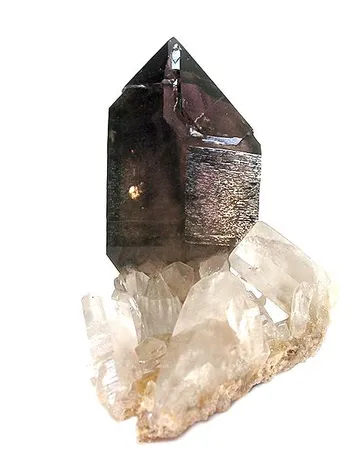
The look of a good Reel specimen is distinctive. The best crystals are not simply purple; they have a lively mixture of transparent to translucent interiors, rich purple caps or cores, smoky overtones, and satin-to-glassy faces. Some clusters form compact bouquets of upright points. Others are intergrown smoky quartz and amethyst, where the smoky body of the crystal carries a purple termination or interior flash. Matrix specimens are especially desirable because so much material from clay pockets comes out as single crystals or loose groups; pieces showing amethyst still attached to quartz-rich or granitic-looking matrix have a much stronger sense of place and are harder to replace.
Search for specimens: View all specimens from Reel Mine, USA
Reel Mine is at Iron Station, Lincoln County, North Carolina, near Alwood Lane and Timber Road, on private land in Ironton Township. Mindat records the locality as Reel Mine, also historically called Reel Amethyst Mine, at approximately 35.45833, -81.11694. County planning documents from 2013 describe the old Reel Amethyst Mine property as a 62-acre parcel on the east side of Timber Road, about 1,000 feet south of Reinhardt Circle, surrounded chiefly by residential land uses.
Geologically, Reel is best understood as a specimen-producing amethyst pocket mine in the crystalline Piedmont rather than an ore mine. The regional mapping around Iron Station shows Paleozoic-or-older crystalline rocks dominated by combinations of mica schist, granite, granite-and-mica-schist units, and related mafic to intermediate rocks in Lincoln County. Mindat places the locality within the broader Carolina terrane framework. At the collecting scale, the important “ore body” is not metallic ore but amethyst-bearing quartz pockets and seams in weathered crystalline rock and clay. Field collectors repeatedly describe productive ground as sticky clay, mud seams, pocket clay, quartz-rich zones, and hard rock requiring pick, sledge, jackhammer, pry bar, and very patient extraction.
The mineralization is simple but high quality. Quartz is the principal species, expressed as colorless to smoky quartz and as amethyst. The amethyst is documented as light purple to smoky purple, with hexagonal-trigonal quartz habit, and the best examples show glassy sharp crystals, purple terminations, smoky interiors, and cluster forms attractive enough to compete with more famous American amethyst localities. Beryl is also recorded from the mine, but it is a subordinate collector’s mineral here; Reel’s reputation rests overwhelmingly on quartz-variety specimens.
The earliest mineralogical literature cited for Reel amethyst reaches back to F. A. Genth’s nineteenth-century work on North Carolina minerals, showing that amethyst from the Iron Station area had entered the formal mineral record well before the modern collecting era. The named Reel Amethyst Mine operation is described by the present mine operators as having been founded by the Reel family in the 1940s, after which the locality became widely known through major discoveries and decades of collector access.
The history of access has changed several times. In the club-dig era, the Mountain Area Gem and Mineral Association played a major role in reopening and working the site. A Lincoln County conditional-use permit approved in 2009 limited digs to MAGMA members, required advance county notification, liability insurance, controls on parking, sanitation, camping away from neighbors, and restoration work after digs, and capped events at no more than 150 participants per day and no more than four weekends per year. In 2013 the owner, Frances Sutphin, applied to amend the permit after MAGMA ended its participation, seeking to allow other groups and individuals and up to one weekend dig per month.
The property was later acquired by James Hall in 2016. Reports from mineral clubs and the present Mine Wisteria website describe a private operation, renewed specimen mining, and a new chapter for the historic property. Public access should not be assumed. Mine Wisteria announced a limited 2026 reopening effort under the Wisteria Amethyst Reserve name, but its current public messaging also states that there are no public digs until further notice. Serious collectors should treat Reel as private property and rely only on direct permission from the operator, not old club-trip notes, old fee-dig listings, or third-party rockhounding maps.
The notable finds are the reason the locality remains important. The 1972 museum cluster, widely described as 2 feet by 2 feet by 1 foot and roughly 165 pounds, is the signature piece. More recent accounts under James Hall’s ownership describe remarkable pockets since 2016, donated specimens displayed at institutions including the Smithsonian Institution, the University of Arizona Alfie Norville Gem & Mineral Museum, the Mim Museum, and the Maine Mineral & Gem Museum. A 2025 club-meeting report described one 8-foot-long pocket with a spectacular matrix specimen at its lower end, removed carefully and later displayed in an Arizona museum lobby. Earlier field accounts from the club-dig period show that even hand collectors could hit memorable clay seams: chains of fist-sized amethyst clusters, dense crystal bands in sticky clay, and matrix pieces that rewarded slow work far more than casual surface scratching.
Quartz from Reel Mine is the structural and visual host of the locality’s amethyst story: colorless, smoky, and amethystine quartz occur as sharp prismatic crystals, compact clusters, and mixed smoky-amethyst groups from clay pockets and quartz-rich seams in weathered crystalline rock. The most desirable non-amethyst quartz pieces are not ordinary massive vein quartz but lustrous smoky crystals with transparency, complete terminations, and three-dimensional form; a particularly strong Reel quartz specimen may show smoky bodies with purple amethyst zoning in the terminations or cores, doubly terminated individuals in small clusters, and minimal bruising despite having come from tight clay-and-rock pockets. Matrix pieces are scarcer and more expressive of the locality, especially where upright crystals remain attached rather than having been recovered as loose singles.
Amethyst is the defining mineral of Reel Mine and occurs as light purple to smoky purple quartz crystals, commonly in bouquet-like clusters, “corsage” groups, and pocket seams where crystals may be embedded in sticky clay or attached to quartz-rich matrix. Fine specimens are judged by color concentration in the terminations, transparency, luster, crystal completeness, and sculptural balance; the best pieces show rich purple faces or internal phantoms with smoky contrast, sharp undamaged points, and enough three-dimensional openness that each crystal can be read individually. Sizes range from small hand specimens and miniatures to cabinet clusters, with the locality’s legendary extreme represented by the 1972 museum cluster; for collectors, however, a smaller but pristine Reel cluster with saturated purple caps, glassy faces, and original matrix will usually outrank a larger bruised or dull piece.
Other minerals documented from Reel are few. Mindat records beryl, quartz, amethyst, and smoky quartz for the locality, and field-trip notices have also used the collector term “ironized quartz” for iron-stained quartz from the site. No type-locality mineral species are documented from Reel Mine; its significance is instead as a classic American amethyst locality where a narrow assemblage produced unusually strong specimen quality.
Reel Mine specimens are collectible enough that locality accuracy matters. The most common mislabelling problem is geographic: older labels may say only “North Carolina amethyst,” “Iron Station,” “Lincoln Co.,” or “Reel Amethyst Mine,” and some online listings confuse Reel with Statesville/Iredell County, with South Carolina amethyst localities, or with other southeastern amethyst sources. True Reel material should fit the known visual language of the locality—smoky to purple quartz crystals, often as compact clusters or clay-pocket specimens—and should ideally carry an old label, mine-owner provenance, club-field-trip provenance, or a credible dealer history.
Claims that the mine was operated by Tiffany & Co. circulate in the trade, but at least one modern gem source phrases that point only as a rumor. Treat “Tiffany” as color, not provenance, unless a specimen is accompanied by documentary evidence. Similarly, “old Reel Mine” can mean several different things in the market: pre-2016 collector material, MAGMA-era field-collected pieces, older Reel-family material, or newer specimens recovered under private operation. Those distinctions affect value.
Condition is the chief collecting issue. Many crystals came from clay pockets and hard rock, and extraction often involved heavy tools before delicate work could begin. Expect edge nicks, bruised terminations, contacted crystals, iron staining, and clay residues. A little iron oxide or tenacious pocket clay is normal and may even support locality character, but broken tips and sawed or heavily cleaned bases reduce desirability. On high-end examples, examine the terminations under strong light; small bruises on glossy purple caps are easy to miss in photographs but significant in hand.
Treatment concerns are the general amethyst concerns: heating can alter amethyst toward yellow, orange, brown, colorless, or occasionally greenish tones. I found no documented Reel-specific fake or treatment scandal, but collectors should be skeptical of oddly uniform color, suspiciously yellow “citrine” labels attached to Reel material, dyed-looking fractures, or polished crystals sold as natural specimens. Natural Reel amethyst commonly has uneven zoning, smoky-purple transitions, and color concentrated in terminations or internal growth zones, not a uniformly dyed appearance.
Fluorescence is not a major collecting feature for Reel quartz. Handling considerations are practical rather than chemical: quartz is durable, but clusters with exposed points should be boxed so crystals do not strike one another, and clay-pocket matrix can be more fragile than the quartz itself. Avoid aggressive acid or ultrasonic cleaning on matrix specimens unless you are prepared to risk destabilizing pocket clay, loosening crystals, or stripping the natural iron-rich surface character that many collectors expect from the locality.
Market availability is limited and uneven. Old club-collected pieces appear from private collections; modern mine-owner specimens appear selectively; and a small number of strong Reel pieces circulate through specialist auctions and East Coast collections. Ordinary singles and small clusters are obtainable, but top cabinet specimens with intense purple color, pristine terminations, smoky contrast, and matrix are scarce. The locality has produced enough material to be known, but not enough for fine examples to be casual purchases.
The great Reel story begins with the 1972 giant. On November 4, 1972, a massive amethyst cluster came out of the Reel Mine at Iron Station—reported in collector accounts as roughly 2 feet long, 2 feet wide, 1 foot high, and about 165 pounds. Its name-recognition comes not only from size but from judgment: John S. White, then one of the major voices in American mineral curation, is associated with the assessment that Reel produced the finest amethyst cluster ever discovered in North America. Grandfather Mountain later featured the piece as the largest North American amethyst in its mineral exhibits, and its 2021 annual report described a new Mineral Cave display where guests would be able to view the largest amethyst found in North America from different angles on a revolving display.
The club-dig era supplied a different kind of legend: not a single museum boulder, but the drama of a pocket opening under hand tools. In Troy Lancaster’s report from the May 27–29, 2011 MAGMA field trip, Reel did not behave like an easy tailings pile. He arrived to see people swinging sledgehammers and pickaxes, and veteran collectors told him, “you really want to get down to new unexposed material.” That advice became the whole method. He started with an old exploratory hole about 3 feet wide and 3 feet deep, then widened and deepened it by shoveling for an hour until it became a real working pit.
The first clues were not glamorous. He described sticky mud, sediment lines that looked as though they had been laid down by rainwater decades earlier, and even a preserved Royal Crown Cola bottle sealed in the mud. The productive layer lay just below that mud. Crystals began appearing intermittently—dark, glassy, and good enough that neighboring diggers stopped to watch. One rock that had blocked his progress for hours finally came free as a 10-by-5-inch piece, and when it did, it revealed amethyst crystals still attached to matrix. That is exactly the sort of find collectors hope for at Reel: not just loose points, but a specimen that still shows how the pocket grew.
Then the pocket became collaborative. Susan, working the same sticky zone, exposed a larger piece and asked for help. After about half an hour of careful work in tacky clay, a fist-sized cluster came out. Behind it was another flash of glass. The seam turned into a chain of amethyst growth in a mud vein, widening to about a 7-inch tube of dense clay with crystals running down its center. Troy removed rock above and alongside the vein while Ben, only a few feet away, kept chiseling through stubborn rock toward the same level.
By midday the pocket had become memorable enough for a nickname. Troy had exposed roughly 2 feet of densely packed crystal growth, and Susan said it looked like a “backbone made of amethyst.” At one point, about six fist-sized clumps were visible end-to-end in the clay. Troy worked lying on his side with bamboo sticks and screwdrivers, pausing only to hand out specimens, wrap them, or shovel away tailings. Ben, meanwhile, was head-down in his own hole at about a 50-degree angle, lying on solid rock and trying to meet the pocket from the side. It is a perfect Reel vignette: beautiful purple quartz, but only after hours of mud, rock, awkward posture, and stubborn excavation.
The modern private-mining chapter has its own quieter drama. In 2025, a mineral-club report summarized James Hall’s path to ownership as beginning with a collecting trip prompted by news that the Reel Mine might soon be sold. The sale did not happen week after week, but Hall’s enthusiasm caught the owner’s attention. A quick, unexpected negotiation followed, and Hall acquired the mine in 2016. Since then, reports describe careful hand work, museum interest sparked by Tucson appearances, and pocket reading refined enough that an 8-foot-long pocket yielded a spectacular matrix specimen at its lower end—removed carefully and later displayed in an Arizona museum lobby.