A collector's guide to Durham, USA: its geology, mining history and notable minerals, illustrated with the 45 specimens documented from this locality on EarthWonders.
Key facts
For mineral collectors, Durham means Durham, Middlesex County, Connecticut, and above all Reed’s Gap Quarry: an active trap-rock quarry cut into the Jurassic Holyoke Basalt along the western edge of town, close to the Wallingford line. It is not a great metallic ore camp and it is not a pegmatite gem mine in the classic New England sense. Its importance is more specialized and, in some ways, more interesting: a basalt quarry whose open fractures and hydrothermal fault breccias produced some of Connecticut’s most distinctive fluorite specimens—sharp green octahedra, commonly with calcite and quartz, in a basalt setting where fluorite is rare enough to feel surprising every time it appears.
The geological setting gives Durham its split personality. The town straddles the Eastern Border Fault of the Hartford Basin: Mesozoic rift-basin rocks, including Portland Formation sandstone and Holyoke Basalt, lie to the west, while metamorphic rocks and pegmatite-bearing uplands lie to the east. Collectors therefore encounter two quite different mineral worlds under one locality name. The classic EarthWonders-style Durham specimens, however, are overwhelmingly Reed’s Gap material: fluorite, quartz, calcite, hematite, fluorapophyllite-(K), prehnite, laumontite, and other low-temperature fracture minerals from basalt.
The best Durham fluorites are immediately recognizable to anyone who knows Connecticut trap-rock minerals. Instead of the cubic fluorite typical of many Mississippi Valley or English veins, Reed’s Gap fluorite is characteristically octahedral, light to medium green, and set on pale calcite or stubby white-to-clear quartz. Fine pieces show crisp, lustrous, gemmy octahedra scattered across a contrasting matrix; exceptional association pieces place the green fluorite on a lavender amethyst layer with golden calcite. Purple fluorite is also documented, mostly as massive material or microcrystals, and the locality is notable for blue fluorescence under ultraviolet light.
Regional View
Country View
Reed’s Gap has also become a reference point in Connecticut mineral literature because it compresses so much local geology into a single quarry face. The quarry exploits hard basalt for crushed stone, yet the collector interest lies in the narrow mineralized cracks, fault zones, and breccias that cross-cut that otherwise massive rock. Those fractures are not lavishly mineralized by world standards, but when they open just enough, they form specimen pockets with quartz, calcite, zeolites, fluorapophyllite-(K), datolite, hematite, and fluorite—a compact New England basalt assemblage with real locality character.
Search for specimens: View all specimens from Durham, USA
Durham, in collector usage here, is best treated as the Durham, Connecticut locality group centered on Reed’s Gap Quarry, also known historically as the New Haven Trap Rock quarry and as Tilcon’s Durham or Wallingford quarry. The quarry lies mostly in Durham, Middlesex County, though its office address and some historical references place it with Wallingford, New Haven County. That border ambiguity is common on labels and should not automatically be read as an error; “Reed’s Gap Quarry, Durham” and “Tilcon Wallingford quarry” can refer to the same quarry complex.
The deposit is a basalt-hosted fracture and hydrothermal mineral occurrence rather than an ore deposit. Reed’s Gap is a trap-rock quarry in Jurassic Holyoke Basalt, a resistant ridge-forming lava unit of the Mesozoic Hartford Basin. Durham itself sits at a geological hinge: Hartford Basin sedimentary and volcanic rocks on the west, and the Eastern Uplands’ metamorphic rocks and pegmatites on the east. That is why the town’s mineral list contains both basalt-fracture species such as fluorite, calcite, laumontite, prehnite, and fluorapophyllite-(K), and pegmatite species such as beryl, microcline, muscovite, schorl, fluorapatite, and columbite-tantalite series material.
At Reed’s Gap, the collectible mineralization occurs in thin open cracks, fault zones, and a cross-cutting hydrothermal fault breccia, not primarily in vesicles. This distinction matters: many Connecticut basalt localities are zeolite-amygdale localities, where minerals line gas cavities in basalt. Reed’s Gap does have zeolite and related low-temperature minerals, but its reputation rests on fluorite and calcite in fracture-controlled settings. The basalt itself is dominated by fine-grained rock-forming phases, and most quarry production is ordinary crushed stone; the specimen pockets are a minor, erratic byproduct exposed only when blasting intersects favorable fractures.
The quarrying history is tied to road metal and construction stone rather than specimen mining. Durham’s older stone industry included brownstone and freestone quarries, with local brownstone used for gravestones, churches, town buildings, and foundations. The Reed’s Gap “bluestone” or trap-rock quarry on Route 68 was started by the New Haven Trap Rock Company and later continued under Tilcon. Durham historical notes state that it was in operation at least by 1939, and possibly earlier: the town reports for 1928 and 1929 list Tidewater Trap Rock Company as an out-of-town taxpayer. Mindat’s locality summary likewise notes operation at least since 1939 and perhaps about a decade earlier under Tidewater Trap Rock Company.
Commercial production is still for aggregate, not minerals. Tilcon’s Wallingford/Durham quarry has supplied crushed trap rock, and rail and industrial references document stone traffic from Reed’s Gap. Collecting access today should be regarded as restricted. This is an active industrial quarry with blasting, heavy equipment, high walls, and private operating rules. Any collecting has historically depended on permission, organized visits, or relationships through mineral clubs; casual entry is neither appropriate nor safe. The safest assumption for modern collectors is that old collection pieces and authorized field-trip specimens are the legitimate channels.
The notable specimen finds are not recorded as a single named “pocket” tradition in the way collectors speak of English fluorite or alpine clefts, but the mineral styles are well documented. Brunet’s 1980 article on Connecticut Valley trap-rock ridges emphasized Reed’s Gap, describing green fluorite octahedra with quartz and calcite, octahedra to about 1/2 inch, larger broken crystals, and purple massive and microcrystalline fluorite. John Pawloski later recorded fluorite crystals to 1.6 cm in the Connecticut chapter of Fluorite: The Collector’s Choice. More recent collecting and specimen records document microcrystal associations, fluorescence, and attractive combination pieces, including fluorite with calcite, fluorite on amethyst, and quartz-rich fracture assemblages.
The eastern Durham pegmatites are a separate collecting story within the same town. The Mica Hills pegmatites and prospects, east of Mica Hill Road and around Cream Pot Road, are simple granite pegmatites intruding the Collins Hill Formation. They show mostly albite, microcline, quartz, and muscovite, with accessory beryl, almandine, schorl, fluorapatite, and columbite-tantalite series minerals. These pegmatites have produced less marketplace-recognizable material than Reed’s Gap fluorite, but they help explain why “Durham” labels can sometimes refer to very different mineral environments.
Durham fluorite is the signature collector species from Reed’s Gap Quarry, occurring chiefly as sharp octahedra in mineralized fractures and hydrothermal breccia within Holyoke Basalt. The classic crystals are light to medium green, commonly lustrous and translucent to gemmy, set with white-to-clear quartz and pale calcite; Brunet recorded octahedra to about 1/2 inch, while later Connecticut fluorite literature gives crystals to 1.6 cm. Purple fluorite is also documented, especially as massive material and microcrystals. The best pieces rise above ordinary locality examples by combining undamaged, well-separated green octahedra with strong contrast against calcite or quartz, and the rarest association pieces place fluorite directly on lavender amethyst with golden calcite on basalt matrix. Reed’s Gap fluorite also has a useful diagnostic feature for collectors: documented blue fluorescence under all ultraviolet wavelengths, making clean, intact, well-labelled examples especially appealing in a Connecticut fluorite suite.
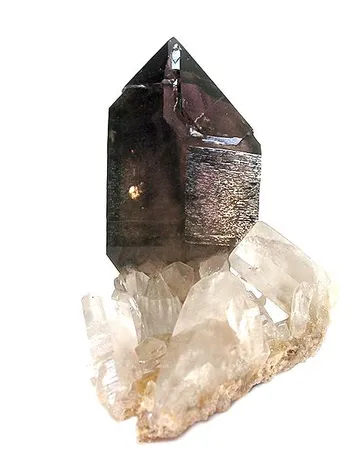
Quartz from Durham’s Reed’s Gap Quarry is usually not the showpiece species by itself, but it is essential to the locality’s best fluorite assemblages. Mindat records it as common at the site, with a white-to-clear color range and stubby prismatic habit; specimen-photo associations tie quartz especially to fluorite, calcite, hematite, fluorapophyllite-(K), stilpnomelane, anhydrite, babingtonite, analcime, pyrite, and goethite. The most collectible quartz-bearing pieces are not large standalone crystals but fracture plates where stubby quartz provides a sparkling base for green fluorite octahedra or where amethyst adds a soft lavender layer beneath fluorite and calcite. Good Durham quartz specimens therefore earn their place by association, contrast, and locality specificity: a crisp basalt-fracture assemblage with fluorite is far more desirable than a detached or featureless white quartz mass from the same quarry.
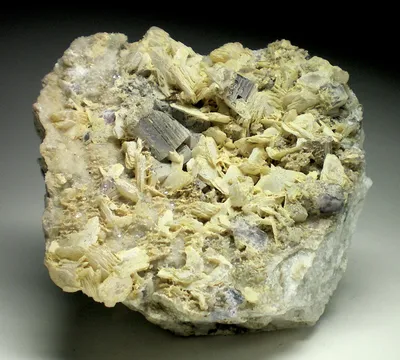
Other documented Durham minerals broaden the locality beyond fluorite and quartz. At Reed’s Gap, collectors should know calcite, fluorapophyllite-(K), prehnite, laumontite, chabazite or phacolite-style material, datolite, babingtonite, analcime, aragonite, pyrite, chalcopyrite, hematite, goethite, stilpnomelane, titanite, and possible inferred anhydrite from pseudomorphs. The laumontite is recorded as flesh-colored to pink, splintery, matchstick-size crystals in vugs and veins, with one reported 10 by 6 inch specimen associated with prehnite. Fluorapophyllite-(K) is another noteworthy basalt-fracture mineral here, occurring in small colorless, pale pink, white, or pale yellow crystals and aggregates, commonly with calcite and datolite. Away from the basalt quarry, Durham’s Mica Hills pegmatites add beryl, schorl, fluorapatite, microcline, muscovite, almandine, albite, and columbite-tantalite series minerals; the beryl may reach several decimeters but is generally pale and poorly crystallized rather than gemmy. No Durham type-locality mineral is part of the locality’s collector reputation; its importance lies instead in an unusually good Connecticut basalt fluorite occurrence and its mixed basalt-and-pegmatite town geology.
The first authenticity issue is locality precision. “Durham” alone is not enough on an old label: it may mean Durham, Connecticut; County Durham, England; Durham County, North Carolina; or simply a broad regional shorthand. A strong label should say Reed’s Gap Quarry, New Haven Trap Rock quarry, Tilcon Durham quarry, or Durham, Middlesex County, Connecticut. Labels that say Wallingford are not automatically wrong because the quarry sits near the Durham-Wallingford boundary and has been administratively associated with a Wallingford address, but the specimen style and any old label chain should be checked carefully.
The second issue is species and habit. Reed’s Gap fluorite is characteristically octahedral and green, with purple material documented mostly as massive or microcrystalline. Large cubic fluorite, deeply saturated English-style green cubes, or Illinois-type purple cubic groups should be viewed skeptically if labelled simply “Durham.” Conversely, small green octahedra on calcite, quartz, amethyst, or basalt matrix fit the locality much better. As with many trap-rock localities, micro-minerals and pale apophyllite/calcite lookalikes can be confused; carbonate testing, crystal habit, and careful microscopy matter on small pieces.
Condition is critical. Fluorite octahedra have exposed points and edges, and basalt matrix can be heavy relative to the crystals it carries. Chipped octahedral tips, rubbed edges, cleaved corners, and bruising from quarry blasting are common. Calcite on Durham pieces may be etched, cleaved, or contacted; quartz plates may be sawed or broken from tight fractures. Matrix specimens should be judged by whether the fluorite crystals remain sharp and readable, not by whether the basalt base is rugged or incomplete.
Fluorescence is a positive feature but should not be the only identification criterion. Reed’s Gap fluorite is documented as blue under ultraviolet wavelengths, and calcite from the locality is recorded as magenta under UV, strongest under midwave. That combination can make a specimen lively in a UV display, but ultraviolet response varies with coatings, matrix, and viewing conditions. Avoid prolonged unnecessary UV exposure to labels and use eye protection with shortwave or midwave lamps.
Market availability is modest. Durham fluorite appears often enough that dedicated Connecticut collectors can find examples, but fine, undamaged matrix pieces are not abundant. The most desirable specimens have sharp green fluorite octahedra, visible quartz or calcite association, good contrast, old or field-trip provenance, and a specific Reed’s Gap/Tilcon Durham label. Amethyst-associated fluorite from the quarry is notably scarcer than ordinary fluorite-calcite pieces and deserves special attention when well preserved. Quartz-only pieces from Durham are generally less competitive unless they carry a strong fluorite, amethyst, fluorapophyllite-(K), or other basalt-fracture association.
Durham’s stone history begins long before collectors cared about green octahedra in basalt. The town’s older quarries cut brownstone and freestone, and local accounts place one early brownstone site on the south side of Maiden Lane. John Johnson, Jr., who lived at 19 Maiden Lane from the Revolutionary War period until 1825, may have worked that stone into gravestones; Henry G. Newton’s history credited Johnson with making nearly all the freestone gravestones in the old graveyard. The stone was not just local building rubble. Durham freestone was thought superior to Portland brownstone, and the town’s quarries supplied foundations for familiar civic and church buildings: the North Congregational Church of 1847, the Town Hall of 1849, the old Methodist Church of 1836, and the Episcopal Church of 1862.
Another old quarry, on Haddam Quarter Road, was already more than 200 years old in local memory. Its stone traveled beyond Durham: one old Yale College building was reportedly built largely from that quarry stone, and stone from the same source went into the houses of Benedict Arnold and Pierre Pont Edwards of New Haven. For a mineral collector holding a Reed’s Gap fluorite today, that older brownstone story is useful context. Durham was a quarry town before Reed’s Gap became a specimen locality; the town’s geological identity was built one foundation block and gravestone at a time.
The most vivid failed mining dream belongs to mica. An August 18, 2004 Middletown Press article, quoting a hundred-year-old account, described a part of Durham known as Hemlock Ridge where mica had been known “for some years.” The plan was ambitious: a party of Ohio men came to Durham, arranged with Mr. Hull to lease the property, offered a stated annual rental plus 10 percent of profits, and intended to return the next week to erect “a big stamp mill” and put men to work mining mica. The practical result was far smaller. Roger B. Newton concluded that the operation was a dream that never materialized, and that he knew of only a small excavation off Mica Hill Road ever worked.
The coal story is stranger still. Durham historical notes recall drilling attempts in the south part of town where a steam engine and diamond drill were brought in to search for coal. The work produced something valuable, but not what the investors wanted: an excellent water supply. In a 1973 Durham History Committee recollection, coal was remembered on the John Steven’s property in a ravine beside the house near New Haven Road and Stagecoach Road. There was said to be a small mound of slack several feet high beside the stream. Samuel Loper dug fossils in the same ravine by pick and shovel, “tedious work” in the understatement of the record. At the J. Roger’s place, 1½ miles away, a coal-drill hole became the household water source; down under the hill, the pressure from the overflowing well was strong enough to reach the second floor of the Eick dwelling.
Against that older background, Reed’s Gap is the modern industrial survivor. The “bluestone” quarry on Route 68, on land in both Durham and Wallingford, was started by the New Haven Trap Rock Company and continued as Tilcon. The quarry was active at least by 1939, with hints of an earlier Tidewater Trap Rock Company presence in 1928 and 1929 town reports. Later rail photographs and railroad accounts show the quarry as a working aggregate source rather than a romantic abandoned pit: locomotives, stone trains, industrial switches, and crushed basalt moving out into Connecticut’s infrastructure. The collector specimens came from that practical world of blasting and crushing—green fluorite saved from a place built to turn basalt into road stone.
One particularly memorable collector episode is preserved in a 2020 auction record for a David Burgess collection specimen. The piece was not a giant: a 12.2 x 8.8 x 5.2 cm cabinet specimen from Reed’s Gap. Its charm was in the combination—dozens of sharp, lustrous, gemmy soft-green fluorite octahedra, up to 7 mm, sitting on gentle lavender amethyst with golden calcite on basalt. The auction house emphasized how rarely fluorite is seen on amethyst from Reed’s Gap. The bidding history shows the collector reality of a small but serious locality: a specimen that began at $10 climbed through repeated bids and closed at $336. For a locality that most casual collectors have never heard of, that is a useful market verdict.