A collector's guide to Foote Lithium Co. Mine, USA: its geology, mining history and notable minerals, illustrated with the 33 specimens documented from this locality on EarthWonders.
Key facts
Foote Lithium Co. Mine, better known among collectors simply as the Foote mine, is one of the defining American pegmatite localities: a lithium-tin-beryllium-niobium-tantalum pegmatite mine on the south side of Kings Mountain, Cleveland County, North Carolina, in the Carolina tin-spodumene belt. Its collector importance is not merely that it was a large open-pit spodumene operation, but that its unzoned, spodumene-rich pegmatite was later fractured, oxidized, and chemically reworked into one of the richest rare-phosphate assemblages in North America.
Geologically, the deposit belongs to the belt of Mississippian-age lithium pegmatites along the west side of the Kings Mountain shear zone. The pegmatites intrude amphibolite and mica schist and are famous for an unusually simple primary fabric—quartz, feldspar, spodumene, muscovite, accessory beryl, cassiterite, triphylite, and manganese-bearing fluorapatite—followed by a spectacular secondary mineral history in seams, joints, and vugs. That late history is the reason collectors know Foote for fairfieldite, bikitaite, fluorapatite, switzerite/metaswitzerite, kingsmountite, earlshannonite, mangangordonite, footemineite, ferraioloite, kayrobertsonite, whiteite-(MnMnMn), jasonsmithite, and many other rare species that reward a loupe or microscope as much as a display case.
The best Foote specimens have a very particular look: pale cleavelandite-albite and sugary quartz matrix carrying lustrous, cream-white fairfieldite blades; clear to white bikitaite laths on broad joint surfaces; sharp purple, lavender, green, brown, or bicolored fluorapatite crystals; pink to orange rhodochrosite in unusual rounded or saddle-like aggregates; and thumbnail-to-small-cabinet rare-phosphate plates that can look modest until magnification reveals a miniature forest of names rarely seen outside museum drawers.
Regional View
Country View
Historically the mine also matters because it helped move lithium production from hand-sorted exotic pegmatite minerals into large-scale industrial beneficiation of unzoned spodumene pegmatite. Mining began in the late 1930s, the Foote Mineral Company became the dominant operator after acquiring and reactivating the property, and the Kings Mountain operation became a cornerstone of the American hard-rock lithium industry through the mid-20th century. For collectors, those same decades opened fresh benches, fractures, and dump material that supplied the classic specimens now dispersed through private collections, museum holdings, micromount cabinets, and the market.


Search for specimens: View all specimens from Foote Lithium Co. Mine, USA
The Foote mine is a former open-cast Li-Sn-Be-Nb-Ta-mica-stone operation at Kings Mountain, Cleveland County, North Carolina. It sits within the Carolina tin-spodumene belt, a northeast-trending pegmatite province developed near the Kings Mountain shear zone, where lithium pegmatites occur in metamorphic country rocks including amphibolite and mica schist. The deposit is classically described as a swarm of tabular spodumene pegmatite dikes; at the mine, the largest dikes were reported as roughly 330 m long and 66 m thick, while many others were far smaller, commonly in the 6–33 m thickness range. The dikes strike generally north-northeast and dip steeply.
Unlike many collector pegmatites famous for graphic zoning, gem pockets, and giant segregations, Foote’s ore pegmatite is notably uniform. Published descriptions give a typical ore composition of about 41 percent feldspar, 32 percent quartz, 20 percent spodumene, 6 percent muscovite, and about 1 percent accessory and secondary minerals. The primary lithium mineral was spodumene, generally in medium- to very coarse-grained masses rather than gem kunzite-like crystals, with accessory cassiterite, beryl, triphylite, and manganese-rich fluorapatite. The lack of strong primary zoning and the high spodumene content are part of what made the deposit industrially attractive.
The collector minerals are mostly not products of the first igneous crystallization. They formed when the primary pegmatite was fractured, sheared, oxidized, and invaded by late hydrothermal fluids. Fractures through quartz, feldspar, and spodumene became small chemical laboratories: triphylite and fluorapatite supplied phosphorus and manganese; feldspar and spodumene supplied aluminum, lithium, calcium, and silica; sulfides, iron oxides, and wall-rock reactions supplied iron and other metals. The result was a highly localized assemblage of late phosphates, silicates, carbonates, zeolites, and oxides in seams and vugs. A dull chunk of pale pegmatite from the dumps can therefore carry, on a hairline crack, species that are type-locality minerals or near-best-of-species collector pieces.
Mining history at Kings Mountain begins with recognition of the spodumene resource in the early 20th century and mining operations in the late 1930s. Solvay Process Company operated the property and mill during the early 1940s; activity declined after World War II, and Foote Mineral Company acquired and reactivated the operation around 1950–1951, installing and renovating crushing and flotation facilities for spodumene concentrate. The mine and associated lithium operations became a major industrial landmark in Kings Mountain. Mining ceased in the late 1980s to early 1990s as brine-derived lithium became more economical, and the open pit later filled with rainwater.
The mine is now part of Albemarle’s Kings Mountain site. Albemarle has pursued redevelopment of the hard-rock lithium resource, including dewatering the open pit, environmental review, permitting, and planning for a concentrator facility. As of 2026 the property should be regarded as an industrial mine-redevelopment site, not a public collecting locality. Historical collecting came from active-mine access, old benches, and especially dumps; present-day collecting requires explicit permission from the owner and must be assumed closed unless arranged through proper channels. Older Foote specimens on the market are therefore increasingly important, especially with original labels from recognized collectors and dealers.
The most famous specimen-producing areas include oxidized dump boulders and fractured pegmatite from the East Dumps and other dump areas. Collectors have distinguished material that originated above the water table—more oxidized and often richer in colorful rare phosphates—from material believed to have come from below the water table, where rare silicates such as bikitaite and brannockite are more expected. Productive pieces are often not dramatic at first glance: a seam of white albite, a sugary quartz-feldspar fracture, a rusty phosphate-stained surface, or an altered spodumene lath may be the host for the entire specimen.
Foote fairfieldite is among the mine’s signature collector phosphates, most admired as cream-white to pale yellowish, translucent-to-lustrous bladed or platy crystal groups on albite, quartz, fluorapatite, and altered phosphate matrix; typical pieces are thumbnail or micromount scale, but exceptional Foote specimens have carried eye-visible aggregates in the centimeter range, including documented groups around 2 cm and a notable analyzed specimen with a main crystal group reported at about 2.5 x 2 cm. It occurs in the secondary phosphate assemblage of fractured spodumene pegmatite, commonly with fluorapatite and, in rarer assemblages, with eosphorite, hureaulite, mangangordonite, whiteite-group minerals, and other late Mn-Fe-Al phosphates. The best Foote fairfieldites are not just “present”: they show distinct crystal form, pearly to vitreous luster, separation from pale matrix, and attractive contrast with purple, green, or brown apatite; ordinary pieces may be granular, crusty, or visually lost in the white albite-quartz groundmass.
Bikitaite from Foote is one of the great surprises of the locality: a rare hydrated lithium aluminosilicate that here forms colorless to white, transparent to translucent lath-like, tabular, or bladed crystals on large flat joint surfaces and in late fractures of lithium-rich pegmatite, commonly with albite, quartz, fairfieldite, and fluorapatite. Published mineral references tie the Foote occurrence to the classic 1968 report of eucryptite and bikitaite from Kings Mountain, and collector descriptions consistently treat Foote as one of the finest localities in the world for crystallized bikitaite, with crystals commonly measured in millimeters but exceptional cabinet material showing blades up to about 2.9 cm on bikitaite-rich matrix with apatite crystals. Strong pieces show discrete, sharply bladed, lustrous crystals with good contrast and minimal breakage; weak examples are merely chalky white blades or indistinct cleavages that can be confused with albite without analysis or expert confirmation.
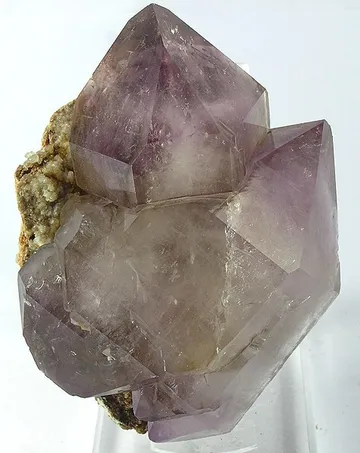
Foote fluorapatite occurs both as a primary accessory in the spodumene pegmatite and as later hydrothermal material along fractures and solution cavities, making it both an ore-stage clue and a collector species in its own right. Its habits at Foote are unusually diverse—equant, tabular, prismatic, euhedral to anhedral—and its color range is one of the mine’s visual pleasures: purple, lavender, mauve, sky blue, aqua, yellow, brown, pink, green-brown, and bicolored combinations are all documented from the locality. Good collector pieces tend to be thumbnail-sized plates or small matrix specimens with sharp hexagonal crystals, sometimes approaching 1 cm or more and commonly paired with fairfieldite, albite, quartz, or other phosphates; the best Foote apatites have clean faces, saturated lavender-purple or attractive two-tone color, and enough matrix context to separate them from the countless broken apatite fragments and altered phosphate grains in the pegmatite.
Rhodochrosite from Foote is a specialist’s pegmatite carbonate, prized less for the classic rhombs of ore deposits than for unusual habits in late cavities and fractures, including pink to orange, saddle-shaped, spherical, and botryoidal-looking aggregates on pale pegmatite matrix. Documented Foote specimens show pinkish-orange rounded groups to about 9 mm associated with white prismatic laumontite and tiny pyrite, and the literature records the locality specifically for saddle-shaped rhodochrosite crystals. It belongs to the same secondary fracture environment as siderite-rhodochrosite, fairfieldite, bikitaite, zeolites, pyrite, and altered phosphates; the best specimens show rich color, distinct rounded or saddle forms, and eye-visible groups on matrix rather than isolated damaged crusts, while ordinary pieces can be drab carbonate films easily overlooked or mislabeled as siderite.
Beyond these four, Foote is one of the premier type-locality mines for rare pegmatite phosphates and tin-bearing silicates. Type-locality or type-material species tied to the mine include switzerite and its dehydrated relationship to metaswitzerite, brannockite, eakerite, tetrawickmanite, kingsmountite, earlshannonite, mangangordonite, lithiomarsturite, footemineite, ferraioloite, kayrobertsonite, whiteite-(MnMnMn), fanfaniite, and jasonsmithite. Collectors also encounter eosphorite, hureaulite, vivianite, roscherite-group minerals, jahnsite- and whiteite-group species, mitridatite, birnessite, cryptomelane, bavenite, bertrandite, eucryptite, laumontite, analcime, milarite, holmquistite, pyrite, cassiterite, schorl, garnet, and altered spodumene-albite-quartz assemblages. Many of these require microscopic study, Raman or X-ray confirmation, or at least comparison with well-documented Foote material.
Foote is a locality where labels matter enormously. A specimen labeled merely “Kings Mountain” may refer to the Foote mine, the broader Kings Mountain district, or another nearby pegmatite occurrence; older labels may use “Foote Mineral Co.,” “Foote spodumene mine,” “Foote quarry,” “Kings Mountain mine,” or “Foote Lithium Co. Mine.” For rare species, the difference between a confident Foote attribution and a vague district label can be the difference between a reference specimen and a curiosity.
The main authenticity problem is misidentification rather than manufactured fakes. Many Foote phosphates are tiny, pale, intergrown, or visually similar: fairfieldite versus messelite/collinsite-like Ca-Mn phosphates; kingsmountite-group species versus other white to tan hydrated phosphates; rhodochrosite versus siderite-rhodochrosite; and rare species such as footemineite, ferraioloite, kayrobertsonite, whiteite-(MnMnMn), fanfaniite, and jasonsmithite that cannot be named responsibly by eye alone. Dealers sometimes note analyzed specimens, and that notation carries real weight here. For high-value rarities, ask what analytical method supports the name, whether the identified mineral is the visible showy phase or only a microscopic associated phase, and whether the specimen has a provenance trail to a known Foote collector.
Condition is another major issue. Many of the most desirable minerals occur on open fracture faces, so they are exposed to bruising, trimming scars, pocket clay, and old glue repairs. Fairfieldite blades can be cleaved or edge-chipped; bikitaite laths can be broken, scuffed, or confused with white matrix; fluorapatite may have contacted terminations; and rhodochrosite spheres or saddles often show natural contacts where the fracture closed. Under magnification, a “busy” Foote specimen may carry dozens of species, but the display value still depends on crispness, contrast, and freedom from pervasive iron staining or heavy matrix damage.
Foote is also a locality where ultraviolet response should be treated as an observation, not an identification. Some apatite and related material may respond under UV, but fluorescence varies, and many of the rare hydrated phosphates are non-fluorescent or inconsistent. Because numerous species are hydrated or occur as delicate microcrystals, specimens should be kept dry, stable, and away from aggressive cleaning. Avoid acids on carbonate- and phosphate-rich pieces, and do not soak friable altered pegmatite unless the matrix has already been tested.
Market availability is uneven. Fluorapatite, fairfieldite, bikitaite, metaswitzerite, and mixed rare-phosphate plates appear periodically from old collections, especially micromount and thumbnail material. Cabinet-quality bikitaite, large fairfieldite aggregates, fine purple fluorapatite thumbnails, and showy rhodochrosite are much less frequent. Type-locality species such as footemineite, ferraioloite, kayrobertsonite, whiteite-(MnMnMn), fanfaniite, and jasonsmithite are genuinely specialized; attractive, correctly identified examples are scarce, and many exist only as microcrystals on pieces whose value lies in documentation as much as aesthetics.
On November 10, 2013, collector-writer Jake Slagle met Jason Smith at the McDonald’s in Kings Mountain and followed him to the East Dumps, pushing roughly 200 yards through woodland briars and brush just west of Interstate 85. That detail captures Foote collecting better than any polished museum case: not a gem pocket opened in a pristine pegmatite wall, but weathered industrial boulders in the woods, each one potentially carrying a mineralogical surprise on a crack too small to see without a serious loupe.
Jason Smith was 36 at the time, a Charlotte geologist already recognized by collectors for his command of Foote rare phosphates. The account describes him as a collector who shared both sites and method, and as someone whose finds were routinely sent to scientists for verification. That habit—break, inspect, suspect, analyze—has become part of the modern Foote tradition. At a locality where the difference between a dull speck and a new mineral can be a few microns of crystal chemistry, collecting skill is inseparable from scientific humility.
The boulders in the East Dumps had reportedly come from above the mine’s water table. That mattered. Greater oxidation in those rocks produced the colorful, aesthetically pleasing rare-phosphate assemblages for which Foote became famous. Smith pointed out one boulder he had been working for several years; that single rock had yielded more than 40 mineral species. On another boulder that day, the notable species included beraunite, mangangordonite, rittmannite, jahnsite, cacoxenite, and strunzite. In some specimens, yellow cacoxenite coated straw-colored strunzite needles so completely that the resulting crystals looked like neither species at first glance.
The standout moment of the day was nordgauite. Smith was excited because it was only the second time in his life he had found it at Foote. At the time of the account, nordgauite was a relatively new IMA-approved species, and the only other reported locality was the Cornelia mine at Hagendorf, Germany. The description is wonderfully unglamorous and very Foote: white crystals resembling felted masses, found not in a dramatic crystal-lined cavity but in the microscopic fabric of an altered pegmatite boulder.
Smith also distinguished the East Dumps from the North Dumps. The North Dumps were said to contain boulders from below the water table and were more likely to host rare silicates such as brannockite and bikitaite, while still carrying phosphates that had experienced less oxidation. That practical field distinction—above-water-table boulders for oxidized phosphates, below-water-table boulders for certain rare silicates—helps explain why old Foote specimens can look so different despite sharing the same locality name.
The work itself was slow, physical, and unforgiving. Smith’s method was to attack large boulders with a chisel and small sledge, creating hundreds of smaller fragments that could be inspected. The crucial tool was not a big hammer but magnification: the account warned that anyone collecting without at least a 20x loupe and the knowledge to use it could expect to be skunked. The final impression was of a mine whose industrial benches had closed but whose dump boulders still contained lifetimes of mineralogical work—provided the collector had patience, permission, and eyes trained for the nearly invisible.