A collector's guide to Rampgill Mill, UK: its geology, mining history and notable minerals, illustrated with the 70 specimens documented from this locality on EarthWonders.
Key facts
Rampgill Mill is the collector’s name attached here to the Rampgill Mine and dressing-floor locality at Nenthead, on Alston Moor in Cumbria: a classic North Pennine lead-zinc-fluorite locality where mine archaeology and specimen mineralogy are almost inseparable. The deposit belongs to the Alston Block portion of the Northern Pennine Orefield, where mineralising fluids exploited faults and cross veins in Carboniferous rocks, especially the Namurian Great Limestone. At Nenthead those structures produced not only vertical veins but extensive “flats” — replacement and open-space bodies in altered limestone — rich in galena, sphalerite, ankerite, quartz, fluorite and barium minerals. For collectors, Rampgill’s signature is not one single species but a very particular architecture: hollow, sparkling quartz epimorphs after fluorite; pale yellow to colourless fluorite cubes; glossy black sphalerite; scattered galena; rusty-brown ankerite and siderite; and, in the barium-rich parts of the system, witherite and barytocalcite showing the North Pennines at its most idiosyncratic.
The locality also matters historically. The Rampgill Vein was discovered in 1690, and the mine became one of the principal workings of the London Lead Company’s Nenthead operation in the eighteenth and nineteenth centuries. Later, as the lead fortunes waned, Nenthead’s sphalerite — once an inconvenient waste mineral to earlier lead miners — became an ore in its own right under zinc-focused operators, notably the Nenthead and Tynedale Lead and Zinc Company and then the Vieille Montagne Zinc Company. The ore-dressing landscape, horse levels, shafts, smeltmill remains and workshops around Nenthead survive as one of Britain’s great mining-industrial landscapes.
Regional View
Country View
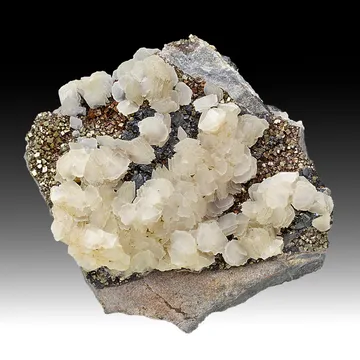
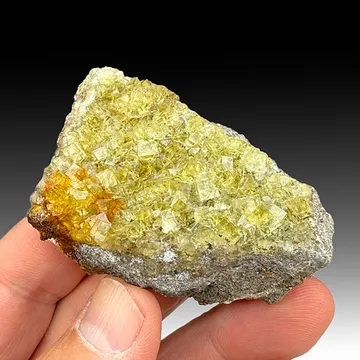
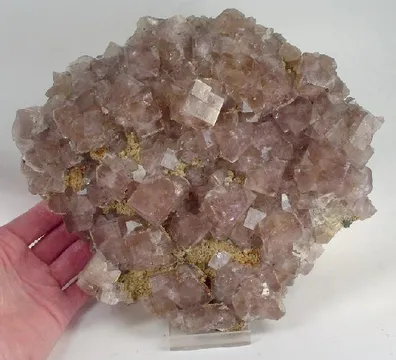
The best Rampgill specimens have a restrained, Northern Pennine beauty rather than the saturated colour of Weardale fluorite classics. A fine piece is often a small cabinet plate: quartz glittering over cubic voids left by dissolved fluorite, with lemon-yellow fluorite regrowths perched in the corners of those casts, black sphalerite for contrast, and tiny carbonate or iron-oxide overprints that tell the sequence of growth and dissolution. Larger plates from the Boundary or Bounder End Cross Vein can be dramatic, but the locality rewards close looking: aligned fluorite remnants, sharp boxwork casts, delicate sphalerite on quartz ribs, and the subtle earthy tones of ankeritized limestone.

Photo: Strickja / Wikimedia Commons

Photo: Strickja / Wikimedia Commons
Search for specimens: View all specimens from Rampgill Mill, UK
Rampgill lies at Nenthead, near Alston, in the upper Nent valley of Cumbria, within the Alston Moor mining district of the Northern Pennine Orefield. The collecting locality is best understood as part of the Rampgill Mine system, reached historically by the Rampgill Horse Level at about NY 782 435, with connections into Scaleburn, Rampgill and related workings. The modern “Mill” name reflects the dressing-floor and ore-processing landscape around the mine rather than a separate mineral deposit.
Geologically, Rampgill is a Pb-Zn-Ba-F hydrothermal system hosted largely by Carboniferous sedimentary rocks of the Alston Block. The most important specimen-producing horizon is the Great Limestone, where mineralised faults and cross veins were accompanied by flats: irregular to tabular zones of replacement, dissolution and open-space filling in altered limestone. In the Nenthead area, cross veins are particularly important because they acted as channels for mineralising fluids and generated extensive flats adjacent to the veins. The common matrix seen on specimens — ankeritized limestone, quartz, fluorite, galena and sphalerite — is a direct expression of that replacement-and-cavity style.
The ore assemblage records several overlapping mineralising episodes. Early alteration produced dolomitised and ankeritised limestone with vuggy porosity. Main-stage mineralisation filled and lined cavities with quartz, fluorite, galena, sphalerite and related sulphides. Later barium and carbonate events introduced or modified baryte, witherite, barytocalcite and calcite, producing the replacement textures that make the North Pennines famous. Rampgill is especially notable for the way these stages are preserved in hand specimens: quartz after fluorite, fluorite regrowth in casts, sulphides on quartz ribs, and barium carbonates overgrown or replaced by other barium species.
The principal named structures associated with the mine include the Rampgill Vein, Rampgill Cross Vein, Scaleburn Vein and Bounder End Cross Vein, also widely encountered in specimen labels as Boundary Cross Vein. The latter is especially important to modern collectors. After long closure caused by collapses in the horse level, renewed access in the 2000s made the Bounder End Cross Vein and its High Flat horizon accessible again, and the resulting specimen material established Rampgill’s modern reputation for quartz epimorphs after fluorite with fluorite, sphalerite, siderite, ankerite and galena.
Historically, the Rampgill Vein’s discovery in 1690 marks the beginning of intensive mining at Nenthead. By the mid-eighteenth century the London Lead Company had made Nenthead one of its core mining and smelting centres. The company developed not only underground workings but also workshops, mineshops, water-management systems, dressing floors, tramways and the smeltmill complex. The Rampgill washing floor was expanded in 1818 and linked to the mines by a light wagon railway. A small stamp mill near the Rampgill Level preserves the base of Cornish stamps introduced in 1796, testimony to the increasing mechanisation of ore preparation.
The London Lead Company gave up its last Nenthead leases in 1882. The leases passed to the Nenthead and Tynedale Zinc Company and then, in 1896, to the Vieille Montagne Zinc Company, reflecting the district’s shift from lead to zinc. In the twentieth century the workings and dumps were also exploited for fluorspar and for the recovery of zinc-rich material from old spoil. Production became intermittent and eventually ceased, but the legacy remained: an unusually complete mining landscape and a deep underground system that continued to attract mine historians, cavers and mineral collectors.
Collecting access today must be treated conservatively. Nenthead Mines is managed by the Nenthead Mines Conservation Society; most of the valley’s historic mining landscape is protected as a Scheduled Ancient Monument, and the site is also valued for metal-tolerant plants and lichens on mine waste. Carrs Mine is opened for guided visitor trips on advertised open days, but Rampgill itself is not a casual collecting venue. Underground collecting should be attempted only with explicit permission, appropriate mine-exploration competence, and current knowledge of access, collapses, ventilation and conservation restrictions. Specimens on the market are therefore usually old collection pieces or material from documented modern work in accessible parts of the Rampgill system rather than casual weekend finds.
Notable specimen finds are strongly tied to the Bounder End Cross Vein and the High Flat horizon of the Great Limestone. Publications and specimen labels describe material from the North String and related cavities, where quartz epimorphs after fluorite line fissures and small cavities in altered limestone. One Mindat-documented specimen from the Boundary Cross Vein formed part of the roof of a very large cavity, about 12 ft long, 4 ft wide and 4 ft high, at the High Flat horizon. Other recorded collector pieces include large plates with galena cubes, black sphalerite, pale yellow fluorite on quartz, and calcite or siderite overprints. These are the specimens that define Rampgill for today’s collector: mineralogically subtle, structurally complex, and unusually well tied to named underground positions.

Quartz is the mineral that gives Rampgill its most recognisable specimen style: drusy, colourless to milky coatings forming hollow cubic epimorphs after earlier fluorite, especially from the Bounder End Cross Vein and the High Flat horizon of the Great Limestone. Good pieces preserve sharp boxwork geometry rather than shapeless crusts, and the finest show later fluorite regrowth tucked into the corners of the casts, black sphalerite scattered across the quartz, and minor siderite, ankerite or galena adding contrast. Most collectible examples are thumbnail to small-cabinet plates, although larger plates are known; quality rests on clean, sparkling quartz, intact hollow casts, obvious cubic ancestry and balanced sulphide or fluorite association.
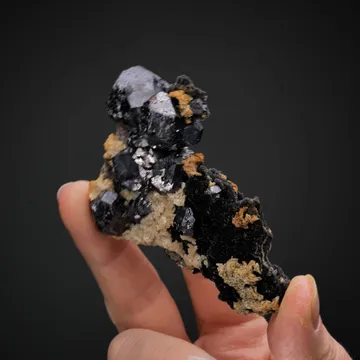
Sphalerite from Rampgill is typically black to very dark brown, lustrous, and strongly associated with quartz epimorphs after fluorite, ankerite, fluorite and galena. It represents the zinc-rich character that made late Rampgill and Nenthead mining economically important after the older lead operations declined. On specimens it may occur as isolated, well-formed crystals on quartz ribs, as dense coatings with ankerite and selenite, or as dark contrast points among pale fluorite cubes. The best collector pieces have bright, distinct sphalerite crystals rather than massive black ore, with the crystals standing proud on quartz or fluorite so that the paragenetic sequence remains legible.
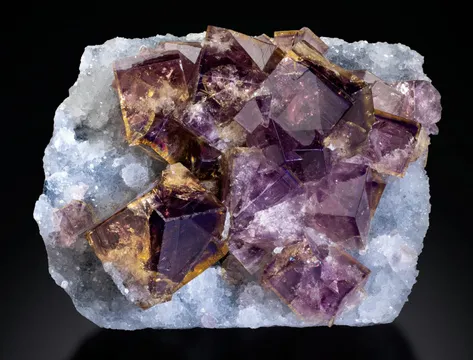
Rampgill fluorite is generally pale yellow, cream, colourless, amber-brown or locally purple, occurring as cubes, small twinned crystals, coatings on quartz, and as the vanished precursor recorded by quartz epimorphs. Documented Boundary Cross Vein specimens show crystals commonly around 1 cm, with some individual cubes and twins a little larger, while larger plates carry clusters of gemmy citron-yellow cubes on undulating quartz with sphalerite. Minute siderite can dust or penetrate the fluorite surfaces, giving a darker, earthy aspect, and fluorescence is a useful locality clue: Rampgill fluorite is reported to fluoresce purple to blue under ultraviolet light. Top examples combine sharp fluorite cubes with clear evidence of the fluorite-quartz replacement story rather than being merely small, dull cubes on iron-stained matrix.
Ankerite is fundamental to Rampgill’s look because the flats in the Great Limestone are hosted by strongly ankeritized limestone, and specimens often carry reddish-brown to tan microcrystalline ankerite on quartz, sphalerite and fluorite. Rather than forming showy freestanding crystals, it typically appears as small rhombs, granular coatings or rusty carbonate crusts that give the pale quartz epimorphs their warm Pennine colour. Collectors should value ankerite here as an association and geological marker: good specimens show crisp ankerite dusting or scattered rhombs without overwhelming the quartz casts or masking the sphalerite, while ordinary pieces are simply brown carbonate-stained fragments of altered limestone.
Galena was the principal lead ore at Rampgill and occurs on specimens as dull to bright grey cubes, commonly with sphalerite, fluorite and quartz. In the Nenthead flats it can occupy cavities in altered limestone or sit on quartz-rich plates from the Boundary Cross Vein; large cubes with black sphalerite overgrowths and pale fluorite on quartz have been recorded from modern finds. Good Rampgill galena specimens are not usually judged by mirror-bright luster alone but by sharp cubic form, clear association with sphalerite and fluorite, and a matrix that shows the Great Limestone flat assemblage rather than a nondescript chunk of heavy ore.
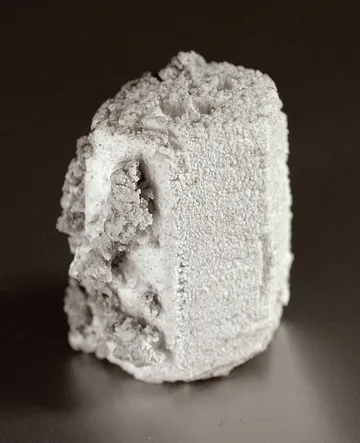
Other documented Rampgill minerals include baryte, barytocalcite, calcite, siderite, pyrite, smithsonite, hydrozincite and native sulphur, with witherite the outstanding rarity for serious North Pennine collectors. Witherite at Rampgill is recorded from a small lens on the Scaleburn Vein and from material in waste rock on the Bounder End Cross Vein; it may occur as colourless to brown radiating masses and as small pseudohexagonal crystals, and the barium-carbonate assemblage has been important in studies of baryte replacement by witherite and barytocalcite. Tiny euhedral native sulphur crystals on galena, small white smithsonite with oxidised siderite on quartz and sphalerite, and secondary baryte encrusting witherite and fluorite add further interest. Rampgill itself is not established as a type locality for the famous Alston Moor species, but it sits in the same mineralogical province as type-locality barytocalcite and alstonite localities and shares the barium-carbonate chemistry that makes the district exceptional.
Rampgill specimens are most likely to be mislabelled by locality nuance rather than by deliberate fabrication. Labels may say Rampgill Mine, Rampgill Mill, Nenthead, Boundary Cross Vein, Bounder End Cross Vein, High Flat, North String, Coalcleugh or Barneycraig. Some of these names refer to connected or adjacent parts of the same broader underground system, but for high-value pieces the exact label matters. “Boundary Cross Vein” and “Bounder End Cross Vein” are commonly used for the same important collecting area, while Coalcleugh and Barneycraig labels may indicate material from the Northumberland side of connected workings rather than from Rampgill proper. A good old label naming the vein, horizon and collector is worth preserving with the specimen.
No well-documented Rampgill-specific fake industry is apparent, but generic risks apply. Quartz epimorphs after fluorite from Rampgill can superficially resemble material from Smallcleugh, Coalcleugh, Barneycraig and other Nenthead workings, so provenance should be judged by a combination of label history, habit and associations rather than by “Nenthead” alone. Be wary of vague labels that upgrade a general Alston Moor quartz-sphalerite piece to Rampgill, especially if the specimen lacks the characteristic cubic quartz casts or the Boundary Cross Vein assemblage.
Condition is central. The prized quartz epimorphs are often thin-walled and easily bruised along cast edges; fluorite cubes have perfect cleavage and can show corner nicks; sphalerite can lose exposed crystal points; and carbonate coatings may be friable. A fresh-looking Rampgill specimen should still tolerate close examination under magnification: intact cubic voids, undamaged quartz sparkle and well-attached sulphides separate a collectible example from a battered mine-run fragment.
Cleaning requires restraint. Acid treatment may remove iron staining but can damage or dissolve calcite, ankerite, witherite and barytocalcite, and it can also alter the natural surface relationships that make these specimens scientifically interesting. Witherite is barium carbonate and should be handled sensibly: avoid dust, ingestion, ultrasonic abuse and unnecessary chemical cleaning. If a specimen carries barium carbonates, treat it as a mineralogical record, not as a decorator rock.
Fluorescence is a useful bonus. Rampgill fluorite is reported to fluoresce purple to blue under ultraviolet light; witherite may fluoresce white under short-wave UV, and calcite can fluoresce red and phosphoresce. Fluorescence should not be used alone to authenticate a specimen, but it can strengthen a label when combined with the right matrix, crystal habit and paragenesis. On the market, good Rampgill pieces appear periodically rather than abundantly. Small quartz-sphalerite epimorph specimens remain obtainable, while large, well-composed Boundary Cross Vein plates, pieces with strong galena-fluorite-sphalerite balance, and convincing witherite or barytocalcite associations are much scarcer.
The most vivid Rampgill stories are not about a glittering pocket opened in a single lucky blow, but about the physical stubbornness of the mine itself. In August 1991, John Lawson and fellow members of the Peak District Mines Historical Society set out to examine the southern Scaleburn Cross Vein workings, reachable only through the Rampgill Horse Level. They were searching for a sump that might connect Rampgill workings to an explored part of the vein some 18 metres below, accessible from Brownley Hill, or Broomsberry, Horse Level. What followed became a two-to-three-year underground engineering project conducted in water, rotten shale and collapsing ground.
The first 100 metres of Rampgill Level were described as lined with dressed stone from Flinty Fell, the level running southeast to Brewery Shaft. Beyond that, the explorers encountered the awkward reality of old lead and zinc workings: stone arching, hoppers dripping water, rails still in side levels, partial blockages and roof falls. In the Scaleburn section, a shale wall still carried the initials “J.P.1795,” a small human mark in a mine whose active life stretched across generations. The team found that an earlier fall blocked the horse level about 40 metres from the steps’ junction, and they decided against simply digging underneath unstable blocks of shale. Instead, they built a wooden protective box inside the collapsed stope, using four 3 x 2 ft plywood boards, three 2 x 2 ft kitchen worktops and four 8 ft Dexion posts, hauling the pieces in by hand over four journeys.
Their method was improvised but careful. Loose shale was bucketed out from inside the box, while the Dexion posts were tapped down so that the whole structure settled gradually through the debris. In April 1992 they drove a 2 m drill steel into the base to judge how far they were above the horse level; later they added steel angle, timber, stemples and an old wheelbarrow. The mine pushed back. A large block fell with a rumble, the box sank about 30 cm, and new holes appeared in the floor. The shield was damaged, rebuilt and widened into a broad arc of steel and timber. Months passed in the slow vocabulary of mine reopening: stemple, wedge, board, sump, fall, shale wall.
On 25 October 1992, Lawson lifted a final lump of shale and saw a hole about 3 or 4 m deep leading down to the horse level. Water could be heard dripping in the distance. On 7 November, after four hours of digging, a hole large enough for Robert Bunting was opened at 14.15. The men had strapped themselves to the side of the shaft to avoid falling into the level. They dropped through onto a greasy slope about 1.5 m above the horse level and found the water about 40 cm deep, with rails still in place. They pressed on and stopped when Bunting noticed what looked like a waterwheel in a chamber off the main level.
It was better than a waterwheel. The chamber held a horse gin — a horse-powered winding mechanism — lying on its side in a worked-out flat, possibly the only surviving underground horse whimsey in the country. Nearby were the sorts of objects that make an abandoned mine feel recently vacated and centuries old at once: a banjo shovel, a long steel poker with its handle still attached, clay pipes left in miners’ “bait” areas, rails, hoppers, trap doors and sump covers. By the end of that first entry, the team had found an underground horse gin, at least two flats and a number of artefacts, and left the mine at 19.30 already planning to return.
The next day justified their caution. When they began stabilising the first blockage beyond the horse-gin chamber, part of the roof, including rotten timbers they had seen the previous day, came down before they had put the new boards in place. Lawson later reflected that they had deliberately avoided going under those timbers on the first exploration — and “it had paid off.” Beyond the fall, the horse level ran 47 m before ending at another blockage known on their plan as the Oil Drum Fall. By then they had reopened 160 m of horse level plus many side passages and workings, but the route ahead oozed moisture from the roof, the floor and the debris itself.
The Oil Drum Fall produced the episode every underground explorer dreads. In January 1993 Lawson cut a 40-gallon oil drum in two, drilled it, carried it underground and reassembled it at the blockage as a makeshift culvert through the wet slurry. He crawled through, followed by Robert Bunting. On the far side, trying to dig into an arched level in the roof, they dislodged wet tailings mixed with large boulders. The material kept coming. Debris piled in front of the drum until the way back was blocked. Despite their efforts, they had sealed themselves into the horse level. Water dripped around the drum, soaking them while they examined what Lawson called their prison: a stone-lined level, a high stope, another level above, and yet another fall inbye. Their escape depended on building a deflector above the oil drum using pieces of rail levered from the horse level with an 800 mm steel bar.
The same explorations also explain why Rampgill specimens can be scarce despite the size of the workings. In places, the later miners had stripped the flats efficiently. Lawson noted sections where expected fluorite mineralisation was absent and suggested that the last workers, likely the Vieille Montagne men, had removed any larger and more spectacular crystals. The mine preserved the engineering, the rails, the pipes, the gin and the clay pipes better than it preserved glittering cavities. Where specimens survived, they tended to be in specific pockets and protected cavities rather than in every accessible opening.
By September 1993, oxygen readings told their own warning story. The main horse level read 20.8 percent oxygen, the horse-whim flat 20.4 percent, the oil drum 20.3 percent, but values dropped progressively inbye: 18.2 percent beyond the fourth blockage, 17.4 percent beyond the fifth, and 16.9 percent at the final fall. Lawson concluded that such air was deleterious to health and warned future explorers to take exceptional care. The account ends with the kind of practical humility old mines enforce: gratitude to the fellow diggers, pride in opening a new part of the Nenthead orefield, and a warning that the stemples and timber in the entrance sump were not to be trusted casually. Rampgill gives up its minerals and its stories on the same terms — slowly, conditionally, and never without respect.