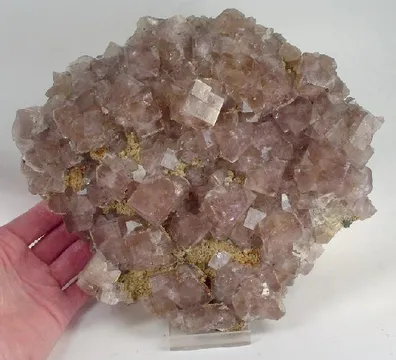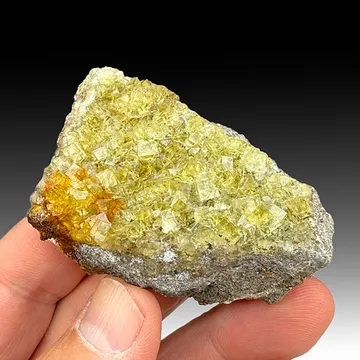
Brownley Hill Mine, UK - a classic Northern Pennine locality yielding sphalerite, galena, fluorite, baryte, and rare alstonite and brianyoungite.
Key facts
Brownley Hill Mine is one of the great collector localities of the Nenthead–Alston Moor part of the Northern Pennine Orefield: not a showy single-species locality, but a complicated lead-zinc-barium-carbonate mine whose best specimens have the unmistakable look of a northern English classic. The mine worked Carboniferous limestone and associated strata cut by a tight lattice of mineralized veins and cross-veins. Its richest collector material came from vein and “flat” replacement mineralization, especially in and around the Great Limestone, where sphalerite, galena, quartz, ankerite, calcite, fluorite, witherite, baryte and rare barium-calcium carbonates all appear in a compact, highly diagnostic assemblage.
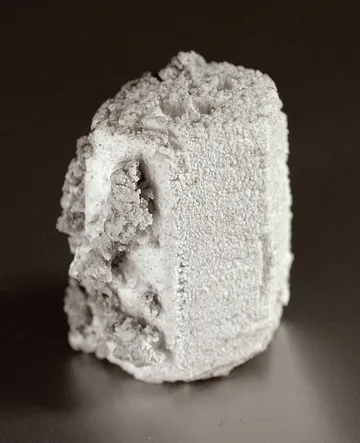
Collectors know Brownley Hill first for lustrous black to dark brown sphalerite on bright quartz, often with modified galena; for amber-yellow fluorite from the Jug Vein; for witherite and baryte-zone minerals from restricted parts of the mine; and, above all for rarity specialists, for alstonite and brianyoungite. Alstonite, BaCa(CO3)2, has Brownley Hill as one of its classic type localities, and the mine’s sharp white to greyish pseudohexagonal crystals remain the benchmark style for the species. Brianyoungite, Zn3(CO3,SO4)(OH)4, was described from post-mining oxidation in Brownley Hill and is one of the locality’s modern mineralogical calling cards.
Historically, Brownley Hill stands apart from much of Nenthead because it was not one of the principal London Lead Company mines. It was worked by a succession of smaller concerns and later by companies interested in zinc as well as lead, culminating in Vieille Montagne activity in the early twentieth century. For specimen collectors this matters: the mine was explored, reopened, scavenged, and collected at different moments for different ore minerals, leaving a specimen record that combines old-time nineteenth-century barium-carbonate pieces, twentieth-century ore specimens, and post-war underground finds.
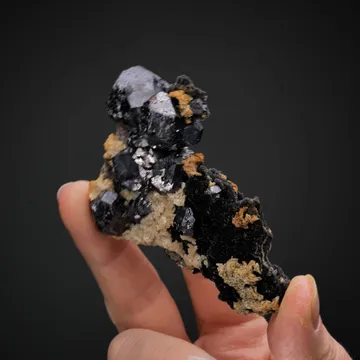
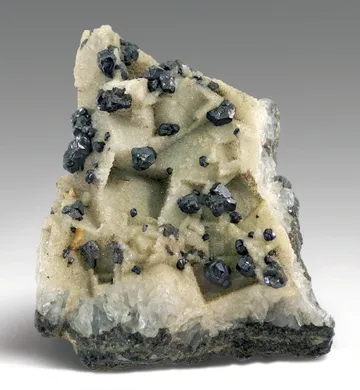
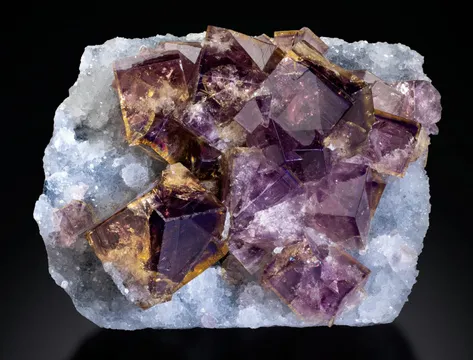
The finest Brownley Hill pieces are not usually giant display objects; they are tight, mineralogically articulate cabinet and miniature specimens. A good sphalerite-galena-quartz is all contrast: black resinous sphalerite, steel-grey galena, and cold white or glassy quartz. A good Jug Vein fluorite is warm amber to yellow, commonly untwinned and gemmy at the edges, with ankerite, dolomite, galena or minor sphalerite providing the North Pennine context. A good alstonite is a rarer thing: sharply crystallized, lustrous, white to pale grey, and preferably from Holmes Rise or the High Cross Vein area, where the species belongs both historically and mineralogically.
Regional View
Country View


Search for specimens: View all specimens from Brownley Hill Mine, UK
Brownley Hill Mine, also known in mineralogical records as the Bloomsberry Horse Level locality, lies near Nenthead on Alston Moor in Cumbria, at roughly NY776447. The mine is part of the Northern Pennine Orefield, a classic fluoritic Mississippi Valley-type lead-zinc-barium-fluorine province developed in Carboniferous strata of the Alston Block. The host rocks are the familiar northern Pennine cyclic succession of limestones, sandstones, siltstones and mudstones, with the Great Limestone particularly important for both ore production and collectible specimens. As elsewhere in the orefield, hard competent beds opened clean fissures and favored mineral deposition, while limestone adjacent to veins could be replaced laterally to form the flat, metasomatic orebodies prized by miners and, later, by collectors.
The mine worked a busy set of veins rather than a single simple lode. Recorded veins include Carrs Vein, Wellgill Cross Vein, Brownley Hill Moss Cross Vein, West High Cross Vein, High Cross Vein and Jug Vein, which are essentially north-south veins, together with east-west structures including Brownley Hill North Vein, Brownley Hill Vein, Tatters String Vein, North Middle Vein, Middle Vein and Sun Vein. Replacement “flats” occur east of Wellgill Vein in association with Middle Vein, with a smaller replacement area between Brownley Hill Vein and Brownley Hill North Vein, possibly related to Tatters String. These relationships explain the diversity of Brownley Hill specimens: one pocket or horizon may be dominated by quartz and sphalerite, another by barium minerals, another by amber fluorite.
The deposit is a lead-zinc system with strong barium-carbonate expression at specific horizons. Galena and sphalerite formed the economic sulphide ores, while quartz, ankerite, siderite, calcite, fluorite, baryte and witherite form the principal gangue and later cavity minerals. Brownley Hill is especially interesting because it sits close to the boundary between contrasting North Pennine mineral zones. The mine includes barium-rich ground, notably around High Cross Vein and Holmes Rise, but also fluorite-bearing ground such as Jug Vein. That combination is not the norm in the orefield, where barium minerals and fluorite are commonly more sharply separated.
The earliest workings were on the Brownley Hill Vein from surface shafts, and eighteenth-century records describe periods of limited economic promise followed by more successful local ventures. The London Lead Company leased the ground in the mid-eighteenth century and worked Brownley Hill Vein in the Little Limestone and overlying hazles, but water and poor ventilation limited deeper work and some trials were abandoned. A new lease at the end of 1765 reportedly proved richer, with ore sold to the London Lead Company. By 1795 the Brownley Hill Lead Company was operating during a period of strong lead prices associated with the wars with France, and the mine developed more substantially in the early nineteenth century as the Bloomsberry Horse Level gave deeper and more systematic access to the veins.
Unlike Rampgill, Smallcleugh and other better-known London Lead Company-dominated workings at Nenthead, Brownley Hill and the related Nentsberry ground passed through a chain of smaller operators. The Alston Moor Mining Company was followed in 1895 by the Nentsberry Mining Company, then by the Lugdale Chemical Company in 1908. Vieille Montagne acquired the mines in 1914, and the shift from exhausted high-grade lead ore to zinc ore marks the final important industrial chapter. Brownley Hill was operated by Vieille Montagne from 1914 until the mid-1930s, with trial work and records extending into the 1936–1938 period. Durham Mining Museum records the mine as closed in August 1937, while mineralogical summaries commonly cite Vieille Montagne operation until 1936.
Collectors should treat Brownley Hill as an historic underground mine, not a casual collecting site. Nenthead Mines Conservation Society owns the Nenthead Mines site and the Brownley Hill mine entrance, and the wider Nenthead mining landscape includes Scheduled Ancient Monument and Site of Special Scientific Interest protections. Underground access is hazardous. Even where sections of the mine remain physically accessible, reports emphasize poor and dangerous access levels, water, unstable ground and conservation concerns. Legitimate collecting requires permission, current local knowledge, and respect for conservation restrictions; many of the specimens now circulating came from old collections, from documented underground collecting in earlier decades, or from dealers handling historic stock.
Several specimen-producing areas recur on reliable labels and in published notes. The Main Flats area off Wellgill Vein produced sphalerite-galena-quartz specimens, including material collected in the early 1980s. Wellgill Cross Vein Flats, both lower and upper, appear on Trevor Bridges collection labels for large sphalerite-galena specimens and hydrozincite. Jug Vein is the signature source for amber-yellow fluorite, including fluorite associated with hydrozincite from flats in the Great Limestone and with ankerite, galena, dolomite or small chalcopyrite. High Cross Vein and Holmes Rise are the crucial labels for alstonite and associated barium minerals. Tatters String is recorded in mine descriptions and appears in locality photographs as part of the underground fabric, while the junction of High Cross and Brownley Hill veins is associated with brianyoungite material in at least one documented collection listing.
Brownley Hill sphalerite is the species most collectors associate with the mine’s best sulphide specimens: lustrous dark brown to nearly black crystals, locally transparent in small “ruby sphalerite” individuals, set on quartz, calcite or ankeritic limestone and commonly accompanied by modified galena. Documented specimens from the Main Flats area off Wellgill Vein show crystalline sphalerite with galena on quartz in hand-sized pieces around 9 x 5 x 5 cm, while other Brownley Hill examples carry smaller black sphalerite crystals to a few millimetres around sharp galena or drusy quartz; better pieces have strong luster, fresh fracture-free crystal faces, and a crisp contrast between resinous sphalerite and bright white quartz rather than massive ore with only scattered crystallization.
Fluorite is not the most abundant Brownley Hill collector mineral, which is exactly why good pieces are noticed: the classic material is amber-yellow to pale greenish or honey-colored fluorite from the Jug Vein and associated Great Limestone flats. Jug Vein crystals are typically untwinned, often stepped on larger cube faces, with gemmy corners and cloudier interiors; associated minerals include pale cream to orange ankerite, dolomite, galena, calcite, quartz, minor sphalerite, chalcopyrite and, in some examples, hydrozincite. Fine specimens may reach cabinet size, with fluorite cubes around 1 to 3 cm reported on documented examples; the best pieces are recognized by their warm color, luster, lack of typical Weardale-style twinning, and the diagnostic Brownley Hill associations rather than by sheer size.
Witherite from Brownley Hill belongs to the barium-rich side of the mine and is best documented from the small High Cross Vein–Holmes Rise area in the Great Limestone, where it occurs with alstonite, baryte and associated sulphides. The characteristic Brownley Hill habit is stacks of thin pseudohexagonal crystals, with multiple re-entrants, exceptionally reaching about 30 mm; smaller pseudohexagonal pyramids are also recorded. Good Brownley Hill witherite is sharply formed, lustrous to pearly, and accompanied by the right matrix—especially alstonite and pale to pinkish baryte—because those associations separate genuine Holmes Rise-style material from more ambiguous old “Alston” witherites and from similar but distinct Nentsberry Haggs specimens.
Galena at Brownley Hill is both ore mineral and aesthetic partner, most desirable as sharp modified cubes or cuboctahedral crystals set against sphalerite and quartz. Documented specimens include galena crystals to about 28 mm across on lustrous quartz with small black sphalerite, cuboctahedral galena around an inch across associated with amber Jug Vein fluorite from the high flat horizon of the Great Limestone, and smaller high-luster crystals with dark brown sphalerite. Fine Brownley Hill galena should look fresh, metallic and sharply modified rather than dull or bruised; combinations with black sphalerite on quartz or with amber fluorite from Jug Vein carry much stronger locality character than isolated massive galena.
Beyond the headline sulphides and spar minerals, Brownley Hill is unusually important for rare barium and secondary zinc minerals. Alstonite, BaCa(CO3)2, is the signature rarity: sharp white, greyish or rarely pinkish pseudohexagonal pyramidal to bipyramidal crystals from Holmes Rise on High Cross Vein, with Brownley Hill recognized as a type locality alongside Fallowfield Mine. Brianyoungite, Zn3(CO3,SO4)(OH)4, was described from the oxidized zone at Brownley Hill as tiny white rosettes associated with gypsum on rubbly or shaly limestone, making the mine its type locality. Other documented minerals include baryte, barytocalcite, calcite, cerussite, chalcopyrite, dolomite, harmotome, hydrozincite, malachite, marcasite, millerite, native sulphur, pyrite, quartz, serpierite, siderite, smithsonite, strontianite, ullmannite, bottinoite and an unnamed zinc analogue of ktenasite. Bottinoite is noteworthy as an early UK occurrence, and the mine’s millerite sprays from the limestone-sandstone contact are sought by locality specialists.
Brownley Hill specimens need careful label scrutiny because several similar-looking Nenthead and wider Alston Moor localities produced overlapping lead-zinc-barium assemblages. Old labels may read Brownley Hill, Brownleyhill, Brownley Hills, Bloomsberry Horse Level, Bromley Hill, Alston, Cumberland, Nenthead, or simply Alston Moor. “Bromley Hill” is especially important: it appears historically in connection with alstonite’s early name “bromlite,” apparently from a misspelling of Brownley Hill, and should not be dismissed automatically. Conversely, an old “Alston” label on witherite or alstonite is not enough to assign Brownley Hill without the right morphology and associations.
Witherite attribution is the most delicate issue. Brownley Hill has sometimes been called the type locality for witherite, but detailed modern historical work rejects that claim: Brownley Hill’s documented barium mineralization at Holmes Rise was opened after the early history of witherite, and its witherite habit and matrix differ from the earliest “aerated ponderous spar” material. Collectors should therefore avoid paying a type-locality premium for Brownley Hill witherite as witherite. Brownley Hill is a type locality for alstonite and brianyoungite, not securely for witherite.
Condition issues are typical of old northern English mine specimens. Sphalerite may be contacted, bruised on high points, or partly massive beneath a bright face; galena tarnishes and is often edge-worn; fluorite from Jug Vein may have cloudy interiors, cleaved corners or later coatings; and witherite and alstonite can show bruising on exposed pyramidal tips. Many good old specimens were trimmed hard from heavy ore, so a flat sawn or broken underside is not inherently suspicious. What matters is whether the display face retains natural cavity luster and whether the associations make geological sense.
Fluorescence can add interest but is not usually the central Brownley Hill value. Some amber fluorites show purple fluorescence, and hydrozincite-bearing pieces may respond to ultraviolet light, but this is a secondary feature compared with locality, habit, association and condition. Witherite is a barium carbonate and should be handled sensibly: avoid generating dust, do not acid-test collectible specimens, and wash hands after handling. Post-mining sulphates and delicate secondary minerals such as brianyoungite, gypsum, hydrozincite and related crusts should be kept dry, stable and protected from abrasion.
Market availability is uneven. Sphalerite-galena-quartz specimens appear periodically and remain one of the more attainable Brownley Hill styles, with prices strongly dependent on crystal sharpness and composition. Jug Vein fluorite is scarcer and more likely to be recognized by specialist dealers. Alstonite is distinctly rare in good crystals, especially with a precise Holmes Rise or High Cross Vein provenance, and fine cabinet specimens command a premium because they represent one of the classic occurrences for the species. Brianyoungite is mostly a micromount and research-collection mineral rather than a mainstream display specimen.
The Brownley Hill story begins with frustration. Records from 1735 describe a mine that was not yet proving its worth, and the first generations of miners found the usual North Pennine problem waiting below them: water. The London Lead Company worked the Brownley Hill Vein in the Little Limestone and the hazles above it and did obtain ore, but deeper ground remained tantalizing. The company tried to beat the water by driving Brownley Hill High Level in the sills above the Great Limestone, hoping to reach the Little Limestone and the bottoms of the old workings. The result was disappointing—only a fraction of the expected ore appeared—and poor ventilation added to the discouragement on Brownley Hill Moss Cross Vein and Jug Vein. The lease was surrendered before its term had run out.
Then the ground changed hands and, in the old mining way, changed reputation. At the end of 1765 a new lease was taken by a two-man partnership that found much better ore in the cross-veins as well as in Brownley Hill Vein itself. The ore was sold to the London Lead Company, the very organization that had walked away from the lease. By 1795 the Brownley Hill Lead Company held the ground, and lead prices during the wars with France made the mine’s timing unusually fortunate. The real transformation came when the Bloomsberry Horse Level was driven, bringing the old veins into a lower, more coherent underground system and opening routes toward Gudhamgill Cross Vein, Wellgill Cross Vein, Brownley Hill North Vein, Brownley Hill Vein, Brownley Hill Moss Cross Vein, High Cross Vein and Jug Vein.
One of the most satisfying Brownley Hill collecting anecdotes is not about a famous museum piece, but about a specimen that preserves a miniature hydrothermal map. In 1968, collector Timothy Greenland recovered a roughly 10 x 10 cm specimen of black sphalerite on white quartz, with galena on the back. Decades later he described how the same specimen looked different from opposite sides: from one direction nearly all sphalerite, from the other nearly all quartz. His punchline was exactly the kind of field observation collectors love: “Guess from which direction the Zn-bearing fluids were coming...” It is a modest specimen story, but a good Brownley Hill lesson—the mine’s best pieces often reward the collector who reads growth direction, replacement texture and mineral sequence, not just color and size.
The old labels on Brownley Hill alstonite tell their own story. A small-cabinet alstonite-with-witherite specimen photographed by Rob Lavinsky carries the sort of documentary baggage collectors dream of: old handwritten labels, an old collection number, and a specimen style expected to date from the mid-nineteenth-century heyday of the mine. The display face is covered with sharp alstonite crystals to about 6 mm, with a 2 cm witherite cluster perched above them. The specimen is attractive, but the labels are part of its mineralogical value because Brownley Hill alstonite is not just a pretty rarity; it is a species-defining locality mineral whose exact origin within the mine—High Cross Vein, Holmes Rise, barium-rich ground—matters.
Modern underground accounts give Brownley Hill a different atmosphere. Explorers describe the mine as part of a larger Nenthead labyrinth of long horse levels, rises, flats, flooded passages and connections toward Haggs. One described route from Haggs toward Brownley Hill involves deep water and confined levels; another account of Nenthead traverses mentions the “lengthy cold and deep water on the Brownley Hill Horizon.” These are not collecting invitations. They are reminders that the clean, jewel-like miniature on a collector’s shelf came from a mine where the practical realities were water, bad air, haulage, backfilled rises, unstable shale and the constant need to understand exactly where one was in a three-dimensional maze.