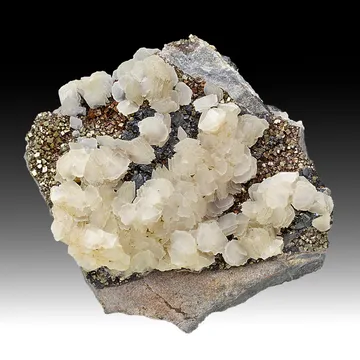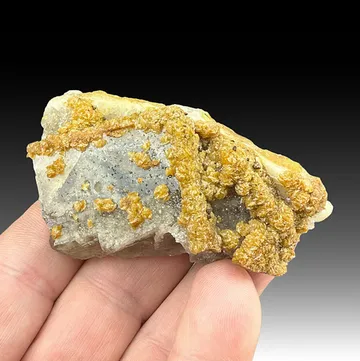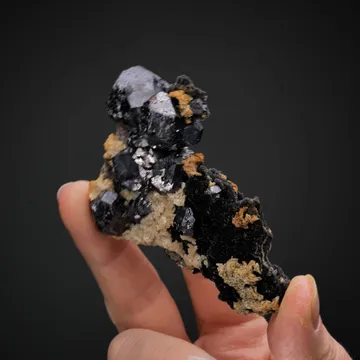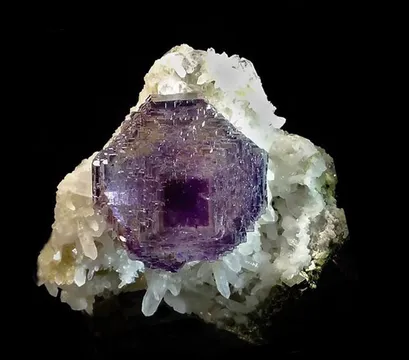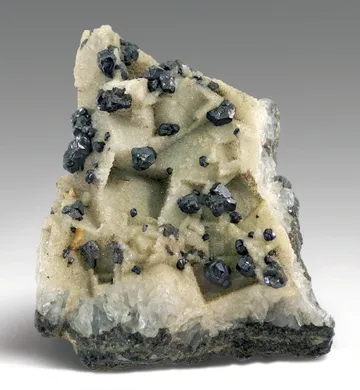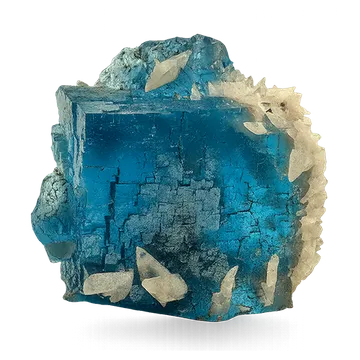
Brownley Hill fluorite — amber cubes on dark sphalerite from the Northern Pennine Orefield; a classic UK locality prized for color, rarity, and mining history.
Key facts
Brownley Hill Mine, on Alston Moor at Nenthead in Cumbria, is a collector’s locality with the character of a true North Pennines classic: lead-zinc mining history, carbonate-hosted veins and flats, and a specimen suite in which amber fluorite sits naturally with dark sphalerite, galena, siderite, ankerite, quartz, calcite, and hydrozincite. It is not the intensely green, daylight-fluorescent style associated with the modern Rogerley-Diana Maria workings farther east in Weardale. Brownley Hill fluorite is quieter and more old-school: warm yellow to amber cubes, commonly on sulphide-rich matrix, with a slightly smoky internal cast, gemmy edges, and cloudy or whitish centres that seasoned British collectors recognize immediately.
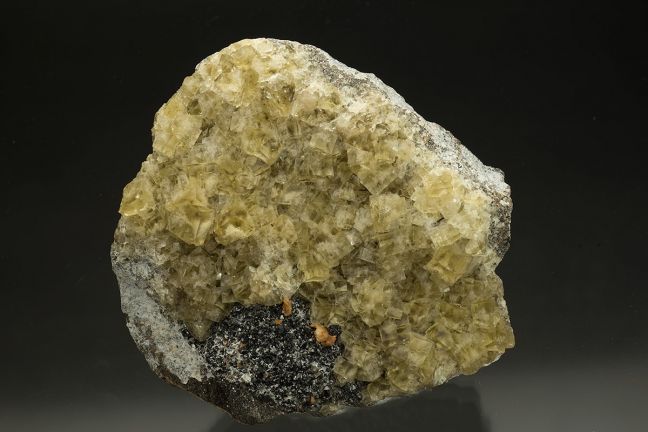
Photo: Steetley Minerals
The mine lies in the Northern Pennine Orefield, where Carboniferous limestones, shales, sandstones, and related strata of the Alston Block were cut by mineral veins and locally replaced by “flat” orebodies. In the central fluorite-rich part of the orefield, fluorite is a major gangue mineral alongside quartz, ankerite, siderite, baryte, witherite, galena, and sphalerite. Brownley Hill’s fluorite is especially associated with the Jug Vein and nearby Great Limestone workings, where collectors prize plates and vugs of lustrous amber cubes on dark sphalerite or brown carbonate.
Brownley Hill is also mineralogically important beyond fluorite. It is listed as the type locality for alstonite, BaCa(CO3)2, and brianyoungite, Zn3(CO3,SO4)(OH)4, and its mineral list runs far beyond the common lead-zinc assemblage. That broader rarity gives Brownley Hill fluorite an added context: a good fluorite is not simply a pretty British spar specimen, but part of one of the most studied and historically layered Nenthead mines.
Collectors look for sharp cubic crystals rather than massive spar, a rich honey-yellow to amber colour, good transparency at the edges, and undisturbed association with sphalerite, siderite, ankerite, quartz, galena, calcite, or hydrozincite. The best pieces carry the unmistakable contrast of pale amber fluorite against black-brown sphalerite, sometimes with metallic galena or iron-carbonate rhombs adding texture. Large, open plates are much less common than small cabinet and miniature specimens, and the strongest examples tend to have old collection provenance or a clearly documented Jug Vein attribution.
Search for specimens: View all fluorite specimens from Brownley Hill Mine, UK
Brownley Hill Mine is part of the Nenthead group of mines on Alston Moor, Cumbria, within the Northern Pennine Orefield. The locality is commonly recorded as Brownley Hill Mine, or Brownley Hill Mine (Bloomsberry Horse Level), Nenthead, Alston Moor, Cumbria, England, UK. Mindat gives the position as 54° 47′ 47″ N, 2° 20′ 53″ W, with UK National Grid Reference NY776447.
Geologically, this is a classic Carboniferous carbonate-hosted Pb-Zn-F-Ba vein and replacement setting. The broader orefield is famous for steep veins following faults and fractures, together with stratabound replacement bodies or “flats” in favourable limestone horizons. At Brownley Hill, the Great Limestone is particularly important, and both veins and flats contributed to the mine’s mineral suite. The mine worked numerous veins, including Carrs Vein, Wellgill Cross Vein, Brownley Hill Moss Cross Vein, West High Cross Vein, High Cross Vein, Jug Vein, Brownley Hill North Vein, Brownley Hill Vein, Tatters String Vein, North Middle Vein, Middle Vein, and Sun Vein. For fluorite collectors, the Jug Vein is the name most often attached to the classic amber-yellow fluorite-sphalerite specimens.
The deposit was worked primarily for lead and later zinc, not for specimen fluorite. Brownley Hill was one of the notable Nenthead mines not developed in the usual way by the London Lead Company. It was opened from two principal levels: the Bloomsberry Horse Level, now generally referred to as Brownley Hill Low Level, and Brownley Hill High Level. Early records from 1735 show the mine was already known in the Greenwich Hospital period, and later eighteenth-century attempts targeted the Brownley Hill Vein, cross veins, and the Jug Vein. By the nineteenth century, the Bloomsberry Horse Level allowed deeper and broader access to earlier workings. As high-grade lead ore declined, zinc became increasingly significant, and the Vieille Montagne Zinc Company took the lease in 1914. The mine operated under Vieille Montagne until 1936.
The mine’s documented production story is not a simple rise and fall. Workings shifted between lead and zinc, higher and lower horizons, and several companies. A later trial Slate Sill level was driven southeast of Brownley Hill Moss Cross Vein between 1964 and 1966, long after the main productive life of the mine. For specimen collectors, however, the key period for many attractive amber fluorite-sphalerite groups is thought to be around 1910–1920, in the late lead-zinc era when the sulphide-rich material that gives Brownley Hill fluorite its best visual contrast was being exposed.
Collecting access is a serious matter here. The mine is an underground historic working, not a casual collecting site. Although extensive sections have been described as still accessible from the Low Level, the access levels are also described as poor and dangerous, even where some Great Limestone workings are comparatively better preserved. Brownley Hill is part of a complex and hazardous Nenthead underground network, with old stopes, pitches, water, bad air risks, unstable ground, and historic mine fabric. Collecting should be approached through legitimate permissions, organized mine-history groups, or established specimen-market channels rather than independent entry.
Notable finds from Brownley Hill extend well beyond fluorite. Alstonite from Brownley Hill has a long history dating to nineteenth-century descriptions, and modern work confirmed alstonite in situ in the mine. Brianyoungite was described as a new mineral from the north of England orefield with Brownley Hill as a type locality. Bottinoite is also recorded from Brownley Hill as an early UK occurrence. For fluorite specifically, the notable finds are the amber to yellow cubic groups from Jug Vein material, especially when associated with sphalerite, siderite, ankerite, galena, hydrozincite, or quartz.
Brownley Hill fluorite is best known as yellow to amber cubic crystals, typically lustrous, translucent to locally gemmy at the edges, and often cloudy in the centre. The most desirable crystals show the warm “old English” honey colour that distinguishes them from the green daylight-fluorescent Weardale specimens and from the sharper, twinned yellow fluorites of certain other northern English localities. Dealer and collection records repeatedly describe Jug Vein material as amber-yellow fluorite on sphalerite-rich matrix, and this association is one of the best visual clues to the locality.
The dominant habit is cubic. Crystals are commonly small, often under 1 cm on more typical matrix specimens, but cabinet pieces with cubes around 1.8 cm are documented, and individual Brownley Hill specimens have been described with fluorite to about 2 cm. A Steetley Minerals Jug Vein specimen measured 110 x 95 x 50 mm and carried rich yellow fluorite crystals up to 9 mm across with sphalerite and hydrozincite. A Mineral Auctions large cabinet specimen measured 15.9 x 13.3 x 4.2 cm and was described as covered with lustrous, glassy amber cubes to 1.8 cm on sphalerite and siderite.
The colour is usually the first attraction: pale yellow, straw-yellow, honey, amber, or smoky amber. Some pieces shift noticeably with lighting, appearing warmer under halogen and cooler or greyer in room light. Purple fluorescence has been reported for at least one documented large cabinet specimen. Collectors should not expect the dramatic daylight fluorescence that makes Rogerley famous; Brownley Hill’s strength is classic assemblage, historic provenance, and the interplay of amber fluorite with dark sulphides and brown carbonate.
Associations are crucial. Mindat’s fluorite occurrence data for Brownley Hill list ankerite, sphalerite, galena, siderite, hydrozincite, chalcopyrite, calcite, and quartz as photo-associated minerals. The broader locality list includes alstonite, aragonite, baryte, barytocalcite, bottinoite, bournonite, brianyoungite, cerussite, dolomite, gypsum, harmotome, hydrozincite, jarosite, marcasite, millerite, pyrite, quartz, serpierite, smithsonite, strontianite, ullmannite, witherite, and several secondary zinc-copper minerals. In fluorite specimens, the practical matrix suite to watch for is sphalerite, siderite or ankerite, galena, quartz, calcite, and hydrozincite.
Quality is judged differently here than for modern pocket fluorites. Perfection matters, but locality character matters more. A Brownley Hill fluorite with modest crystal size can be very desirable if it has crisp amber cubes, lustre, intact matrix, old labels, and a credible Jug Vein or Brownley Hill attribution. The strongest pieces show a balanced composition: fluorite crystals standing proud rather than forming a flat crust, dark sphalerite or metallic galena for contrast, and minimal bruising along cube edges. Cloudy centres are not necessarily a defect; on documented Brownley Hill material they are part of the classic look.
The main authenticity issue is locality precision, not treatment. Amber fluorite with sulphide matrix occurs at several northern English localities, and vague labels such as “Alston Moor,” “Nenthead,” or simply “Cumbria” should be treated as less secure than labels naming Brownley Hill, Bloomsberry Horse Level, or Jug Vein. Brownley Hill material is especially convincing when the fluorite is associated with sphalerite and iron carbonate matrix and when the label history is consistent with old British collections or reputable specialist dealers.
Misattribution is particularly plausible between Brownley Hill, nearby Nenthead mines, and other Alston Moor or northern Pennine localities. Steetley Minerals notes that attractive amber fluorite-sphalerite groups thought to be from the Gudhamgill/Brownley Hill area can be distinguished from Hilton material by sphalerite association and lack of twinning. That is a useful market clue: if a specimen is sold as Brownley Hill but looks like a twinned Hilton-style yellow fluorite without the expected sulphide context, ask for provenance.
No widely cited Brownley Hill-specific fluorite treatment tradition is attached to the locality. The more common problem is cleaning. Hydrochloric acid or aggressive cleaning can dull carbonate matrix, remove iron staining that gives the piece its natural contrast, loosen crumbly sulphide-rich areas, or leave hydrozincite-looking white residues that are difficult to interpret. Old Brownley Hill specimens may also have been trimmed heavily from larger vein material; careful trimming is normal, but fresh sawed backs, ground matrix, or suspiciously isolated cubes should be weighed against the label and overall assemblage.
Condition issues are typical of fluorite on sulphide-carbonate matrix but should be examined closely. Fluorite has perfect octahedral cleavage, and amber cubes often show small edge nicks, corner bruises, or internal cleavage flashes. Sphalerite can be brittle and may chip or shed from protruding matrix. Galena, where present, can be soft and easily rubbed. Siderite and ankerite may be naturally brown and uneven, so not every rough surface is damage; the key is whether the fluorite display face retains crisp cube outlines and good lustre.
Rarity is relative. Brownley Hill is well represented in specialist British collections, and small examples still surface, but fine fluorite plates are not abundant. Large, sharp, well-composed amber fluorite-sphalerite specimens with old provenance are much less common than loose or small matrix pieces. A documented large cabinet Brownley Hill fluorite with sphalerite and siderite sold at auction for $675 in December 2020, illustrating that high-quality examples occupy a serious but still accessible market tier compared with the most famous Weardale fluorites. The best buying opportunities usually come from old collection dispersals, British dealers specializing in classic localities, and auction listings with photographs of both the specimen and its labels.
Brownley Hill’s story begins with a disappointment. Records from 1735, in the Greenwich Hospital period, described the mine as having no real economic value. The earliest workings were surface shafts on the Brownley Hill Vein, where lead was the target and silver was recovered as a by-product. In the middle of the eighteenth century, the London Lead Company took a lease for just under 20 years and tried to make the ground pay. They worked the Brownley Hill Vein in the Little Limestone and in the hazles above it, and did obtain a considerable amount of ore, but water stopped them from following the ore deeper.
Their answer was engineering: drive Brownley Hill High Level in the sills above the Great Limestone, hoping to reach the Little Limestone and gain access to the bottom of old workings. The plan did not deliver. Only a fraction of the expected ore was found. The company also tried Brownley Hill Moss Cross Vein and Jug Vein, the very name that would later become important to mineral collectors, but poor ventilation forced them to abandon that ground as well. The outlay had produced too little, and the lease was surrendered before it expired.
Then came a reversal. At the end of 1765, a new lease was taken by a two-man team who won a very large amount of ore from the cross veins as well as the Brownley Hill Vein. Their ore was sold to the London Lead Company, turning the earlier failure into a profitable episode. In 1795 the lease passed to the newly formed Brownley Hill Lead Company, at precisely the moment when war with France was pushing up the price of lead. When the lead price fell again, the lease was sold in 1816, but the mine continued under the same Brownley Hill Lead Company name.
The great practical change was the Bloomsberry Horse Level. Once driven, it allowed earlier veins to be worked from below: Guddamgill Cross Vein, Wellgill Cross Vein, Brownley Hill North Vein, Brownley Hill Vein, Brownley Hill Moss Cross Vein, Brownley Hill High Cross Vein, and Jug Vein. The lower lead ore was poorer than the higher ground had been, but the zinc ore was good enough to matter. That zinc would become Brownley Hill’s late-life strength. The operation survived into the mid-1850s, changed hands again in 1869, was sold to the Nenthead and Tynedale Lead and Zinc Company in 1890, and eventually passed to Vieille Montagne in 1914 after high-grade lead ore had been depleted. Vieille Montagne worked it for zinc until 1936.
A mineralogical story runs in parallel with the mining story. In 1909, Jacob Walton of Alston wrote about the history of alstonite, recalling that the mineral was first obtained at Brownley Hill around 1834 or 1835, when his grandfather, also Jacob Walton, was manager. Walton remembered it as coming from “a small vein or branch leading from a larger vein, called the Jug vein,” in the Great Limestone. That recollection is a collector’s gift: a named family, a manager’s memory, a named vein, and the same geological horizon that later attracts attention for Brownley Hill fluorite.
Modern underground accounts give the locality a different kind of life. A Black Rose Caving Club trip report from Saturday, 29 November 2003 records Peter Dale and Duncan Jones leaving at 5:40 a.m. after an overslept start and reaching Nenthead by 7:30 a.m. The entrance was only about 100 m from the car, and the mine felt warm after the breezy weather outside. They followed the entrance passage toward the sound of a waterfall, reached a junction where water flowed left into a sump, and described the sump as “eerie” but also the thing keeping the mine relatively dry.
Their objective was the Admiralty concession in Nentsberry Haggs, reached through Brownley Hill by a demanding route: a descent into Haggs, “a lot of walking and wading,” then a 70 ft pitch. At the bottom, one explorer tugged the rope to reassure himself; at the top, he noted that the rigging was “just as bad as last time.” Six belay points ran to different lengths of scaffold pole, with old rail lines spanning the shaft and the whole arrangement tied together with “bits of tatty rope.” Beyond that was another 9 m climb up poles and rock to the Admiralty flats. They found galena mixed with sphalerite in a large vug, squeezed into a cramped hole where good specimens had to be left behind, and later found alstonite in the lower workings. The exit delivered them into horizontal rain and gale-force winds, ending any thought of a second trip into Smallcleugh that day.
Those details matter because they put the specimens back into the mine. Brownley Hill fluorite did not come from an open tourist quarry or a modern specimen adit. It came from old lead-zinc ground threaded through limestone, shale, stopes, flats, pitches, sumps, and abandoned workings; from a mine where economic failure and revival alternated for two centuries; and from a district where the same names—Jug Vein, Great Limestone, Bloomsberry Horse Level—connect mining ledgers, mineral descriptions, and the amber cubes now sitting in collectors’ cabinets.
Green, David I.; McCallum, David; Wood, Mike. “Famous Mineral Localities: The Brownley Hill Mine, Alston Moor District, Cumbria, England.” The Mineralogical Record, 31(3), 231–250, 2000. — The key modern locality article for Brownley Hill and the standard reference cited for many species from the mine.
Young, B.; Greenbank, L.; Nancarrow, P. H. A. “Alstonite in situ at Brownley Hill Mine, Nenthead, Cumbria.” Mineralogical Magazine, 54(376), 515–516, 1990. — Confirms alstonite in place at Brownley Hill and discusses Jug Vein and Great Limestone mineralization.
Livingstone, A.; Champness, P. E. “Brianyoungite, a new mineral related to hydrozincite, from the north of England orefield.” Mineralogical Magazine, 57(389), 665–670, 1993. — Description of brianyoungite, for which Brownley Hill is listed as a type locality.
Livingston, A. “The zinc analogue of ktenasite from Smallcleugh and Brownley Hill mines, Nenthead, Cumbria.” Journal of the Russell Society, 4(1), 13–16, 1991. — A focused note on secondary zinc-copper sulphate mineralogy from Brownley Hill and nearby Smallcleugh.
Critchley, Martin F. “The History and Workings of the Nenthead Mines, Cumbria.” Bulletin of the Peak District Mines Historical Society, 9(1), Summer 1984. — A historical overview of the Nenthead mining complex and its company history.
Dunham, K. C. Geology of the Northern Pennine Orefield, Volume I: Tyne to Stainmore. Geological Survey / British Geological Survey, 1948; revised edition 1990. — Foundational regional geology for the Northern Pennine Orefield, including the Alston Block vein system.
Hall, Townshend M. The Mineralogist’s Directory: or, a guide to the Principal Mineral Localities in the United Kingdom of Great Britain and Ireland. Edward Stanford, 1868. — Early printed locality reference cited for Brownley Hill species including alstonite, galena, and sphalerite.
Mindat locality entry: Brownley Hill Mine (Bloomsberry Horse Level), Nenthead, Alston Moor, Cumbria, England, UK. — Current locality page, coordinates, mineral list, type-locality status, photos, and references.
Mindat occurrence entry: Fluorite from Brownley Hill Mine. — Fluorite-specific occurrence record with associated minerals and photo data.
“IRB1841 Fluorite, Brownley Hill Mine, Cumbria UK” — Crystal Classics — Vimeo specimen video showing a Brownley Hill fluorite offered by Crystal Classics.
“Video Report – Brownley Hill Lead Mine, Nenthead, UK” — MrMcGoo / 28DaysLater forum — Underground exploration report with a substantial historical summary of Brownley Hill’s workings and company history.
Nenthead Mines videos — Nenthead Mines Conservation Society — Official Nenthead Mines page linking to their YouTube and Sketchfab collections on the local mining landscape and underground heritage.
Category: Brownley Hill Mine — Wikimedia Commons — Open media category with Brownley Hill mineral images, especially alstonite and witherite specimens.
Mindat: Brownley Hill Mine locality page — Best single online reference for the locality, coordinates, mineral list, type-locality status, and bibliography.
Mindat: Fluorite from Brownley Hill Mine — Fluorite-specific occurrence page with associated mineral data and photo links.
Steetley Minerals: Fluorite & sphalerite from Jug Vein, Brownley Hill Mine — Dealer record illustrating the classic yellow fluorite-sphalerite Jug Vein style.
Steetley Minerals: Alston Moor locality notes — Useful British dealer overview of Alston Moor localities, including Brownley Hill and notes on amber fluorite-sphalerite groups.
Mineral Auctions: Brownley Hill fluorite with sphalerite and siderite — Archived auction record documenting a large cabinet Brownley Hill fluorite, crystal size, provenance, fluorescence, and sale price.
Northern Mine Research Society: Brownley Hill Mine — Bibliographic mine-history entry with key publications on Brownley Hill and Nenthead.
Buddlepit Mine Database: Brownley Hill Mine — Mine database entry summarizing levels, veins, Vieille Montagne period, access condition, and publication list.
GeoGuide: Mineral veins and minerals of the North Pennines / Northern Pennine Orefield — Regional geological context for fluorite-rich central-zone North Pennines veins.
BGS Earthwise: Northern Pennine Orefield — British Geological Survey regional overview of vein and replacement mineralization in the Alston Block.
North Pennines National Landscape: Minerals and mines — Accessible overview of the Northern Pennine Orefield and its famous minerals.
Black Rose Caving Club trip report: Brownley Hill Mine and Nentsberry Haggs — Field report giving a vivid sense of the underground conditions and collecting/exploration context.
Historic England: Lead mines, ore works and smeltmill at Nenthead, Alston Moor — Scheduled monument entry for the broader Nenthead mining landscape.