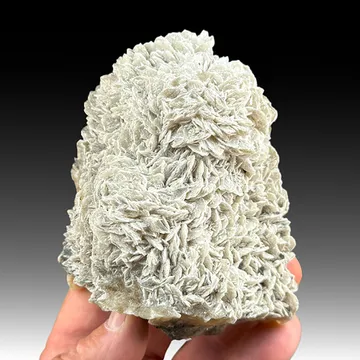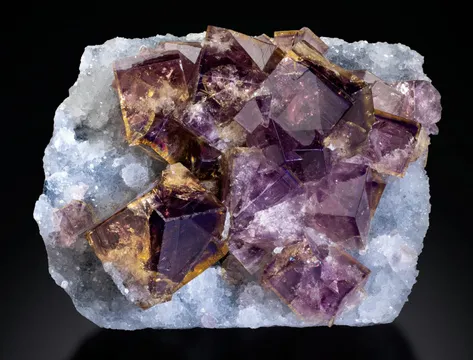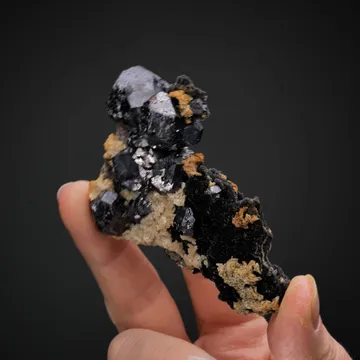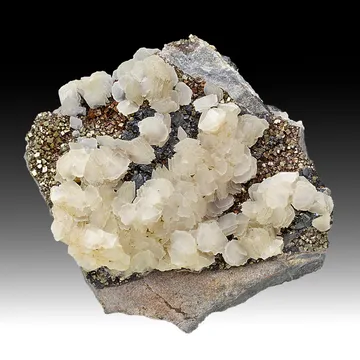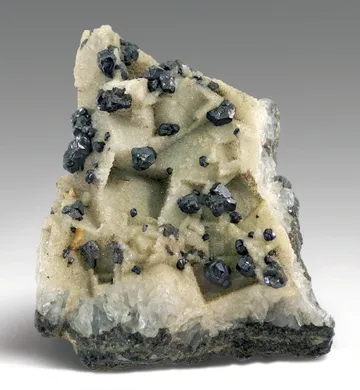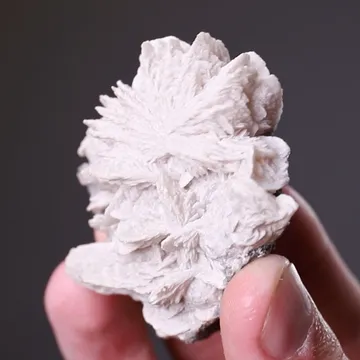
Nentsberry Haggs Mine, UK — renowned Pennine locality famed for baryte, witherite, barytocalcite and complex zinc–lead assemblages, a key site for collectors.
Key facts
Nentsberry Haggs Mine is one of the great collector localities of Alston Moor, not because it yielded the greatest tonnage of ore, but because one small and difficult part of its workings preserves an unusually complete story of barium mineralization in the Northern Pennine Orefield. The mine lies near Nenthead in the Nent Valley, in the Alston Block, where Carboniferous limestones and shales were cut by lead-zinc veins and locally replaced by stratabound “flat” deposits. Its collector fame rests on the Admiralty Concession Flat, a cavity-rich replacement body associated with the Second Sun Vein, where baryte, witherite, barytocalcite, alstonite, sphalerite, galena, quartz and iron-carbonate alteration minerals occur in intimate and often puzzling relationships.
The best Nentsberry Haggs specimens have a look unlike ordinary Pennine vein material. Witherite appears as pseudohexagonal prisms, radiating white masses, glassy cream to pale yellow crystals, and mammillary or hemispherical surfaces, often with a thin white alteration skin of baryte and calcite. Barytocalcite from the Admiralty Flats is famous for curved, bladed, flower-like clusters in white, pale brown and honey-brown tones, commonly showing surface alteration and replacement textures. Baryte is not merely a gangue mineral here; it is part of the locality’s signature, occurring as large corroded blades, etched relics, epimorphs and pseudomorphic forms that record the conversion of a sulphate mineral into barium-carbonate assemblages.
Historically, Nentsberry Haggs also belongs to the later, zinc-and-barium phase of Alston Moor mining. Lead had been worked in the district since the 18th century, but the mine’s most important redevelopment came in the late 19th and early 20th centuries, when Nentsberry Mining Company, Lugdale Chemical Company and then the Vieille Montagne Zinc Company worked ground that eventually produced the classic specimens now scattered through British, European and North American collections.
Regional View
Country View
For collectors, the mine is especially important because the Admiralty Concession Flat is not just a source of loose specimens; it has been studied underground as an in-situ example of complex barium mineralization. In the lower flat, baryte was deposited first in open cavities and was later corroded, dissolved and locally replaced by barytocalcite, with smaller amounts of witherite and alstonite. In the upper flat, witherite is the dominant barium mineral, with barytocalcite more subordinate. The result is a suite in which habit, association and replacement texture matter as much as species name.


Search for specimens: View all specimens from Nentsberry Haggs Mine, UK
Nentsberry Haggs Mine is situated near Nentsberry Bridge, between Alston and Nenthead, within the Alston Moor district of Cumbria. In older literature the locality appears under several names: Nentsberry Haggs Mine, Nentsbury Mine, Haggs Mine and Nentsberry Mine. The main access was the Nentsberry Haggs Horse Level, driven from the northeast side of the Alston-to-Nenthead road, just below Nentsberry Bridge. The historically important specimen ground lies not at the portal but deeper in the system, in the Admiralty Concession Flat at the western end of the Second Sun Vein, close to the relationship between the Second Sun Vein, Wellgill Cross Vein and High Raise Vein.
Geologically, the mine sits in the Alston Block of the Northern Pennine Orefield. The workings pass through shales below the Four Fathom Limestone, encounter Carrs Vein, continue toward Wellgill Cross Vein, and ultimately reach ground beneath the Great Limestone. The Admiralty Concession Flat itself is wholly within the Great Limestone. It is a strata-bound replacement deposit rather than a simple open fissure vein: the limestone was altered by dolomitisation and iron-rich carbonate metasomatism, creating hard calcium-iron-carbonate rock, porosity, brecciation and cavities. These cavities became the stage on which the later sulphide and barium minerals crystallized.
The ore assemblage follows a classic but locally distinctive Pennine pattern. Sphalerite and galena are the main sulphides, with pyrite minor, and quartz and iron-rich carbonate lining many cavities. Fluorite is only inferred in the Admiralty Concession Flat from quartz epimorphs after small cubic crystals; actual fluorite was apparently dissolved during the mineralizing sequence. The barium assemblage came late. In the lower flat, baryte grew as thick bladed crystals in open cavities, some blades reaching 15 cm on edge and more than 20 to 30 mm thick. Later, many baryte crystals were fractured, etched, partly dissolved or removed altogether, leaving cavities and epimorphs. Barytocalcite then formed in abundance, with lesser witherite and alstonite. In the upper flat, witherite became the principal barium mineral, while barytocalcite remained present but subordinate.
The mine’s production history spans several distinct phases. Work in the Haggs area was established by the 18th century, and records indicate that the Nentsberry Haggs Vein was being worked in the 1730s. By the mid-19th century, the Haggs Level had reached the High Raise Vein. In the modern commercial phase, the mine was worked by the Nentsberry Mining Company from 1895 to 1908 and by the Lugdale Chemical Company from 1908 to 1912. In 1913–1914 the Vieille Montagne Zinc Company took over and undertook major development. Wellhope Shaft was sunk in 1925 to a depth of 416 feet, connecting with the Nentsberry Haggs workings and enabling more efficient exploitation of the Wellhope side of the system. Production peaked in the interwar period, with large quantities of crude ore and lead concentrate extracted between 1923 and 1928; zinc, lead and barium carbonate ores all played roles, though the intimate association of blende and witherite caused dressing difficulties.
The best mineral specimens came from several related but not always consistently labelled areas. The Admiralty Concession Flat is the key name for barytocalcite and much of the studied barium-carbonate suite. Liverick Vein is associated with exceptional witherite collected by Arthur Russell in 1931, including the celebrated pseudohexagonal prismatic style with a slight baryte coating. The High Raise and Second Sun Vein area produced rare alstonite and baryte pseudomorph material, while later collector access in the 1970s and 1990s yielded barytocalcite and witherite-bearing specimens from the old workings. Labels may also cite Wellhope Shaft, Liverick Vein, High Raise, Admiralty Flats or Second Sun Vein; these should be read carefully rather than treated as interchangeable.
Collecting access today should be considered highly restricted and hazardous. The Nentsberry Haggs Level is gated, the workings include deep water, unstable shale sections, bad roof, rotting timber, rises, collapses and difficult underground navigation, and the Admiralty Concession Flat is not a casual field-collecting destination. Any underground visit requires permission from the relevant land and mineral-rights holders and should be undertaken only through properly equipped, experienced mine-exploration groups. The nearby Nenthead Mines Conservation Society maintains and interprets parts of the wider Nenthead mining landscape and offers public access to selected safe areas, but that is not the same as unrestricted collecting in Nentsberry Haggs.
Witherite from Nentsberry Haggs is the mine’s flagship species and occurs in both the upper and lower Admiralty Concession flats, with notably different expressions: the upper flat yielded abundant radiating masses and pseudohexagonal forms, usually white from a late microcrystalline baryte-calcite alteration crust but sometimes glassy, while the lower flat produced pseudohexagonal prisms on corroded baryte, mammillary to hemispherical witherite cementing baryte fragments, doubly terminated prismatic crystals with pyramidal terminations, complex pyramidal forms, and small flat hexagonal plates. The great collector pieces are those with well-defined pseudohexagonal architecture, visible translucency or glassy surfaces, and attractive associations with baryte, barytocalcite, sphalerite or galena; ordinary pieces tend to be chalkier, heavily altered, etched, incomplete, or reduced to white crusts where the witherite habit is present but the crystal quality is weak.
Barytocalcite is the mineral that gives the Admiralty Concession Flat its most distinctive visual character: in the lower flat it is abundant toward the northeast end as curved, bladed, often crusty masses and epimorphic forms after baryte, usually white to pale brown because of surface alteration, while rarer cavities contain small lustrous colourless monoclinic prismatic crystals up to about 5 mm; in the upper flat it is commonly pale brown and intimately associated with witherite, including honey-brown material intergrown with the bases of larger witherite crystals and sprays on clear witherite. The finest Nentsberry Haggs barytocalcite specimens show sharply organized flower-like sprays or lustrous honey-brown crystals, especially where the contrast with witherite or corroded baryte makes the paragenesis readable; lesser pieces are massive, heavily whitened, rubbed, or so altered that the original barytocalcite habit is largely obscured.
Barite, the American-market spelling of baryte, is central to understanding Nentsberry Haggs specimens even when it is not the showiest phase: in the lower Admiralty Concession Flat it formed terminated bladed crystals in quartz-sulphide-iron-carbonate lined cavities, with individual blades reported to 15 cm on edge and more than 20 to 30 mm thick, and these were later fractured, etched, partly dissolved, cemented by witherite, or engulfed and replaced by barytocalcite. Collectors prize pieces where barite retains crisp bladed form yet also shows corrosion, replacement, or association with witherite and barytocalcite, because those textures are the locality’s calling card; plain massive white barite or indistinct crusts from Nentsberry Haggs carry far less interest unless supported by precise vein or pocket provenance.
Baryte from Nentsberry Haggs is best approached as both a primary sulphate and a late alteration product: beyond the large lower-flat blades, it appears as white microcrystalline crusts with calcite on barium-carbonate minerals, spear-shaped secondary crusts in the upper flat, pseudomorphic or epimorphic forms after witherite, barytocalcite and alstonite, and fractured blades recemented by witherite or rarer alstonite. Good baryte-labelled specimens from this mine generally show a convincing pseudomorph, epimorph, or replacement relationship—especially baryte after alstonite or baryte/calcite crusts preserving a former barium-carbonate shape—whereas nondescript white coatings are difficult to value highly without a strong old label, documented find history, or a visibly diagnostic association with sphalerite, galena, witherite or barytocalcite.
Other documented minerals from Nentsberry Haggs include sphalerite, galena, quartz, pyrite, calcite, alstonite, ankerite-group carbonate material, goethite, hydrozincite, gypsum, epsomite, melanterite, sulphur, probable jarosite, harmotome and schulenbergite. Alstonite is the most important rarity after the principal barium species: in the Admiralty Concession Flat it occurs as small clear pseudohexagonal pyramidal crystals to about 8 mm and, more commonly, as altered pseudomorphic material on sphalerite, quartz, baryte and broken wall rock; separate collector specimens of baryte after alstonite from the High Raise–Second Sun Vein area are well known. Harmotome is another noteworthy rarity, found as tiny elongated prismatic crystals, usually less than 1 mm, with the characteristic cruciform cross-section and association with sphalerite. Sphalerite and galena are not merely background ore minerals here; the studied flat has produced lustrous black sphalerite cavity linings, small silvery cubo-octahedral galena, and museum-quality sulphide specimens, though most collectors seek the barium-carbonate suite first.
Nentsberry Haggs material is challenging because the very processes that make it scientifically important also complicate labelling. Witherite, barytocalcite, baryte and calcite can be intergrown, altered, replaced or present only as epimorphs. A white surface on a witherite or barytocalcite specimen may be a late microcrystalline baryte-calcite crust rather than simple dirt or weathering. Conversely, a specimen sold as “baryte after witherite,” “witherite with baryte,” “barytocalcite after baryte,” or “baryte after alstonite” may require careful visual examination and, for important pieces, analytical confirmation.
No well-documented systematic fakery is known for this mine, but misidentification and overconfident pseudomorph labels are common risks. Specimens from the locality have been described under multiple mine names and sublocalities—Nentsberry Haggs, Haggs Mine, Nentsbury Mine, Nentsberry Mine, Admiralty Flats, Admiralty Concession Flat, Second Sun Vein, Liverick Vein, High Raise and Wellhope—so an old label should be preserved even when its wording seems imprecise. Provenance matters greatly: an Arthur Russell, Bob King, Lindsay Greenbank, George Elling, Martin Zinn, Harry Critchley, Ralph Sutcliffe or other old British-collection association can add confidence and historical weight.
Condition issues are typical of altered barium-carbonate specimens. Witherite crystals may be contacted, bruised at tips, etched, chalky, or coated by baryte and calcite; barytocalcite blades may be friable, rubbed, softened by alteration, or partially replaced; baryte blades may be naturally corroded and fractured rather than freshly damaged. Distinguishing geological corrosion from post-collection breakage is part of evaluating these specimens. Look for consistent surface patina, old healed or cemented breaks, and matrix relationships; sharp fresh white breaks across an otherwise old, altered surface are less desirable.
Witherite is barium carbonate and should be handled sensibly. It is not a mineral to taste, lick, powder, or expose to acids; wash hands after handling friable material, keep dust out of the air, and store specimens away from children and pets. Some Nentsberry Haggs witherite specimens have been noted in the trade as fluorescing under short-wave ultraviolet light, sometimes with minor long-wave response, but fluorescence is not uniform enough to authenticate a specimen by itself.
On the market, good Nentsberry Haggs specimens appear intermittently rather than abundantly. Witherite is seen more often than choice barytocalcite, but sharply crystallized, translucent, lightly altered witherite with strong form is still scarce. Barytocalcite with honey-brown colour, flower-like sprays, or convincing Admiralty Flats provenance is much harder to replace. Baryte or baryte/calcite pseudomorphs after alstonite, witherite or barytocalcite are specialist pieces: they may look modest to a casual buyer, but for a Pennine collector a correct label and diagnostic habit make them important.
In January 1931, Sir Arthur Russell gained access to Nentsberry Haggs at exactly the right moment in the mine’s modern history. Vieille Montagne had begun major redevelopment at Nenthead in the 1920s, and the new work exposed the kind of cavity that collectors dream of but rarely see recorded with precision. Russell collected many fine witherites, including a specimen measuring 100 by 68 by 8 mm, carrying crystals to 33 by 6 by 23 mm. Peter Bancroft later regarded it as the finest witherite specimen ever collected. Its style was highly distinctive: prismatic pseudohexagonal crystals with a slight surface coating of baryte, from a large cavity on Liverick Vein in the crosscut between Treloar and the High Raise veins. Similar specimens entered the Bob King Collection, now represented at Amgueddfa Cymru, but labels on those pieces vary—Treloar Vein, Carr’s Vein, Haggs Mine, Nentsberry Mine—an object lesson in how a single underground discovery can scatter across collections under several names.
The Admiralty Concession Flat itself reads like a geological crime scene. The lower working preserves baryte blades that were once large, clear and thick, then fractured, etched, partially dissolved and recemented. In one area, baryte crystals sit in a silt-like rock that may be the residue of dissolved limestone; elsewhere, barytocalcite preserves the negative forms of vanished baryte. The investigators of the flat described cavities ranging from small openings to minor caverns, slickensided walls recording fault movement, and two levels of barium mineralization that do not behave the same way. The upper flat is dominated by witherite; the lower flat by baryte and barytocalcite. For a collector, that distinction explains why two specimens with the same mine name can look as if they came from entirely different deposits.
Modern explorers have added a different kind of story, one less about collecting specimens than about understanding why the locality is not a casual destination. A 2022 underground video report described Haggs Mine as ensuring the party was “fully wet” before revealing “beautiful alien formations” and colourful shale banding. Other accounts of the Haggs-to-Brownley system emphasize deep flooded levels, confined passages, and the long search for through-routes between workings. These are not romantic warnings; they are practical context. The same old haulageways and levels that carried ore and exposed the collector pockets now include gated entrances, bad roof, shale falls, deep water and complex connections. Nentsberry Haggs is a classic mineral locality, but it is not a weekend dump-collecting spot.
Trevor F. Bridges, Frank Bouweraerts and Helen Wilkinson, “The Mineralogy of the Admiralty Concession Flat, Nentsberry Haggs Mine, Nenthead, Cumbria,” Journal of the Russell Society, 17, 40–51, 2014 — The essential modern locality paper; includes geology, underground relationships, paragenesis, species notes and the bacteriogenic model for baryte dissolution and barium-carbonate formation.
Trevor F. Bridges and David I. Green, “Baryte Replacement by Barium Carbonate Minerals,” Journal of the Russell Society, 9, 73–82, 2006 — Discusses replacement of baryte by witherite and barytocalcite at Nentsberry Haggs and Rampgill, with geochemical interpretation.
Journal of the Russell Society, Volume 25, 2022 — Includes a detailed discussion of witherite in the North Pennines, with important Nentsberry Haggs historical notes, Arthur Russell’s 1931 collecting, and museum specimens in the Natural History Museum and Amgueddfa Cymru.
K. C. Dunham, Geology of the Northern Pennine Orefield, Vol. 1: Tyne to Stainmore, British Geological Survey Memoir, 2nd edition, 1990 — The foundational geological synthesis for the Alston Block and its zoning of fluorite, baryte and sulphide mineralization.
Jon E. Bouch, Jonathan Naden, Thomas J. Shepherd, John A. McKervey, Brian Young, Antony J. Benham and Hilary J. Sloane, “Direct evidence of fluid mixing in the formation of stratabound Pb-Zn-Ba-F mineralisation in the Alston Block, North Pennine Orefield (England),” Mineralium Deposita, 41, 821–835, 2006 — A broader Alston Block study explaining fluid mixing and stratabound Pb-Zn-Ba-F mineralization, essential background for the Nentsberry Haggs flat.
Jon E. Bouch, Jonathan Naden, Thomas J. Shepherd, Brian Young, Antony J. Benham, John A. McKervey and Hilary J. Sloane, Stratabound Pb-Zn-Ba-F mineralisation in the Alston Block of the North Pennine Orefield (England): origins and emplacement, British Geological Survey Research Report RR/08/06, 2008 — BGS report placing the flat-style deposits of the Alston Block in a wider structural and hydrothermal framework.
Mineralogical Record general indexes mentioning Nentsberry Haggs Mine — Useful for tracking older short notes on pseudomorphs, including baryte and calcite after alstonite and witherite from Nentsberry Haggs.
Nenthead Mines mineral display collection — Includes displayed witherite from Nentsberry Haggs and etched witherite from the Admiralty Concession Flat.
CCDD1734 BARYTOCALCITE, Nentsberry Haggs Mine, Cumbria, UK — Crystal Classics — Short specimen video focused on a barytocalcite specimen from the locality.
Video Report: Haggs Mine Explore, Nenthead — UKAME on 28DaysLater — Underground exploration report with history notes and screenshots showing the flooded, difficult character of the mine.
Mindat locality page for Nentsberry Haggs Mine — Main species list, photographs, locality hierarchy and references.
Mindat witherite entry for Nentsberry Haggs Mine — Focused occurrence page for the mine’s most collectible species.
Mindat barytocalcite gallery — Useful for comparing Nentsberry Haggs barytocalcite habits and associations with other world occurrences.
Wikimedia Commons: Witherite from Nentsberry Haggs Mine — Freely licensed image of a small-cabinet witherite specimen from the locality.
Wikimedia Commons: Barytocalcite from Nentsberry Haggs Mine — Freely licensed image of a classic Admiralty Flats barytocalcite specimen.
Northern Mine Research Society: Nentsberry Mine — Bibliographic entry for mining-history references on Nentsberry Haggs and related operators.
Durham Mining Museum / Mine & Quarry Engineering extract on Nentsberry Mine — Historic mining account with production figures, Wellhope Shaft details and ore-dressing notes.
Nenthead Mines Conservation Society — Best starting point for the wider Nenthead mining landscape, conservation work and public open days.
Co-Curate: Haggs Mine, Nentsberry — Concise historical overview of the mine site, buildings and closure chronology.
Steetley Minerals: Alston Moor — Collector-oriented overview of Alston Moor localities, including notes on Nentsberry Haggs barytocalcite and witherite.