Quiruvilca Mine, Peru - a high, cold Cu-Pb-Zn-Ag-Au vein locality famed for orange orpiment on barite, black hutchinsonite needles, and sulfide associations.
Key facts
Quiruvilca is one of the great Andean sulfide-and-sulfosalt localities: a high, cold, polymetallic Cu-Pb-Zn-Ag-Au vein system in La Libertad, northern Peru, famous not because it produced one attractive mineral, but because it produced several collector classics from the same arsenic-rich hydrothermal system. Its best specimens have a distinctive Quiruvilca look: saturated orange orpiment on pale barite, glossy black hutchinsonite needles with red internal fire, sharp brassy pyrite octahedra on white quartz, metallic enargite prisms and trillings, and dark cogwheel bournonite in sulfide-rich association. Few localities combine visual drama, difficult chemistry, and serious mineralogical rarity so tightly.
The deposit sits in Miocene volcanic rocks of the Calipuy volcanic complex, where narrow but persistent veins filled fractures and faults in andesitic to basaltic host rocks. The classic zoning of the district is central to understanding the specimens: an inner enargite-rich copper zone, a surrounding transition zone, a lead-zinc zone, and an outer stibnite zone. That zonation is not merely an ore-geology abstraction; it explains why Quiruvilca specimens so often juxtapose copper-arsenic sulfides, lead-zinc sulfides, thallium-bearing sulfosalts, barite, quartz, carbonates, realgar, orpiment, and native arsenic in combinations that are immediately recognizable to experienced collectors.
Regional View
Country View
Historically, Quiruvilca was worked long before it became a modern specimen name. Mineralization in the district was reported in 1789; later small-scale silver mining gave way to industrial-scale development by Northern Peru Mining and Smelting, the ASARCO-associated operator that made Quiruvilca a major twentieth-century mine. To collectors, the mine’s reputation sharpened in the 1970s and 1980s, first with superb pyrite and orpiment, then with the hutchinsonite-orpiment-barite associations that still define the locality’s highest collector tier. Later decades produced sporadic new material, including notable native arsenic and renewed hutchinsonite finds, but the finest classic pieces remain fundamentally historical.
Search for specimens: View all specimens from Quiruvilca Mine, Peru
The Quiruvilca Mine is in Quiruvilca District, Santiago de Chuco Province, Department of La Libertad, in the northern Peruvian Andes east of Trujillo. Published mine descriptions place it above the tree line, with workings roughly between the mid-3,000-meter and just over 4,000-meter elevations. The access road from Trujillo climbs from the coast into the high Andes, a journey that has become part of the mine’s collecting lore because specimens from Quiruvilca are inseparable from the difficult geography of their source.
Geologically, Quiruvilca is a large polymetallic vein district developed in volcanic rocks. Richard W. Lewis described the district as lying in bedded andesitic and basaltic volcanics intruded by small andesitic and dacitic bodies, with numerous dikes and breccia pipes. Later technical descriptions emphasize that the deposit consists of more than 130 mineralized structures, most of them narrow fissure-fill veins occupying fractures and faults. The productive veins may be narrow, commonly well under a meter in average mined width in later operations, but many have excellent lateral and vertical continuity, with splits, loops, pinches, swells, and locally wider ore shoots.
The classic mineral zoning is one of Quiruvilca’s most important features. At the center is the enargite zone, an enargite-pyrite copper core with lesser chalcopyrite, tennantite, tetrahedrite, sphalerite, galena, and hutchinsonite. Around it lies a transition zone rich in sphalerite, pyrite, tetrahedrite-tennantite, galena, marcasite, arsenopyrite, covellite, and wurtzite. Farther outward, the lead-zinc zone is dominated by sphalerite and galena with pyrite, chalcopyrite, tetrahedrite-tennantite, marcasite, arsenopyrite, gratonite, and wurtzite. Beyond that is the stibnite zone, where stibnite, arsenopyrite, pyrite, sphalerite, galena, quartz, and rhodochrosite are characteristic. This outward shift from high-sulfidation copper-arsenic assemblages toward lead-zinc and antimony-rich assemblages is the backbone of Quiruvilca mineral collecting.
The vein paragenesis is commonly divided into four broad stages: an early pyrite-quartz stage; a base-metal stage with arsenopyrite, galena, enargite, tetrahedrite-tennantite, sphalerite, pyrite, chalcopyrite, stannite, and related copper-tin or silver-bearing sulfides; a sulfosalt stage with minerals such as alabandite, marcasite, arsenopyrite, quartz, manganaxinite, clinozoisite, stibnite, robinsonite, jamesonite, barite, orpiment, realgar, hutchinsonite, geocronite, native arsenic, seligmannite, and lead-arsenic-sulfur glassy material; and a carbonate stage with manganoan calcite, rhodochrosite, dolomite, calcite, and quartz. For the collector, this translates into recurring visual pairings: orpiment with barite and hutchinsonite; pyrite with quartz and sphalerite; enargite with pyrite or tetrahedrite-tennantite coatings; bournonite with pyrite, quartz, sphalerite, and galena; and late carbonates cutting or lining sulfide-rich material.
Mining history at Quiruvilca is long and complicated. Mineralization was reported in 1789, and small-scale silver mining continued in the district during the nineteenth and early twentieth centuries. Northern Peru Mining and Smelting, predecessor to later Mina Quiruvilca operations and associated with ASARCO, consolidated concessions in the 1920s. The mine shut down in 1931, reopened in 1940, and became a sustained polymetallic producer. Early operations focused on the copper-bearing enargite zone, but production later shifted substantially toward lead-zinc veins. In 1967 the mill began treating complex ores to produce separate copper, lead, and zinc concentrates. Pan American Silver acquired Quiruvilca in 1995, and later reports describe production from dozens of veins, underground cut-and-fill mining, and selective flotation to make copper, lead, and zinc concentrates carrying silver and gold values.
The mine’s ownership and operating status changed significantly in the twenty-first century. Pan American Silver sold the mine to a Southern Peaks Mining-related entity in 2012; subsequent ownership changes led to Sociedad Minera Quiruvilca Inversiones S.A.C. and then Compañía Minera Quiruvilca. Commercial operations ceased after the late-2017 shutdown and bankruptcy-related crisis, followed by abandonment, unresolved closure obligations, environmental orders, and occupation of workings by informal miners. Modern collector access should therefore be treated as effectively closed and unsafe. Quiruvilca is not a casual collecting locality; specimens now reach the market primarily from old collections, historical dealer inventories, miner-saved material, and occasional post-operational trickles rather than organized collector digging.
Specimen-producing pockets were never an everyday byproduct of the mine. Reports from visits during active Southern Peaks operations describe large numbers of working faces and constant ore movement, yet very few open cavities suitable for collectible crystals. That scarcity explains the premium on intact classic specimens. The enargite zone supplied many of the most famous orpiment, realgar, hutchinsonite, and enargite associations; historic orpiment material of the finest quality is tied especially to the 1970s through early 1980s period. Hutchinsonite-orpiment-barite material is particularly prized where black to red hutchinsonite needles stand cleanly above orpiment and pale barite. A later, highly unusual native arsenic find in the summer of 2013 produced large botryoidal gray masses, some on contrasting quartz, and gave collectors a very different kind of Quiruvilca arsenic specimen.
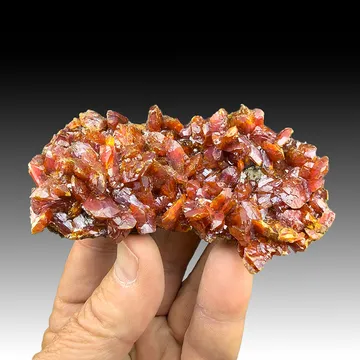
Quiruvilca orpiment is the mineral that gives the locality its strongest color signature: yellow-orange to burnt-orange, commonly wedge-shaped or chisel-terminated crystals to about 3 cm, often richly perched on pale barite and intergrown or associated with hutchinsonite, realgar, pyrite, enargite, quartz, seligmannite, sphalerite, calcite, and native arsenic. The best pieces are not simply bright; they are sharp, lustrous, translucent to gemmy, and undamaged, with discrete crystal form rather than dull orange crust. Classic cabinet-quality orpiments are mostly historical, especially from the 1970s to early 1980s, and the finest examples show saturated color, three-dimensional composition, and survival of fragile crystal edges despite the mine-to-market handling history.
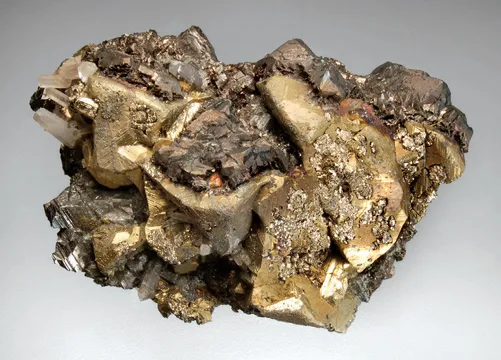
Quiruvilca pyrite is famous for sharp brassy octahedra and pyritohedra, commonly on white quartz or pyrite-rich matrix, with good crystals reaching around 2 cm and exceptional groups showing larger intergrown octahedra, stepped faces, and attractive modification by pyritohedral or dodecahedral forms. Early collector recognition of Quiruvilca in the 1970s was strongly tied to these pyrites, which were considered among the finest octahedral pyrites available at the time. The best pieces have bright metallic luster, crisp edges, balanced spacing on contrasting quartz, and minimal bruising; lesser examples are massive, crowded, contacted, or dulled by oxidation and clay from the vein environment.
Native arsenic from Quiruvilca occurs as gray to dove-gray botryoidal and layered masses, typically with a satiny to matte surface and in the best specimens set off by quartz or sulfide matrix. Although native arsenic was documented in the broader Quiruvilca assemblage, the collector-important material is especially associated with a highly unusual pure-arsenic find in the summer of 2013 that yielded sculptural plates and mounded cabinet specimens. Good pieces are three-dimensional, thickly botryoidal, and visibly layered rather than thin smears; the most desirable examples have contrasting white quartz around the margins or as a pedestal, giving an otherwise austere elemental mineral real display presence.
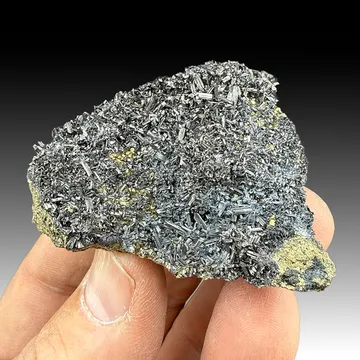
Quiruvilca is the modern collector benchmark for hutchinsonite, a rare Tl-Pb-As sulfosalt that here forms black to deep red, lustrous, acicular to prismatic crystals, commonly described as thick needles to about 1 cm and showing red internal reflections when broken edges or strong lighting reveal the color beneath the dark surface. The classic association is hutchinsonite with orpiment and barite, sometimes with argentobaumhauerite or related lead-arsenic sulfosalt material, and it belongs to the arsenic-rich sulfosalt environment of the enargite zone. The best specimens show abundant, well-separated needles or sprays on contrasting orange orpiment or pale barite; ordinary pieces may require magnification, have sparse black needles lost in dark sulfide matrix, or be confused with stibnite by non-specialists.
Enargite from Quiruvilca is one of the mine’s defining ore and specimen minerals, forming metallic gray to black prismatic and tabular crystals, including distinctive six-pointed trillings that can resemble star forms. Large prisms may be partly or wholly coated by epitaxial tetrahedrite-tennantite, and such coatings have sometimes led to mistaken “pseudomorph” labels when the relationship is really overgrowth or replacement on enargite. Fine Quiruvilca enargites come from the central enargite zone and are judged by crystal size, sharpness, luster, recognizable trilling or prismatic habit, and clean contrast with pyrite, quartz, or barite; lesser pieces are massive ore fragments or dull black aggregates without readable crystal form.
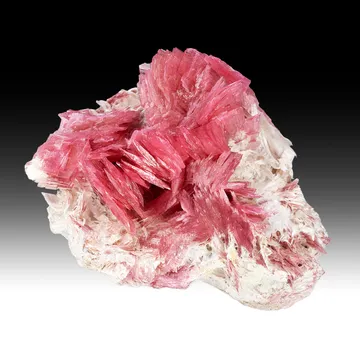
Barite at Quiruvilca is important less as a stand-alone show mineral than as the pale architectural stage for the mine’s arsenic-rich specimens, especially orpiment-hutchinsonite combinations. It occurs as tabular to bladed pale crystals and rosette-like aggregates in the sulfosalt assemblage, closely tied to orpiment, hutchinsonite, realgar, pyrite, enargite, sphalerite, and rare lead-arsenic sulfosalts. The best barite pieces are those where the barite is clean, sharp, and compositionally useful, either carrying bright orange orpiment rosettes or exposing dark hutchinsonite needles; ordinary barite without colorful or rare associates is far less sought after, even though it is geologically central to many classic Quiruvilca specimens.
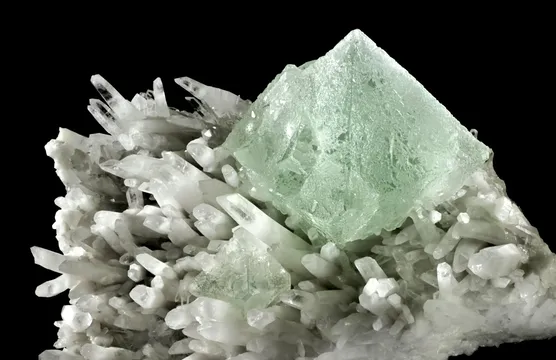
Quartz is a persistent Quiruvilca gangue mineral and a key visual contrast in the mine’s sulfide specimens, appearing as white to colorless drusy coatings, small prisms, vein quartz, and quartz-rich matrices carrying pyrite, sphalerite, enargite, hutchinsonite, native arsenic, calcite, and bournonite. In some pyrite specimens the white quartz host sets off brassy octahedra beautifully, while in arsenic specimens quartz around the edge of gray botryoidal native arsenic can make a cabinet piece far more aesthetic. Good Quiruvilca quartz specimens are usually combination specimens rather than quartz-only pieces, valued for clean support, fresh luster, and the way the quartz frames the sulfides and sulfosalts.
Quiruvilca bournonite forms gray-black to black metallic crystals, most prized as cogwheel twins that may reach about 3 cm, commonly associated with pyrite, quartz, sphalerite, galena, tetrahedrite-group minerals, calcite, hutchinsonite, chalcopyrite, gratonite, seligmannite, and stannite. The arsenic-rich character of the district can darken and complicate the bournonite appearance, making sharp form and confirmed identification important. A fine Quiruvilca bournonite has distinct cogwheel morphology, bright luster, and separation from the sulfide matrix; ordinary pieces can be difficult to distinguish visually from other dark sulfosalts or may present as crowded, massive, low-relief metallic aggregates.
Sphalerite is abundant in the lead-zinc and transition parts of Quiruvilca’s zoned system and appears on specimens as dark resinous to black crystals or granular masses associated with pyrite, bournonite, hutchinsonite, galena, quartz, barite, orpiment, gratonite, calcite, tetrahedrite-group minerals, seligmannite, chalcopyrite, rhodochrosite, and native arsenic. For collectors it is usually a supporting mineral, but a good Quiruvilca sphalerite specimen can be important when it carries sharp pyrite octahedra, bournonite twins, or rare sulfosalts. The most attractive examples show distinct crystals and contrast; routine material from the lead-zinc zone is commonly massive, dark, and ore-like.
Calcite belongs chiefly to the late carbonate stage at Quiruvilca, with manganoan calcite, calcite, dolomite, rhodochrosite, and quartz filling later vein space after the main sulfide and sulfosalt stages. As a specimen mineral it is generally secondary to the sulfides, appearing with pyrite, quartz, sphalerite, bournonite, orpiment, and other vein minerals, but it can add useful pale contrast and late-stage texture. Good Quiruvilca calcite specimens are combination pieces where the carbonate is clean, crystallized, and visually clarifies the paragenesis; ordinary calcite is common gangue or late vein filling and rarely competes with Peru’s famous carbonate localities unless accompanied by classic Quiruvilca sulfides or sulfosalts.
Beyond the headline species, Quiruvilca is a serious sulfosalt locality. Documented rarities include seligmannite, gratonite, geocronite, robinsonite, jamesonite, stannite, famatinite, luzonite, tetrahedrite- and tennantite-subgroup minerals, argentobaumhauerite or baumhauerite-like material, and the historical non-IMA “revoredite” lead-arsenic-sulfur glassy material. Scheelite, realgar, chalcopyrite, stibnite, arsenopyrite, galena, wurtzite, fluorapatite, rhodochrosite, dolomite, and manganoan calcite round out the collector-relevant assemblage. Quiruvilca is not best understood as a type-locality destination; its importance lies in world-class crystallization of rare arsenic- and thallium-bearing species, exceptional examples of ore minerals in a zoned Andean vein system, and a paragenesis that rewards careful labels and careful identifications.
Quiruvilca specimens demand careful handling. Orpiment and realgar are arsenic sulfides; hutchinsonite contains thallium as well as arsenic and lead; native arsenic is elemental arsenic; many associated sulfosalts contain lead, arsenic, antimony, copper, or silver. These are not minerals for children’s collections, kitchen display shelves, or humid open cabinets. Handle specimens as little as possible, wash hands after handling, do not cut or grind them, and avoid generating dust. Hutchinsonite and orpiment combinations should be treated as highly toxic and fragile.
Condition is the central issue with Quiruvilca orpiment. Orpiment is soft, sectile, easily bruised, and vulnerable to loss of edges and luster. Even a light touch can dull or damage crystals. Realgar is light sensitive, and orpiment specimens should also be kept away from strong direct light to preserve color and prevent long-term degradation of arsenic sulfide surfaces. Store fine orpiment and realgar in a dark, stable cabinet and avoid repeated display under hot lamps or direct sun.
Mislabelling is common enough to matter. Older labels may say “La Libertad Mine,” “ASARCO Mine,” “Mina Quiruvilca,” or simply “Quiruvilca,” all potentially referring to the same mining complex, but buyers should distinguish Quiruvilca Mine specimens from broader Quiruvilca District material and from other Peruvian sulfide localities. Hutchinsonite has historically been mistaken by miners or dealers for stibnite, especially when the red internal color is not obvious. Enargite partly coated or replaced by tetrahedrite-tennantite may be mislabeled as a pseudomorph. Bournonite, enargite, tetrahedrite-tennantite, and other dark metallic sulfosalts can be difficult to separate visually without context or analysis.
Authenticity problems are less about outright manufactured fakes than about locality inflation, incomplete species identification, and repaired or stabilized fragile arsenic sulfide specimens. Loose orpiment clusters may have been reattached; old breaks can be disguised by color and luster; and dark acicular “hutchinsonite” should be viewed skeptically if it lacks the correct Quiruvilca association or if no provenance is offered. On valuable hutchinsonite, bournonite, enargite, or arsenic specimens, a solid old label, a known dealer pedigree, or analytical confirmation is worth a premium.
Fluorescence is not a major buying point for the headline Quiruvilca minerals; several key species are reported as non-fluorescent. Scheelite, where present, may be fluorescent, but Quiruvilca is not primarily a fluorescence locality. Market availability is uneven: small orpiment, pyrite, barite-or-hutchinsonite combinations, and mixed sulfide pieces appear periodically, while top orpiment, large sharp enargite, fine cogwheel bournonite, and abundant hutchinsonite on orpiment remain scarce. The 2013 native arsenic find made good arsenic specimens more obtainable for a time, but fine matrix pieces remain distinctive and finite. Since the mine’s commercial closure and unsafe informal occupation, new supply should be regarded as irregular rather than dependable.
The modern collecting story of Quiruvilca has one particularly vivid chapter: Ray McDougall’s 2013 visit with his longtime collecting friend David Joyce. The trip began not as ordinary mineral tourism but through a corporate-mining connection. In his previous career as a corporate securities lawyer, McDougall had helped a client negotiate the acquisition of the Quiruvilca Mine; when the transaction was complete after 15 months, the owner invited him to visit the mine as a special guest. For a collector, that meant something very unusual: guided access to a world-famous underground sulfide mine while it was still operating.
The approach itself was memorable. After flying to Trujillo, McDougall and Joyce climbed into the Andes on the road toward Quiruvilca, above the Moche River valley, on narrow mountain roads shared with trucks carrying explosive materials. McDougall later summed up the driving culture in one line: “There was no ‘right side’ of the road.” The destination was the town of Quiruvilca at about 12,500 feet, or roughly 3,800 meters, where the name “Quiruvilca” was explained to them as a Quechua phrase meaning “sacred tooth,” linked by locals to a protruding landform in the landscape.
Once in town, they looked for specimens the old-fashioned way: by visiting miners’ homes. Even there, at the source, fine material was hard to find. Local specimen runners were already buying material on a nearly daily basis and sending it into Peruvian dealer channels, so direct mine-town acquisition did not mean easy access to classics. That detail explains much about the modern market: many Quiruvilca specimens seem to appear suddenly far from the mine, but at the source the chain from miner to runner to Lima dealer could move faster than visiting collectors.
Their underground access came through Southern Peaks and included guided days in active workings. At the time of the visit, the operation was running 24 hours a day, in three shifts, with small teams of six workers each digging at about 60 separate working faces. About 1,000 people were working across the mining, milling, and office complex. Ore moved out by rail carts, and the scale of the operation was industrial, not romantic. Yet for collectors the decisive lesson was scarcity: the visitors saw sulfide mineralization and examined promising ground, but open pockets suitable for fine specimens were rare.
The underground conditions also left an impression. Corrosive water meant rails in active workings needed replacement about every five years, and timber supports every couple of years. McDougall and Joyce saw the practical infrastructure of a working mine: rails, timber, headings, ore carts, and constant maintenance, with safety treated as the first priority. In one small pocket McDougall found chalcopyrite, tetrahedrite, and micros—interesting enough to investigate, but not good enough to extract as serious specimens. The story is a useful corrective to show-table abundance: even in one of the world’s great specimen mines, a day underground could yield more geological understanding than collectable crystals.
The mineral stories carried their own contrasts. The mine that collectors first recognized in the 1970s for octahedral pyrite later became renowned for orpiment, enargite, bournonite, and hutchinsonite. McDougall emphasized the fleeting nature of such finds: the famous enargite-zone environment that produced the finest orpiment and hutchinsonite was no longer the focus of modern mining. In the same presentation he showed Quiruvilca orpiment as both magnificent and vulnerable—large, golden-orange classics surviving only when they passed quickly into careful hands, and tiny micro-scale associations of orpiment and realgar that required close photography to appreciate.