






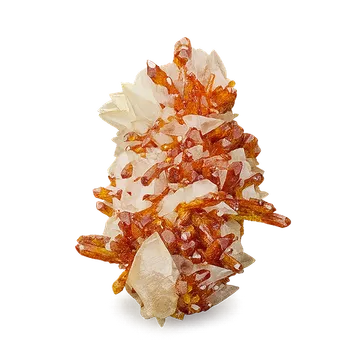
Orpiment — Quiruvilca, Peru: vivid orange to honey-yellow As2S3 with translucent crystals and chisel terminations, a Peruvian locality prized by collectors.
Key facts
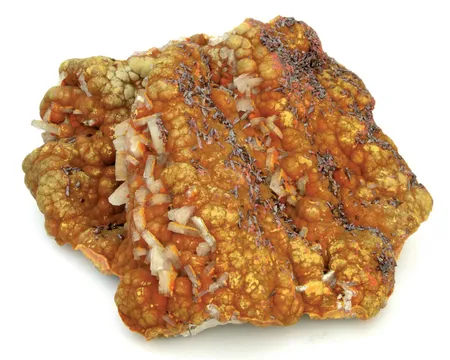
Quiruvilca orpiment is one of the great Peruvian mineral classics: glowing orange to honey-yellow As2S3 from a high-Andean polymetallic vein system whose mineralogy reads like a catalogue of arsenic-rich sulfides and sulfosalts. The best specimens have a warm internal fire that is difficult to capture in ordinary light—translucent chisel-terminated crystals, wedge-like blades, lustrous platy sprays, and botryoidal to drusy orange crusts that can look almost molten when backlit. At its finest, Quiruvilca orpiment is not simply “good for Peru”; it belongs in the broader world conversation for top-quality crystallized orpiment.

Photo: Marie-Lan Taÿ Pamart / Wikimedia Commons
The locality is the Quiruvilca Mine, also known historically as the La Libertad Mine or ASARCO Mine, in Quiruvilca District, Santiago de Chuco Province, La Libertad, northern Peru. It is a large underground polymetallic vein deposit hosted chiefly by the Miocene Calipuy volcanic sequence: andesite flows and flow breccias, minor basalt flows, and related volcanic-sedimentary units cut by dikes, stocks, and steep fracture systems. The ore field is strongly zoned. The inner copper-rich enargite zone grades outward through transition and lead-zinc zones to an outer stibnite zone. Orpiment belongs to the arsenic-rich sulfosalt stage of mineralization and is most memorable in association with baryte, realgar, hutchinsonite, pyrite, enargite, native arsenic, sphalerite, quartz, calcite, and other Quiruvilca sulfides and sulfosalts.
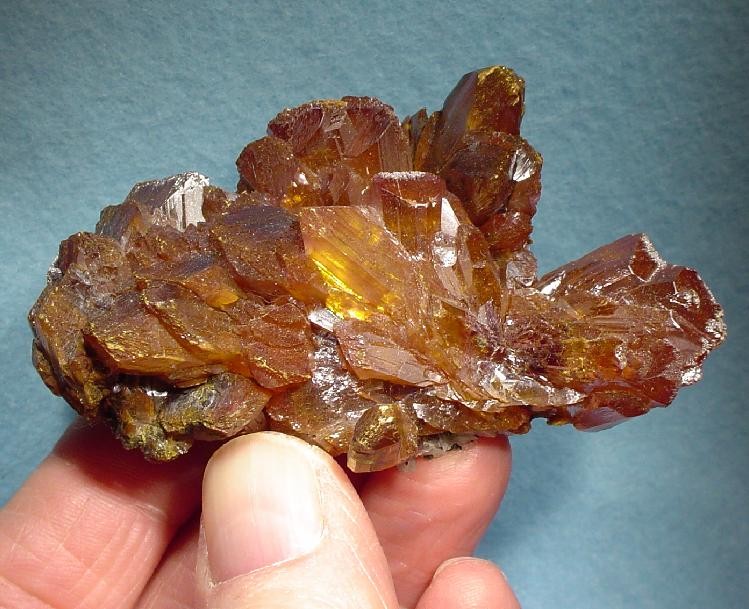
Photo: Rob Lavinsky / Wikimedia Commons
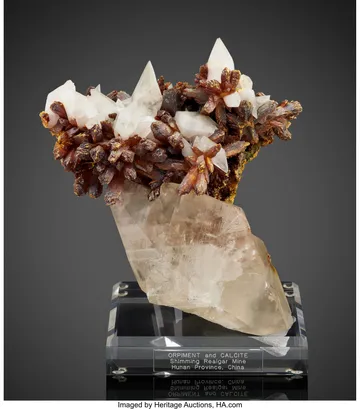
Collectors prize the locality for two different but equally characteristic looks. The first is the classic crystallized style: sharp, translucent, orange to burnt-orange crystals, often with chisel-like terminations and a glassy-to-resinous luster. The second is the association style: botryoidal or radiating orange orpiment hosting clear to white baryte, red realgar, dark hutchinsonite, pyrite, or mixed arsenic-rich sulfosalts. A specimen that combines transparency, undamaged crystal edges, strong color, and documented old Quiruvilca provenance is far more desirable than a massive or powdery yellow-orange piece, even if both are legitimate orpiment from the district.
Historically, Quiruvilca came to collectors’ attention not as an orpiment mine but as a major base- and precious-metal operation that happened to produce exceptional specimens. Its fame in the collector world expanded during the specimen-market boom of the 1960s and 1970s, when miners and local intermediaries began moving fine pyrite, enargite, hutchinsonite, realgar, and orpiment into Lima and onward to international dealers. The finest old orpiments are now collection pieces first and mine products second: fragile, light-sensitive survivors from a mining district whose richest specimen zones have been heavily worked.
Search for specimens: View all orpiment specimens from Quiruvilca District, La Libertad, Peru
The collecting locality is the Quiruvilca Mine in the high Andes of La Libertad, about 76–80 km east of Trujillo by road. The mine lies at roughly 3,450–4,075 m elevation, with the town and mine area around 3,800 m. The setting is starkly Andean: steep valleys, cold wet-season roads, a mining town pressed into limited mountain space, and underground workings developed through more than a century of industrial mining.
Geologically, Quiruvilca is a classic zoned polymetallic vein district. The host rocks belong mainly to the Calipuy volcanic sequence, a thick Miocene volcanic package of andesite flows, breccias, minor basalt, and tuffaceous lacustrine sediments. The veins fill steep fractures and faults, especially E-W and NE-SW structures, and the deposit contains more than 130 mineralized structures. Although many veins are narrow, they can be laterally and vertically persistent, with splits, loops, pinch-and-swell structure, massive sulfide sections, banded sulfide-gangue textures, and occasional vugs that made specimen growth possible.
The district’s metal zoning is central to understanding its orpiment. The copper-rich core is the enargite zone, historically a key part of the mine and the source area for many of the famous arsenic-rich specimen associations. Around it lies a transition zone rich in sphalerite, pyrite, tetrahedrite-tennantite, and related sulfides; farther out is the lead-zinc zone with sphalerite and galena; beyond that is a stibnite zone. Orpiment is part of the late arsenic- and sulfosalt-rich mineral suite with realgar, hutchinsonite, native arsenic, stibnite, jamesonite, robinsonite, geocronite, seligmannite, baryte, quartz, and other species. This explains why the best orpiment specimens so often carry baryte, realgar, pyrite, hutchinsonite, or mixed dark sulfide matrix rather than occurring as isolated pure crystals.
Mining history at Quiruvilca reaches back at least to reported mineralization in 1789, with small-scale silver mining in the 19th century and industrial-scale development in the early 20th century. Northern Peru Mining and Smelting, tied to ASARCO, operated the property for much of the 20th century. Operations shut down in 1931, reopened in 1940 with a flotation plant, and later produced copper, lead, zinc, and silver concentrates from complex ores. Pan American Silver acquired Quiruvilca in 1995 and later sold it in 2012 to Quiruvilca Ltd., a subsidiary of Southern Peaks Mining. Subsequent ownership and operating changes were followed by a difficult closure and environmental period; modern access should be regarded as controlled, hazardous, and unsuitable for casual collecting.
Quiruvilca specimen recovery was historically tied to active mining rather than organized collector digging. Miners recovered specimens when pockets or vugs appeared during production, often before or after shifts or during breaks. Local “laques,” the Quechua-rooted term used in collector accounts for mineral specimens, moved from miners to local buyers and Lima dealers, then into the international market. That system explains why many old pieces have dealer labels but little pocket-level documentation, and why fine condition is so important: orpiment is so soft and fragile that many crystals were damaged before ever reaching a collector’s cabinet.
Notable finds include crystallized orange orpiment from the 1970s to early 1980s, later hutchinsonite-orpiment associations, and smaller modern recoveries from active workings. Field accounts from 2013 describe the richest historical enargite-zone specimen areas as largely worked out, while active mining at the time was focused mostly in the lead-zinc and transition zones. That matters to collectors today: the great old orange crystal groups are not being replenished in quantity, and the best specimens increasingly appear as old-collection pieces rather than fresh mine production.
Quiruvilca orpiment spans several habits, but the most collectible material falls into three recognizable categories.
The first is crystallized orange orpiment: translucent to semi-transparent crystals, commonly wedge-like, platy, bladed, or chisel-terminated, with individual crystals reported to around 2.5–3 cm on exceptional pieces. These specimens can show saturated orange, burnt-orange, yellow-orange, or brownish-orange color, sometimes with a honey glow when light passes through the crystal edges. Sharp termination faces, intact luster, and clean separation between crystals are the features that lift these pieces above ordinary massive orpiment.
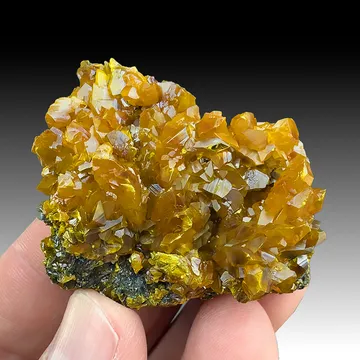
The second is botryoidal and radiating orpiment, typically yellow-orange to orange, sometimes forming rounded masses coated with tiny drusy crystals. This style may occur on white or colorless baryte, altered volcanic wall rock, pyritic matrix, or mixed dark sulfides. It is especially attractive when clear baryte blades or tabular crystals sit on the orange arsenic sulfide, giving a strong color contrast.
The third is association material, where orpiment serves as the chromatic stage for other Quiruvilca classics. Red realgar, dark hutchinsonite, baryte, pyrite, enargite, sphalerite, native arsenic, seligmannite, argentobaumhauerite, quartz, calcite, and fluorapatite are all documented associates in the locality’s specimen record. Orpiment with hutchinsonite is especially prized when the hutchinsonite forms sharp dark crystals against bright orange orpiment. Orpiment with realgar has the dramatic red-orange/yellow-orange palette collectors love, but it demands extra care because realgar is even more famously light-sensitive.
Color is one of the main quality factors. The best Quiruvilca orpiment is richly orange rather than dull sulfur-yellow, with translucency or backlit glow. Brown-orange pieces can be attractive if lustrous and undamaged, but muddy, powdery, or heavily oxidized surfaces are less desirable. Luster should be resinous to glassy on crystal faces; silky or earthy surfaces usually signal botryoidal or degraded material rather than top crystal quality.
Size matters, but condition matters more. A small pristine thumbnail with one complete, lustrous, translucent crystal can be more important than a larger plate with rubbed edges and bruised terminations. On cabinet-size pieces, look carefully for broken crystal tips, abraded ridges, compression marks from packing, and hidden repairs. Quiruvilca orpiment can be so soft that even gentle handling can leave a mark; specimens with undamaged faces and protected old provenance deserve a premium.
Matrix and association affect both aesthetics and confidence. Baryte is one of the classic companions and gives useful context. Pyrite, realgar, hutchinsonite, enargite, and dark sulfide matrix are also highly credible Quiruvilca companions. A loose orange crystal without matrix can still be legitimate, but it is harder to place confidently unless accompanied by strong provenance.
Quiruvilca orpiment should be treated as a fragile display specimen, not as a handling mineral. Orpiment has very low hardness, perfect cleavage, and an arsenic sulfide composition. Keep it out of children’s reach, do not lick or wet it, avoid grinding or trimming it without professional controls, and wash your hands after handling. Specimens should be displayed behind glass or acrylic, not passed around.
Light exposure is a real preservation issue. Quiruvilca collectors often discuss the mineral in the same breath as realgar because the two occur together, and both are sensitive collector species. Store fine Quiruvilca orpiment in darkness when not on display, and avoid direct sun, high heat, and intense display lighting. If the piece contains realgar, dark storage becomes even more important; realgar can alter under light to yellow-orange pararealgar, changing the specimen permanently.
Condition is the first authenticity filter. A pristine Quiruvilca orpiment should look plausible for a mineral of hardness 1.5–2: sharp but delicate, with no suspiciously over-cleaned surfaces, no glossy coatings hiding bruises, and no fresh-looking breaks disguised by matrix dust. Many legitimate specimens show minor edge wear because miners, runners, and dealers handled them long before they reached modern collectors. The goal is not perfection at any cost, but honest condition relative to the specimen’s age, size, and habit.
There is no widely documented Quiruvilca-specific fake tradition comparable to the classic “manufactured” problems of some other species and localities. The more realistic concern is mislabeling. Orange botryoidal orpiment with baryte has appeared from more than one arsenic-rich locality, and isolated crystals are easier to detach from their geological context. Provenance matters: old labels from established dealers, collection history, and associations such as baryte, realgar, hutchinsonite, enargite, or pyrite on typical Quiruvilca matrix all strengthen the case.
Repairs are possible and should be checked for, especially on larger old crystal groups. Use a loupe and good side lighting to examine contact points between crystals and matrix. Look for glue sheen, unnatural gaps filled with dust, or crystal clusters whose orientation does not match the rest of the growth. Orpiment is soft enough that aggressive cleaning can be just as damaging as breakage; avoid specimens whose surfaces appear scrubbed, polished, waxed, or consolidated unless the treatment is disclosed.
Market availability is steady but limited at the high end. Small orpiment-baryte pieces and massive to botryoidal examples appear regularly enough, while top old crystallized plates with 2 cm-plus lustrous orange crystals are much scarcer. The best examples tend to surface through old collections, auction lots, or established fine-mineral dealers rather than as fresh mine output. A Quiruvilca orpiment with strong color, intact terminations, and good provenance is worth buying carefully when it appears; replacing it later may not be easy.
A modern trip to Quiruvilca begins almost at sea level and ends in a different world. Ray McDougall and David Joyce reached the mine in 2013 after flying to Trujillo and then climbing into the Andes by road. The first stretch passed along the coast and through fields of sugar cane, but the comfort did not last. Past Carabamba, the road became a long construction zone of mud, potholes, heavy trucks, buses, pickups, and supply vehicles feeding a booming mining belt. In McDougall’s later account, the highway was so treacherous that a week after their visit a bus with 60 people crashed from the same road into a river gorge, killing everyone aboard. The road’s chaos became part of the locality’s story: potholes large enough to swallow a tanker truck, traffic using whichever lane could be survived, clouds opening briefly over the steep Moche valley, and the mine town waiting far above at about 3,800 m.
Quiruvilca’s name gave the trip a moment of poetry. McDougall wrote that “Quiruvilca” means “sacred tooth” in Quechua, referring to a prominent volcanic neck rising several kilometres from town. In a district built on veins, adits, ore cars, and sulfides, that image is hard to forget: a tooth of volcanic rock above one of Peru’s classic arsenic-rich mineral districts.
At the mine, the visitors stayed inside the guarded company compound, a remnant of the ASARCO era with management houses, trees, and a mine manager’s residence that felt to Joyce like a guest house. Marina, who had worked in the house for about 30 years, prepared meals and kept the place comfortable. The compound was “dry,” so there was no wine with dinner despite the cold mountain evenings and the fireplace. The altitude, however, was unavoidable. Joyce felt the usual light-headedness and breathlessness; McDougall was hit harder, with racing pulse, nausea, and headache, and spent much of a day recovering with oxygen under the company doctor’s supervision.
Underground, the scale of Quiruvilca came into focus. The mine was not a tidy single tunnel but a hodge-podge of older and newer workings, multiple access adits and ramps, rail haulage, conveyor systems, ore passes, skip-hoisting, timbered stopes, and many kilometres of drifts. In 2013, active mining was taking place in roughly 60 stopes, while the mill capacity was described at about 1,725 tons per day. McDougall estimated, after seeing maps and plans, that the workings could total 100–200 km of tunnels, possibly more. Joyce described high-grade sulfides held together by clay in places, with the ore minerals supported by material that seemed to have almost no tensile strength. Heavy timbering was not decoration; it was survival in poor ground.
The collectors were allowed underground on three days. Their goal was specimen recovery, but the mine was not conveniently working the old orpiment ground. Most active stopes were in the lead-zinc-silver zone, not the copper-rich enargite zone that had produced the great orpiment, enargite, and hutchinsonite specimens of earlier decades. Joyce found dark sphalerite, pseudomorph-like spherical forms after perhaps enargite, iridescent gemmy sphalerite, tiny sharp seligmannite crystals, and botryoidal sphalerite speckled with tetrahedrite. But he also recorded the collector’s hard truth: there were cavities, yet most were too small or too barren to produce important specimens. “You have to be in the right place, at the right time” could be written above many of the world’s great mine localities, and at Quiruvilca it explains why the best orpiment seems almost miraculous.
The town itself was part of the specimen economy. Joyce noted miners walking to and from work in their gear, homes crowded into every available space, and very few English speakers. McDougall and Joyce looked for minerals by visiting miners’ homes, but found it difficult; good specimens were often bought quickly by runners and passed to Peruvian dealers, sometimes almost daily. That local chain—miner, family, runner, Lima dealer, international collector—is one reason many Quiruvilca labels preserve the district and mine name but not the exact stope or pocket.
There is a final, almost comic, Lima footnote. After the mountain work, Joyce visited mineral dealers in a difficult area west of Plaza San Martín. During one of the forays, a pickpocket stole his small camera. His regret was not just the camera but the memory card: he wondered what the thief thought when she looked through the images and found not family snapshots or tourist scenes, but minerals, mine roads, and Quiruvilca.
Richard W. Lewis, “The Geology and Ore Deposits of the Quiruvilca District, Peru,” Economic Geology, vol. 51, no. 1, 1956, pp. 41–63 — The classic geological study of the district and still a foundational citation for Quiruvilca mineralization.
P. J. Bartos, “Geology, Mineralisation, Alteration, and Zoning of the Cu-Pb-Zn-Ag Lodes at Quiruvilca, Peru,” Pacrim 87, AusIMM, 1987 — Summarizes the zoned Cu-Pb-Zn-Ag lode system and reports production from approximately 60 veins since 1789.
P. J. Bartos, “Quiruvilca, Peru: Mineral Zoning and Timing of Wall-Rock Alteration Relative to Cu-Pb-Zn-Ag Vein-Fill Deposition,” Economic Geology, vol. 82, 1987, pp. 1431–1452 — Cited in Pan American Silver’s technical report as a key reference for zoning and alteration.
Pan American Silver, “Technical Report for the Quiruvilca Property, La Libertad, Peru,” effective July 31, 2007 — A detailed NI 43-101 technical report covering geology, ownership, mining history, zoning, mineralization, concessions, reserves, and operations.
Mindat occurrence record: Orpiment from Quiruvilca Mine — Lists orpiment as an excellent, world-class/significant species for the locality, with documented habit, color, associated minerals, and photo-based association statistics.
Mindat locality record: Quiruvilca Mine — The broad locality page for the mine, including the species list, formulas, and locality hierarchy.
File: Orpiment-211605.jpg, Wikimedia Commons / Rob Lavinsky — Documents an 8.0 x 4.9 x 2.9 cm Quiruvilca orpiment specimen with orange to burnt-orange crystals to 2.5 cm, attributed to the 1970s–1981 production period.
File: Orpiment Quiruvilca Mine Minéraux SU.jpg, Wikimedia Commons / Marie-Lan Taÿ Pamart — A high-resolution image of a Sorbonne University mineral collection orpiment from Quiruvilca.
File: Orpiment (Quiruvilca, Peru) (18910362301).jpg, Wikimedia Commons / James St. John — A Cleveland Museum of Natural History specimen image, useful as a museum-collection reference for the locality.
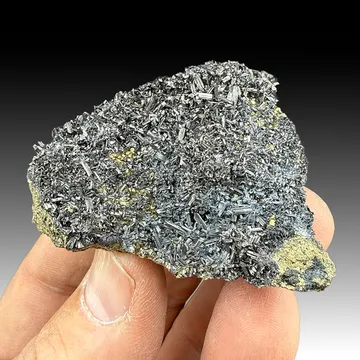
File: Hutchinsonite-Orpiment-171832.jpg, Wikimedia Commons / Rob Lavinsky — Documents a 5.6 x 5.4 x 1.4 cm hutchinsonite-orpiment specimen from Quiruvilca, illustrating one of the locality’s signature arsenic-rich associations.
“Mining and Collecting Minerals in Quiruvilca, Peru: Into the Andes” — Ray McDougall, Mineralogical Society of the District of Columbia
A 2024 MSDC presentation based on McDougall’s 2013 visit with David Joyce, covering the road to Quiruvilca, the mine, zoning, collecting, and significant Quiruvilca minerals including orpiment.
https://www.youtube.com/watch?v=dZFi-qmjgLA
“Quiruvilca Mine Visit” — David K. Joyce Minerals
A detailed illustrated field report from Joyce’s 2013 visit, including travel conditions, underground collecting, mine geology, town observations, and specimen notes.
https://djoyceminerals.com/quiruvilca-mine-visit/
“Into the Andes: Quiruvilca, Peru” — Ray McDougall, McDougall Minerals
A collector’s field account with photographs from the road, town, mine complex, underground workings, and Quiruvilca specimens.
https://www.mcdougallminerals.com/blog/into-the-andes-quiruvilca-peru/
Mindat: Orpiment from Quiruvilca Mine — The best quick reference for the species occurrence, habit, color, quality ranking, and documented mineral associations.
Mindat: Quiruvilca Mine locality page — The main locality database entry for the mine and its full mineral list.
Pan American Silver 2007 Technical Report for the Quiruvilca Property — The most useful public technical report for geology, zoning, mine layout, concessions, and operating history.
AusIMM: Geology, Mineralisation, Alteration, and Zoning of the Cu-Pb-Zn-Ag Lodes at Quiruvilca, Peru — A concise publication record for the 1987 Bartos work on Quiruvilca zoning and mineralization.
D. Joyce Minerals: Quiruvilca Mine Visit — A detailed, first-person collector account of visiting and collecting underground at Quiruvilca in 2013.
McDougall Minerals: Into the Andes: Quiruvilca, Peru — A vivid companion field report with travel, town, mine, and specimen context.
Mineralogical Society of DC: November Program Report on Quiruvilca — A useful synopsis of Ray McDougall’s presentation, with collector-oriented discussion of Quiruvilca’s major minerals and field experience.
Wikimedia Commons: Orpiment-211605.jpg — A classic photographed Quiruvilca crystal group with detailed specimen notes and open licensing.
Wikimedia Commons: Orpiment Quiruvilca Mine Minéraux SU.jpg — A high-resolution photograph of a Sorbonne University collection specimen.
Wikimedia Commons: Hutchinsonite-Orpiment-171832.jpg — A good visual reference for the hutchinsonite-orpiment association that helps distinguish Quiruvilca’s arsenic-rich specimen style.


_(18910362301).jpg)
