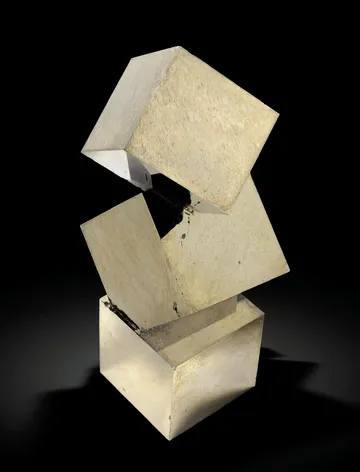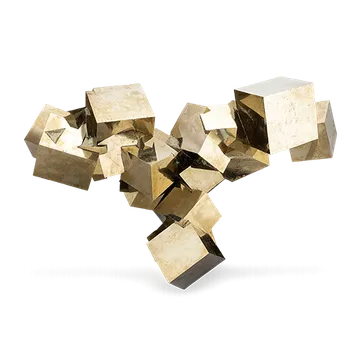
Navajún pyrite, La Rioja, Spain - iconic cubic crystals with sharp edges and mirror-bright luster from marlstone; prized for geometry and the famed locality.
Key facts
Navajún pyrite is the mineral world’s great argument that nature does, in fact, make straight lines. From the Ampliación a Victoria mine in the Sierra de Alcarama of La Rioja, the classic specimen is a brassy, mirror-bright cube of FeS2 perched in pale gray to cream marlstone, with edges so sharp and faces so planar that non-collectors routinely assume the crystals have been cut or polished. They have not. The best Navajún pieces are natural cubic pyrite at its most architectural: single cubes, interlocking cubic clusters, and matrix specimens in which metallic geometry rises cleanly out of soft sedimentary rock.
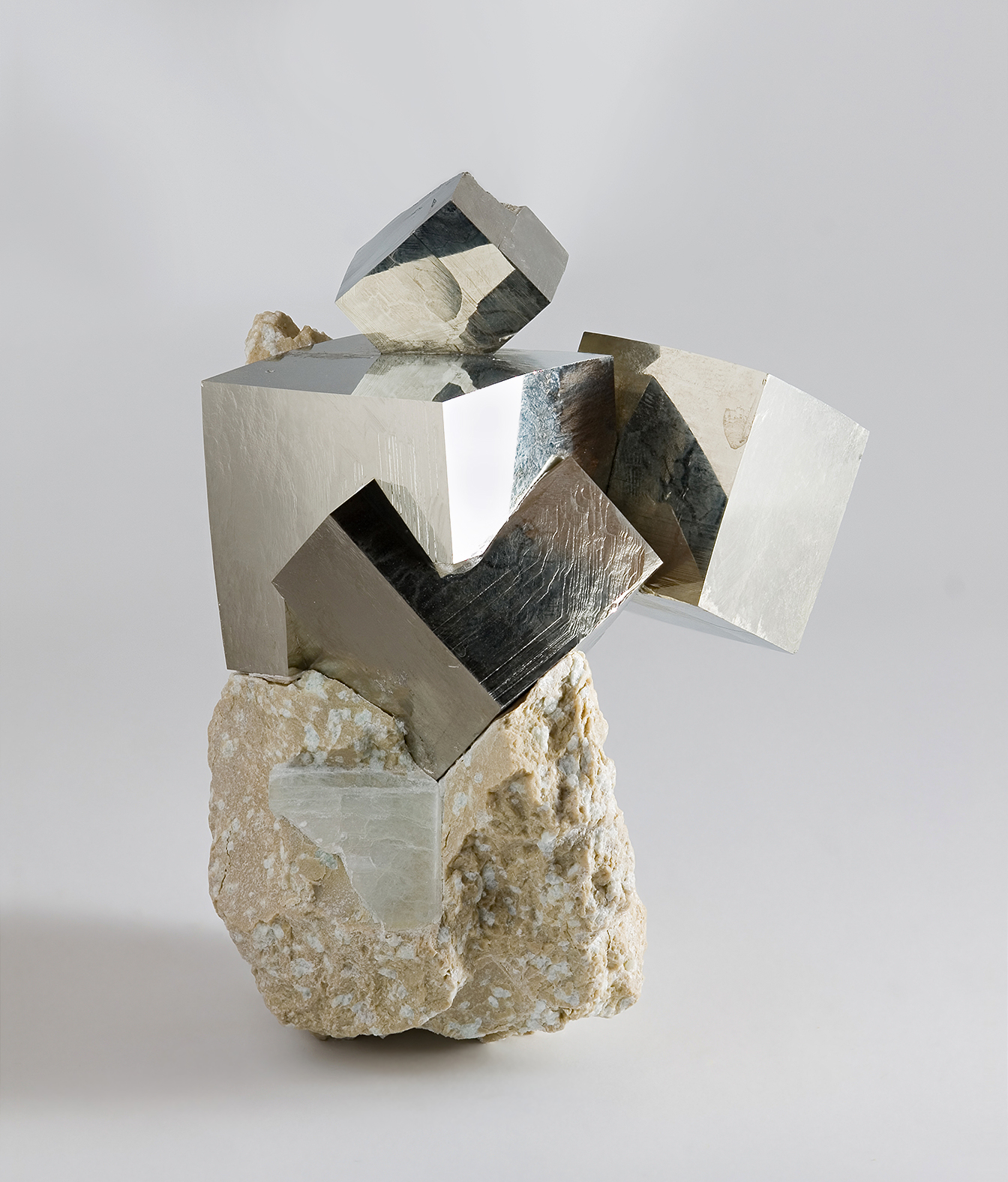
Photo: Wikimedia Commons
The deposit lies in the Cameros Basin, where Lower Cretaceous Weald facies sediments—especially marls and associated sandstones—were affected by low-grade hydrothermal metamorphism. The most widely accepted modern interpretation is that fluids mobilized sulfur through the sedimentary pile while iron was supplied by the host sediment, allowing pyrite to crystallize in laterally persistent marl horizons. Earlier collectors often described these pyrites simply as sedimentary or diagenetic cubes; later work on trace elements, sulfur isotopes, inclusions, and basin metamorphism made the setting more nuanced and much more interesting.
Historically, the broader La Rioja–Soria pyrite district was known long before Navajún became an international mineral locality. Sixteenth-century Spanish writing already described pyrites as golden or silvery “square grains like dice,” a phrase that could scarcely be more apt for the region. The modern collector story, however, belongs to Navajún: exploitation began in the late twentieth century, and by the 1970s and 1980s the mine’s cubical pyrite had become a fixture of high-end mineral cabinets, museum displays, and show tables.
Collectors look first for geometry. A fine Navajún specimen should have undamaged cube edges, clean corners, bright metallic luster, and good contrast with the marl. Matrix pieces are especially desirable when the cube appears naturally seated rather than awkwardly isolated. Intergrown groups can be superb, but they demand careful scrutiny because many clusters detach along thin marl seams during extraction and have been reassembled. That does not automatically make a piece undesirable—reconstruction is common and can be acceptable when disclosed—but undisclosed repair changes both value and collecting importance.
Search for specimens: View all pyrite specimens from Navajn, Spain
The collector locality is the Ampliación a Victoria mine near Navajún, La Rioja, Spain, in the Sierra de Alcarama close to the La Rioja–Soria boundary. Mindat gives the locality as an active mine and records it at approximately 41° 59′ 9″ N, 2° 6′ 41″ W, reached by a dirt road from the village of Navajún. Spanish geological-inventory sources place the mine in the broader “Yacimientos de pirita de Navajún y Ambasaguas” geosite of the Cameros Basin, an area recognized for mineralogical, mining-metallogenetic, and cultural interest.
The deposit is best understood as a stratiform to stratoid pyrite occurrence in Weald facies marls and sandstones of the Cameros Basin. The pyrite-bearing beds are sedimentary host rocks, but the growth of the conspicuous crystals is tied to low-grade hydrothermal metamorphism. In simple collector terms, the cubes grew within marl rather than in open vugs like many vein minerals; that is why Navajún specimens so often show crystals emerging from a fine-grained, pale matrix rather than from quartz, calcite, or sulfide ore.
The official mine account describes mineralization in Cretaceous marl layers, with three pyrite-bearing levels inside the Ampliación a Victoria concession. The first, lower level has been the most heavily worked and is the level most associated with the largest and highest-quality cubic crystals. A typical mineralized horizon is reported as meter-scale, and the mine literature notes an average dip on the order of 15 degrees. Spanish geological-inventory records emphasize that the pyrites are disseminated in marl levels and that the economic interest of the locality is not ore extraction but specimens for mineral collections.
The mine’s modern history begins with Pedro Ansorena Garret, who applied for an exploration permit in 1965. A formal exploitation concession for “Ampliación a Victoria” was granted on May 2, 1983, covering ground in Navajún and Valdemadera in La Rioja and adjoining municipalities in Soria. Since then the mine has been worked as a specimen mine rather than a conventional metallic-ore operation. Earlier Mineralogical Record reporting noted that the prospect consisted of a small open pit and an adit, and that outsiders could not collect independently.
Access remains controlled. This is not a casual roadside collecting site: the mine is private, active, and reached by unpaved tracks. Modern sources describe visits by prior arrangement with Piritas de Navajún, and the Spanish geological inventory flags hazards including machinery and waterlogged areas. The responsible collector treats Navajún as a commercial specimen mine, not an open collecting ground. Purchased specimens with good provenance are the normal route into the locality.
Notable finds range from loose single cubes to large, sculptural groups. Calvo and Sevillano reported crystals reaching as much as 20 cm on edge, though most are 5 cm or less. The most celebrated pieces are large matrix clusters with multiple sharp cubes; one 20 cm-tall Navajún group was illustrated in The Mineralogical Record as a Smithsonian specimen, and later accounts described an eight-inch-tall cluster of ten near-perfect cubic crystals entering the National Museum of Natural History collection in Washington, D.C. Such pieces explain why Navajún is not merely a prolific pyrite source, but one of the defining pyrite localities in the history of specimen collecting.
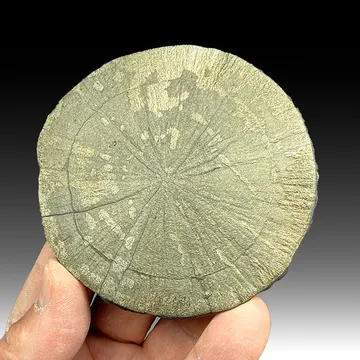
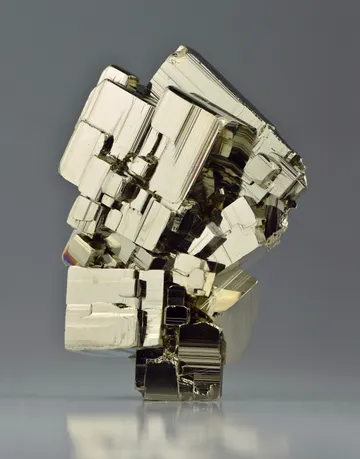
The canonical Navajún crystal habit is the cube: clean 100 form, flat metallic faces, and nearly right-angled edges. Octahedral modifications on cube corners are rare but recorded, and the broader district also produces pyritohedrons, cuboctahedrons, and “pinecone” aggregates, especially at nearby localities such as Ambasaguas. At Navajún itself, the collector ideal remains cubic, either as a single freestanding crystal or as a cluster of cubes apparently locked together in geometric balance.
Color is brassy yellow to bright golden metallic when fresh and unoxidized. Faces may be mirror-smooth, lightly striated, or show subtle growth zoning and “wrinkled” surfaces caused by incipient pyritohedron development. The best examples have a reflective, almost machined surface. Oxidized material shifts toward brown tones, limonite coatings, or duller surfaces, particularly where near-surface weathering has affected the crystals.
Size is one of the locality’s strengths. Tiny crystals and small loose cubes are abundant, but good cabinet specimens commonly feature cubes in the centimeter range. Published accounts place ordinary good crystals at 5 cm or less, while exceptional material can reach 10 cm and, in the largest reports, 20 cm on edge. Many “large cubes” are actually near-parallel growths of smaller cubes, a distinction that can be difficult to judge without close inspection of face continuity and edge geometry.
Matrix matters enormously. The host is marlstone—typically pale, fine-grained, and comparatively soft beside the dense pyrite. A cube properly presented in matrix has far more visual contrast than a loose cube, and a group with undamaged crystals still naturally positioned in marl is a premium object. The problem is that the same marl that makes the specimens beautiful also makes them vulnerable: crystals can part from the matrix, and clusters can separate along thin seams.
Associated minerals are sparse compared with many classic sulfide deposits. Mindat records pyrite with chamosite, chlorite-group minerals, chloritoid, cookeite, and gypsum at Ampliación a Victoria. Scientific work has made chloritoid particularly important, because near-Fe-endmember chloritoid inclusions were identified inside large Navajún pyrite cubes. Calvo and Sevillano also noted occasional chlorite-filled pockets in the host rock and alteration products such as gypsum and iron sulfates in the broader district. Pyrite is the principal collector species; the locality is not a multi-species cabinet locality in the way a complex hydrothermal vein mine might be.
Quality is judged by a demanding hierarchy: sharpness, luster, completeness, matrix position, lack of oxidation, lack of repair, and aesthetics of the composition. A small but razor-sharp cube on clean marl can be more satisfying than a larger damaged one. For groups, the finest pieces look inevitable: cubes rising at different angles, each crystal with crisp corners, the matrix trimmed enough to display the geometry but not so much that the piece feels artificially staged.
The main authenticity issue with Navajún pyrite is not that the cubes are carved or polished; genuine Navajún cubes are natural. The real issue is reconstruction and restoration. Because spectacular groups can be separated by only a thin film of marl, clusters commonly come apart during extraction from the hard host. Reassembly at the mine or in preparation is documented in the classic literature and is generally considered acceptable only when disclosed. In practice, collectors should assume that complex clusters deserve careful examination and direct questions.
Look for glue lines between crystals, unnatural gaps filled with resin or metallic paste, abrupt differences in luster, and color mismatch on corners or edges. Calvo and Sevillano specifically described restorations in which small missing areas were filled with brassy metallic paste; a restored corner may look convincing at a glance but will usually betray itself by a difference in color, reflectivity, or surface texture. Longwave/shortwave UV, magnification, and oblique lighting can help reveal fills and adhesives, though the best tool remains experience with unaltered surfaces.
Matrix attachment is another common point of concern. Detached cubes are often reset into their original sockets or stabilized to prevent further loosening. Stabilization in the original position is less troubling than deceptive fabrication, but it should be disclosed. A natural matrix specimen should show coherent contact: pyrite emerging from marl, pressure shadows or sockets that make geological sense, and no obvious modern adhesive halos. Completely loose cubes are common and affordable, but they do not carry the same locality premium as clean matrix pieces.
Condition issues include chipped cube corners, bruised edges, scratched mirror faces, oxidation, and friable or crumbling marl. Pyrite itself from Navajún is generally regarded as stable compared with many pyrite localities, but the matrix can be weak and should be handled carefully. Avoid repeated wetting, prolonged humidity, and aggressive cleaning. Acid preparation has been used commercially to remove matrix, but collectors should not experiment casually: surface alteration, matrix loss, and adhesive failure are all easy mistakes.
Rarity is relative. Navajún is productive and specimens remain widely available on the collector market, from inexpensive loose cubes to important cabinet pieces. What is rare is a large, undamaged, unrepaired, mirror-bright cube or cluster on attractive matrix with excellent balance. The market recognizes that difference sharply. Loose thumbnail cubes can be plentiful; fine matrix specimens with disclosure, old provenance, and no visible restoration are much harder to replace.
For centuries, the pyrites of the La Rioja–Soria district were more than collector specimens. The old Spanish description from 1568—golden and silvery grains “like dice” in the cliff—captures the exact visual shock of the district, even if the writer did not pin down Navajún as the source. The Spanish geological inventory preserves a rougher local memory: shepherds used the dense cubes as sling ammunition to drive wolves from their flocks. In that world, a sharp-edged pyrite cube was not a cabinet object; it was a small, heavy missile, remembered under names such as “cantalobos” and “Piedras de Santa Casilda.”
The modern mine story begins with a different kind of recognition. In 1960, French collectors reportedly spent weeks digging at Navajún and assembled what was then the best collection of material from the site. Their work drew the attention of Pedro Ansorena Garret, a mining man connected with the Las Manforas zinc mine in Cantabria. He had seen enough good sphalerite from Las Manforas to understand the specimen market, and when he examined the Navajún diggings he saw that the pyrite in protective matrix was not dull surface debris but brilliant, sharply formed crystal material. As ore it was worthless; as mineral specimens it was extraordinary. Ansorena secured the mining rights and gave the concession the name Ampliación a Victoria.
The first commercial work was physically simple and mineralogically delicate. Miners removed blocks of pyrite-bearing marlstone, broke them down, and trimmed matrix to expose cubes in relief. Explosives were a poor option because the pyrite was brittle and the collector value lay precisely in undamaged edges and reflective faces. The mine became a specimen operation in the truest sense: rock was not being processed for metal, but opened carefully to reveal form.
A darker episode came when the surface diggings were giving way to underground work. In 1990, Pedro Ansorena began mining underground; the workings were limited, but the rock proved unstable. Ansorena was caught in a rockfall, partially buried, and suffered two broken legs. After that accident, timbers were installed for support. It is a vivid reminder that even a specimen mine famous for polished-looking cubes is still a mine, with the same unforgiving ground conditions as any other excavation.
Visitors to Navajún often remember the place before they remember a single specimen. Travel accounts describe leaving the quiet stone village and pushing out over gravel tracks into the Sierra de Alcarama, toward a deposit that feels hidden in the hills. On the ground, tiny brassy flecks catch the sun. Inside the mine, the surprise is scale: cubes showing from the walls, bright faces in the marl, and the dawning realization that the geometric objects on dealer tables began as natural forms locked in a sedimentary bed. One visitor wrote of the irresistible impulse to pocket small pyrites underfoot and compared the feeling to a treasure hunt; another practical lesson followed soon after—collecting a pleasing cube is easy, but finding one that remains perfect after extraction is much harder.