






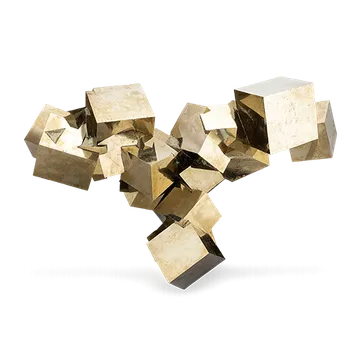
Sparta pyrite, Illinois - renowned sunburst disks from Pennsylvanian shales; multi-inch, display-quality radiating crystals, prized for locality and size.
Key facts
Sparta pyrite is the classic American “pyrite sun”: a flat, metallic, radially crystallized disk of FeS2 from the coal-mining country around Sparta, Randolph County, Illinois. Among serious collectors, the best examples have a presence unlike ordinary pyrite cubes or pyritohedra. They are thin, coin-like, often nearly circular, and built of outward-splaying crystal bundles that catch the light as a brassy, silvery-gold shimmer. The most attractive pieces show a strong central point, crisp radial growth, complete rims, and enough luster to flash as the specimen is tilted.

Photo: Wikimedia Commons / James St. John
The locality is not a conventional pyrite-crystal pocket locality. The specimens formed in Pennsylvanian black shale associated with the Herrin Coal, especially the Anna Shale roof rock above the coal seam. Instead of growing freely as cubes, the pyrite grew in a severely confined bedding-plane environment. Overburden pressure made vertical growth difficult, so the crystals took the path of least resistance and spread laterally through the shale, producing the famous sunburst habit.
That combination of geology and form is what gives Sparta material its status. Small pyrite disks occur in organic-rich marine shales elsewhere, but the Sparta region is exceptional for multi-inch disks of display quality. ISGS material describes the Sparta area as hosting the largest known deposit of multi-inch pyrite disks, with common collector specimens around 3 to 4 inches across and larger examples reaching 5 inches or more; collector-market sources and Rock & Gem reporting also note exceptional pieces approaching dinner-plate size or roughly 8 inches.

Photo: Wikimedia Commons / Rob Lavinsky, iRocks.com
Historically, these specimens entered the collecting world through coal miners, not mineral-claim diggers. “Miner’s dollars,” “pyrite dollars,” “sun dollars,” and “pyrite suns” all refer to the same collector tradition: thin disks discovered in the roof shale and carried out of underground workings. They are sometimes mistaken for fossils or pyritized sand dollars, but they are mineral concretions, not fossils. A good Sparta pyrite sun is valued because it is unmistakably local, visually iconic, and geologically improbable: a pyrite specimen whose most important “crystal face” is really the flat pressure-bound architecture of the shale bed that held it.
Search for specimens: View all pyrite specimens from Sparta, USA
“Sparta, USA” for this material means Sparta, Randolph County, Illinois, USA, in the southern Illinois coal field. Mindat records Sparta as a city-level locality famous for pyrite suns and pyrite dollars, with pyrite found in shale layers, notably the Anna Shale Member, above Pennsylvanian Herrin Coal measures. The broader district includes numerous coal mines and nearby coal operations in Randolph, Perry, and Washington Counties; mines listed in the Sparta locality framework include Blackhawk, Boyd, Crystal, Florida, Hawkeye, Moffat, Southern Gem, and Spartan, with nearby named occurrences such as River King, Ziegler No. 11, Baldwin No. 1, Prairie Eagle, and Marissa appearing in regional locality data.
The deposit is sedimentary and diagenetic rather than hydrothermal. The host is black, organic-rich marine shale associated with the Herrin Coal of the Carbondale Formation in the Illinois Basin. In the Sparta mines, the suns occur a few inches above the coal seam in thin pyrite-rich roof-shale layers. The ISGS Geobit on pyrite suns specifically illustrates a specimen embedded in Anna Shale 3 inches above the Herrin coal at the Gateway Mine and states that the Sparta suns occur in Pennsylvanian rocks about 300 million years old, 200 to 250 feet below ground in coal mines that extract the Herrin coal.
The geological setting matters directly to collecting quality. The black shale supplied the confined laminated space; the reducing, organic-rich environment supplied conditions favorable for iron sulfide; and the weight of overlying sediment forced crystal growth outward along bedding. The result is a radial, discoidal concretion rather than a cluster of conventional pyrite cubes. Where growth was more irregular, the same horizon can produce misshapen pyrite blebs or intergrown masses; where conditions were ideal, it produced round, thin, complete suns.
Coal mining is the collecting history. Illinois Basin coal production began in the nineteenth century, and Rock & Gem reports that Sparta-area miners were collecting pyrite suns as novelty items in the 1800s. The specimens became a broader commercial mineral-collecting item in the 1950s, when mineral collecting expanded nationally and miners began saving attractive suns for dealers. In practice, the supply has always depended on working coal mines, roof-shale handling, and miners willing and able to preserve delicate pieces before they were crushed, discarded, or broken.
Access is not a public rockhounding situation. These are underground coal-mine specimens from private, industrial workings, and the relevant roof shale is part of a hazardous mine environment. Collecting by the public in active or abandoned underground coal mines is not appropriate, and any collecting around mine property, spoil, or reclaimed ground requires explicit permission and attention to mine-safety and land-access rules. Most collectors today acquire Sparta pyrite through dealers, old collections, miners’ retained material, or occasional specimens from active and legacy coal operations rather than field collecting.
Modern availability is tied to the decline and mechanization of Illinois underground coal mining. Rock & Gem notes that older small, hands-on underground operations were ideal for recovery, while modern mechanized mines give miners fewer opportunities to notice and preserve specimens. Dealer inventories still contain Sparta suns, but the number of fresh, high-quality, naturally lustrous pieces is limited. Matrix pieces are scarcer than loose suns because the shale is friable and the disks detach easily.
Sparta pyrite is prized almost entirely for its “sun” habit: thin, flattened, discoidal concretions with radial crystal bundles spreading from a central nucleation area. The surface may show fan-shaped sectors, concentric rings, a central depression or hub, and a granular to sparkling radial texture. Some examples have a clear circular rim; others are oval, scalloped, irregular, or partially incomplete where the disk broke along the shale.
The color ranges from pale brassy yellow to silvery bronze, gray-gold, or smoky metallic gray depending on freshness, oxidation, and shale residue. The finest untreated specimens have strong metallic luster and a moving, chatoyant shimmer across the radial surface. Natural iridescence can occur, but bright rainbow iridescence should be evaluated carefully because acid treatment has been used to enhance or induce color on some market specimens.
Typical collector sizes range from small coin-sized pieces to cabinet specimens around 3 to 4 inches across. ISGS describes the range as from a small penny to dinner-plate size, commonly 3 to 4 inches; its Sparta-specific discussion notes well-formed showy disks up to 5 inches or more. Mindat and Wikimedia-documented collector pieces include examples around 7.4 x 7.3 x 0.4 cm and 8.4 x 8.4 x 0.3 cm, while gallery descriptions record larger cabinet specimens exceeding 10 cm.
Thickness is one of the key locality traits. Many suns are only a few millimeters thick relative to their diameter, giving them a true “dollar” or medallion character. Cross sections may show a central line or plane where growth began in the shale, with a thin pyrite crust around the outer margin. ISGS notes that small cubic pyrite crystals can sometimes occur on the outside edge, an intriguing reminder that the mineral is still pyrite even though the overall habit is not cubic.
The associated material is simple but important: black Anna Shale, organic-rich roof shale, coal, and locally minor marcasite intermixed with the pyrite. Mindat’s photo-based associated mineral data for the Sparta pyrite occurrence records shale. The marcasite component is mineralogically important because pyrite and marcasite share the formula FeS2 but differ in structure; marcasite is less stable and can contribute to oxidation problems. Many older labels and dealer descriptions use “marcasite sun” casually, but the classic Sparta specimens are best described as pyrite suns with minor marcasite unless analytical work proves otherwise.
Quality factors are highly specific. Collectors look for complete rims, a round or aesthetically oval outline, strong radial definition, bright metallic luster, minimal shale smear, no obvious repaired cracks, and good stability. Loose floaters are desirable when both faces are attractive; matrix specimens are desirable when the sun is naturally seated in shale and the matrix provides geological context. Very thin, complete, lustrous floaters with a clean radial pattern are often more attractive than larger but dull or distorted pieces.
The most important authenticity issue is not whether the disk itself is natural; genuine Sparta pyrite suns are abundant enough in old and dealer stock that wholly artificial disks are not the usual problem. The more common concern is matrix manipulation. Suns detach readily from the black shale, and specimens reattached to their original matrix are common and generally tolerated when disclosed. More problematic are composites in which a loose sun has been glued into a carved or prepared depression in shale that was not originally associated with that disk.
Examine matrix specimens from the side. A natural seat should make geological sense: the disk should fit the shale depression closely, with consistent bedding, no suspicious carved trough, and no thick halo of adhesive. Repairs may be visible as shiny glue along the contact, inconsistent shale texture, or a sun that sits unnaturally proud of the matrix. Because the shale is organic-rich and fragile, aggressive testing is risky. A 2025 Mindat discussion documented an acetone test intended to remove glue residue that instead caused the sun to break and the shale matrix to largely disintegrate; solvent testing should not be treated as harmless on this material.
Condition is another major issue. These disks are thin and brittle, and they chip along the rim or split along radial weaknesses if dropped or flexed. Matrix shale can flake, crumble, or shed. Loose suns often have contacted backs, minor edge losses, or dull patches where shale adhered. A complete rim is a significant premium feature, especially on larger specimens.
Stability varies. Some Sparta suns remain unchanged for decades; others develop symptoms of pyrite oxidation, sometimes called pyrite decay or pyrite disease. Warning signs include a sulfurous or acidic odor, powdery white, yellow, or rusty efflorescence, cracking, swelling, and surface dulling. The minor marcasite content reported for Sparta material is relevant because marcasite is more oxidation-prone than pyrite. Keep specimens dry, avoid water cleaning, avoid humid display cases, and store vulnerable pieces with silica gel in a stable, low-humidity environment.
Iridescent suns deserve special caution. Natural iridescence exists, but Rock & Gem reports that many iridescent examples reaching the market during the 1990s were acid-treated to induce or intensify color, and that treated iridescent suns show higher oxidation rates than untreated specimens. A subtle blue-green or bronze overtone is less concerning than an unnaturally bright rainbow film, especially if the piece also has etching, dullness, or a history of rapid deterioration.
Rarity is best understood by grade rather than by mere presence. Ordinary small or partial loose suns remain available, and dealer inventories often include affordable examples. Fine large, complete, bright, stable, untreated pieces are much scarcer. Natural matrix specimens with the sun still convincingly seated in Anna Shale are also harder to find, especially in good condition, because the shale breaks easily and the disks separate from it. As coal mining has declined and become more mechanized, the stream of newly saved specimens has narrowed, giving old-collection pieces and well-documented examples greater collector appeal.
The Sparta pyrite sun story begins in a place most mineral collectors never see: a coal-mine roof, a few inches above the Herrin seam, in black Anna Shale. The specimens were not waiting in open vugs. They were hidden in thin sheets of roof rock, the same rock miners watched carefully because loose roof shale could fall naturally or be pulled down for safety. When a sheet broke just right, it could reveal a brassy disk with rays running outward like a little metal sunrise.
That is why the old name “miner’s dollar” has real weight. The suns were recovered by coal miners as byproducts of work done 200 to 250 feet underground, then carried out in lunch buckets or lunch pails before machinery, waste handling, or blasting could destroy them. The best pieces survived because someone underground noticed a flash in the shale and decided it was worth saving.
There is a small but persistent myth that these are fossils—pyritized sand dollars, lily pads, or some other once-living disk. The mistake is understandable. A clean Sparta sun looks biological: circular, radial, and strangely symmetrical. Illinois State Museum material makes the correction bluntly: call them pyrite suns, pyrite dollars, miner’s dollars, or sun dollars, but do not call them fossils. The radial pattern is mineral growth, not a replaced organism.
In the collecting boom after the 1950s, the miner’s keepsake became a commercial mineral specimen. Rock & Gem describes miners “high-grading” the suns, carrying them from the mines in lunch buckets and selling them to specimen dealers. That shift created the classic supply chain for Sparta pyrite: not claims, not pockets, not fee digs, but working miners saving geological curiosities from the coal stream.
The most dramatic modern cautionary tale is not from underground but from a collector’s workbench. A Mindat contributor acquired a pyrite sun on matrix with glue residue and tried the familiar acetone approach to soften or remove adhesive. The fit looked convincing; the sun appeared to belong to the matrix, and there was no obvious repair around the disk. After an overnight soak, the acetone had turned dark brown, apparently dissolving organic material from the shale. The result was disastrous: the sun broke into several pieces and the shale matrix mostly disintegrated. For Sparta material, the story is a useful warning. The same organic-rich shale that helped make the suns can be the thing that fails first under solvent, moisture, or careless cleaning.
_1.jpg)

