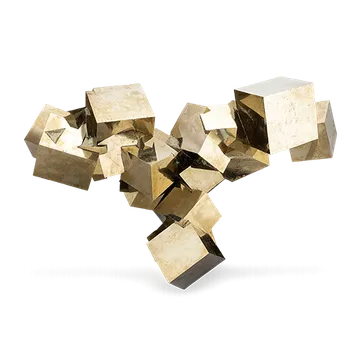
Huanzala Mine, Peru - premier pyrite locality, producing bright brass crystals in cubes and pyritohedrons; abundant yet sculptural pieces prized by collectors.
Key facts
Huanzala is one of the great modern pyrite localities: not merely a place that produced good crystals, but a mine that made pyrite a serious cabinet-specimen species for generations of collectors. The best pieces have the instantly recognizable Huanzala look—bright brass to pale gold crystals, mirror to satiny luster, heavy metallic presence, and a restless variety of forms: cubes, modified cubes, pyritohedrons, octahedrons, and complex combinations that make the same species look almost like several different minerals.

Photo: Ivar Leidus, Wikimedia Commons
The mine is a polymetallic lead-zinc-copper-silver operation in the high Andes near Huallanca. Its ore system is not a simple vein locality; Huanzala’s pyrite belongs to a complex replacement and skarn-related deposit developed in limestone and shale, intruded by quartz porphyry, with pyritization forming a fundamental early part of the ore system. That geological setting is the reason the specimens are so varied. The same mine that gives collectors lustrous pyrite also produced sphalerite, galena, quartz, calcite, fluorite, arsenopyrite, chalcopyrite, bournonite, scheelite, fluorapatite, and a long list of rarer sulfides, sulfosalts, and alteration minerals.
For collectors, Huanzala pyrite is distinctive because it is both abundant and selective. Ordinary pieces exist by the ton—sparkling “chispas” pyrite, small crystal crusts, decorator-grade masses—and yet the finest cabinet specimens are genuinely important. Aesthetic groups with complete crystals, bright luster, sharp form, and minimal bruising are a different world from the bulk material. The most desirable examples are sculptural clusters of large, clean crystals, modified octahedral groups with strong geometric drama, bright striated cubes, pyritohedral clusters, and combination pieces where pyrite contrasts against black sphalerite, silvery galena, pink fluorite, or glassy quartz.

Photo: Robert M. Lavinsky, Wikimedia Commons
Huanzala’s historical significance is unusual in the specimen world. Many classic mines are famous because they yielded a few glorious pockets; Huanzala is famous because it yielded specimens on an industrial scale while still producing world-class individual pieces. Rock H. Currier’s oft-repeated assessment—that Huanzala may have produced more mineral specimens by tonnage than any other mine—has become part of the lore of Peruvian minerals. Whether one owns a modest thumbnail, a bright small cabinet, or a monumental museum-scale octahedral group, a Huanzala pyrite is a direct link to one of the most productive specimen mines of the late twentieth century.
Search for specimens: View all pyrite specimens from Huanzala Mine, Peru
Huanzala Mine is in the Huallanca District, Bolognesi Province, Ancash, Peru, although older labels and older literature often place it in Huánuco Department or use the older Dos de Mayo Province wording. This is not usually evidence of a bad label; it reflects administrative boundary changes and the long life of the mine in the specimen trade. Mindat’s current locality entry gives the mine at approximately 9° 52′ 21″ S, 77° 0′ 10″ W, in high Andean terrain.
The mine is a lead-zinc operation with copper and silver mineralization, long operated by Compañía Minera Santa Luisa, part of the Mitsui Kinzoku Group. Mitsui records Huanzala as one of its own developed Peruvian mines, with operations beginning in 1968; the Pallca Mine was later developed as a branch operation in 2006. Santa Luisa’s own company information describes the Huanzala unit as producing zinc, lead, and copper concentrates, with the mine’s extracted minerals processed immediately through the Huanzala concentrator.
Geologically, Huanzala is best understood as a polymetallic replacement and skarn-related system hosted by Cretaceous limestone-shale sequences. Early Japanese studies described the country rock as an alternation of limestone and shale known as the Huanzala Ore Formation, about 180 meters thick, with mineralization occurring as lenses, veins, and irregular masses along favorable horizons. Several quartz-porphyry dikes intrude along bedding planes, and highly pyritized zones occur parallel to the Pb-Zn-Cu ore zones.
Later mineralogical work refined the picture: Huanzala ores were divided into pyritic ore, skarn ore, and “shiroji” argillized ore. The mineralizing sequence began with pyritization near the time of quartz-porphyry intrusion, followed by skarnization and iron-rich “red sphalerite,” then galena and chalcopyrite, then shiroji alteration with iron-poor “black sphalerite,” and finally bornite-chalcocite and tennantite stages. This early, extensive pyritization is crucial to understanding why the mine became a pyrite locality of world importance rather than merely a base-metal mine that happened to contain pyrite.
The deposit also shows a broader two-style hydrothermal story. Resource Geology work on Huanzala distinguishes an adularia-sericite type zinc-lead assemblage with broad pyrite bodies and skarn, and an acid-sulfate type copper-silver assemblage characterized by minerals such as enargite, luzonite, and bornite. That combination helps explain the mine’s unusual mineral diversity: pyrite is not an isolated late-stage curiosity but part of the architecture of the orebody.
Exploration began in earnest in May 1964 under Mitsui Mining & Smelting, with geological mapping, surface and underground diamond drilling, and tunnel driving. The mine entered operation in April 1968. More recent published exploration work described a deep mineralized zone discovered roughly 200 meters below the then-current operating zone, in downward-continuing limestone blocks displaced by a reverse structure known as the Lower Fault. That deep zone contained copper-silver and copper-zinc minerals with skarn and massive pyrite, reinforcing the point that pyrite is a persistent exploration guide at Huanzala, not simply specimen-shop byproduct.
Collecting access has long been difficult and politically sensitive. Huanzala is an active industrial mine, not a fee-collecting locality. Specimens historically entered the market through miners, local buyers, and Lima dealers, especially during periods when mining activity, labor conditions, or mine oversight allowed specimens to move out in quantity. By the early 1980s, management reportedly banned specimen collecting in the mine and specimen sales in the company town, but material continued to circulate through informal channels for many years.
Since January 2020, Gemrock Peru S.A.C. has presented itself as holding exclusive rights for the extraction and global sale of Huanzala pyrite under an arrangement with Santa Luisa and the municipality of Huallanca. Gemrock describes this as a social-responsibility initiative intended to replace dangerous and illegal extraction with legal workshop employment and certified origin paperwork. Whatever one’s view of the commercial arrangement, the practical collector’s point is clear: newly mined Huanzala pyrite now has a documented chain-of-origin issue that serious buyers should take seriously.
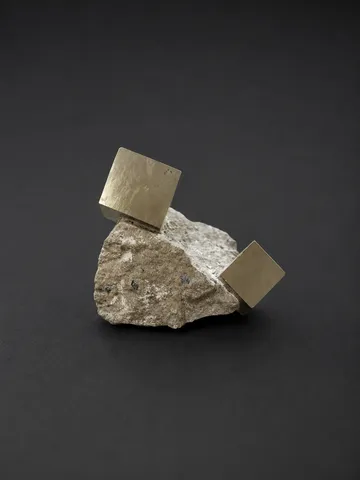
Huanzala pyrite is most famous for the breadth of its crystallography. The locality produces cubes, pyritohedrons, octahedrons, and combinations of these forms, often with modifications that give the crystals a muscular, almost architectural complexity. Cubes are commonly striated; the striations can be so strong that a cube face takes on a ribbed or wavy appearance. Modified cubes often show repeated oscillation between cube and pyritohedral growth, producing stepped, beveled, or curved-looking faces rather than flat textbook geometry.
Pyritohedrons are especially characteristic. They may be bright and lightly striated, or more satiny where growth is more complex. Because pyritohedral faces are pentagonal and irregular, these specimens have a different visual rhythm from simple Navajún-style cubes: less “perfect geometry,” more movement and metallic sculpture. Good pyritohedral clusters from Huanzala can be very attractive even when the crystals are not huge, because the forms catch light from many directions.
Octahedral Huanzala pyrite is the form that often gives the locality its greatest drama. The best examples show sharp, triangular faces, beveled or modified edges, and a bright metallic luster that can look almost chrome-gold under strong light. Some famous lots produced crystals far larger than ordinary cabinet size; individual octahedral crystals of 8–10 cm were reported as common in one major 1988 find, and crystals to about 20–25 cm on an edge have been documented in the specimen literature.
Color ranges from pale brass yellow to deeper brassy gold, with many specimens showing darker gunmetal reflections where faces are shadowed or lightly tarnished. Fresh, high-quality crystals have strong metallic luster, from mirror-bright to satiny. Luster is one of the most important quality markers at Huanzala. A specimen with large crystals but tired, frosted, oxidized, or abraded faces usually falls behind a smaller specimen with sharp form and crisp reflection.
Typical collector specimens range from thumbnails and miniatures of small bright crystals to small-cabinet and cabinet clusters. Decorator and bulk-grade material can be much larger but often consists of small, glittering crystals on massive pyrite. Fine cabinet pieces with individual crystals in the 2–5 cm range are highly collectible; pieces with truly large, undamaged crystals are much scarcer. The largest documented historic specimens are museum-scale and can be extremely heavy, with major examples weighing tens of kilograms.
Associations are a central part of Huanzala’s appeal. The most common and important companions for pyrite include sphalerite, quartz, galena, calcite, fluorite, chalcopyrite, baryte, arsenopyrite, bournonite, scheelite, dolomite, and fluorapatite. Dark sphalerite can give strong contrast to brassy pyrite, especially where the sphalerite forms sharp blackish tetrahedra or stepped crystals. Quartz is often present as small white, waxy, satiny, or clear prismatic crystals rather than large dominant crystals; this fine drusy quartz can be a useful locality clue. Galena provides heavy silvery-gray contrast, commonly as cubes or modified cubes, while fluorite—especially pink to multicolored octahedral fluorite—is among the most desirable associations.
Collectors should distinguish between several broad quality classes. At the lower end are “chispas” and similar sparkling masses with many small crystals: attractive, abundant, and historically exported in large quantities for decorator and gift-shop use. Mid-grade pieces have sharper individual crystals, good luster, and pleasant coverage but may show bruising, crowded growth, or ordinary composition. Fine pieces have well-separated crystals, strong metallic brilliance, aesthetic architecture, and minimal damage. The top tier combines large crystal size, sharp form, undamaged faces and edges, attractive balance, and meaningful associations such as sphalerite, galena, fluorite, or quartz.
Huanzala pyrite is common in the market, but fine Huanzala pyrite is not common in the same way. This is the locality’s great paradox. A casual collector may see Peruvian pyrite everywhere—at shows, online, in metaphysical shops, in decorator bins—yet a serious collector looking for a genuinely sharp, lustrous, undamaged, well-composed Huanzala specimen can search for quite a while. The lower grades teach the eye; the better grades reward it.
Authenticity problems usually involve labeling, quality inflation, and presentation rather than elaborate mineral fakery. Pyrite itself is rarely faked convincingly in collector-grade Huanzala specimens because the weight, luster, hardness, crystal form, and associations are difficult to imitate in a way that would fool a knowledgeable buyer. The greater risks are vague “Peru” labels upgraded to Huanzala, bulk decorator pyrite sold as fine specimen material, glued or stabilized display pieces not disclosed as repairs, and carved or polished pyrite objects confused with natural crystal specimens.
There is also a legal-origin issue for recent material. Gemrock’s Huanzala Pyrite Project states that since January 2020 it has held exclusive rights for extraction and global sale of Huanzala pyrite through an official arrangement, and that other Peruvian export or sale of Huanzala pyrite should be considered illegal. Older specimens, ex-collections, pre-2020 material, and pieces with long provenance remain widely traded, but contemporary buyers of freshly mined material should ask for documentation when legal chain of custody matters.
Treatments are usually physical or chemical cleaning rather than enhancement in the gem sense. The Mineralogical Record’s Peru article noted that Peruvian dealers commonly dissolved late carbonate coatings from sulfides and other crystals using hydrochloric acid. That is not automatically a defect—many classic sulfide specimens have been cleaned—but it matters if the cleaning left etched surfaces, loosened matrix, removed attractive calcite, or produced an unnaturally stripped appearance. As with all sulfides, avoid aggressive chemical cleaning unless you know what the associated minerals are. Sphalerite, galena, calcite, dolomite, fluorite, quartz, and clays can respond very differently to acids, water, and mechanical work.
Condition is critical. Huanzala pyrite is hard enough to resist casual scratching, but the crystal edges and points bruise easily in mine handling and shipment. Large octahedrons often show contact marks, chipped edges, broken tips, or abraded high points. Striated cubes can hide small rubs in the ribbing; inspect under low-angle light. Massive pieces are heavy, and their own weight can cause pressure damage during transport if not packed properly. Check the underside as well: many specimens were trimmed from large masses, and a sawed or broken base is normal, but a specimen should still sit securely or be properly mounted.
Stability is generally good for Huanzala pyrite when kept dry, but pyrite is an iron sulfide and should not be stored in damp, acidic, or poorly ventilated conditions. Avoid soaking specimens unnecessarily, especially those with clay seams, microcrystalline sphalerite, galena, or carbonate remnants. A soft brush, compressed air used cautiously, and very brief gentle washing when appropriate are safer than heroic cleaning.
Current availability remains strong across lower and middle grades. Bright small clusters, decorator-grade chispas, carved pyrite products, and commercial-quality crystal groups are easy to find. Fine older cabinet specimens from major 1980s and early 1990s finds are much scarcer and command a different level of attention. Association pieces with pink fluorite, clean galena, sharp sphalerite, or unusual pseudomorphs are especially worth considering when aesthetics and condition are strong.
In August 1988, Rock H. Currier arrived in Lima and bought what he thought was the tail end of an outstanding find of octahedral pyrite. It was not the tail end. It was, in his memorable phrase, the “leading edge.” Soon afterward Huanzala went on strike, and the pyrite began moving out in quantity, continuing until about the middle of December.
The strike changed the rhythm of collecting. During normal operations, only miners had access to the workings, and even they had to fit collecting around ore production—lunch, shift changes, Sundays, the odd pause in the routine. During the strike, miners and local men could spend full days collecting in the mine. The result was one of the great pyrite events in modern specimen history: not a pocket of neat miniatures, but a production-scale outpouring of giant octahedral crystal groups.
The crystals were too large for the usual collector categories. Average crystals ran 8–10 cm, and Currier personally measured the edge of the largest crystal he saw in Lima at 20 cm. The specimen carrying that crystal weighed at least 45 kg, about 100 pounds, but damage kept it from being a top aesthetic piece. Ferdinand Zatch, a German dealer living in Lima, reported seeing a 150 kg specimen and passing on it because the quality was not high enough. Zatch estimated that the find may have produced as many as 100 specimens weighing 50 kg or more, perhaps 40 of them going to Europe.
The details are wonderfully specific. There were essentially no thumbnails. Even good small-cabinet pieces were rare, not because the find was poor, but because the crystals were simply too large. Many crystals had points truncated by small cube faces and other minor forms, with slightly modified octahedral edges. The large faces bore small angular lustrous growth pits concentrated near their centers. Some crystals were dull; some carried gray drusy quartz centered on those pits; one specimen Currier saw was partly covered with black tetrahedrite microcrystals. Some pyrite showed fractured and rehealed growth. From the size and shape of the pieces, he judged that the vein must have had at least a meter of open space in places and extended for many meters.
The street economics were just as vivid. Prices “ranged all over the map,” depending on what the seller thought of the buyer’s wealth and experience. One lot of about 15 large specimens, mixing acceptable pieces with poor ones, was priced at $20 per kilogram. Lesser pieces could fall to $2 per kilogram, and Currier thought that if he had pushed, he might have bought the lowest-grade material at $1 per kilogram. Even then, export costs from Peru could exceed $1 per kilogram before shipping.
The 1988 find was not the only large-scale event. The literature records a 1982 specimen from a lot of cubic pyrite that sounds like a complete Huanzala orchestra: clusters of large pyrite cubes on sericitic matrix, large clear octahedral fluorites perched on one side, large white calcites on the other, and a dusting of tiny bright sphalerite crystals over the whole piece. It is the kind of association that explains why collectors do not treat Huanzala pyrite as merely “pyrite from Peru”; the best pieces are miniature orebody cross-sections, metallic and transparent, brassy and pink, sulfide and carbonate all locked together.
By 1990, Currier had another enormous lot of Huanzala pyrite. At the Tucson shows of 1991 and 1992 he offered a group he had obtained in 1990 that weighed about 1000 kg. The lot included octahedral, cubic, and pyritohedral forms in brilliant groups, some large enough to be difficult to lift. This was Huanzala at full scale: not a flat of specimens, not a suitcase lot, but a ton of pyrite moving through the collector trade.
The “chispas” story belongs to a different side of the locality. Chispas pyrite—literally “sparkling” pyrite—was exported by the ton for the decorator market. Currier and his coauthors estimated that more than 1000 tons of this material had been collected and sold from Huanzala. Countless pewter figurines were mounted on these glittering pyrite masses. In 1987–1988, good chispas specimens with small green octahedral fluorites on pyrite were common on the streets of Lima. That material made Huanzala familiar to the general public, even while the great cabinet pieces were moving into major private and institutional collections.
There is a harder edge to the story. The specimen abundance caused production problems almost from the beginning of modern mining. Miners could earn secondary income by collecting specimens, and pyriteros—buyers running between Lima and the mines—visited frequently to buy high-graded material. One account bluntly describes miners working “in a totally pyritic environment” and notes the grim Peruvian mining saying, “there are no old miners in Peru.” Each shift could bring out a ton or more of specimen pyrite, sorted by size and priced accordingly, then quickly absorbed into the world market. Demand was so strong that even huge quantities vanished into collections, shops, and decorator supply chains.
The crystallography of Huanzala pyrite has its own smaller stories. In a Mindat discussion about a large Huanzala specimen, collectors worked through the form: a dominant cube modified by oscillating pyritohedral faces, with repeated parallel faces producing the striations and curved-looking cube surfaces. One participant summed up the charm and frustration of the specimen perfectly: “Nature can be messy.” Another explained that the striations on pyrite cubes are not scratches but records of alternating growth between forms—the cube and the pentagonal dodecahedron—made visible as parallel ridges on the crystal face. Huanzala is one of the localities where that lesson is not academic; it is written boldly across the crystals.