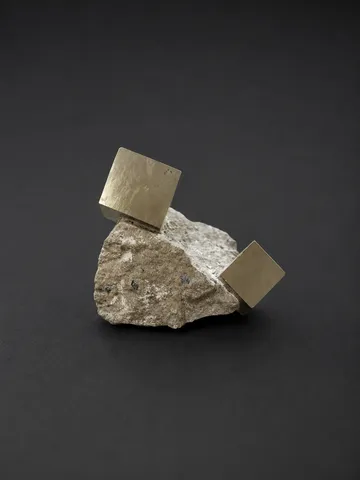
Navajún, Spain - premier pyrite locality famed for bright brass-yellow cubes from Mina Victoria; sculptural crystals with exact geometry and generous matrix.
Key facts
Navajún is the name collectors use almost instinctively when they mean the finest natural cubic pyrite on Earth. The classic specimens come from the Mina Ampliación a Victoria, high in the Sierra de Alcarama near the small village of Navajún in La Rioja, northern Spain. This is not a volcanogenic massive-sulfide pyrite mine like the great industrial deposits of the Iberian Pyrite Belt; it is a specimen deposit in Cretaceous Wealden marls and related metasedimentary rocks of the Cameros Basin. Low-grade hydrothermal metamorphism mobilized sulfur through the sediment pile, and iron from the marls combined with that sulfur to grow exceptionally isolated, sharply bounded FeS2 crystals in beds of gray to pale marl.
The locality matters because it gives collectors something almost no other pyrite locality gives with such consistency: bright brass-yellow cubes that look machined until one sees them emerging from the wall. The best Navajún pieces are not merely “cubic pyrite.” They are sculptural mineral specimens: mirror-faced cubes sitting proud on pale matrix, stacked cubes with exact ninety-degree geometry, sharp floater crystals, and intergrown groups that read like modernist architecture. Fine pieces combine clean luster, undamaged edges, natural placement, and enough matrix to prove context without overwhelming the crystals.
Historically, the area belongs to a broader pyrite province across La Rioja and adjacent Soria, where localities such as Ambasaguas, Valdeperillo, Canales de la Sierra, Villarijo and others produce their own habits: pyritohedra, cuboctahedra, elongated cubes, “pinecone” aggregates and, in some districts, distinctive twins. Navajún became the international standard because its dominant habit is the simple cube, expressed with unusual size, polish and visual purity. Labels may refer to Navajún, La Rioja, Logroño, Mina Victoria, Mina Ampliación a Victoria, or Victoria Mine; for serious collecting, the precise mine name and any notes on repair or preparation matter.
Regional View
Country View
The deposit is also one of the rare mineral localities where a single species dominates the entire identity of a place. Navajún pyrite has been mined, studied, sold, photographed, filmed and collected primarily as pyrite specimens rather than as ore. Even after decades of production, it remains active as a specimen and visitor locality, and its pieces still circulate in every tier of the mineral market, from inexpensive loose cubes for beginners to cabinet specimens with carefully prepared, mirror-bright crystals on matrix.
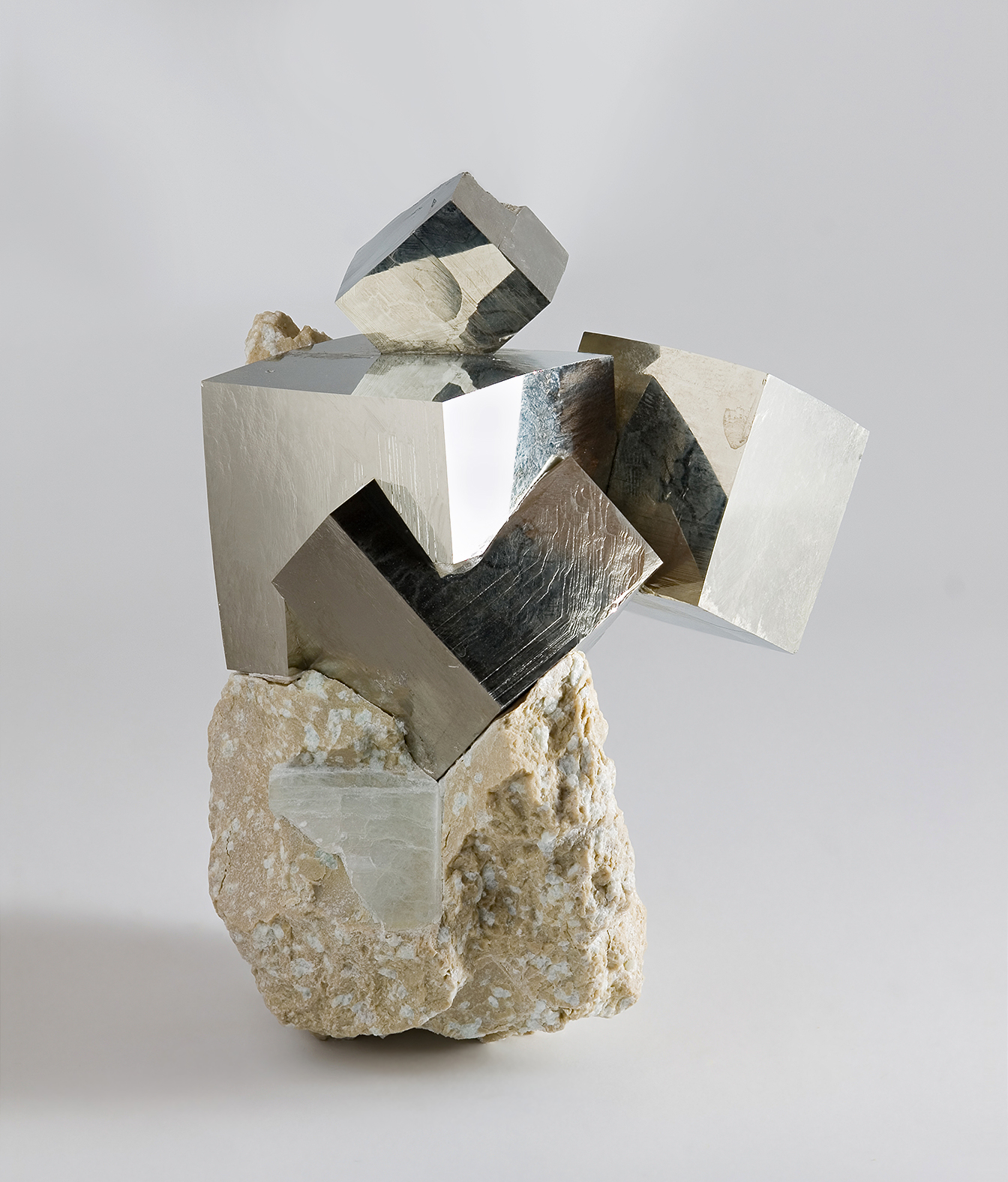
Photo: Wikimedia Commons

Photo: Wikimedia Commons
Search for specimens: View all specimens from Navajún, Spain
The collecting locality is the Mina Ampliación a Victoria, in the Navajún–Valdemadera area of La Rioja, near the boundary with Soria. The Spanish geological inventory places the Navajún occurrence at Umbría de la Dehesa in the Sierra de Alcarama, in the Barranco del Pedregal sector, with access from Navajún by rough track toward the Minas Victoria area. The mine lies several kilometers from the village, at roughly 1,170–1,200 meters elevation, in sparse, rocky, scrub-covered upland country. It is remote enough that old labels using “Logroño” or simply “Spain” are understandable, but modern locality precision should read Ampliación a Victoria Mine, Navajún, La Rioja, Spain.
Geologically, the deposit is a stratiform to stratoid pyrite mineralization in marl and sandstone of Wealden facies within the Cameros Basin of the Iberian Range. The key host is Cretaceous marl: calcareous, clay-rich sediment that was buried, heated and altered during low-grade metamorphism and hydrothermal fluid flow. In the regional model, sulfur was mobilized by metamorphic fluids, while much of the iron was supplied by the sediment itself. The result was not a massive orebody but pyrite dispersed through discrete marl beds, where individual crystals could grow in relative isolation instead of becoming a dense, fine-grained sulfide mass.
The mine is described as having three principal mineralized levels. The first level has supplied the most abundant and highest-quality specimen material and is especially known for large, bright, cubic crystals; cuboctahedral crystals and pyritohedra occur but are subordinate. The official Navajún mine description gives the mineralized marl layers an average thickness around 2.5 meters and a dip of about 15 degrees, while other field descriptions describe several beds a few meters thick. The practical lesson for collectors is that the crystals are bed-controlled: habit, size, oxidation and density vary from level to level and even along the same working face.
The best crystals grew as cubes in the marl, singly or in intergrown groups. Common collectable crystals are in the centimeter range; bright cubes around 3–5 cm are classic, and larger cubes are much more selective material. Published and locality sources record exceptional crystals approaching 20 cm on an edge, but those are landmark pieces rather than the normal run. The larger, most display-worthy specimens tend to be isolated cubes on pale matrix, balanced clusters of several cubes, and large plates or upright matrix pieces where the pyrite is well exposed and naturally spaced.
Although pyrite in the broader La Rioja–Soria region was known long before modern collecting, the Navajún locality rose to prominence in the second half of the twentieth century. Older Spanish mineral literature discussed pyrite from La Rioja and Soria, but not always with modern locality precision. A 1965 exploration permit by Pedro Ansorena Garret led to the development of the site, specimen extraction began in the early 1970s, and the Ampliación a Victoria exploitation concession was formally granted on 2 May 1983. Since then, the deposit has been worked not as a conventional ore mine but as a mineral-specimen operation, with Piritas de Navajún becoming the name most associated with the mine.
Mining and preparation are intimately linked here. Explosives are poorly suited to the deposit because the crystals chip, detach and fracture easily, and the marl matrix is both protective and fragile. Pyrite-bearing blocks are removed, inspected and then worked down with hand tools, water, fine mechanical preparation and, in some cases, chemical treatment to expose the cubes. The preparator’s job is to remove enough matrix to reveal the geometry while retaining the specimen’s integrity. This is why Navajún pieces range from loose floater cubes to highly sculptural matrix specimens, and why restoration history should be part of the description of any important piece.
Collecting access today is controlled by the mine operators and should be treated as private, managed access rather than open collecting. Current public visitor arrangements are by guided visit, with a meeting point at the Ermita de Santa María de Atisca near Navajún. The official booking information describes a two-hour guided visit, weekend and holiday access times, a group limit, and the opportunity to collect small pyrite samples by hand at the end of the visit; it specifically says that hammering or “picking” is not permitted under that visitor format. Serious collectors should contact the operator in advance rather than arriving unannounced, because mine access, collecting rules, road conditions and active workings can change.
Notable finds from Navajún include large mirror cubes, clusters of cubes to cabinet size, near-parallel growths that look like one large crystal until the composite growth is examined, and unusual modified forms with small octahedral or pyritohedral faces. A 2011 report by collectors noted an uncommon flattened morphology from the mine. The locality is also known for the visual drama of pyrite crystals protruding from the mine wall before extraction: brilliant metallic cubes set in pale marl, so regular that first-time visitors often assume they must have been cut or planted.
Pyrite from Navajún is the locality’s defining mineral and one of the modern classics of the species: FeS2 as bright, brass-yellow to golden metallic cubes in pale gray, cream or tan marl. The dominant habit is the cube, commonly with smooth, reflective faces and sharp edges; fine striations, slight surface waviness, small bevels, pyritohedral modifications and cuboctahedral tendencies appear but do not dominate the finest pieces. Crystals range from millimetric specks to large display cubes, with common collectable examples in the 1–5 cm range and exceptional crystals reported up to about 20 cm on an edge. Matrix pieces may show one isolated cube, paired cubes, intergrown sculptural clusters or near-parallel cube groups; loose floaters are abundant but lack the geological context of good matrix specimens. The highest-grade Navajún pyrite combines mirror luster, crisp edges, minimal bruising, natural attachment, attractive spacing and a stable, well-prepared marl base; ordinary pieces are duller, oxidized, nicked, crowded, poorly exposed, or heavily reconstructed without disclosure.
Other documented minerals from the Navajún area are subordinate and, for the most part, not specimen drivers. Gypsum, chlorite-group material and manganese oxides are reported from the Ampliación a Victoria workings, and detailed analytical work identified nearly pure Fe-endmember chloritoid as the major included phase inside large Navajún pyrite cubes, with associated microscopic or included muscovite, quartz and rutile noted in mineralogical records. Mindat’s broader Navajún entry also lists calcite, chamosite, cookeite, fluorite, galena and native sulphur from the locality area, including Fuente del Moro for some species. Navajún is not known as a mineral type locality; its “rarities” are instead textural and paragenetic—chloritoid inclusions locked inside pyrite cubes, occasional modified forms, rare flattened habits, and the uncommon preservation of clean, lustrous, large cubic pyrite in a soft marl matrix.
The first authenticity issue with Navajún pyrite is psychological: the crystals really are natural. Their flat faces, sharp corners and mirror luster are so geometric that non-collectors often assume they have been cut, cast or polished. Good Navajún cubes may look artificial, but the cubic habit is a natural expression of pyrite’s crystal structure under the growth conditions of the Navajún marls. Natural does not, however, mean untouched. Most market specimens have been prepared, and many complex matrix or intergrown specimens have some degree of reattachment, stabilization, gap-filling, matrix consolidation, or reconstruction.
For collectors, the key distinction is between acceptable disclosed repair and deceptive fabrication. Navajún cubes commonly loosen from the marl during extraction and preparation, and a crystal may be reattached to its original seat or a fragile matrix reinforced to preserve the specimen. That can be reasonable when clearly disclosed. More problematic are clusters assembled from unrelated loose cubes, cubes glued into freshly carved matrix, crushed matrix pasted around bases to hide glue, or dramatic chains of cubes rebuilt into compositions that no longer honestly represent the original association. On important pieces, inspect the base of every cube with magnification: look for glossy adhesive, unnatural halos of powdered matrix, mismatched color or texture around the seat, soft glue lines between cubes, and geometry that appears balanced for display rather than consistent with in-situ growth.
Condition is central to value. The best Navajún pyrite is bright and reflective, but cube faces scratch and fingerprint easily, edges bruise, corners chip, and broad mirror faces show every scuff. Tiny nicks on a cheap loose cube are ordinary; the same damage on a large isolated matrix crystal is a major value issue. Many older specimens have dulling, brown limonite films, edge wear or broken contact points. Some cubes have natural contact marks from neighboring crystals; these are less damaging to value than fresh chips if the overall form remains strong.
The matrix is the other vulnerability. Navajún marl can be crumbly and water-sensitive, and matrix specimens should not be soaked or washed casually. Even water that does little to the pyrite can weaken the marl, release a crystal, or soften old preparation material. Dust should be removed with a very soft brush, bulb blower or controlled dry cleaning. Avoid ultrasonic cleaners, strong household chemicals and unnecessary handling of mirror faces. If a specimen must be stabilized, conservation-grade methods and full documentation are preferable to hidden glue repairs.
Pyrite is not a fluorescence locality in the practical collecting sense, and fluorescence should not be expected as a diagnostic feature. The main preservation concern is humidity. Navajún pyrite has a reputation for better stability than many pyrites, particularly compared with marcasite-rich or framboidal pyrite assemblages, but FeS2 still belongs in a dry collection environment. Store pieces away from damp basements, condensation and acidic vapors; a sealed display case with desiccant is sensible for valuable specimens. Watch for powdery efflorescence, rust-colored staining, sulfurous odor, or new cracking in matrix—especially on repaired or heavily prepared pieces.
Availability remains good because the deposit has produced for decades and the mine continues to be represented in the specimen trade. Loose cubes and small matrix pieces are common. Attractive miniatures and small cabinets with sharp, lustrous cubes are consistently available but vary widely in repair and preparation quality. Large, clean, isolated cubes on original matrix; sculptural multiple-cube groups with convincing natural association; and old, well-documented specimens from early production are much scarcer and command a premium. For labels, prefer “Ampliación a Victoria Mine, Navajún, La Rioja, Spain” over vague “Spain pyrite,” and treat “Logroño” as an older regional reference rather than a precise locality.
Long before Navajún became a mineral-show name, its pyrite was part of local life. In the Sierra de Alcarama, the cubes were not simply specimens in drawers; they were useful, hard, heavy objects with folklore attached. The Spanish geological inventory records old names such as “cantalobos” and “Piedras de Santa Casilda.” Local shepherds are said to have used the dense pyrite cubes as sling stones to frighten wolves away from their flocks. It is a vivid image: a brass-yellow cube of FeS2, sharp-edged and heavy for its size, flying from a shepherd’s sling across the stony uplands of La Rioja.
The modern collecting story begins more like a rumor than a mining venture. For years, collectors picked up weathered loose cubes from the surface, and the locality remained a curiosity. Then, around 1960, French collectors came to Navajún and dug seriously for several weeks, assembling what was then the finest group of Navajún pyrites known. Their work caught the attention of Pedro Ansorena Garret, a mining man connected with the Las Manfores zinc mine in Cantabria. He had experience with specimen value because good red sphalerite crystals from Las Manfores had already found a market. When Ansorena inspected the Navajún diggings after the French party left, he saw the difference between surface-weathered cubes and the brilliant, protected crystals still enclosed in marl. The material had little ore value, but as mineral specimens it had a future.
Ansorena’s decision changed Navajún from a local oddity into a specimen mine. The early work was physical and selective: remove pyrite-rich marl, split it, expose the cubes, and save pieces that could survive preparation. The mine’s rise was not immediate, but by the 1970s Navajún pyrite had reached European collectors, and by 1976 mention in The Mineralogical Record helped carry its reputation across the Atlantic. The locality then entered the era of the classic Spanish pyrite cube: the kind of specimen that a dealer could place on a table and watch people argue, in good faith, over whether nature could really make a cube so perfect.
One of the harder episodes came when surface digging was no longer enough. In 1990, as work moved underground, the rock proved unstable. Pedro Ansorena was caught in a rockfall, partially buried, and suffered two broken legs. After that, timbering was installed for support. The incident is a reminder that Navajún’s polished specimens hide a difficult practical reality: the crystals are lodged in a matrix fragile enough to crumble in preparation, but the workings themselves were unstable enough to injure the miner who built the locality’s modern fame.
Visitors’ accounts often return to the same first shock: the ground and walls glitter. Modern guided visits do not resemble a vast industrial mine; they feel more like entering a famous collecting story in person. Travelers describe the track from Navajún into the Sierra de Alcarama, the meeting near the Ermita de Santa María de Atisca, and the moment when tiny pyrite cubes begin to appear underfoot. The most memorable view is not the souvenir piece taken home, but the wall itself—pale marl studded with metallic cubes, some small and some startlingly large, still locked in place before the slow work of extraction and preparation begins.