A collector's guide to Prince of Wales Island, USA: its geology, mining history and notable minerals, illustrated with the 146 specimens documented from this locality on EarthWonders.
Key facts
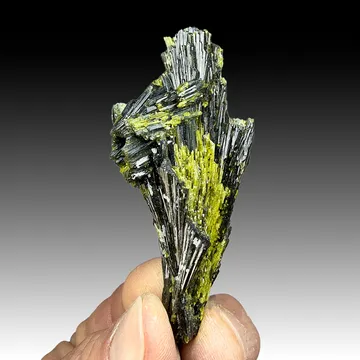
Prince of Wales Island is one of the great American epidote localities, and for specimen collectors its name is inseparable from Green Monster Mountain, Copper Mountain, and the old Jumbo–Copper Mountain skarn belt of southeastern Alaska. The classic pieces did not form in Alpine fissures or pegmatites; they came from contact-metamorphic skarn where intrusive rocks altered marble and calcareous country rock of the island’s older terranes. That setting gave the locality its unmistakable look: dense, dark, lustrous, iron-rich epidote in stout monoclinic prisms, commonly set with white to colorless quartz and more rarely with calcite.
The best Prince of Wales Island specimens have a rugged, high-relief skarn aesthetic rather than the delicate green-bladed style of Knappenwand or Bourg d’Oisans. Fine pieces show deep bottle-green to green-black epidote, sharp chisel-like terminations, strong vitreous luster, and translucent olive flashes along thin edges or broken corners. Quartz is not just matrix here; it can be an important part of the specimen, occurring as clear to milky prisms, as crystals carrying epidote inclusions, and in celebrated Japan-law twins. Calcite, when present, adds a pale carbonate contrast that makes the darkest epidote crystals read with unusual drama.
Historically, the locality matters because it entered serious collections early. Copper prospecting and mining exposed the skarns, and by the first decades of the twentieth century “Prince of Wales Island,” “Sulzer,” “Copper Mountain,” and “Green Monster Mountain” labels were already attached to American epidote classics. The Smithsonian/Roebling collecting work of the 1930s helped place the locality firmly in museum collections, and Douglas C. Toland’s later Mineralogical Record article gave Green Monster Mountain the kind of modern locality treatment normally reserved for the world’s canonical specimen districts.
Regional View
Country View

Photo: U.S. Geological Survey
For collectors, Prince of Wales Island is best understood as a group of related but not identical sources. Green Monster Mountain supplied the archetypal dark epidote on quartz and skarn; Copper Mountain is represented by old labels, doubly terminated epidote, and quartz-epidote combinations; the Jumbo Basin and neighboring skarn prospects establish the broader geological and mining frame. Elsewhere on the island, especially at Bokan Mountain, an entirely different rare-metal story unfolds in peralkaline granite, uranium-thorium mineralization, and unusual REE-Y-Zr-Nb minerals. Those Bokan occurrences are scientifically important, but the cabinet-mineral identity of Prince of Wales Island remains the dark epidote from the Green Monster–Copper Mountain skarns.

Search for specimens: View all specimens from Prince of Wales Island, USA
The collector locality belongs to the rugged Copper Mountain–Jumbo district on western Prince of Wales Island, in the Ketchikan mining district of southeastern Alaska. The principal specimen-producing geology is skarn: marble and calcareous rocks altered near intrusive contacts and along faults by hot fluids associated with diorite to granodioritic bodies. At Green Monster Mountain, the important epidote-quartz crystal area lies in a much-fractured epidote-garnet-quartz-uralite-pyrite-chalcopyrite skarn, close to an epidotized diorite body and to old copper-magnetite showings. The same geological belt includes skarns rich in garnet, diopside, actinolite, magnetite, chalcopyrite, pyrite, calcite, and quartz.
The ore bodies were never simple, continuous veins. They were irregular skarn replacements, sulfide-rich pods, copper-magnetite concentrations, and fault-controlled zones. Green Monster Mountain was described as having massive sulfides in skarn, disseminated sulfides in skarn, and sulfide-bearing veins in skarn and hornfels. The crystal pockets formed within this same altered system: vugs in skarn, in places filled with decomposed clay-like material, held euhedral epidote and quartz that could be removed as individual crystals or groups. Some epidote crystals show evidence of fracturing and healing by later tiny quartz, a detail that fits the locality’s repeated movement and mineral growth along fractures.
Mining history in the district is older than the specimen trade. Prospecting around Jumbo began in the late nineteenth century, and the Jumbo Mine became a major copper producer after ore shipments began in 1907. By 1913 it was the leading copper producer in the Ketchikan district, with aerial tramways carrying ore down toward Hetta Inlet. Jumbo’s recorded production from 1907 to 1923 was 10.2 million pounds of copper, 7,076 ounces of gold, and 87,778 ounces of silver from 122,937 short tons of ore. The nearby Copper Mountain Mine produced ore between 1903 and 1906 and supported the Coppermount smelter at Copper Harbor, one of the very few smelters built in Alaska.
Green Monster Mountain itself was discovered as a copper-magnetite prospect around 1900. When C. W. Wright examined the area in 1908, the development consisted of two tunnels about 20 m long and a pit about 3 m deep. Later reports noted that little industrial mining had occurred there beyond stripping in the area where epidote crystals were collected. By 1972, lessees of Eskil Anderson were still exploring for epidote pockets, showing how the locality had shifted from a small ore prospect to a specimen locality whose value lay in pockets rather than tonnage.
The collecting ground has never been easy. Prince of Wales Island is wet, steep, brushy country; the Green Monster and Copper Mountain sites sit high above tidewater and historic access involved trails through heavy timber, muskeg, slide scars, and dense undergrowth. Modern collectors should not treat the locality as an open casual rockhounding site. Old accounts and Bureau of Mines notes describe private or claim-controlled crystal ground, and the old workings, pits, adits, unstable skarn blocks, and remote terrain add obvious hazards. Any attempt to visit requires current land-status research, permission from claim or property holders where applicable, and serious backcountry judgment.
The most important specimen finds were pocket finds, not bulk mine products. Green Monster Mountain produced the familiar heavy, dark, glassy epidote groups with quartz; Copper Mountain yielded notable older pieces, including doubly terminated epidote and bright elongated prisms; and the broader Jumbo-Copper Mountain contact zone produced not only epidote but quartz crystals, garnets, pyrite, and other skarn minerals. Museum and dealer records show that the locality’s best specimens range from thumbnails and miniatures to substantial cabinet pieces with epidote crystals in the several-centimeter class, and exceptional examples with large individual crystals remain scarce on the market.
Prince of Wales Island epidote is the locality’s signature species, especially from Green Monster Mountain and related Copper Mountain skarns, where it occurs as deep olive-green, bottle-green, and nearly black prisms, commonly thick rather than delicate, with strong striations, sharp terminations, and bright vitreous luster; classic pieces range from small sharp miniatures with crystals around 1–3 cm to cabinet specimens carrying crystals in the 4–7 cm class, and old museum material from Copper Mountain includes doubly terminated crystals on quartz. The best examples are not merely dark masses: they show crisp monoclinic form, intact terminations, glassy faces, flashes of translucency at the edges, and balanced association with white or clear quartz, calcite, and skarn matrix; ordinary pieces tend to be massive, bruised, overly black, or crowded with incomplete quartz.
Quartz from Prince of Wales Island is important because it completes the classic epidote aesthetic and because the Green Monster–Copper Mountain district produced quartz habits of its own: clear to milky prismatic crystals, quartz needles with epidote, green-included quartz, doubly terminated quartz in vugs, and Japan-law twins that were noted in early Smithsonian collecting accounts and later Mineralogical Record indexing. Around the Copper Mountain contact zone, quartz crystals up to large cabinet scale were reported with other skarn assemblages, while Green Monster pieces more commonly show smaller quartz prisms intergrown with or perched among epidote; the finest quartz-bearing specimens are open, undamaged combinations where the quartz is transparent enough to brighten the dark epidote and not simply broken white matrix.
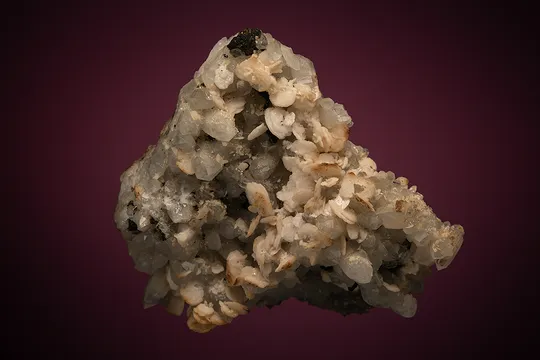
Calcite is a less common but highly desirable associate in Prince of Wales Island specimen material, occurring in the skarn and carbonate zones at Green Monster Mountain with epidote, quartz, actinolite, sulfides, malachite-stained carbonate, and dolomitized marble. Mineralogical Record indexing notes gray-white calcite crystals from Green Monster Mountain skarn cavities reaching large cabinet dimensions, and collector specimens with calcite, quartz, and thick lustrous epidote are prized because the pale carbonate gives the locality’s nearly black epidote a stronger visual contrast than quartz alone; the best calcite pieces retain clean, unetched crystal faces and stable matrix, while ordinary examples are chalky, iron-stained, cleaved, or subordinate to broken skarn.
Beyond epidote, quartz, and calcite, Prince of Wales Island records an unusually broad mineral suite because several deposit types share the island. Green Monster Mountain and neighboring skarns include actinolite, diopside, grossular-andradite garnet, magnetite, hematite, chalcopyrite, pyrite, pyrrhotite, sphalerite, malachite, chrysocolla, clintonite, scapolite, titanite, laumontite, orthoclase, rhodonite, and native gold. Jumbo Basin is notable for copper-gold skarn mineralogy and zoned garnets, while the Copper Mountain contact zone is recorded for spectacular quartz and pyrite in adularia. Far to the south, Bokan Mountain adds a rare-metal suite unrelated to the classic epidote pockets: aegirine-bearing peralkaline granite, albite-quartz veins, uraninite, thorite and uranothorite, brannerite, fluorite, zircon, xenotime, allanite, bastnäsite-group minerals, monazite, aeschynite-group minerals, samarskite-(Y), fergusonite, pyrochlore-group minerals, hydronováčekite, nováčekite, sklodowskite, parauranophane, uranophane, and iimoriite-(Y), the latter documented from the I and L No. 4 claim and treated in the mineralogical literature.
Prince of Wales Island epidote is generally not a locality with a famous problem of manufactured fakes, but it is a locality where labels deserve scrutiny. Old specimens may be labelled “Sulzer,” “Copper Mountain,” “Green Monster,” “Jumbo,” or simply “Prince of Wales Island,” and those terms have sometimes been used loosely in the trade. “Sulzer” on an old label often reflects the nearest settlement or shipping point rather than a precise collecting spot. For serious cataloguing, preserve every old label and avoid “upgrading” a general Prince of Wales Island label to Green Monster Mountain unless provenance or morphology supports it.
Condition is the central issue. The epidote is hard enough for display, but many crystals grew in fractured skarn and were recovered from rugged pockets, so contacts, bruised terminations, small edge chips, and healed fractures are common. Dark green-black color can hide damage until the piece is examined under strong side lighting. Look closely at terminations, prism edges, and the contact between epidote and quartz; a specimen that appears bold in a case may reveal dull bruising or missing crystal tips under magnification.
Quartz on these specimens is often more vulnerable aesthetically than the epidote. Many quartz crystals are incomplete, chipped, or partly buried in skarn, and green inclusions or coatings can make broken quartz look more attractive in photographs than in hand. On combination pieces, the premium goes to open quartz with clear terminations, especially when the quartz frames the epidote rather than obscuring it. Japan-law twins and doubly terminated quartz associations should be checked carefully for repairs because they are among the most collectible quartz features from the locality.
Calcite-bearing pieces require more caution in cleaning and handling. The same iron staining that can make a skarn specimen look dingy may tempt aggressive acid cleaning, but calcite will etch readily and lose luster. Any specimen advertised as epidote on calcite should be inspected for acid-softened carbonate, dulled faces, and artificially over-brightened contrast. Gentle mechanical cleaning and conservative storage are preferable to making the matrix look unnaturally white.
Market availability is steady but uneven. Small epidote-quartz pieces appear regularly, including old collection material and modern recycled specimens, but truly fine Prince of Wales Island epidote is much scarcer than the number of labels might suggest. The highest premiums attach to large, sharp, lustrous crystals; attractive matrix placement; visible translucency; old Roebling, Smithsonian, Montgomery, Over, or long-held collection provenance; and combinations with unusually good quartz or calcite. The locality is classic enough that provenance is part of value, not a footnote.
The classic Prince of Wales Island story begins not with a show table but with copper. Prospectors working the skarns around Copper Mountain, Jumbo, and Green Monster Mountain were looking for ore, and the epidote crystals emerged from the same contact zones that carried chalcopyrite, pyrite, magnetite, garnet, quartz, and calcite. In the old accounts the mountains are not romantic abstractions: Green Monster Mountain stood above tidewater, Copper Mountain sat at timber line, and the trails between the shore and the crystal ground cut through wet, heavy timber and dense undergrowth. A Smithsonian account compared those trails to a “tropical jungle,” with moss hanging from branches and covering fallen timber, and the undergrowth “always wet.”
C. B. Ferguson is the name that keeps returning in the early specimen history. He was credited as the original discoverer of the epidote localities on Copper Mountain and Green Monster Mountain, and by the mid-1930s he was still important enough that a Smithsonian expedition wanted him in the field. When Arthur Montgomery spoke to the Philadelphia Mineralogical Society on November 5, 1936, his subject was “Collecting Epidote on Prince of Wales Island, Alaska,” and the meeting note says the party had been accompanied by Ferguson, who had discovered the Copper Mountain and Green Monster Mountain localities 36 years earlier. The talk was illustrated with lantern slides and specimens of epidote, twinned quartz, uralite, and limonite pseudomorphs after pyrite.
The Smithsonian/Roebling expedition gave the locality much of its museum aura. E. P. Henderson, assistant curator of physical and chemical geology at the United States National Museum, spent several months on Prince of Wales Island with Arthur Montgomery of New York, Edwin Over of Colorado Springs, and C. B. Ferguson of Seattle. Their aim was direct and unabashed: to collect epidote and other minerals from a locality already famous for them. The published institutional account says they collected hundreds of fine epidote crystals, thousands of garnets, and many miscellaneous minerals. Another report describes “great numbers of fine single crystals and groups of epidote,” along with Japan-law twinned quartz, uralite groups, unusually large andradite garnets, and limonite pseudomorphs after pyrite.
One of the most memorable details is that not every pocket was a long-term mine. A newly found Copper Mountain locality, encountered during the expedition, yielded many elongated, brilliant epidote prisms and was then “completely exhausted.” That line captures the specimen-mining reality of Prince of Wales Island: a pocket might make a museum suite, a dealer’s stock, and a locality legend, then vanish in a season. The Green Monster style became the durable public identity, but the island’s best pockets were finite, isolated, and often known through the labels attached to the pieces they produced.
The material was split with institutional purpose. One half of the Smithsonian expedition’s recovered material went into the Roebling collection of minerals at the National Museum, while the other half remained with Montgomery and Over. That division helps explain why Prince of Wales Island epidote appears both in old museum holdings and in classic private-market pedigrees. Montgomery and Over were not casual visitors; they were among the most important American field collectors and specimen marketers of their generation, later associated with Red Cloud wulfenite, Fairfield variscite, and Mount Antero pegmatite minerals. Their Prince of Wales Island work belongs to that same era of ambitious, difficult, specimen-focused field collecting.
Douglas C. Toland, “Famous Mineral Localities: Green Monster Mountain, Prince of Wales Island, Alaska,” The Mineralogical Record, 35(5), 383–404, 419–420, 2004 — The essential modern locality article for Green Monster Mountain, its mineralogy, history, and collector context.
Mineralogical Record Vol. 35, No. 5, 2004 — Publisher listing for the issue containing Toland’s Green Monster Mountain article.
Arthur Montgomery, “The Epidote Localities of Prince of Wales Island,” Rocks & Minerals, 12(7), 195–208, 1937 — Classic early collector account, verified in later biographical and symposium references to Montgomery’s field work.
Herreid, G. H., Bundtzen, T. K., and Turner, D. L., Geology and geochemistry of the Craig A-2 Quadrangle and vicinity, Prince of Wales Island, southeastern Alaska, Alaska DGGS Geologic Report 48, 1978 — Detailed geological source for the Green Monster, Copper Mountain, Jumbo, and Summit Lake skarn setting.
Maas, K. M., Still, J. C., and Bittenbender, P. E., Mineral investigations in the Ketchikan mining district, Alaska, 1991 — Prince of Wales Island and vicinity, U.S. Bureau of Mines Open-File Report 33-91 — Includes observations on the privately owned Green Monster epidote crystal locality and the Copper Mountain mining area.
Maas, K. M., Still, J. C., and Bittenbender, P. E., Mineral investigations in the Ketchikan mining district, southeastern Alaska, U.S. Bureau of Mines Open-File Report 11-95 — Useful district-scale treatment of Prince of Wales Island mineralization, including Green Monster museum-quality epidote, Jumbo Basin skarns, and Copper Mountain crystal assemblages.
Wright, C. W., Geology and ore deposits of Copper Mountain and Kasaan Peninsula, Alaska, U.S. Geological Survey Professional Paper 87, 1915 — Foundational early government study of the Copper Mountain and Kasaan Peninsula ore deposits.
Wright, C. W., and Paige, Sidney, Copper deposits on Kasaan Peninsula, Prince of Wales Island, U.S. Geological Survey Bulletin 345, 1908 — Early published account of the Prince of Wales Island copper deposits.
Warner, L. A., Goddard, E. N., and others, Iron and copper deposits of Kasaan Peninsula, Prince of Wales Island, southeastern Alaska, U.S. Geological Survey Bulletin 1090, 1961 — Detailed study of the Kasaan Peninsula iron-copper skarns and related gangue mineralogy.
Foord, E. E., Staatz, M. H., and Conklin, N. M., “New data for iimoriite,” American Mineralogist, 69, 196–199, 1984 — Mineralogical record documenting iimoriite-(Y) from the I and L No. 4 claim at Bokan Mountain.
USGS Spectral Library sample description: Epidote GDS26, Prince of Wales Island, Alaska — Analytical and descriptive record for a Prince of Wales Island epidote sample in the USGS Denver Spectroscopy Laboratory.
Report of the Secretary, Smithsonian Institution, account of E. P. Henderson’s Prince of Wales Island work — Institutional account of the Roebling Fund expedition that collected epidote, garnets, and associated minerals.
The American Mineralogist, 22, Philadelphia Mineralogical Society meeting note, 1937 — Contemporary note recording Arthur Montgomery’s lecture on collecting epidote on Prince of Wales Island.
Green Monster Mountain, Prince of Wales Island — Mindat locality page — Mineral list, locality hierarchy, and reference trail for the classic epidote source.
Bokan Mountain, Prince of Wales Island — Mindat locality page — Overview of the island’s rare-earth, uranium, thorium, niobium, yttrium, and zirconium mineralization.
USGS: Epidote and Quartz — Public-domain specimen photograph of a 6.0 cm epidote-quartz sample from Prince of Wales Island.
Wikimedia Commons: Minerals of Prince of Wales Island — Open image category with Prince of Wales Island epidote and quartz specimens.
Wikimedia Commons: Epidote-Quartz-57295.jpg — Rob Lavinsky photograph of an old-time epidote-quartz specimen from Prince of Wales Island.
USGS Publications Warehouse: Iron and copper deposits of Kasaan Peninsula — Government monograph on the nearby iron-copper skarn deposits and their mineralogy.
Alaska DGGS: Geology and geochemistry of the Craig A-2 Quadrangle — Primary geological report for Green Monster Mountain, Copper Mountain, Jumbo Basin, and related prospects.
USGS: Bokan Mountain and Dora Bay Rare Earth Element Deposits — Scientific overview of the island’s major rare-earth-element system.
USGS: The Early Jurassic Bokan Mountain peralkaline granitic complex — Research article record for Bokan Mountain petrogenesis and rare-metal mineralization.
Alaska Mining Hall of Fame: William Sulzer — Historical context for the Jumbo Mine, William Sulzer, and early Prince of Wales Island copper mining.