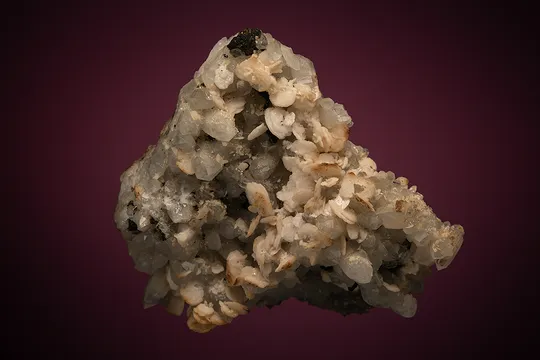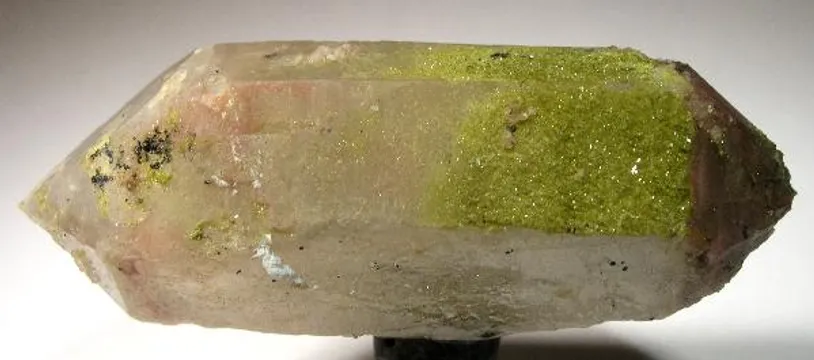
Alaska, USA - a vast mineral province, producing native gold, rare platinum-group minerals, garnets, and copper ores; frontier geology prized by collectors.
Key facts
Alaska is not a single mineral locality in the ordinary collecting sense; it is a continent-sized mineral province, and that is exactly why it matters. For collectors, the state’s identity rests on a hard-to-match combination of native gold, classic almandine garnet in schist, high-grade copper secondary minerals from Kennecott, rare platinum-group minerals from Goodnews Bay, lithium-bearing tourmaline from Black Rapids Glacier, and a long record of obscure but important species from tin-boron-fluorine systems in the Seward Peninsula. Its best specimens are not usually about dainty abundance. They are about frontier geology: nuggets worked from frozen placer gravels, gold in milky quartz from hard-rock lodes, wine-red garnets standing proud of silvery mica schist, blue azurite and green malachite on chalcocite-rich copper ore, and fractured pink-and-green tourmaline locked in quartz from a glacier-borne pegmatite source.
The state’s mineral diversity follows directly from its geology. Alaska is an accreted mosaic of terranes, metamorphic belts, granitic intrusions, ultramafic complexes, volcanic arcs, sedimentary basins, and immense glacial and alluvial systems. The collector sees that history in miniature. In the Interior and on the Seward Peninsula, weathered gold lodes fed rich placers. In the Talkeetna Mountains and Juneau gold belt, mesothermal gold-quartz veins cut metamorphic and intrusive rocks. In the Wrangell Mountains, copper-rich fluids replaced carbonate rocks above the Nikolai Greenstone and produced the extraordinary Kennecott ores. On the Stikine River mainland near Wrangell, contact metamorphism and regional metamorphism produced the celebrated “Fort Wrangell” almandines. At Goodnews Bay, platinum placers derived from ultramafic rocks yielded native platinum alloys and type-locality palladium and rhodium-bearing minerals. At Brooks Mountain and Lost River, granite-related tin, tungsten, fluorite, beryllium, boron, and greisen systems supplied a very different collector appeal: rare species and systematic cabinet labels rather than display-size crystals.
Regional View
Country View
Historically, Alaska is one of North America’s great gold and copper stories. Juneau, Nome, Fairbanks, Hatcher Pass, Fortymile, Iditarod, and many smaller districts were shaped by gold discovery and mining. Kennecott, in what is now Wrangell-St. Elias National Park and Preserve, became one of the emblematic copper operations of the early twentieth century, with mountain mines, aerial tramways, a 14-story mill, and ore so rich that it altered the fortunes of the Kennecott enterprise far beyond Alaska. For the specimen collector, however, Alaska’s historical importance is not only in production figures. It is in labels: “Garnet Ledge, Wrangell,” “Goodnews Bay,” “Kennecott,” “Fort Knox,” “Independence Mine,” “Black Rapids Glacier,” “Brooks Mountain,” and “Lost River” all carry real geological meaning.
The best Alaska specimens have a distinctly northern character. Gold is commonly rounded placer material, but fine pieces retain crystalline, hackly, or leaf-like forms, and quartz-matrix examples from lode settings command a different sort of respect. Wrangell almandines are prized when the dodecahedrons are clean, sharp, and lustrous, with translucent cherry-red flashes visible at thin edges. Kennecott azurite and malachite are usually secondary copper minerals on dark sulfide or carbonate-rich matrix rather than Moroccan-style crystal groups, but pieces with saturated color, old labels, or direct mine provenance are deeply desirable. Black Rapids tourmaline is valued for locality and zoning as much as perfection, because most crystals are fractured and specimen recovery is difficult.
Search for specimens: View all specimens from Alaska, USA
Alaska’s collector minerals come from several quite different deposit families. The first is gold: placers, low-sulfide gold-quartz veins, stockwork systems, and large lode deposits. Interior Alaska and the Seward Peninsula produced enormous quantities of placer gold, with the Fairbanks and Nome districts especially central to the story. Much of the placer gold ultimately traces back to quartz veins and mineralized zones in metamorphic and intrusive rocks, although the precise bedrock source is not always preserved or exposed. In the Willow Creek-Hatcher Pass district, the collector’s mental picture should be quartz veins in shear zones cutting quartz diorite and related intrusive rocks, carrying pyrite, arsenopyrite, scheelite, sphalerite, galena, and native gold. At Fort Knox near Fairbanks, gold occurs in and along stockwork quartz veins, quartz-filled shears, and fractures in granite; this is a bulk-mining orebody rather than a classic crystal-pocket locality, but visible-gold quartz specimens from such systems have strong Alaskan appeal when provenance is solid.
Southeastern Alaska adds another great vein province: the Juneau gold belt. The Alaska-Juneau lode system is a quartz-stringer lode in which many quartz veins, commonly inches to feet wide, were mined as large blocks of mineralized ground. The metallic assemblage includes native gold with pyrrhotite, galena, sphalerite, and arsenopyrite. For collectors, the Juneau material is historically important, but specimen-grade pieces are much scarcer than the scale of mining might suggest; much of the ore was mined for milling rather than preserved as cabinet material.
The copper assemblage is dominated, historically and visually, by Kennecott. The Bonanza, Jumbo, Mother Lode, Erie, and Glacier mines exploited extraordinarily rich copper sulfide ore in the Nizina district. The principal ore mineral was chalcocite, with covellite, bornite, chalcopyrite, enargite, and related sulfides; malachite and azurite formed in oxidized zones and along fractures. Old Kennecott specimens may show blue and green secondary copper minerals on dark sulfide ore, carbonate matrix, or copper-rich breccia. The greatest specimen value lies in color contrast, old labels, and tight provenance to a mine such as Bonanza or Jumbo, rather than in large freestanding azurite crystals.
Almandine garnet belongs to a different geological setting. The famous Garnet Ledge near Wrangell lies on the mainland near the mouth of the Stikine River, north of Wrangell, in garnet-bearing schist of the Wrangell-Revillagigedo metamorphic belt along the western margin of the Coast Range batholith. Intrusion of quartz diorite contributed to the development of sizable garnet-bearing zones near the contact. The garnets are disseminated in schist, and classic specimens show red almandine crystals partly exposed in pale to silvery mica-rich matrix. The locality supplied “Fort Wrangell” garnets to museums and collections for generations, but modern access is not a free-for-all: the Garnet Ledge is private property held for the benefit of Wrangell children, and digging is specifically reserved for children and their parents or guardians under local stewardship.
The Black Rapids Glacier tourmaline occurrence in the Delta River mining district is one of the most unusual Alaska specimen stories. It is a pegmatite occurrence represented by float on a medial moraine along the north edge of the glacier, west of the Richardson Highway. The reported assemblage includes lepidolite, tourmaline, quartz, microcline, and spodumene, with both schorl and pink-and-green elbaite/liddicoatite “watermelon” tourmaline. Access is difficult and historically has involved helicopter travel or long glacier approach, and much material is fractured. That fracture-prone nature is part of the locality’s character: an unbroken, well-zoned, well-provenanced crystal is far less ordinary than a colorful broken section in quartz.
The Seward Peninsula supplies several Alaska labels of special interest to systematic collectors. Lost River is a tin-tungsten-fluorite-beryllium system with greisen, skarn, and replacement mineralization involving cassiterite, fluorite, wolframite, scheelite, chrysoberyl, beryl, euclase, topaz, tourmaline, zinnwaldite, and many sulfides and alteration minerals. Brooks Mountain is central to Alaska’s rare boron-tin mineral story, including hulsite and schoenfliesite. These are not localities that feed the decorative specimen trade in the same way as Wrangell garnet or Alaska gold, but they are important in the mineralogical literature.
Goodnews Bay, in southwestern Alaska, is Alaska’s great platinum-group-mineral locality. The placers of the Salmon River-Red Mountain district yielded native platinum alloys and a suite of PGM species, including type-locality mertieite and pseudomertieite, as well as bowieite from platinum-alloy nuggets. For most collectors, these minerals are microscopic or ore-mineralogical rather than display specimens, but their labels are among the most significant in Alaskan systematic mineralogy.
Collecting access across Alaska is highly variable. Recreational gold panning is possible in designated public areas and on some public lands where regulations allow it, but active claims, private property, Native corporation lands, state parks, national parks, and historic sites each carry their own restrictions. Hatcher Pass and Nome are often mentioned in public collecting and panning discussions, but the responsible collector must distinguish between open recreational areas, claimed ground, private holdings, park restrictions, and historic structures. At Kennecott, the surviving mill town and mines are historic resources within a National Park Service landscape; collecting from structures, workings, or protected ground is not appropriate. At Garnet Ledge, the rule is even more specific: the ledge is for Wrangell children, and commercial digging by adults is prohibited.
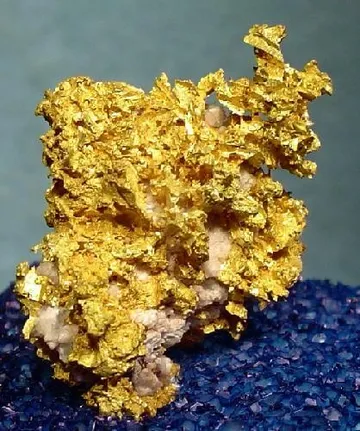
Alaska gold ranges from fine placer flakes and rounded nuggets to less common crystalline, hackly, leaf-like, and quartz-matrix pieces, with the strongest collector labels tied to Nome, Fairbanks, Fortymile, Iditarod, Valdez Creek, Hatcher Pass, Juneau, and other historically productive districts. Ordinary Alaska gold is abundant enough in the market as small placer nuggets, but truly good specimens show either attractive sculptural form, coarse size, bright natural color, attached quartz, or unusually strong locality data. Quartz-associated gold from lode settings such as Hatcher Pass, Juneau-area veins, and granite-hosted systems near Fairbanks is especially appealing when it preserves visible native gold in place rather than merely a polished or sawn ore fragment; placer nuggets from beach or creek gravels are judged more by shape, weight, surface texture, and provenance.
Quartz is one of the essential gangue minerals of Alaska’s gold story, and its most locality-specific collector value is not as isolated rock crystal but as the carrier of gold-bearing vein systems. In the Willow Creek-Hatcher Pass district, the Independence vein and related lodes consist chiefly of quartz with minor sulfides including pyrite, arsenopyrite, sphalerite, galena, scheelite, and native gold; in the Alaska-Juneau system, numerous quartz veins form stringer-lodes with gold and sulfides; at Fort Knox, stockwork quartz veins and quartz-filled shears host visible gold in granite. Good Alaska quartz specimens therefore separate themselves from common milky vein quartz by association: visible gold, sharp sulfide textures, vein structure, old mine labels, or a convincing link to a documented lode district.
Almandine from the Wrangell Garnet Ledge is Alaska’s classic crystallized silicate specimen: dark wine-red to brownish-red dodecahedrons, commonly partly embedded in mica schist, with the finest examples showing sharp form, lustrous faces, and translucent cherry-red windows when backlit at thin edges. The garnets occur disseminated in schist near the mouth of the Stikine River, north of Wrangell, and crystals around a few millimeters to roughly 3 cm are well documented, with exceptional collector pieces valued for clean exposure on attractive schist matrix rather than loose, battered singles. Matrix matters here; a good Wrangell piece looks like a garnet growing naturally out of Alaska’s metamorphic fabric, not merely a dark red lump pried from rock.
Alaska azurite is most meaningfully represented by oxidized copper zones, especially the Kennecott mines of the Nizina district, where azurite accompanies malachite, chalcocite, covellite, bornite, chalcopyrite, and related copper minerals in and around exceptionally rich copper ore. Rather than large freestanding crystal groups, classic Alaska azurite is typically valued as vivid blue fracture-fill, crusts, small crystals, or patches on dark sulfide-rich ore or carbonate matrix, with old Kennecott, Bonanza, Jumbo, or Mother Lode provenance adding far more importance than sheer size. Better pieces show saturated blue color, visible association with malachite or chalcocite, and enough matrix context to read as genuine mine ore rather than generic copper-carbonate material.
Malachite is the green signature of Alaska’s oxidized copper deposits, again with Kennecott providing the most historically resonant collector material. At Bonanza and Jumbo, oxidized ore included malachite with azurite and other copper minerals above and along rich chalcocite-covellite ore bodies in carbonate rocks near the greenstone contact; old mine specimens may show malachite as coatings, seams, earthy to silky masses, or color-rich patches around dark sulfides. The best examples are not judged by Congo-style botryoidal perfection but by locality: strong green color, intimate association with azurite or chalcocite, unsawn natural surfaces when possible, and documentation tying the specimen to Kennecott’s named mines.
Alaska tourmaline is most distinctive from the Black Rapids Glacier pegmatite occurrence, where schorl and elbaite/liddicoatite watermelon tourmaline occur with quartz, lepidolite, microcline, and spodumene in pegmatite float on a glacier moraine. Reported crystals can be large in boulders, but they are commonly highly fractured, so collector-grade pieces are judged by color zoning, visible pink core and green rim, crystal form preserved in quartz matrix, and secure Black Rapids provenance. The locality is especially important because studied material showed pink elbaite overgrown by pale green liddicoatite, giving Alaska an unexpectedly sophisticated lithium-pegmatite tourmaline story in a setting better known for ice, moraine, and difficult access than for gem mining.
Beyond the featured species, Alaska has a remarkable list of rarities and locality-significant minerals. Mindat records more than 400 valid minerals for Alaska and seven type-locality minerals, including aluminocopiapite, bowieite, gillespite, hulsite, mertieite, pseudomertieite, and schoenfliesite. Goodnews Bay is especially important for platinum-group minerals such as native platinum, native osmium, native iridium varieties, laurite, mertieite, pseudomertieite, and bowieite; Brooks Mountain and Lost River anchor the tin-boron-fluorine suite with hulsite, schoenfliesite, fluorite, cassiterite, topaz, chrysoberyl, euclase, beryl, tourmaline, and tungsten minerals. Alaska also supplies nephrite jade, pyrite, scheelite, cassiterite, fluorite, zeolites, native copper, cinnabar, stibnite, jade, garnet-group species, and a wide spectrum of sulfides and alteration minerals tied to its many mining districts.
The main authenticity issue with Alaska specimens is not a famous, single fake tradition; it is locality vagueness. “Alaska gold” is easy to write on a label and difficult to disprove when the specimen is a loose nugget. Serious collectors should favor material with district, creek, mine, claim, dredge, or old collection provenance. “Fairbanks,” “Nome,” “Fortymile,” “Valdez Creek,” “Hatcher Pass,” and “Juneau” are far more meaningful than “Alaska” alone, and a specific claim or mine is better still. Gold in quartz deserves special scrutiny: natural gold-quartz specimens should show convincing relationships between metal and vein material, not obvious glued gold, modern saw-and-polish enhancement passed off as natural matrix, or vague “Alaskan gold quartz” without a chain of ownership.
Condition expectations vary by species. Placer gold is naturally worn, so rounding is not damage; instead, look for surface texture, pleasing form, and absence of heavy cleaning residues. Crystalline gold is more fragile and commands a premium when bright, undamaged, and not flattened or polished. Quartz-matrix gold can be chipped, iron-stained, or sawn; none of those is automatically disqualifying, but the treatment should be disclosed. For historic lode specimens, a sawn face may be acceptable if the piece is honestly presented as ore, while a natural cabinet specimen should retain undisturbed surfaces and visible mineral relationships.
Wrangell almandines are often fractured, partly embedded, or damaged during extraction from schist. That is normal for the locality. The strongest pieces preserve garnets standing proud of a coherent mica-schist matrix; loose garnets with abraded faces are less desirable unless large, sharp, or translucent. Because the Garnet Ledge is held for the children of Wrangell, modern specimens with ethical, local provenance are especially important. Be wary of labels that imply recent adult commercial digging from the ledge.
Kennecott azurite and malachite are frequently old ore specimens rather than perfect display minerals. Expect massive chalcocite-rich matrix, carbonate rock, oxidation seams, and small-scale color. Avoid overpaying for generic blue-green copper ore with only a loose “Alaska” attribution; Kennecott labels should ideally name Bonanza, Jumbo, Mother Lode, Erie, Glacier, or the broader Kennecott mines. Some old material is cut or polished to show ore textures, and that can be legitimate if described correctly. Fragile azurite coatings and earthy malachite should be kept dry, handled minimally, and stored away from abrasion.
Black Rapids tourmaline is usually fractured, and that should not be confused with later damage in every case. The locality’s glacier-moraine setting and pegmatite float produce broken, included, and naturally stressed crystals. A top specimen preserves color zoning and matrix context despite cracking. Because “watermelon tourmaline” is common in the world market from many countries, Alaska provenance is the value driver; insist on credible labeling.
For systematic collectors, Goodnews Bay and Brooks Mountain material often requires microscopy or analytical confidence. PGM grains, hulsite, schoenfliesite, mertieite, pseudomertieite, and bowieite are not casual visual identifications. Labels should be tied to publications, known collections, old ore-mineral mounts, or analytical work. In this part of the Alaska cabinet, a tiny verified grain is far preferable to a showy but unsupported name.
Market availability is uneven. Alaska gold is readily available, though high-quality crystalline or quartz-matrix pieces with precise provenance are much scarcer. Wrangell garnets appear regularly but the finest sharp matrix plates are collected quickly. Kennecott copper secondary specimens are not rare as small ore pieces, but old, aesthetic, mine-specific examples are much harder to replace. Black Rapids tourmaline is distinctly uncommon. Type-locality and PGM material from Goodnews Bay and Brooks Mountain is primarily a specialist market.
At Kennecott, the mineral story begins with an almost cinematic problem: rich copper on a steep, snowy peak in the middle of an Alaskan wilderness. Around 1900, prospectors identified ore so rich that it stunned the mining world, with copper content reported as high as 85 percent in places. The deposit was not beside a railroad, a port, or a town. It was surrounded by rivers of ice, deep snow, severe cold, and country so difficult that simply moving materials became an engineering campaign. The solution was as audacious as the ore: build a railroad about 200 miles long to connect the mines to tidewater, raise tracks over rough ground with roughly 30 miles of trestles, bring material by steamship and animal sled, and even dismantle steamships to carry them around river rapids before reassembling them on the far side.
The mines themselves were perched thousands of feet above the mill town. Bonanza, Jumbo, Mother Lode, Erie, and Glacier were tied into a system of underground workings and aerial tramways. Ore cars came down the mountain on cables toward the great mill, where muscle power and gravity still did much of the work. A loaded tram car might carry a few hundred pounds of ore, and the mill’s job was to separate valuable copper minerals from worthless limestone before the material began its long journey by rail and steamship to the Tacoma smelter. The mill stood 14 stories high, a vertical machine for crushing, sorting, concentrating, leaching, floating, sacking, and shipping. Even now, the surviving structure reads like an industrial cliff face built into the mountain.
Kennecott’s most astonishing human detail is its endurance. The operation ran through long winters, deep snow, and temperatures described at 50 below zero. The railroad, trams, mines, and mill had to work not as a romantic frontier sketch but as a disciplined industrial machine. By the time the high-grade ore was exhausted and the operation closed in 1938, Kennecott had become more than an Alaska mining camp. It had financed corporate expansion elsewhere and left behind one of the most evocative mining landscapes in the United States: a mill town where, after abandonment, many ordinary objects remained because only the most valuable items were worth taking out by train.
Wrangell’s Garnet Ledge tells a completely different kind of story. The deposit had commercial ambitions in the early twentieth century, and in 1907 two sisters incorporated the Alaska Garnet Mining & Manufacturing Co. But the locality’s lasting fame did not come from industrial garnet production. It came from children. In 1962, businessman and former mayor Fred Hanford deeded the Garnet Ledge to the regional Boy Scout council, with provisions that turned the ledge into a community trust. His vision was not merely extraction; he imagined 37 acres that could become a showplace and recreation area, with Wrangell schoolchildren and Boy Scouts at the center of it.
That gift created one of the most unusual collecting traditions in North America. Generations of Wrangell children dug garnets and sold them to tourists, especially cruise-ship visitors. The specimens became both souvenirs and local inheritance: dark red crystals in mica schist, collected by children from a named ledge near the mouth of the Stikine River. Over time, the site suffered from unauthorized blasting, weathering, and digging that undermined the slope, creating safety concerns. In 2006, after decades of Boy Scout stewardship, the property passed to the First Presbyterian Church under the deed’s reversion provision. The church has continued to regard the ledge as being held for Wrangell children. The modern rule is blunt and memorable: the ledge belongs to the children, not adult commercial collectors.
Goodnews Bay is quieter in the public imagination, but to mineralogists it is one of Alaska’s great small-object localities. The district’s platinum placers produced heavy metallic grains and nuggets from a world of ultramafic rocks, chromite, and dense platinum-group minerals. Under the microscope, these tiny grains yielded new mineral species. Mertieite and pseudomertieite came from Goodnews Bay platinum material, and bowieite was described from platinum-alloy nuggets there. These are not minerals that shout across a display case; they are minerals that reward reflected-light microscopy, polished mounts, and patient analytical work. For the systematic collector, a Goodnews Bay label can carry more intellectual weight than a large but common hand specimen.
Black Rapids Glacier adds a final Alaskan note: a gemstone mineral in a landscape that seems designed to hide it. The tourmaline occurrence is not a tidy mine bench with pockets opened in place. It is pegmatite float on a medial moraine along the north edge of a glacier, a locality reached historically by helicopter or by a demanding approach involving river crossing and glacier travel. The reported occurrence is an ice-cored hill with a veneer of pegmatite debris, containing quartz, microcline, spodumene, lepidolite, and tourmaline. In boulders, tourmaline crystals up to two feet long have been reported, but the material is commonly fractured. Scientific study of Black Rapids tourmaline revealed pink elbaite cores and green liddicoatite rims, giving the locality a rare combination of rugged field setting and refined pegmatite chemistry.