Power's Farm, USA, Pierrepont's black tourmaline locality with jet-black, lustrous crystals from calcite veins; prized for sculptural form and collecting appea…
Key facts
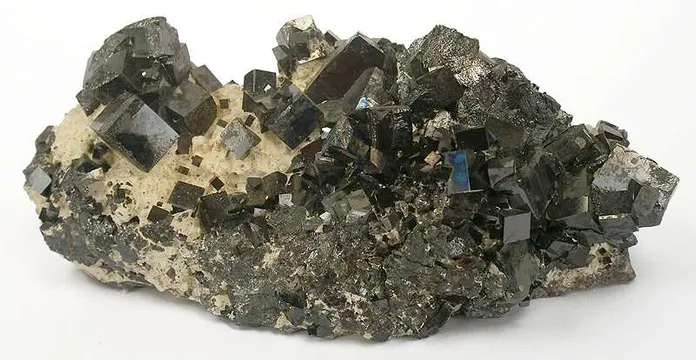
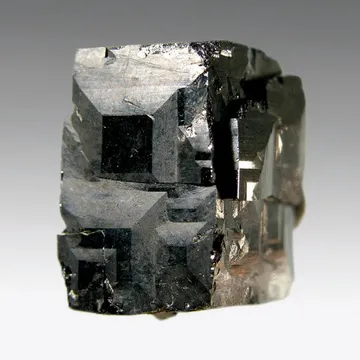
Power's Farm is the classic black-tourmaline locality of Pierrepont, St. Lawrence County, New York: an Adirondack Lowlands occurrence where compact, lustrous, sharply terminated tourmaline crystals weather from quartz-tourmaline-calcite veins and calc-silicate pods in Grenville-age metasedimentary rocks. To generations of collectors the name meant “uvite,” and older labels commonly read uvite, schorl, or even the obsolete name pierrepontite; modern work has shown the material to sit on the dravite–uvite boundary, with dravite, uvite, and fluor-uvite/uvite-series zoning possible within the same black crystal. That nomenclature tangle is part of the locality’s charm, but the visual identity of the best pieces is unmistakable: stout, almost equant trigonal crystals, glossy jet-black on the surface, brown and translucent only under very strong light, commonly with shortened c-axes, smooth prism faces, and the sharply geometric presence that made Pierrepont tourmaline famous well beyond New York.
Regional View
Country View
The locality is not a commercial mine in the usual sense. Its specimen history is one of field collecting, trenching, weathered calcite seams, small private digs, and the long patience required to follow tourmaline-bearing veins through glacial cover and soft schist. The best historical crystals are prized because they combine sculptural form with a surface that can be unusually bright for an opaque black tourmaline. Fine examples occur as single doubly terminated crystals, clusters free of matrix, tourmalines partly freed from calcite, and rarer combinations with quartz, uralite after diopside, mica, actinolite-tremolite, fluorapatite, and the accessory mineral suite of the farm’s several named veins.
Search for specimens: View all specimens from Power's Farm, USA
Power's Farm lies near Pierrepont in northern New York’s St. Lawrence County, in the Adirondack Lowlands close to the Carthage-Colton shear zone. The occurrence has also appeared on labels and in older literature as Bower Powers Farm and as the Ryland Crary Farm. It is a broad, multi-site collecting area rather than a single pit, with the original “Top of the Hill” area, the Smoky Quartz Trench, a southeastern ridge formerly called the “Swamp,” and later excavated veins identified as the Phosphate Vein, Middle Vein, Waddell Vein, and Wallace-Carlin Vein. Leonard Brook is a key landmark in the field history of the site; several trenches and trails are described relative to the brook, and later collecting restrictions have specifically protected the brookside area from digging.
Geologically, the deposit is best understood as part of the Adirondack silicocarbonate pegmatite association: coarse quartz-tourmaline-calcite and calc-silicate mineralization cutting older Grenville Supergroup metasedimentary rocks. At Power's Farm, vertical to steeply dipping tourmaline-bearing veins cut across the foliation of a mixed package of marble, calc-silicate gneiss, quartz-tourmaline-biotite schist, and related metasedimentary rocks. Modern geochronology on zircon from the silicocarbonate pegmatite places crystallization near 1.15 billion years, consistent with late Shawinigan-age intrusion or fluid movement during the waning stages of high-grade Grenville tectonism. Fluid-inclusion work on quartz from the quartz-tourmaline vein has given high formation conditions for the vein assemblage, with temperatures in the roughly 438–500 °C range and pressures of several kilobars.
The collector sees this geology in a practical way: the tourmalines occur in quartz-tourmaline rock, in seams and pockets later filled or cemented by calcite, and as crystals released by weathering from marble or calcite-rich material. Glacial till masks much of the bedrock, and field guides note that overburden can be deep enough to make the geology deceptively patchy at the surface. The best pockets are uncommon; more typical finds come from seams lined with tourmaline and later filled by massive calcite. Where calcite weathered out naturally, crystals can be free, sharp, and stable. Where calcite remains as cement, cleaning becomes delicate because many crystals are internally fractured and can fall apart if the calcite is aggressively dissolved.
The locality was already known to nineteenth-century collectors, and early accounts helped place Pierrepont among the classic American mineral localities. Dana mentioned the occurrence in the nineteenth century, George F. Kunz discussed it in the context of North American precious stones, and later mineralogical texts continued to illustrate or cite Pierrepont tourmalines. In the twentieth century the site became a regular stop in New York field-collecting culture. A 1971 New York State Geological Association trip guide called Bower Powers Farm one of the world’s best-known localities for doubly terminated black tourmaline crystals, describing near-perfect trigonal crystals with shortened c-axes, smooth prism faces, and common association with quartz and uralite. By the mid-1970s, widely circulated local collecting manuscripts brought a new wave of visitors, and later organized field trips and private collecting projects kept the locality active.
There is no meaningful ore-production history here in the sense of an operating metal mine. Its “production” is specimen production: black tourmaline, quartz, calcite, fluorapatite, phlogopite, actinolite-tremolite, diopside/uralite, sulfides, rare accessory phases, and the occasional specimen-quality pocket or vein section. The land has been privately owned and has historically been operated as a fee collecting locality by the Powers family, with permission required. Published field-trip accounts from the 2000s and 2010s describe a modest per-person collecting fee, while later notes emphasize that access is at the discretion of the landowners and that digging along Leonard Brook is not allowed. Collectors should treat any older directions and fee information as historical only: current permission, rules, parking, tool limits, and protected areas must be confirmed before visiting.
The notable specimen finds are spread across the farm’s named sublocalities. The old Top of the Hill area yielded the archetypal black tourmaline crystals and clusters, and the Smoky Quartz Trench is remembered for quartz and tourmaline associations. The Phosphate Vein added a distinct suite including fluorapatite, allanite-(Ce), synchysite-(Ce), sulfides, and other accessory species. The Waddell Vein is especially important for tourmaline morphology, including relatively common hemimorphic crystals with one end pointed and the other more flattened. Later work on the northwestern part of the classic hilltop area exposed an undiscovered calcite vein under a two-foot cap of soft schist, producing dravite and some exceptional uralite crystal clusters after sustained hand excavation.
Power's Farm uvite is the old collector’s name for the locality’s classic black tourmaline, and many fine specimens in collections still carry that label; the crystals are generally black, opaque-looking, stout, sharply trigonal, and often doubly terminated, though strong transmitted light can reveal a brown translucency in thinner areas or broken edges. Published descriptions record individual tourmaline crystals up to about 20 cm in diameter, but crystals over roughly 4 cm are uncommon, and the most desirable uvite-labeled specimens are not simply the largest ones but those with bright glassy luster, crisp terminations, minimal internal shattering, and either a sculptural freestanding form or a clean association with quartz, calcite, uralite, or mica. Much of the uvite identity at Power's Farm is compositional rather than visual: some crystals and zones fall on the uvite side, while many specimens historically sold as uvite have dravite rims or dominantly dravite chemistry, so an old uvite label is part of the locality’s collecting history but not a substitute for analysis.
Modern Power's Farm dravite is the chemically favored name for much of the black tourmaline from the locality, especially under the IMA tourmaline nomenclature applied to New York material; it occurs as lustrous iron-rich black crystals, compact crystal groups, and larger clusters in quartz-tourmaline-calcite veins, with typical habits that are equant to squat trigonal rather than long and striated. Good dravite specimens from the farm show smooth faces, sharp trigonal outlines, clean terminations, and a bright black luster; ordinary pieces are often dull, fractured, calcite-etched, or massive vein fragments lacking a full crystal outline. The best-known associations are quartz, calcite, actinolite-tremolite/uralite, phlogopite, and locally fluorapatite, while the Waddell Vein is especially valued for hemimorphic crystals with a pointed end and a flatter termination—an important locality-specific habit that makes visually strong pieces stand out even when their exact dravite-versus-uvite chemistry remains unresolved without testing.
“Tourmaline” is often the most honest label for unanalyzed Power's Farm material, because the locality’s black crystals cannot be reliably separated by eye into dravite, uvite, fluor-uvite, or zoned combinations of those compositions; the same stout black crystal habit may carry several historical labels depending on when it was collected or sold. The collector-grade tourmaline from Power's Farm is defined by morphology: near-perfect trigonal crystals, shortened c-axes, generally unstriated or only subtly marked faces, doubly terminated singles, compact clusters, and occasional plates of crystals from calcite seams and pockets. Fine specimens have the “Pierrepont look”—black, glossy, crisp, geometric, and self-contained—whereas lesser examples are partly massive, broken along internal fractures, dulled by weathering, or damaged during acid removal of calcite; old labels reading schorl, uvite, dravite, or pierrepontite should be preserved because they document the specimen’s passage through the locality’s long nomenclatural history.
Beyond tourmaline, Power's Farm has yielded a serious Adirondack calc-silicate and silicocarbonate-pegmatite suite. Quartz occurs in at least two generations, including common milky to smoky barrel-shaped crystals that may reach large size but are often imperfect, and much rarer, clearer smoky crystals from streamside workings that produced exceptional quartz-tourmaline combinations. Calcite is important both as a specimen mineral and as the cement that preserves or destroys tourmaline during cleaning. Fluorapatite occurs as green translucent to opaque crystals, usually small but documented to several centimeters. Phlogopite and biotite form large pseudohexagonal books, while actinolite and tremolite, including uralite pseudomorphs after diopside, are among the best non-tourmaline collector targets. The Phosphate Vein and related workings add allanite-(Ce), synchysite-(Ce), sphalerite, pyrite, chalcopyrite, marcasite, goethite, microcline, talc, and even reported native gold to the locality list. No valid type-locality mineral is maintained for the farm, but the obsolete name pierrepontite—once applied to the black iron tourmaline of Pierrepont—remains a historical footnote that serious label collectors should recognize.
The most important authenticity issue for Power's Farm specimens is not artificial manufacture but naming. Old labels may say schorl, uvite, iron-rich uvite, dravite, tourmaline, dravite-uvite, fluor-uvite/uvite series, or pierrepontite. The black crystals are visually deceptive: habit and color alone do not identify the species, and even analyzed material can be zoned across the dravite–uvite boundary. For an unanalyzed specimen, “tourmaline from Power's Farm” or “dravite-uvite series tourmaline from Power's Farm” is often more defensible than a visually assigned species name. If a seller offers a firm species name, ask whether it is based on analysis of that exact specimen or simply on locality convention.
Condition matters enormously. Many crystals are internally fractured, and calcite can act as a natural glue. Acid removal of calcite may improve exposure but can also loosen, crumble, or destroy a specimen if the tourmaline was held together by calcite. Examine crystals for repaired breaks, open fractures crossing terminations, etched or granular surfaces, and contact damage on the underside of loose clusters. A naturally weathered, stable crystal with clean terminations is usually preferable to a larger specimen that has been harshly etched from calcite and left fragile.
The best Power's Farm pieces are sharp, lustrous, and architectural. Doubly terminated singles, undamaged clusters, hemimorphic Waddell Vein crystals, quartz-tourmaline combinations, and specimens with old provenance all carry a premium. Typical small black tourmalines from the locality are available enough that they remain accessible to collectors, but truly excellent examples—especially large bright crystals, matrix pieces with aesthetic quartz, and specimens from older collections—are much less common than the locality’s fame might suggest. EarthWonders currently represents the locality with uvite, dravite, and general tourmaline listings, reflecting the same nomenclature spread seen in the broader market.
The earliest great Power's Farm story reads like the origin myth of a classic locality. Reverend Roselle Theodore Cross recalled being taken as a child to a religious meeting twenty-five miles from home in the hills of Pierrepont. At the farmer’s house where the family stopped, he saw a shining black tourmaline crystal and asked where it had come from. The answer was astonishingly casual: there were many near an old sawmill about half a mile away. The next morning he was taken to the spot and dug what he called “black brilliants” for only half an hour before a thunderstorm drove the party off. He remembered the place for years. Some crystals later reached a farmer in another part of the county, Mr. Nims followed the clue back to the source, and the locality entered collecting lore with the image of wagon loads of black tourmaline crystals being sold from Pierrepont.
That phrase—wagon loads—can sound like exaggeration until one understands how the old collecting areas worked. Weathering removed marble and calcite around resistant tourmaline, freeing crystals into soil and near-surface debris. Early diggers were not chasing a single vein face with modern sensibilities about preservation; they were encountering loose crystals, clusters, and calcite-seam material in a farm landscape that had not yet been worked for generations. Cross’s judgment of the material was equally memorable: he wrote that no blacker, more brilliant, or more sharply cut tourmalines could be found. It is a nineteenth-century statement, but it still captures why collectors recognize a good Pierrepont crystal across a room.
The locality’s access history has been almost as dramatic as its mineralogy. In 1978, George Robinson wrote to The Mineralogical Record warning that the famous Pierrepont uvite locality might be closing after the death of Bower Powers Senior. His note reported that Bower Powers Junior, heir to the property, wanted nothing to do with collectors and that the outlook did not look good. The warning was bleak, but the farm did not vanish from collecting culture. Later field-trip accounts describe the site as open again by permission and fee, while also making clear how fragile that privilege was. Littering, unrealistic demands, and disregard for the owners’ rules had already threatened access once; every later collector walked in under the shadow of that lesson.
Modern digging has produced its own smaller legends. In June 2013, Mike Walter and his father began what was intended as a scouting trip on the northwestern edge of the classic hilltop site. They were looking especially for amphiboles and pseudomorphs to strengthen a St. Lawrence County suite, not expecting a major new discovery. On the first day they found an undiscovered calcite vein under a cap of soft schist about two feet thick. Walter recognized at once how unusual that was: it had been decades since anyone had found such a vein on the hilltop. The plan changed immediately from scouting to mining the vein carefully.
That 2013 effort became a serious campaign. Walter later recorded thirty-eight days of collecting for himself and another ten to fifteen days contributed by his father. The rock was soft and deeply weathered, which made the physical work easier but also meant many crystals were poor. The exceptions justified the time: several dravites of exceptional quality, some of the finest uralite crystals and clusters he had seen, occasional magnetite crystals, and a variety of quartz forms. The account is valuable because it describes the real economics of Power's Farm collecting: not a casual afternoon of easy classics, but weeks of selective work for a handful of specimens good enough to matter.