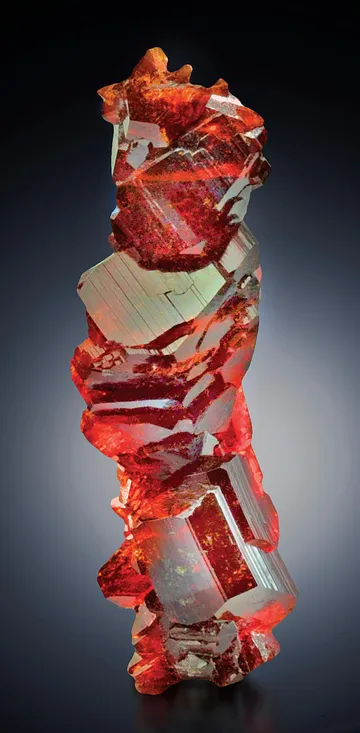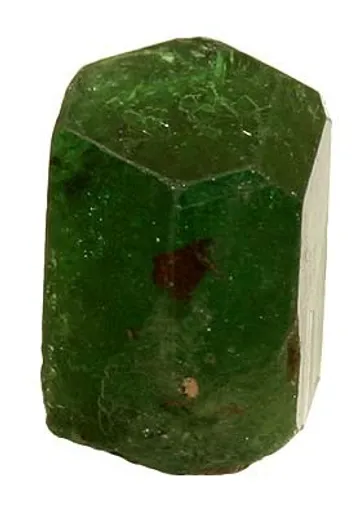
Uvite — calcium–magnesium tourmaline with greens to brown colors, lustrous blocky crystals on carbonate matrices, notable localities like Brumado and Sri Lanka.
Key facts
Uvite is the calcium–magnesium end-member of the tourmaline supergroup, typically forming in marbles, skarns, and metamorphosed magnesium-rich rocks. It ranges from deep bottle-green and olive to honey-brown, reddish-brown, and nearly colorless, often with a bright, vitreous luster. Crystals are commonly short, stout trigonal prisms with complex, highly reflective terminations; rosettes and radial aggregates also occur. Fine specimens frequently contrast against white magnesite, dolomite, or calcite, or sit with skarn minerals like diopside, phlogopite, and spinel. Among tourmalines, uvite is distinctive for its occurrence in carbonate environments and for the sculptural, high-luster crystals that can be exceptionally aesthetic on light matrix.
Collectors prize uvite for:
While elbaite dominates the gemmy, rainbow-colored side of tourmaline collecting, uvite commands strong interest among specimen collectors. Its best occurrences produce highly lustrous, sculptural crystals on bright white matrix—display pieces with strong “pop.” The Brumado (Brazil) finds, in particular, set a benchmark, delivering cabinet clusters and pristine thumbnails with elite luster and form. Indian Deccan-basalt occurrences make uvite accessible in attractive, affordable pieces, while skarn sources in Russia and classic Sri Lankan marble occurrences provide variety and locality significance. Because pristine matrix pieces with undamaged terminations are far less common than loose crystals, top uvites remain comparatively scarce and can command robust prices, especially when size, luster, and contrast all intersect.
Below are notable, well-documented sources of uvite that have produced specimens prized by collectors.
The Serra das Éguas area at Brumado (Bahia) is the modern reference locality for uvite. Crystals occur on bright white magnesite and dolomite, often as stout lustrous prisms or rosette-like clusters. Colors range from deep bottle-green and olive to warm honey-brown; some crystals show zoning and superb mirror-bright terminations. Associations include magnesite, dolomite, diopside, phlogopite, and occasionally tiny quartz. Many pieces are breathtaking display specimens with dramatic contrast. Intact matrix specimens with multiple undamaged crystals and strong luster represent the pinnacle and are highly coveted.
Best known for rubies and spinels, Mogok’s marble-hosted deposits also produce uvite in green to brown hues. Crystals range from sharp single prisms to rosette-like sprays on calcite and associated marbles. While not as frequently encountered as other Mogok species, fine uvite from here combines locality prestige with attractive form and composition, often showing elegant associations with scapolite, diopside, and phlogopite.
Color
Luster and Clarity
Crystal Form and Habit
Matrix and Associations
Size and Aesthetics
Condition
Repairs and Reattachment
Polishing and Enhancement
Assembly or Composite Pieces
Handling
Cleaning
Light and Heat
Environment and Storage
Special Notes for Carbonate Matrices