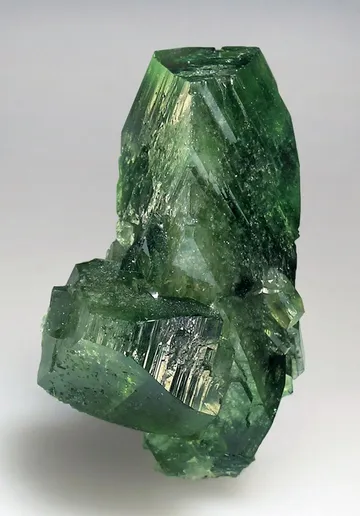
Potosi Mine, USA — Nevada locality known for arsenopyrite-rich ore oxidized to scorodite, carminite, and jarosite; sought for fine microcrystals and color.
Key facts
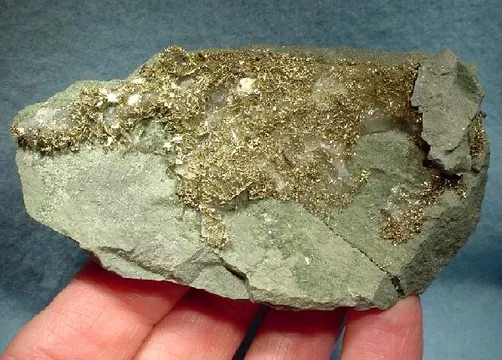
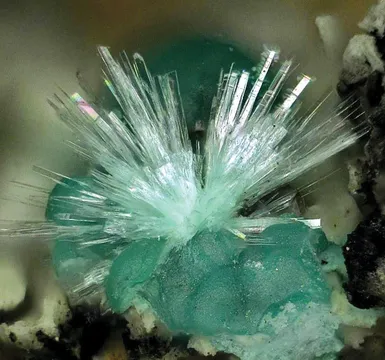
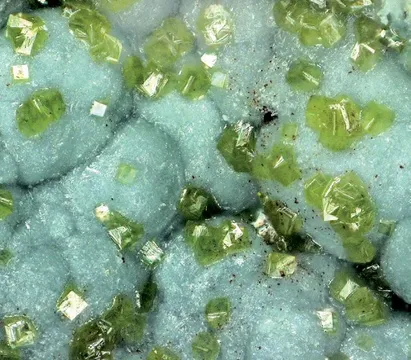
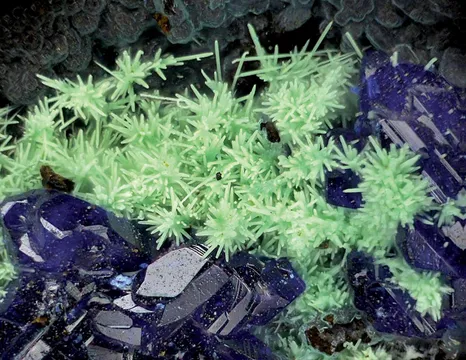
Potosi Mine, more properly the New Potosi Mine or Peterson Mine of the Candelaria Mining District, is one of those Nevada localities whose specimen interest is out of proportion to the amount of display-size material that ever escaped the workings. Economically it was a silver-lead-antimony-gold vein mine on the western side of the old Candelaria camp in Mineral County, but to collectors it is a compact supergene laboratory: arsenopyrite-bearing, jamesonite-galena primary ore oxidized into a suite of scorodite, carminite, beudantite, jarosite, plumbojarosite, anglesite, cerussite, bindheimite, and iron oxides. Its best specimens are not flamboyant cabinet pieces; they are close-looking pieces—rusty, quartzose, locally manganiferous vein rock that comes alive under the lens with glassy to adamantine microcrystals, greenish scorodite, red carminite, amber jarosite, pale lead sulfates and carbonates, and the earthy yellow-green products of antimony-rich lead ore.
The setting is classic western Nevada Basin and Range, but the immediate geology is more particular. The productive Candelaria veins occupy fractures and bedding-fault structures in and near the lower part of the Early Triassic Candelaria Formation, just above the Permian Diablo grit, in a district complicated by folding, recurrent faulting, alteration, Tertiary volcanic cover, and later Basin-and-Range normal movement. The Potosi vein system lies at the west end of the principal mineralized belt that runs through the famous Northern Belle and Mount Diablo ground. That western position matters mineralogically: compared with the eastern mines, Potosi ore was relatively rich in lead, antimony, gold, and oxidation products derived from jamesonite and galena.
Regional View
Country View
The mine is historically important in two overlapping ways. It belongs to the Candelaria story, one of Nevada’s great 19th-century silver camps, where refractory oxidized ores, remote desert geography, and chronic water problems shaped development as much as geology did. It also had a mid-20th-century afterlife: G. A. Peterson reopened the idle Potosi ground in 1947 and shipped mixed oxide and sulfide ore through the early 1950s, when deeper sulfide ore that earlier miners could not treat profitably became workable on a modest scale. For mineral collectors, that oxidized-versus-sulfide transition is the key to the locality’s personality: primary quartz, galena, jamesonite, sphalerite, pyrite, and arsenopyrite supplied the chemical ingredients; weathering supplied the specimen minerals.
Search for specimens: View all specimens from Potosi Mine, USA
Potosi Mine is in the Candelaria Mining District of Mineral County, Nevada, at roughly 38.1525° N, 118.1067° W, near 6,250 feet elevation. The name has been used in several forms—Potosi, New Potosi, Mt. Potosi, Mount Potosi, and Peterson—and that name history is worth preserving on labels because “Potosi Mine” by itself is ambiguous in mineral collecting. This is the Mineral County, Nevada, Candelaria locality, not the old Potosi Mine in the Goodsprings District of Clark County, not the Mexican Potosí mines, and not Cerro Rico de Potosí in Bolivia.
The deposit is a polymetallic vein system carrying silver, lead, antimony, gold, and minor copper and zinc. Mineralization is tied to east-trending veins in the Candelaria Formation, many of them broadly concordant with bedding or occupying bedding-related reverse faults. Page’s mapping placed the favorable vein horizon just above the Diablo grit bed in the lower Candelaria Formation, with the Potosi, Hecla, and part of the Climax workings falling along this structurally favorable stratigraphic interval. West of the Potosi mine, two or three veins lie side by side, showing that the productive horizon is not a single narrow bed but a zone several hundred feet thick.
The primary ore at Potosi was only partly exposed and only limited polished-section work was reported, but the described material is distinctive. One studied specimen contained milk-white quartz with small prisms and thick veinlets of jamesonite, Pb4FeSb6S14, as the principal metallic mineral. Sphalerite was fairly abundant, locally with microscopic chalcopyrite blebs; pyrite occurred as small cubes and veinlets; arsenopyrite appeared as sparse euhedra in quartz; and some sulfide ore lumps were largely massive galena protected within fine-grained quartz. Spectrographic work showed that silver resided in both galena and jamesonite rather than in visible discrete silver minerals. In less protected material, galena oxidized to anglesite and cerussite, while jamesonite supplied the lead-antimony oxidation products that make the locality chemically interesting.
The oxidized zone was the collector’s zone. Published accounts describe limonite-rich, locally manganiferous weathered ore and yellow to greenish-yellow bindheimite-like material derived from jamesonite. Later collector records added the small but important arsenate-sulfate suite—scorodite, carminite, beudantite, jarosite, plumbojarosite, and fluorapatite—largely as microminerals in oxidized vein material. The presence of arsenopyrite in the primary assemblage makes scorodite a logical supergene product here, and the lead-rich, antimony-bearing nature of the Potosi ores explains why lead arsenates and lead sulfates occur beside more ordinary cerussite and anglesite.
Mining history at Candelaria began with silver-vein discoveries in 1863, followed by the organization of the Columbus mining district. The camp developed slowly at first because the ores were refractory, the district was remote, water was scarce, and early holdings were fragmented. The Northern Belle success in the 1870s transformed the district into one of Nevada’s notable silver camps. Candelaria itself began in 1876 and by 1880 had become the largest settlement in the immediate area, with a surprisingly complete town life for such a harsh setting. The broader district produced an estimated $15 million to $20 million, principally from oxidized silver ore, with the bonanza years concentrated in the 1870s and 1880s.
Potosi’s own production is less completely known than that of Northern Belle, but it ranked among the significant western properties in the district. Historic records list discovery in 1868 and patenting in the 1870s. G. A. Peterson began operating the idle mine in 1947, and several thousand tons of mixed oxide and sulfide ore were shipped between 1948 and 1952. Reported average values for that period were approximately 0.5 to 0.6 ounce gold per ton, 8 to 12 ounces silver per ton, 8 to 12 percent lead, 4 to 6 percent antimony, 12 to 15 percent iron oxide, and about 0.5 percent each copper and zinc. Underground production was still reported in 1956, but activity had ceased before the early 1960s.
The workings were extensive. MRDS-derived descriptions note that the vein had been stoped continuously along strike for at least 600 feet to the surface, and Page’s figure caption described adits and open stopes climbing obliquely up Candelaria Mountain along the trace of a north-dipping vein. Those older workings and oxidized dumps are the likely source of the small collector pieces in circulation. Today, Potosi should be treated as a closed historic mine locality on private or controlled mining ground within a modern exploration landscape. Do not assume access from old field guides, MRDS coordinates, or the presence of dumps; permission, current claim status, and mine-safety considerations come first.
Scorodite from Potosi is a collector’s micromineral rather than a showy cabinet species, best appreciated as small greenish to gray-green crystals and crusts in oxidized, quartz-rich lead-antimony-silver vein material. Its significance here is contextual: arsenopyrite is part of the primary Potosi assemblage, and scorodite represents the supergene iron-arsenate response to that arsenic-bearing sulfide in an intensely oxidized vein. The better pieces show distinct crystal faces or sparkling druses rather than dull green stains, and association is everything—scorodite with carminite, beudantite, jarosite, plumbojarosite, limonite, quartz, and remnant lead minerals is far more characteristic and desirable than an isolated, locality-ambiguous green coating. Because the known pieces are typically small and detail-rich, magnification, clean contrast against rusty matrix, and an old, precise “New Potosi / Peterson / Candelaria District” label add much of the value.
Calcite at Potosi is part of the carbonate-gangue story rather than the mine’s headline species. Page described repeated reopening of fractures in the Candelaria veins, with quartz and calcite or dolomite deposited during some episodes, and later quartz cutting earlier gangue and sulfides; that history makes Potosi calcite most interesting when it appears as a later, pale to colorless carbonate accent on oxidized quartz-sulfide or lead-arsenate matrix. Ordinary massive carbonate from the district is not difficult to overlook, but collector-quality Potosi calcite earns attention when it provides contrast for scorodite, carminite, jarosite, cerussite, anglesite, or iron oxides, or when small crystal faces are preserved without the bruising and iron staining typical of old dump material. Its best role is visual and paragenetic: it helps tell the story of a vein repeatedly opened, sealed, mineralized, broken, and oxidized.
Other documented minerals from Potosi include galena, jamesonite, sphalerite, pyrite, arsenopyrite, chalcopyrite, tetrahedrite-subgroup minerals, quartz, cerussite, anglesite, aurichalcite, chlorargyrite, fluorapatite, beudantite, carminite, jarosite, plumbojarosite, bindheimite-like lead antimonate, and limonite. No IMA type-mineral status is central to the Potosi mine’s reputation; its real mineralogical distinction is the combination of silver-bearing galena-jamesonite primary ore with a compact, specimen-forming arsenate and lead-antimony oxidation suite. Carminite and beudantite are the rarities most likely to interest advanced micromounters, while chlorargyrite and fluorapatite are label-sensitive species that benefit from analytical or collection-history support.
The first authenticity issue is locality precision. “Potosi Mine” is a dangerously incomplete label: there is a Potosi Mine in the Goodsprings District of Clark County, Nevada; famous Potosí localities in Mexico and Bolivia; and many dealer labels that compress New Potosi Mine, Peterson Mine, and Potosi Mine into one name. For this guide, the correct collector locality is New Potosi Mine (Potosi Mine; Peterson Mine), Candelaria Mining District, Mineral County, Nevada, USA. Good labels should say Mineral County or Candelaria District; labels that merely say “Potosi Mine, Nevada” deserve scrutiny.
No well-established fake industry is associated with Potosi scorodite or calcite, but misidentification is easy. Green coatings may be called scorodite too casually, especially where aurichalcite, altered copper minerals, beudantite-group material, or iron-arsenate crusts are present. Red to brown microcrystals should not automatically be called carminite without context or testing, and yellow-green lead-antimony oxidation products may sit under older “bindheimite” usage that does not always map cleanly onto modern species nomenclature. For serious microcollections, analytic support by Raman, XRD, SEM-EDS, or a trusted prior collection is preferable for the rare arsenates and Pb-Sb phases.
Condition is the normal problem with Potosi material. Much of what reaches collectors appears to have come from oxidized workings and dumps, so bruised edges, iron staining, earthy limonite, friable pockets, and partial coatings are expected. Strong pieces preserve sharp microcrystals in protected cavities or on coherent quartzose matrix. Specimens that have been aggressively cleaned can look worse rather than better; acids may attack carbonates and destabilize arsenate or lead minerals, and mechanical cleaning can remove exactly the tiny crystals that make the specimen desirable.
Handling should be conservative. Scorodite, carminite, beudantite, plumbojarosite, cerussite, anglesite, galena, and bindheimite-type material bring arsenic and lead into the collector’s tray. These are not display hazards under normal dry cabinet conditions, but they should not be powdered, licked, soaked in unknown reagents, or handled carelessly by children. Wash hands after handling, keep loose crumbs out of food areas, and store friable micromount material in closed boxes.
Fluorescence is not a major selling point for Potosi scorodite; at least some recently traded micromount material has been reported as non-fluorescent under both longwave and shortwave ultraviolet. Calcite from many localities can fluoresce, but Potosi calcite should be bought on locality, association, and aesthetics rather than on any assumed UV response unless the individual specimen has been tested.
Market availability is sporadic. Potosi is not a continuing specimen mine, and the best pieces tend to circulate as micromounts or small thumbnails from older Nevada collections. Scorodite is the most recognizable EarthWonders species from the locality, while calcite is scarcer as a labeled standalone specimen and more often meaningful as an associated gangue mineral. Pieces with scorodite plus carminite or beudantite on intact matrix are far more desirable than massive ore fragments, and labels connecting the specimen to the New Potosi/Peterson name history should be preserved with the piece.
Candelaria was never an easy place to make a silver camp. The first silver veins were found in 1863 by Spanish prospectors in a bleak section of the Candelaria Mountains, and the district was organized that same year under the older Columbus name. The earliest town grew not beside the richest mines but five miles southeast at Columbus, where water could be had along the edge of the Columbus Salt Marsh. In 1867 Columbus had about 200 people, many tied as much to salt as to silver, because Nevada mills needed salt for metallurgy. Small test crushings reportedly ran $50 to $200 per ton, good enough to tempt investment but not enough to overcome the obvious problems: refractory ore, divided claim ownership, distance, and water.
The boom came with the Northern Belle. Two 20-stamp mills were built not at the mines but eight miles west at Belleville, where water was available—one in 1873 and another in 1876—and roasting furnaces were installed because Candelaria ore did not surrender its silver easily. In April 1875 the Northern Belle began paying monthly dividends, and for a decade it produced about a million dollars a year in bullion. The town of Candelaria followed in 1876. By 1880 it had the improbable urban inventory of a desert silver camp: three doctors, three lawyers, two hotels, six stores, and ten saloons.
Water was the camp’s daily torment. Before pipelines, every operation in the district depended on hauling or piping water across a dry, exposed landscape. When water was finally piped from Pinchower Creek and Trail Canyon in the mid- to late 1880s, the price reportedly fell from $1.00 per gallon to $0.05 per gallon—a single statistic that says more about life in old Candelaria than a dozen general statements about hardship. Page’s 1959 field description still found the landscape stripped and severe: arid sagebrush country, 5,500 to 6,700 feet above sea level, hot in summer and often freezing in winter, with steep bare hillsides and bedrock widely exposed.
Potosi sits on the western edge of that mineralized world, and its later revival has a quieter, almost stubborn character. After the boom years, Candelaria declined; by World War II the old water system had disintegrated, buildings collapsed, and the town was described as virtually vanished. In 1947, G. A. Peterson began a small but profitable operation at the idle Potosi mine. Between 1948 and 1952 he shipped several thousand tons of mixed oxide and sulfide ore valued at $35 to $75 per ton. The ore was not bonanza silver in the old Northern Belle sense; it was a complex smelter product paid for in four metals—gold, silver, lead, and antimony. Average reported contents ran 0.5 to 0.6 ounce gold per ton, 8 to 12 ounces silver, 8 to 12 percent lead, 4 to 6 percent antimony, and abundant iron oxide. For collectors, that same chemistry explains the later beauty in miniature: lead, antimony, iron, arsenic, sulfur, carbonate, and oxidation all gathered in one weathered vein system.
There is also a memorable underground image from the geologic work. Page described the trace of the Potosi vein visible from the west, marked by adits and open stopes ascending Candelaria Mountain obliquely. The published technical language is dry, but the picture is vivid: a north-dipping vein climbing the hillside, old stopes following ore upward to daylight, and below it the record of repeated movement—fractures opened, sealed by quartz and carbonate, broken again, filled with pyrite and sulfides, then fractured once more before late quartz cut the earlier vein matter. A small scorodite specimen from Potosi is a shard of that long mechanical and chemical history.