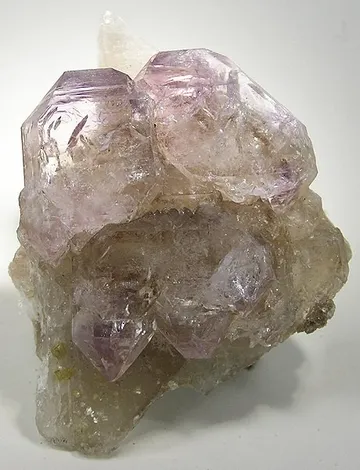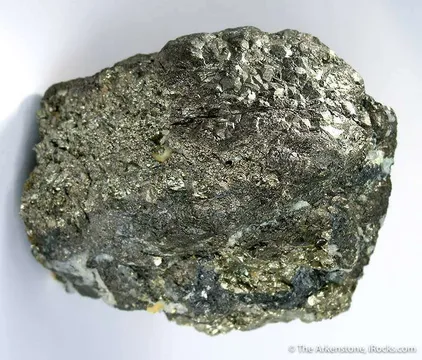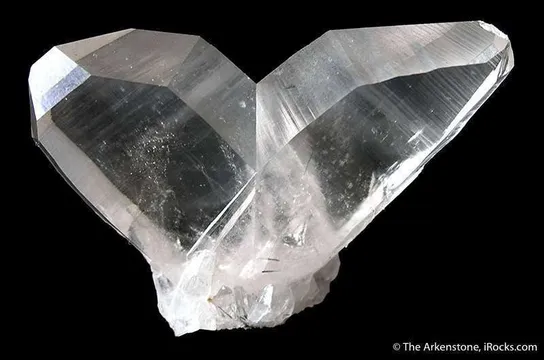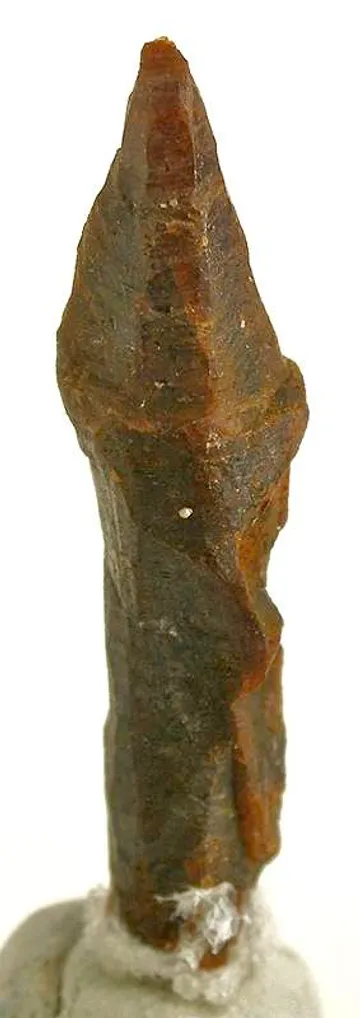
Pohndorf Mine, USA: iconic gem pegmatite yielding scepter amethyst atop tourmalinated quartz; prized for rare, visually dramatic crystals.
Key facts
The Pohndorf Mine is one of the classic amethyst localities of the Boulder Batholith pegmatite belt in southwestern Montana: a small, specimen-driven gem pegmatite whose fame rests not on tonnage but on a very distinctive style of quartz. Its best pieces are scepter crystals in which purple amethyst overgrows an earlier smoky or nearly black tourmalinated quartz stem, often with sharp stepped-growth faces, doubly terminated forms, and a glassy violet “head” perched on a dark, schorl-included base. For American amethyst collectors, Pohndorf occupies the same mental shelf as a handful of other old U.S. quartz localities—important not because material is common, but because the finest specimens are instantly recognizable.
Geologically, the mine lies in the Toll Mountain area of Jefferson County, about 15–20 miles southeast of Butte and just east of the Continental Divide, within late-stage pegmatites related to the Boulder Batholith. The deposit is not a metallic orebody in the usual Butte sense; it is a gem pegmatite, developed for pockets and vugs that yielded amethyst, smoky quartz, tourmalinated quartz, feldspar, albite, green mica, and accessory titanium minerals. The historic workings were small, but the mineralogical impact was large: Pohndorf specimens appear in serious quartz suites and older U.S. locality collections, and good examples remain scarce on the market because the locality is no longer an active collecting site.
Regional View
Country View
The collector appeal is unusually visual. Ordinary quartz from many pegmatites can look anonymous; Pohndorf’s signature pieces tend to show a generational story in a single crystal. First came smoky or tourmalinated quartz, darkened either by true smoky coloration or by dense black schorl needles. Later amethyst formed as scepters, caps, parallel-growth additions, or stepped overgrowths. The best examples are miniature to small-cabinet display specimens with strong grape-purple color, bright luster, well-balanced architecture, minimal bruising, and enough dark tourmalinated stem to make the violet head stand out dramatically.

Photo: Wikimedia Commons

Photo: Wikimedia Commons
Search for specimens: View all specimens from Pohndorf Mine, USA
The Pohndorf Mine is in the Toll Mountain area of the Boulder Batholith, Jefferson County, Montana, at roughly 45.87° N, 112.36° W. It has also appeared on old labels as the Pondorff Mine, a spelling that still turns up often enough that collectors should recognize it as a historical variant rather than a separate locality. The mine is a pegmatite occurrence rather than a sulfide mine: its collectible value comes from miarolitic cavities and vugs in a zoned, quartz-rich pegmatite body hosted by Boulder Batholith intrusive rocks.
Published descriptions portray the deposit as a lens-shaped pegmatite in quartz monzonite or granodioritic Boulder Batholith host rock. The body is about 140 feet long and up to 55 feet wide, trending roughly N. 60° E.; a flat-lying massive quartz core about 60 by 25 feet occurs toward the northeast end. Around that core is fine- to medium-grained pegmatitic rock composed of microcline, quartz, plagioclase, apatite, biotite, muscovite, magnetite, and titanite. The productive specimen zone was the vuggy microcline–quartz part of the pegmatite, with tourmaline, sericite, albite, smoky quartz, and amethyst in cavities.
Later geological work refined the picture: the pegmatite is distinctly zoned, with a progression from a nearly pure coarse quartz zone through a two-feldspar phase into a massive microcline phase rich in late-stage vugs. Those vugs are the key. They produced museum-quality scepter amethyst on tourmalinated quartz, and they explain why a small mine has such an outsized reputation. In the broader Boulder Batholith context, Pohndorf belongs to a family of late-stage, quartz-rich, locally miarolitic pegmatites that were attractive to collectors long after any realistic industrial value in mica or feldspar had faded.
The mine’s human history begins in the late nineteenth century, when August Pohndorf, a Denver jeweler and mineral dealer, worked the property for specimens and gem material. Early accounts credit him with obtaining much tourmalinated quartz and amethyst. The mine was later worked by Arthur Montgomery and Edwin Over, who recovered attractive small amethysts around 1938; collector accounts and locality notes indicate that Over and Montgomery filed claims after Pohndorf’s death and continued specimen work for many years. Names attached to later collecting lore include Ed Over, Arthur Montgomery, Dan Price, Mike Sprunger, and other Butte-area collectors who knew the pegmatites firsthand.
Production was always specimen- and gem-oriented. There is no reason to think of Pohndorf as a high-volume mine comparable to industrial or metal mines in the Butte region. Even in older geological reports, the tone is cautious: amethyst was present and the deposit was not considered exhausted, but the amethyst was not abundant and not all of it was gem quality. That combination—small pockets, uneven gem quality, and sporadic exceptional specimens—is exactly what the surviving material suggests.
Collecting access today should be treated as closed without explicit permission. The locality is on private property, and published locality notes indicate that the land was sold, partly reclaimed, and later associated with a private home or summer home site. Collectors should not attempt to visit or dig without direct landowner permission. Modern Pohndorf specimens therefore come primarily from old collections, auction dispersals, and historical dealer stock rather than fresh production.
The finest documented finds are scepters and complex overgrowth pieces: amethyst caps or clusters rising from smoky quartz prisms, black tourmalinated stems, and occasionally full floaters with multiple terminations. A separate vuggy albite zone at the north end of the pegmatite has been reported to yield smaller specimens with green sericite and micros of titanite, anatase, brookite, and tourmaline needles. Those micros are interesting, but the locality’s enduring market identity remains amethyst-on-smoky or amethyst-on-tourmalinated quartz.
Pohndorf amethyst is most prized as scepter overgrowths and stepped purple terminations on earlier smoky or tourmalinated quartz; the strongest pieces show saturated grape-purple color in transparent to gemmy heads, commonly miniature in scale but occasionally reaching small-cabinet size when clusters or multiple scepters are preserved. Good examples may be doubly terminated, parallel-grown, or built up in “stair-step” growth faces, and they are typically associated with smoky quartz, schorl needles, albite, and green muscovite or sericite from the vuggy microcline–quartz portions of the pegmatite. The ordinary material can be small, pale, damaged, or only patchily colored, so the real collector premium here goes to sharp scepter habit, strong color zoning, visible generational contrast between dark stem and violet head, fine luster, and credible old locality provenance.
Quartz at Pohndorf is not merely the gangue; it is the structural host for the locality’s best specimens, occurring as massive quartz core material, smoky prisms, tourmalinated crystals, milky or colorless portions, and later amethyst overgrowths from pegmatite cavities. The most distinctive quartz specimens show multiple growth episodes: early prismatic or doubly terminated crystals, darkened by smoky coloration or schorl inclusions, followed by scepter caps, sidecar crystals, or clusters of smaller secondary points. Fine Pohndorf quartz is judged less by sheer size than by architecture—clean terminations, balanced scepter proportions, sharp edges, complex but readable growth, bright surfaces, and the presence of schorl or green mica that ties the piece convincingly to the mine’s classic assemblage.
Pohndorf smoky quartz is best known as the dark first-generation stem or prism beneath amethyst scepters, though some “smoky” pieces are visually black because they are packed with fine schorl needles rather than simply irradiated smoky quartz. The best examples preserve a strong contrast between smoky or tourmalinated base and later purple amethyst, sometimes with doubly terminated floaters, Tessin-like tapering forms, macromosaic or suture lines, and additional small quartz points on the sides. Ordinary smoky quartz from the pegmatite can be visually subdued, opaque, or worn, but a top Pohndorf smoky earns its place when the dark prism is sharp, lustrous, structurally complete, and compositionally tied to the amethyst-overgrowth story rather than being just another detached smoky crystal.
Other documented minerals from the Pohndorf Mine include albite, microcline, muscovite and sericite, schorl, tourmaline, biotite, apatite, magnetite, titanite, anatase, brookite, allanite-group minerals, and milky quartz. No type-locality mineral species is documented from Pohndorf; its importance is instead as a classic U.S. pegmatite specimen locality. Among the rarer collector targets, titanite, anatase, and brookite occur as small crystals in vuggy albite-rich material, while allanite-group minerals and schorl help round out the Boulder Batholith pegmatite assemblage.
The main authenticity issue is locality attribution. Pohndorf-style amethyst is distinctive, but the broader Boulder Batholith contains other amethyst-bearing pegmatites, including nearby Little Gem and other lesser-known occurrences. Old labels can be vague, misspelled, or regionally broad—“Butte,” “Pondorff,” “Big Timber,” and other inaccurate or imprecise names have circulated with specimens. A credible Pohndorf specimen should ideally have an old collection label, a chain of ownership, or strong visual evidence: amethyst scepter growth on smoky or heavily tourmalinated quartz, commonly with schorl needles and sometimes green mica. Specimens lacking any schorl or tourmalinated character are not automatically wrong, but they deserve closer scrutiny.
Condition is a serious value factor. Many Pohndorf pieces are small, structurally complex, and prone to peripheral bruising, chipped scepter caps, contacted sides, and broken stems. Some of the most attractive specimens are complete floaters, but even these often have tiny edge rubs or healed-looking growth irregularities. Stepped-growth faces and contact surfaces should not be mistaken for damage; in this locality, growth truncation against cavity walls can create flat, fingerprint-like or terraced surfaces that are part of the crystal history. Conversely, freshly broken stems, missing terminations, and polished or sawn gem fragments do reduce specimen value.
Treatments and fakes specific to Pohndorf are not well documented, but general amethyst caution applies. Heat can alter amethyst color, and any unusually uniform yellow, orange, or brown “citrine” from a Pohndorf-labeled quartz should be viewed skeptically unless the history is clear. The more common problem is not treatment but mislabeling—nearby pegmatites, generic Montana amethyst, or Boulder Batholith quartz being promoted as Pohndorf because the name commands attention. Fine specimens should be bought on a combination of habit, assemblage, label history, and dealer credibility.
Market availability is limited. The mine is no longer a routine source of new specimens, so the best pieces appear when old collections are dispersed. Auction records and dealer archives show that collector-grade miniatures and small-cabinet specimens have sold periodically, including pieces from the Richard Hauck, Rock H. Currier, George Loud, Steven Chamberlain, Ed Over, and Arthur Montgomery spheres of provenance. Prices vary widely: small imperfect scepters may remain accessible, while large, balanced, vividly colored, old-label amethyst-on-tourmalinated-quartz specimens can command strong premiums because they represent both the locality and a historic era of U.S. quartz collecting.
One of the most vivid Pohndorf stories survives through collector memory rather than formal mine reports. The mine was not a grand industrial operation; it was a hard-rock specimen locality where local knowledge mattered. Collectors who knew the area described years of waste rock, underground diggings, and small vugs that might reward persistence with a single memorable scepter. That is the sort of mine Pohndorf was: a place where the difference between barren pegmatite and a classic specimen might be one pocket in a hillside of otherwise unremarkable quartz and feldspar.
The old Butte collecting network gives the mine much of its personality. William C. “Chris” van Laer, one of the important voices on Boulder Batholith pegmatites, described Pohndorf as best known for amethyst scepters with purple tips, smoky stems, and sometimes smoky quartz packed with fine tourmaline needles. He recalled that gem-quality amethyst had once been shipped to New York City in 55-gallon drums, but that the average material was small and not particularly gemmy, so the effort did not continue as a major gem operation. That detail—drums of amethyst leaving a small Montana pegmatite, only for economics and quality to decide the mine’s fate—captures the locality perfectly.
Another remembered episode concerns local collector Dan Price, who had collected the mine extensively in the 1950s after obtaining a lease. One multi-tipped amethyst scepter with a tourmalinated stem, about 2.5 inches high, was reportedly sold by Price to Koop’s Gems for $40. Koop later priced it at $1,500. Whether read as a dealer story, a collector’s lament, or simply an index of how much Pohndorf material was revalued over time, it says a great deal about the trajectory of the locality: once a small Montana dig, later a classic source whose best scepters became far harder to replace than their early prices suggested.
The field setting also had its vanished landmarks. Collectors remembered a Toll Mountain rock shop east of the Continental Divide along the old highway from Butte to Whitehall, owned by Delmar and Marifoy Hart. By later accounts, after the Harts passed away in the mid-1990s the shop, house, and associated buildings were disassembled, leaving little trace. For collectors who came through the area in the 1960s and 1970s, those shops were information hubs as important as maps: places where directions, specimens, gossip, and warnings about private ground moved from hand to hand.
Even in the twenty-first century, the locality continued to draw curiosity. A 2011 visit reported the site as not fully reclaimed in the modern landscaped sense—somewhat bulldozed, with nearby houses, and still looking much as it had decades earlier. Later locality notes identify the ground as private property and no longer a collecting destination. That ending is familiar for old U.S. specimen localities: the mine survives not as a public dig, but as labels, old collections, photographs, and the occasional scepter emerging from a drawer after half a lifetime.