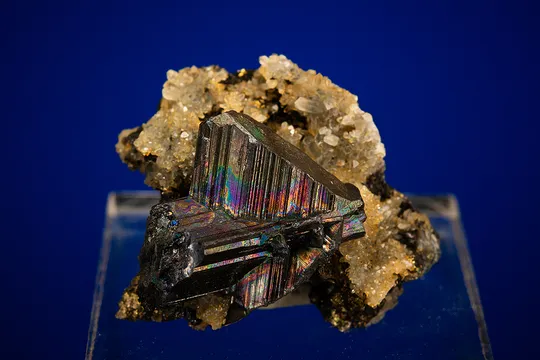
East Colusa Mine, USA — official type locality of colusite Cu13VAs3S16, with covellite iridescence, enargite, and quartz; a key Butte copper locality for colle…
Key facts
East Colusa is one of the great old Butte names: a vanished underground copper mine now absorbed into the Berkeley Pit, but still alive on labels attached to some of the finest American sulfide specimens. Its importance rests on three overlapping identities. It was part of the central copper ground of Butte, Montana, where porphyry-related hydrothermal activity in and around the Butte Quartz Monzonite produced a spectacular Main Stage vein system. It was a historically productive copper mine of the Colusa group on the east side of the Butte Hill, later tied operationally to the Leonard Mine and the Boston & Montana–Anaconda succession. And, for mineral collectors, it is the official type locality of colusite, Cu13VAs3S16, the rare bronze copper-vanadium-arsenic sulfosalt named for the Colusa ground.
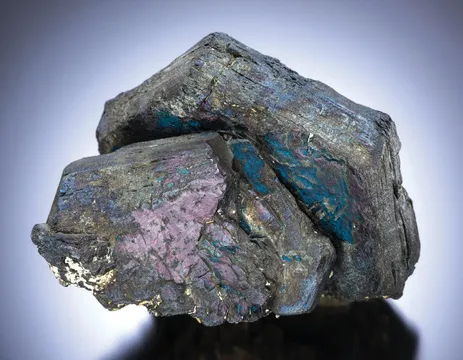
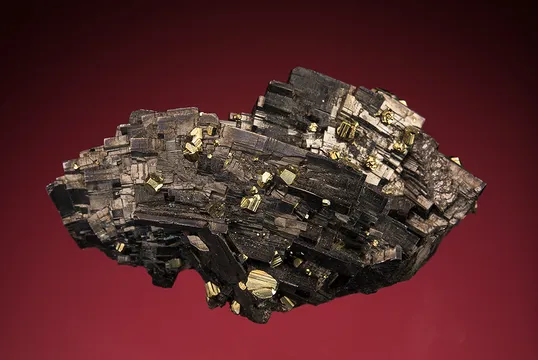
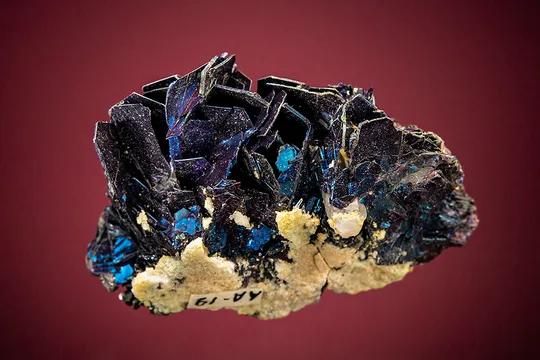
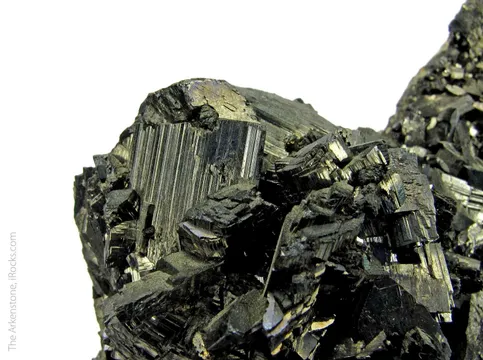
The best East Colusa specimens have the look that made Butte sulfides legendary: hard metallic color against pale gangue, not pastel cabinet prettiness. Covellite forms iridescent blue, violet, and magenta plates and leafy masses, often perched on glittering pyrite. Enargite appears as jet-black to steel-gray, bright, striated prisms or prow-shaped crystals, commonly with sharp brassy pyrite. Colusite, rarer and more subtle, occurs as bronze to silvery-bronze metallic crystals or rich microcrystalline seams in quartz and pyrite. Quartz is not merely background here; needle quartz, milky vein quartz, and drusy coatings provide the stage on which the dark copper sulfides are best displayed.
Regional View
Country View
East Colusa is especially valuable to locality specialists because it sits at the point where Butte’s industrial and mineralogical histories overlap. Many Butte specimens are labeled only “Butte” or “Berkeley Pit,” but an old, credible East Colusa label narrows the story to one of the Colusa shafts and vein systems that helped define the camp’s early copper production. The mine has also become a cautionary locality: the workings are gone, the surface locality lies within the Berkeley Pit area, and nearly all collectible material on the market is old-time material, estate material, or specimens that passed through earlier collections.

Photo: Wikimedia Commons

Photo: Wikimedia Commons
Search for specimens: View all specimens from East Colusa Mine, USA
East Colusa was an underground copper mine at Meaderville, on the east side of the Butte Hill in Silver Bow County, Montana. Its recorded position falls within the present Berkeley Pit area, near the Leonard and West Colusa ground. In modern locality terms it belongs to the Butte Mining District, also known as the Summit Valley Mining District. The old mine is not an accessible collecting locality today: the physical ground was consumed by open-pit mining, the historic underground workings are closed or flooded, and the Berkeley Pit is a controlled industrial and Superfund landscape rather than a collecting site.
Geologically, East Colusa belongs to the Butte porphyry copper-molybdenum system and its later, enormously productive Main Stage vein overprint. The central Butte veins were fissure and shear-zone systems in intrusive rocks of the Boulder batholith, especially Butte Quartz Monzonite and related quartz porphyry, aplite, and rhyolite dikes. In the Leonard–East Colusa area, mine descriptions note large bodies of quartz porphyry and a “horsetail” style of splitting and branching vein structures—an ore geometry that produced numerous closely spaced mineralized fractures rather than one simple vein. Post-mineral rhyolite dikes are specifically mapped between the Leonard and East Colusa shafts, an important detail because it helps explain why specimens and labels from this corner of Butte can be geologically intimate yet historically assigned to neighboring shafts.
The central copper-zone assemblage at Butte is the key to understanding East Colusa specimens. The characteristic ore minerals were pyrite with chalcocite, digenite, covellite, enargite, bornite, and related copper sulfides and sulfosalts in quartz-rich vein material. East Colusa specimens show exactly that language: quartz and pyrite as the common framework, with covellite, enargite, chalcocite, bornite, chalcopyrite, tennantite-subgroup minerals, sphalerite, baryte, apatite, rhodochrosite, and the defining rarity colusite documented from the mine. Unlike many western copper localities where collectors seek colorful secondary carbonates, East Colusa’s collector identity is dominated by hypogene and supergene sulfides—metallic, brittle, dark, and intensely reflective.
Historically, the Colusa ground was already important in the early copper era of Butte. The Colusa was one of the first four claims acquired by W. A. Clark in 1872, and the Lewisohn brothers of New York acquired the East Colusa from Charles Meader in 1878–1879. Their Montana Copper Company later became Boston & Montana in 1887, one of the dominant Butte producers after Anaconda. In 1883 the East Colusa reportedly produced $1,784,720 in copper and $318,700 in silver, figures that place it firmly among the major early copper sources on the hill. By the early twentieth century, Boston & Montana properties included the East Colusa, West Colusa, Leonard, Mountain View, Moose, and associated ground, and by about 1901 the Boston & Montana operations had become part of the Amalgamated/Anaconda copper empire.
East Colusa’s later history reflects Butte’s changing economics. It was formerly a copper producer of the Anaconda Company, but by 1916 it was also being described as a zinc operation, with a 900-foot shaft, levels from 300 to 700 feet, a vein about 60 feet wide, and daily zinc-ore output on the order of 200 tons. That zinc phase matters for collectors because it helps explain why sphalerite, baryte, quartz, and rhodochrosite appear in the East Colusa mineral list alongside the more famous copper sulfides. By the mid-twentieth century, the old individual shaft identities were increasingly overprinted by larger operating systems. The Leonard became a principal shaft for working nearby mines, and East Colusa later functioned as a service and ventilation shaft connected with the Leonard workings.
Specimen-producing “pockets” at East Colusa are best understood as ore shoots and open spaces within quartz-pyrite-sulfide vein material rather than alpine-style crystal cavities. The notable old specimens include covellite plates on pyrite, enargite crystal groups with pyrite, chalcocite bands among needle quartz, baryte-sphalerite-quartz combinations, rhodochrosite with quartz, and rare colusite-rich pieces in quartz-pyrite matrix. The most famous scientific material is colusite, though a historical wrinkle is worth noting: the mineral was connected with the Colusa ore body and officially named for the East Colusa locality, while some accounts trace the earliest recognized material to the 1200 level of the Leonard Mine, which exploited the same Colusa system. That closeness is one reason older Butte labels reading East Colusa, Leonard, Colusa, or Berkeley Pit must be handled with care rather than treated as interchangeable.
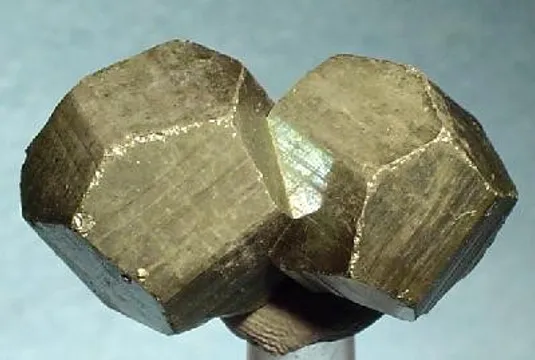
Pyrite from East Colusa is the indispensable matrix mineral and, in good pieces, a collector species in its own right: brassy to mirror-bright octahedrons, pyritohedrons, and sparkling microcrystalline crusts set off the dark Butte copper sulfides. Documented associations at the mine include enargite, colusite, quartz, covellite, tennantite-subgroup minerals, and bornite, and dealer-described specimens show octahedral pyrite crystals to about 9 mm with enargite, plus striated, bright pyrite pyritohedrons complementing black enargite groups. The best East Colusa pyrite pieces are not merely “ore with pyrite”; they have sharp, lustrous crystals with enough open space to flash, strong contrast against covellite or enargite, and an old, specific East Colusa provenance.
Covellite is East Colusa’s most visually dramatic mineral: iridescent indigo-blue, violet, magenta, and peacock-toned plates, leafy aggregates, and jagged masses on pyrite or quartz-rich matrix. Verified East Colusa examples include specimens around 4.8 to 4.9 cm across with solid veins or “mountain” forms of covellite plates on quartz and pyrite, and a notable 6.2 x 5.3 x 3.5 cm old-time piece composed largely of blade-like covellite with intense iridescence. Fine examples show distinct plate edges, strong metallic luster, a broad color play rather than dull blue-black tarnish, and a natural, balanced attachment to pyrite; ordinary examples are massive dark sulfide with only limited flash or broken, flattened plate faces.
East Colusa enargite occurs as bright black to steel-gray metallic crystals, typically prismatic and striated, associated most often with brassy pyrite and sometimes quartz or colusite-bearing material. Dealer records document black, well-defined enargite crystals to about 7 mm with pyrite to 9 mm, as well as higher-grade old specimens with splendent, doubly terminated or prow-shaped enargite crystals to about 2.0 cm, including stellate sprays on pyrite. Top East Colusa enargites stand out by crystal sharpness, clean terminations, striated prism faces, and the contrast of black enargite against fresh yellow pyrite; mediocre pieces are massive enargite ore or dull, bruised crystals without clear form.
Quartz at East Colusa is the essential gangue and display partner rather than the usual headline mineral: milky massive vein quartz, drusy quartz, and dense fields of needle quartz appear with chalcocite, covellite, pyrite, colusite, baryte, sphalerite, and rhodochrosite. A recorded chalcocite specimen from the mine shows a lustrous hackly microcrystalline chalcocite band set among needle quartz on a pyrite-bornite-quartz matrix, while colusite specimens are commonly described as bronze crystals or microcrystalline seams on quartz and pyrite, and an EarthWonders colusite cabinet specimen is a large druse of dark gray colusite on massive milky quartz. Good East Colusa quartz specimens are those in which the quartz creates architecture—needles, druse, or pale contrast—without overwhelming the sulfide species that define the locality.
Other documented East Colusa minerals include chalcocite, bornite, chalcopyrite, sphalerite, baryte, apatite, rhodochrosite, digenite, limonite, and tennantite-subgroup minerals. Colusite is the locality’s defining rarity and the only mineral for which Butte is the type locality; it is recorded as bronze to silvery-bronze metallic crystals, microcrystalline veins, and rare rich masses in quartz-pyrite matrix. Particularly desirable colusite pieces show modified octahedral and dodecahedral crystals, sometimes only a few millimeters across, though one well-documented East Colusa specimen has bronze crystals reported to 1.7 cm. A rare recent auction record also described probable East Colusa colusite pseudomorphs after covellite, with rose-shaped groups of former hexagonal covellite blades replaced by black colusite on quartz, the individual blades reaching about 1 cm.
East Colusa is a provenance-sensitive locality. The mine itself is gone within the Berkeley Pit area, and new legally collected underground material should not be expected. Serious collectors should therefore value old labels, collection history, and consistency of the assemblage. Labels reading East Colusa, Leonard, Colusa, Berkeley Pit, or simply Butte can refer to physically close but distinct collecting histories; because the Leonard and East Colusa workings were connected and exploited related ore bodies, ambiguous old labels are common and should be preserved rather than “corrected” without evidence.
The main authenticity concern is not laboratory treatment but assembly, repair, and mislabeling. A notable auction description of a major East Colusa covellite recorded that two covellite clusters had once been glued together; this is exactly the kind of issue to watch for in plate-like covellite, where broken blades and contact points can hide old joins. Inspect covellite under magnification for glue seams, mismatched luster, artificial junctions between clusters, and unnatural matrix attachments. East Colusa covellite is brittle, thinly platy, and prone to edge bruising; sharp blade margins, undisturbed iridescent surfaces, and natural pyrite or quartz contacts carry a premium.
Enargite and colusite require their own cautions. Enargite is a copper arsenic sulfide, and colusite is an arsenic-bearing copper sulfosalt; intact specimens are safe to display with normal mineral-handling discipline, but they should not be ground, cut, polished, or cleaned aggressively without proper precautions. Wash hands after handling and keep powder or dust away from children, pets, and food surfaces. Enargite is also brittle, so check tips and terminations carefully, especially on specimens advertised as old-time or ex-museum material.
Pyrite from Butte is generally stable compared with pyrite from some sedimentary localities, but any sulfide specimen should be stored dry and away from dramatic humidity swings. Covellite’s color is surface-dependent, so avoid chemical cleaning, oils, ultrasonic cleaning, and overhandling of bright faces. Rhodochrosite-bearing East Colusa pieces are uncommon and attractive, but they are a secondary side of the locality’s market identity; the strongest demand remains for covellite on pyrite, enargite with pyrite, and colusite from the type locality.
Market availability is thin but not nonexistent. East Colusa material appears mainly through old collections, specialist dealers, auction dispersals, and occasional Butte sulfide suites. Small enargite and covellite specimens can still surface, but top covellite plates, sharp enargite-pyrite combinations, and any well-crystallized colusite with unquestionable East Colusa provenance should be treated as legacy specimens.
The East Colusa story begins with a name that seems, at first, out of place in Montana. “Colusa” almost certainly points back to the California county and town of that name, a reminder that western mining claims often borrowed names from earlier camps, homes, and speculative hopes. The claim became one of the first four properties acquired by W. A. Clark in 1872, during the years when Butte was still transforming from a hard-rock silver camp into the copper city that would electrify America.
The Lewisohn brothers entered the story in 1878–1879, acquiring the East Colusa from Charles Meader. From New York, the German-born brothers built the Montana Copper Company around the Colusa vein system. By 1883 the East Colusa alone was credited with $1,784,720 in copper and $318,700 in silver—astonishing figures for a mine whose name is now mostly encountered in small print on specimen labels. In 1887 their enterprise became Boston & Montana, and in the hierarchy of Butte it stood second only to Anaconda. Had the Lewisohns lived in Butte rather than directing operations from the East, they might well have been counted among the “Copper Kings.”
Colusite adds a wonderfully mineralogical twist. The mineral that made East Colusa a type locality was tied to the Colusa ground, but one account places the first recognized material on the 1200 level of the Leonard Mine. Reno Sales, the great Butte geologist, chose the name in 1915 for the older Colusa claim and East Colusa Mine because the Leonard had originally been opened to exploit the Colusa ore body. The preliminary work was driven by chemical analyses showing anomalous tin—an odd and memorable clue in a district where tin was scarce. The formal description waited until 1933, when Robert E. Landon and A. H. Mogilnor published colusite as a new mineral of the sphalerite group.
By the twentieth century, the old shaft names became part of a larger underground organism. The new Leonard shaft, equipped with major hoisting and pumping machinery, became the principal access for nearby ground including East Colusa, West Colusa, Minnie Healey, and Tramway. In later underground practice, East Colusa could function less as a romantic ore-hoisting shaft and more as a working artery for men and air. Oral history from Butte miners records the East Colusa as a service and ventilation shaft for Leonard: part of the shift could go down and come up through East Colusa simply to move men more efficiently through the interconnected workings.
That same underground intimacy later became part of the locality problem for collectors. East Colusa, Leonard, West Colusa, and neighboring mines were not isolated mineralogical islands; they were connected workings on related ore systems. A specimen might have been mined through one shaft, carried through another, labeled by a collector decades later, and finally sold after the Berkeley Pit had erased the surface geography. For that reason, an old East Colusa label is both precious and imperfect—an artifact of the mining system as much as a mineral locality tag.
The final act was physical disappearance. The Berkeley Pit expanded across Butte’s east side, consuming old mine yards and headframes, including the East Colusa area. What remains for collectors is portable geology: old covellite plates that still flash violet and blue, black enargite prisms with bright pyrite, and bronze colusite from the one Butte locality that gave the world a new mineral species.